Evangelos Markopoulos, Panagiotis Markopoulos (2023). Addressing the UN 2030 sustainable development agenda and the ESG index with serious games in virtual environments. In: Human Factors in Virtual Environments and Game Design. AHFE Open Access, vol. 96, pp. 11–20. https://doi.org/10.54941/ahfe1003862
The gaming industry has been dominated by the entertainment games since the early 70s and evolved over the years with the technological advancements especially in hardware that allowed more demanding software to be developed. Over the time and in particular the last decade the serious games have emerged with gamified applications on any type of corporate operations. Serious games became a new global market as the gamification benefits radically impact operations performance, competitiveness, and brand awareness. However, a more significant contribution of serious games can be considered their immerse interaction with the users and the opportunities offer to participate and deliver business operations remotely, effectively, enjoyably and rewardingly. Without being the initial target of the gaming industry, serious games seem to contribute much on sustainable development oriented corporate strategies and operations. The integration of Virtual Reality, Augmented Reality, Mixed Reality and now Metaverstic environments in gamified corporate applications signifies a new era in serious gaming that can be aligned with the UN 2030 Sustainable Develop agenda and the UN Sustainable Development Goals (SDGs). This paper introduces the use of gaming and futuristics interactive technologies applied on the UN SDGs. It explains how each SDG can be supported with such technology and what could be the impact in the society and the economy. Furthermore, it indicates how gamified SGDs applications can impact the ESG scores and points out the added value serious games can offer in organizational efforts to comply with the ESG requirements. The triangulation of the serious games with the UN SDGs and the ESG is powered by the Company Democracy Model as the catalyst for the democratic innovation developed to generate green ocean strategies with sustainable innovation and pink ocean strategies with social innovations.The paper introduces a matrix that highlights the combination of the gaming and futuristics interactive technologies that can be used for the support of each SDG and ESG category criteria. It also indicates ways and provides indicative examples of applications to practically addresses these combinations. The integration of the company democracy model in the developed of such gamified corporate or organizational strategies is empowered with the development of a democratic knowledge-based culture where gaming elements, concepts and techniques derive from the contributions of anyone with fantasy, imagination and creativity. The research conducted is supported with and extensive literature review, cases studies and primary research delivered with survey and interviews from business executives around he worlds and form difference business sectors. The research conducted in based on an extensive literary review, primary research with surveys and interviews but also with the analysis of several case studies to indicate the needs and the trends for the alignment of the gaming technology with the UN 2030 sustainable development agenda. Furthermore, the paper presents the pre and post condition on adopting such a strategy, highlights research limitations, and identifies areas of further research to be conducted for the application and the adaptation of such strategic approaches in vertical organizational sectors and geographic regions.
The gaming industry has been dominated by entertainment games since the early 70s and evolved over the years with significant and impressive tech- nological advancements, especially in hardware that allowed complex and demanding software to be developed. In the last decade, serious games have emerged with gamified applications for any type of corporate operation.
The term Serious Games intends to address video games that mostly fulfill learning objectives (Ulicsak & Wright, 2010) than entertainment/leisure, or both when needed, to support Game-Based Learning or gamified learning.
A simple definition of the term gamification can be the process of enh- ancing a service with affordances for graceful experiences to support users’
value creation. This approach is focused on the effects obtained from the acti- vation of intrinsic and extrinsic motivation with gamified systems rather than the analysis of the game design characteristics, elements, and incentives for the practical and actual adaptation and utilization of gamified applications within organizations (Markopoulos et al., 2022a).
Over the years, serious games became a new global market as gamifica- tion benefits radically impact operations performance, competitiveness, and brand awareness. The global Serious Game market size is projected to reach USD 7218.5 million by 2026, from USD 3474.2 million in 2019, at a CAGR of 10.9 percent during 2021–2026 (Marketwatch, 2023).
However, a more significant contribution of serious games can be conside- red their immersive interaction with the users and the opportunities offered to participate in and deliver business operations remotely, effectively, enjoyably, and rewardingly.
Without targeting the gaming industry, serious games seem to contribute much to sustainable development-oriented corporate strategies and opera- tions. The integration of Virtual Reality, Augmented Reality, Mixed Reality, and now Metaverstic environments in gamified corporate applications signify a new era in serious gaming that can be aligned with social and sustainable innovations.
LITERATURE REVIEW
The 17 Sustainable Development Goals (SDGs) of the 2030 Agenda for Sustainable Development — officially came into force on January 1, 2016. Since then, extensive academic research and corporate strategies have been dedicated to understanding and coordinating transition processes and meth- odologies (Campagnolo, 2018) and assessments Kørnøv, 2020) towards their effective and efficient adaptation at the global level, in both the private and public sector (Jackson, 2020).
The SDGs ignited the concept of circular economy (Belmonte-Ureña, 2021) which soon became a strategic operations model for many organizations, and an inspiration for several corporate performance metrics related to the SGDs, such as the ESG, among others ESG turns out today to be a critical organiza- tional valuation index that impacts tremendously investment decisions and actions (Rollenhagen, 2022). In 2018 the sustainable responsible investment (SRI) assets reached 12 trillion dollars from 8.1 trillion in 2016. Of those 12 trillion, 11.6 were handled by asset managers considering the ESG criteria (US/SIF, 2018).
Both the SGDs and the ESG have been supported by several software technologies mostly related to reporting relevant actions for which the orga- nizations receive reputational credit and recognition in the society but also an ESG score that contributes to the company’s financial valuation and investor’s attractiveness (Markopoulos et al., 2023).
In the last ten years, and prior to the introduction of the SDGs and the ESG, a trend has been indicated toward social and sustainable gamification primarily in education (Simões et al., 2013) and other applications aiming to
Addressing the UN 2030 Sustainable Development Agenda and the ESG Index 13
prevent world hunger or to improve the quality of life of people with incu- rable diseases, among other applications (McGonigal, 2011). This serious gamification thinking got extended to cover social and sustainable gamified business models and strategies. The democratic pro-environmental behavior Model towards achieving effective ESG corporate strategies indicates the ada- ptation of the serious games concept at a higher level. The model is based on the Yu-Kai Choo Octalysis gamification framework (Chou, 2015) and the Company Democracy Model (CDM) for knowledge-based shared innovation (Markopoulos and Vanharanta, 2015). It is executed in six levels of organi- zational maturity for the identification and utilization of human intellectual capital (Markopoulos and Vanharanta, 2014). The model provides intrinsic and extrinsic motivation drives for employees to share social and sustainable knowledge contributions.
The social and sustainable gamification trend tends to increase as the seri- ous games market increases as well. However new gamification technologies should be introduced to democratize the benefits of social and sustainable gamification with the interactive, engaging participation of more, if not all. Such technologies could be immersive and futuristic interactive technologies such as Virtual Reality, Augmented Reality, Mixed Reality, and others that can combine the adaptation and promotion of the SDGs with the fulfillment of ESG requirements and lead to a new and profitable era in games design and corporate (serious) gamification.
PRIMARY RESEARCH The primary research conducted was based on an open industry survey with 710 participants for quantitative data and 6 interviews with business exe- cutives around the world and from different business sectors for qualitative data.
The survey was composed of 26 questions in 6 segments covering demogra- phic data, knowledge of the UNSDGs and the ESG, experience with serious games, gamified corporate strategies, and recommendations. A key finding of the survey is the high awareness of the ESG and SDGs, which is a good start. Enthusiasm for futuristic interactive technologies has been recorded especi- ally after the introduction of the term ‘Metaverse’ by Facebook. This has increased people’s willingness to experiment with such technologies, but they are not sure if such a way of working can be efficient and productive. The sector with the higher interest to adopt social and sustainable serious games was education followed by the agricultural sector while the Scandinavian countries, in general, indicated higher readiness on gamified applications and sustainability awareness, however, northern European countries tend more toward social innovations.
The interviews involved executives from the sectors of education, agri- culture, shipping, health, manufacturing, logistics, and consulting. Two executives were from the UK, and one was from Finland, Germany, Greece, and Italy. The interview questions were supplementary to the survey for in-depth data collection. The key findings were contradictory. Goodwill was indicated to adopt gamified social and sustainable applications, but the
14 Markopoulos and Markopoulos
timing, the budget, and the discussion of the potential operations were a concern.
Combining the findings from the primary research and the secondary rese- arch (literature review) the following three main issues emerge. First is that serious games is indeed an innovative futuristic technology for most organi- zations but are also fuzzy on their implementation and integration with their daily operations. The second one is related to the identification of the type of futuristic interactive technology that can be used for such applications to cover as many possible SDGs as possible and ESG criteria. The third one is their concerns about how employees can participate and support gamified strategies and how the return on their investment can be achieved.
Gamified Futuristic Interactive Technologies The term Futuristic Interactive Technologies describes emerging interactive technologies Such as Virtual Reality (VR), and Augmented Reality (AR) and their combinations (see Table 1.) not been fully adopted yet due to technology and industry maturity constraints and readiness. However, these technologies can play a critical role in social and sustainable gamified applications. VR for example can tap into many SGDs, reducing inequalities (SDG 10), providing quality education (SDG 4), gender equality (SDG 5), decent work (SDG 8), and others. The same applies to AR and the combination of VR and AR can enhance the user experience.
The gamification of Futuristic Interactive Technologies involves the inte- gration of game mechanics in the execution of an application, which can be defined as gameplay. There is not a specific or defined list of game mechanics as there are many and their combinations can multiply the available options
Table 1. Main FIT technologies.
Table available in the original PDF paper.
Description Example of commercial use FIT Technology
VR Using a headset with pose tracking and 3D near-eye displays, often paired with controllers, users can access digital worlds and interact with them.
The re-creation of training scenarios for limited costs in a danger-free virtual environment. AR The projection of real-time virtual graphics and information in a real-world environment.
Virtual interior decoration using the projection of virtual furniture in a real-life room. MR AR but the virtual elements merge and interact with real-life objects in a physical space.
N/A
Digitally trying on clothes by projecting them on one’s live video feed. XR XR is an umbrella term encapsulating AR, VR, MR, and everything in between.
VRSS (VR Social Spaces)
An application that lets multiple users access, as digital avatars, virtual environments that are designed to function like social hubs.
N/A
Having virtual meetings that mimic the social aspect and interactivity of real ones. Metaverse A hypothetical iteration of the Internet as an immersive virtual world, best accessed using VR/AR devices.
Addressing the UN 2030 Sustainable Development Agenda and the ESG Index 15
based on the type and objective of each application. Table 2 indicates the most common ones.
Table 2. Indicative game mechanics.
Table available in the original PDF paper.
Description Example of commercial use Game Mechanic
Time limit Putting a time limit on a challenge or task.
Emphasizes the urgency of a task in time-sensitive situations. Multiplayer Having multiple users co-exist in the same virtual space.
Tests ingenuity, memory and/or knowledge.
Encourages teamwork and/or competitiveness or creates a more social experience. Puzzles A game/test designed to test ingenuity, memory and/or knowledge.
Resource Management
The management of limited virtual resources within a game.
Tests proper resource management within the safety of a virtual world and currency. Win/Lose conditions
Conditions that allow for victory or defeat in a game.
Sets a clear goal and introduces interferences to its completion. Motion Controls
Encourages physical activity, adds immersion, and habituates muscle memory.
The ability to be a virtual avatar or perform in-game actions using real body movements and/or gestures. Often with the aid of a controller or body trackers.
Dialogue Choices
Allows for a more personalized experience that better fits the user’s, ideals, motives, and expectations and adapts the virtual experience based on them.
The user is presented with multiple choices to decide from during a virtual conversation, with an NPC, that leads to different conversation paths.
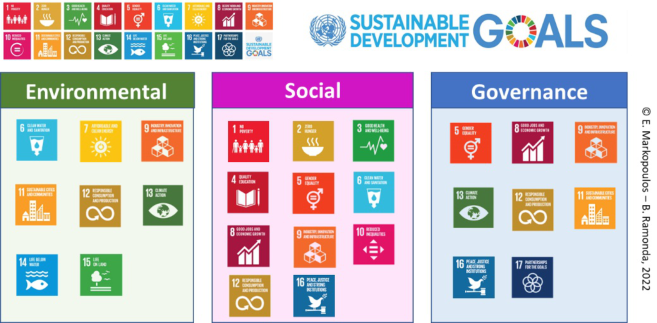
SDG and Key ESG Pillars Relationship The alignment of the SDGs with the ESGs has been examined by several resea- rchers under different industry, cultural and technology perspectives but this is not easy as some SGDs can be used to fulfill more than one ESG requi- rement. Figure 1 presents such an alignment to provide ground for further discussion.
Game Mechanics, FIT, SDG, and ESG Pillars Matrix Most of the game mechanics and the futuristic interactive technologies can be applied in many SGDs, however, some can be more suitable than others per case. Table 3 presents an indicative matching matrix with the futuristic interactive technologies, the game mechanics, and the SDGs. The SDGs can then relate to the ESG pillars as grouped in Figure 1.
The Company Democracy Model as Change Catalyst Based on the primary research results the most significant finding was the confusion of the organizations on where to start and if a gamified social and sustainable strategy could be accepted and adopted by the company itself first and then by the clients and the industry. Therefore, the root of the issue is
16 Markopoulos and Markopoulos
the organizational culture in place to support and promote such initiatives. Democratic cultures tend to be more efficient when it comes to innovation adaptation. The more ideas and knowledge contributed by the employees, the more options, solutions, and alternatives exist to design a strategy that will be accepted by the base of the organization which are the employees themselves. On the other hand, democratic cultures without the actual involvement, or the opportunity to be involved, of each employee tend to be more oligarchic or elitist than democratic.
Figure 1: Alignment of the SDGs on the ESG pillars (Markopoulos et al., 2022b).
For such a strategic approach the Company Democracy Model can be used for the identification of which processes can be gamified, in what order, and what is the social and sustainable impact of each process based on the opinion of the employees. Such an approach helps select the processes that are better
Table 3. SGDs – Technologies matching matrix.
Table available in the original PDF paper.
FIT Game Mechanic SDG
1, 2, 3, 4, 5, 8, 9, 10, 11, 12, 13, 14, 15
VR Time limit, Multiplayer, Resource Management, Motion Controls, Dialogue Choices
3, 4, 5, 6, 8, 9, 10, 12, 11, 13, 15
AR Time limit, Multiplayer, Resource Management, Win/Lose conditions, Motion Controls, Dialogue Choices
Addressing the UN 2030 Sustainable Development Agenda and the ESG Index 17
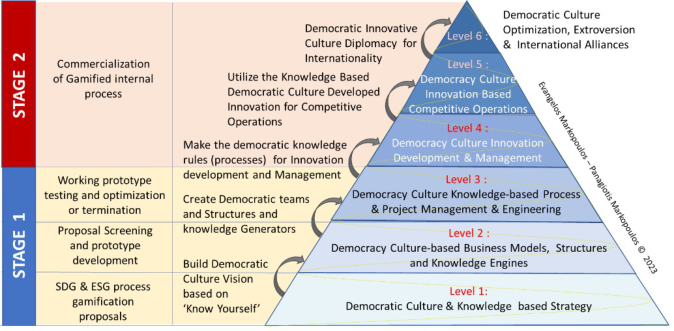
aligned with one or more SDGs and at the same time contributes to the ‘G’ of the ESG as democratic management and leadership can be considered as ethical governance. Figure 2 presents the levels of the CDM with the most employee involvement for the execution of such a strategic approach. These are the first three levels of the model.
The first level welcomes all ideas and suggestions. The second level creates discussion teams and workgroups for the deeper analysis of each idea and the development of a preliminary execution plan. At this level, employees are supported by gamification experts to help them transform their social or sustainable idea into a gamified process or application prototype. This, however, is not easy as most of the ideas are eliminated. The third level does not involve the employees much as contributors, but mostly as users. It is the level that the working prototype developed in level 2 has been developed at full scale and applied temporarily in the company or in the industry. This is an application, adaptation, and feedback period, where the employees are called to apply and test their ideas in practice.
The first 3 levels end this democratic management approach as the ideas that have been fully valid and well-tested can now be adopted officially by the organization. However, levels four, five, and six are activated by the manage- ment in case the gamified application or process indicates significant success commercialization potential. In this case, the organization proceeds with fur- ther investments at level 4, more competitiveness-based marketing at level 5, and an extroversion strategy at level 6. The execution of levels 4, 5, and 6 is quite unlikely as this might expose internal processes to competitors, but the possibility still exists.
Figure 2: CDM levels are used for the adaptation of democratic gamified innovation.
PRE AND POST CONDITIONS Most of the survey participants and all the interviewees in this research agreed that social and sustainable innovative strategies must be followed towards the alignment of their organizations with the SDGs and the ESG, however,
18 Markopoulos and Markopoulos
a democratic organizational culture must be in place as the first and most important pre-condition. This will automatically score on the ESG under the ‘Governance’ pillar and fulfill SDG 8 (Decent work and economic growth), SDG 9 (Industry innovation and infrastructure), and SDG 11 (Sustainable cities and communities), with others to follow.
As postcondition can be considered the fulfillment of the pre-conditions and the further deployment of the developed applications to include key sup- pliers, partners, and distributors to create an ecosystem that will increase the ESG score.
LIMITATIONS AND AREAS OF FURTHER RESEARCH The research was limited to the number of game mechanics used and their combination with futuristic interactive technologies due to publication limi- tations. This can possibly lead to misconceptions or misinterpretations. For the same reason, the examples and the tables have not been fully developed.
Further research will be conducted using the results of this paper and the new version of the Company Democracy model to obtain more results on the proposed implementation strategy. The research can also be narrowed to VR and AR technologies as they form the base for the rest futuristic interactive technologies listed in this work.
CONCLUSION
The world is gaming. As organizations today tend to develop strategies to adapt as many SGDs as possible, and as long as ESG scores are linked with the SDGs, the need to discover new and innovative ways for this to be achi- eved with the maximum participation of their employees and their business environment becomes a necessity.
This paper introduced the use of gaming and futuristic interactive techno- logies applied for the alignment of corporate operations with the UN SDGs. The integration of the Company Democracy Model in the development of such gamified corporate or organizational strategies is empowered with the development of a democratic knowledge-based culture where gaming ele- ments, concepts, and techniques are derived from the contributions of anyone with fantasy, imagination, and creativity.
Gamification and futuristic interactive technologies combine creativity, incentivized engagement, and fun together with process optimization, moni- toring, and tremendous data collection from such operations and user behavior (Markopoulos et al., 2021b). Therefore, and since precision beh- avioral data is involved in serious games, gamification will be getting closer to cognitive science, and the closer it gets more the world will be gaming, even more.
REFERENCES
Belmonte-Ureña L. J., Plaza-Úbeda J. A., Vazquez-Brust D., Yakovleva N. (2021).
Circular economy, degrowth and green growth as pathways for research on
Addressing the UN 2030 Sustainable Development Agenda and the ESG Index 19
sustainable development goals: A global analysis and future agenda Ecological Economics. Vol. 185, 107050. https://doi.org/10.1016/j.ecolecon.2021.107050. Campagnolo L, Eboli F., Farnia L., and Carraro C. (2018). Supporting the UN SDGs transition: a methodology for sustainability assessment and current worldwide ranking. Economics: The Open-Access, Open-Assessment E-Journal, 12 (2018- 10): 1–31. https://dx.doi.org/10.5018/economics-ejournal.ja.2018-10. Chou, Y-K. (2015). Actionable Gamification: Beyond Points, Badges, and Leaderbo-
ards, Octalysis Media (Kindle Edition), 2015. Jackson E. A (2020): Importance of the Public Service in Achieving the UN SDGs. Published in: Springer Nature Publisher (4 June 2020): pp. 1–16. Kørnøv L., Lyhne I., Davila J. G (2020) Linking the UN SDGs and environmental
assessment: Towards a conceptual framework Environmental Impact Assessment Review. Volume 85, November 2020, 106463. https://doi.org/10.1016/j.eiar .2020.106463. Marketwatch (2023). Serious Game Market 2023 by Global Industry Developments, Key Players, Increasing Demand, and Growth Rate Forecast to 2027. February 8, 2023. MarketWatch website: https://www.marketwatch.com/press-release/seriou s-game-market-2023-by-global-industry-developments-key-players-increasing-d emand-and-growth-rate-forecast-to-2027-2023-02-08. Markopoulos E., and Vanharanta H (2015). ‘Company Democracy Model for Deve-
lopment of Shared Value’, Elsevier, Procedia Manufacturing, Volume 3, Pages 603–610, 2015. Markopoulos E., and Vanharanta H. (2014). ‘Democratic Culture Paradigm for Organizational Management and Leadership Strategies - The Company Demo- cracy Model.’ In: Charytonowicz J. (ed) Advances in Human Factors and Sustai- nable Infrastructure. 5th International Conference on Applied Human Factors and Ergonomics. Vol. 20. pp. 190–201, (2014). Markopoulos E., Luimula M., Calbureanu-Popescu C., Markopoulos P., Ranttila P.,
Laukkanen S., Laivuori N., Ravyse W., Saarinen J., Nghia T. (2021). Neu- ral Network Driven Eye Tracking Metrics and Data Visualization in Metaverse and Virtual Reality Maritime Safety Training. 12th IEEE International Confere- nce on Cognitive Infocommunications (CogInfoCom) pp. 537–544, 2021. ISBN 978-1-6654-2494-3. Markopoulos, E., Katheeri, H., Qayed, H. (2023). A decision support system architecture for the development and implementation of ESG strategies at SMEs. In: Ahram T, Karwowski W, Di Bucchianico P, Taiar R, Casarotto L, and Costa P (eds) Intelligent Human Systems Integration (IHSI 2023): Integrating People and Intelligent Systems. AHFE Open Access, vol. 69. AHFE International, USA. https://doi.org/http://doi.org/10.54941/ahfe1002916. Markopoulos, E., Ramirez, A., Markopoulos, P., Vanharanta, H. (2022a). Gami-
fication in a Democratic Pro-Environmental Behaviour Model towards achie- ving effective ESG corporate strategies. In: Evangelos Markopoulos, Ravindra S. Goonetilleke, and Yan Luximon (eds) Creativity, Innovation and Entrepre- neurship. International Conference. AHFE Open Access, vol. 31. pp. 104–114. Ahttp://doi.org/10.54941/ahfe1001512. Markopoulos, E., Ramonda, M. (2022b). An ESG-SDGs alignment and execution model based on the Ocean Strategies transition in emerging markets. In: Evange- los Markopoulos, Ravindra S. Goonetilleke, and Yan Luximon (eds) Creativity, Innovation and Entrepreneurship. AHFE Open Access, vol. 31. pp. 93–103. USA. http://doi.org/10.54941/ahfe1001511.
20 Markopoulos and Markopoulos
McGonigal, J. (2011). Reality is broken: Why games make us better and how they can change the world. Penguin Press. Rollenhagen. L. (2022). Know about ESG Investing. Wealthsimple website: https:
//www.wealthsimple.com/en-us/learn/esg-investing#pros_of_esg_investing. Simões J., Redondo R. D, Vilas A. F. (2013). A social gamification framework for a K-6 learning platform. Computers in Human Behavior. Volume 29, Issue 2, March 2013, Pages 345–353. Ulicsak, M. & Wright, M. (2010). Games in education: serious games. A Futurelab literature review. Futurelab. United Kingdom, June. Available: www.futurelab.org.uk. US/SIF (2018). Sustainable investing assets reach $12 trillion as reported by
the US SIF Foundation’s biennial Report on US Sustainable, Responsible, and Impact Investing Trends. https://www.ussif.org/files/US%20SIF%20Trends% 20Report%202018%20Release.pdf.
LISTED IN THE AHFE DIGITAL BOOKSTORE CATALOGUE
Explore the complete digital volume
Human Factors in Virtual Environments and Game Design
Read this individual research paper free through the original publisher, or explore the full digital proceedings book.
ISBN 978-1-958651-72-8
Explore this ISBN in the AHFE Bookstore ↗Listed in the July 2026 bookstore catalogue; search by ISBN to confirm current availability · Digital book purchase optional