Gu Hongqing, Xiaoling Fang (2024). The Application and Trends of semiotics in design. In: Usability and User Experience. AHFE Open Access, vol. 156, pp. 227–232. https://doi.org/10.54941/ahfe1005433
Semiotics is the study of symbol systems, first proposed at the beginning of this century by the Swiss linguist Saussure, the American philosopher and founder of the philosophy of pragmatism Pierce. Semiotics is the study of the theory of symbols, and its scope of study involves the nature, characteristics, and meaning of the symbols of things, as well as the relationship between symbols and human beings. Design is a discipline closely related to "meaning", so the theory of semiotics is bound to have a strong guiding effect on design.Objectives This paper mainly researches the application of Semiotics in design by answering the following three questions: (1) Which countries and institutions are the application subjects of Semiotics in design? (2) What are the hotspot research topics of Semiotics in design? What are the future frontier trends? (3) What are the topics and paradigms of Semiotics in design high-impact literature research?Methods This paper uses the methods of bibliometrics and information visualization. To obtain more rigorous and comprehensive data indicators, VOS viewer and Cite Space (two pieces of bibliometric visualization software) were used to draw a map of scientific knowledge such as cooperative countries co-occurrence network, keywords co-occurrence clustering network and reference co-citation clustering network so as to conduct an empirical analysis on the retrieved data. In this paper, the Web of Science database is selected to retrieve the journal and paper data related to Design semiotics. In order to ensure the authority and research value of literature data, only SCI, SSCI and A&HCI were selected as the search source, with (Topic= (" semiotics ") AND Title= ("design")) as the search criteria and an unlimited time span. Finally, 407 retrieved papers published from 2000 to 2023 were exported as TXT files in the format of "fully recorded and cited references" to generate a visual knowledge map for quantitative analysis.Results (1) The output of papers related to design semiotics is generally on the rise, with the main output countries are China, Brazil, the United States, the United Kingdom, Italy, and Australia. Among them, China has the largest share of relevant research volume, indicating that China attaches great importance to research in this field and has a wide range of application areas. In addition, Research related to design semiotics is distributed, i.e. many schools and organizations are doing related research, but there are no very prominent institutions yet. (2) Nowadays, the research hotspots of Design semiotics include Computer Science, Engineering, Education Educational Research, Social Sciences, Business Economics, etc., which are mainly applied to "Provide a semiotic methodology primarily for problem solving", thus demonstrating its theoretical value. We can see that the combination of design semiotics with other approaches mainly involves sensory experience and cognitive science, user interface design, affective design and psychology, making design semiotics an interdisciplinary property.(3) At present, a bulk of influential and highly-cited literature on Design semiotics has been generated. For example, some literature has examined Gender and design cultures in information and communication technologies. Some literature has examined the Semiotic Approach to Information Systems Design. They constitute the classic cases and knowledge base of the application of Design semiotics and provide a research basis for the subsequent application of Design semiotics.
Semiotics is the study of symbol systems, first proposed at the beginning of this century by the Swiss linguist Saussure, the American philosopher and founder of the philosophy of pragmatism Pierce (Yakin and Totu, 2014). Semiotics is the study of the theory of symbols, and its scope of study involves the nature, characteristics, and meaning of the symbols of things, as well as the relationship between symbols and human beings. Design is a discipline closely related to “meaning”, so the theory of semiotics is bound to have a strong guiding effect on design (Stamper et al., 2000).
Semiotics, a discipline that deeply explores the theory of symbols in human cultural phenomena, reveals the essence behind symbols, the laws of their development and evolution, and the meanings they carry from a unique perspective (Zlatev, 2015). Not only that, semiotics further analyzes the inter- relationships between symbols and how they are closely connected to human activities. Among them, a core concept is to construct a system that achieves
communication or meaning through symbols. This system has become the key to understanding and explaining human culture and social behavior. Design, as an outstanding representative of human production practice, con- tains a profound information exchange mechanism in its process. This is not only a simple material creation process, but also a complex and subtle sym- bol and language communication between people and themselves, people and products, and products and products. In these communications, design sym- bols play a vital role. They are important carriers for conveying information, meaning, etc. of man-made objects, and are also core components of practical functional systems (Crilly, 2010).
Design semiotics, as an important branch of design research, is closely con- nected with many disciplines such as design, sociology, management, mechan- ical engineering, computer science, etc. The cross-fertilization between these disciplines provides rich theoretical support and practical applica- tions for design semiotics (Buchanan, 1992). Through an in-depth study of design semiotics, we can better understand the knowledge structure, cross- correlation, knowledge genealogy and research path characteristics of design in the context of multidisciplinary intersections. This not only helps promote the development of design theory, but also provides strong theoretical sup- port and practical guidance for actual design practice. Therefore, semiotics and its application in the field of design provide us with a new perspective to examine and understand human culture and social behavior. Through in- depth study of design semiotics, we can not only gain insight into the nature and laws of design, but also provide strong theoretical support and practical guidance for future design practice and innovation.
Methodology
This paper uses the methods of bibliometrics and information visualiza- tion. To obtain more rigorous and comprehensive data indicators, VOS viewer and Cite Space (two pieces of bibliometric visualization software) were used to draw a map of scientific knowledge such as cooperative coun- tries co-occurrence network, keywords co-occurrence clustering network and reference co-citation clustering network so as to conduct an empirical analy- sis on the retrieved data. In this paper, the Web of Science database is selected to retrieve the journal and paper data related to Design semiotics. In order to ensure the authority and research value of literature data, only SCI, SSCI and A&HCI were selected as the search source, with (Topic = (“semiotics “) AND Title = (“design”)) as the search criteria and an unlimited time span. Finally, 409 retrieved papers published from 2000 to 2023 were exported as TXT files in the format of “fully recorded and cited references” to generate a visual knowledge map for quantitative analysis.
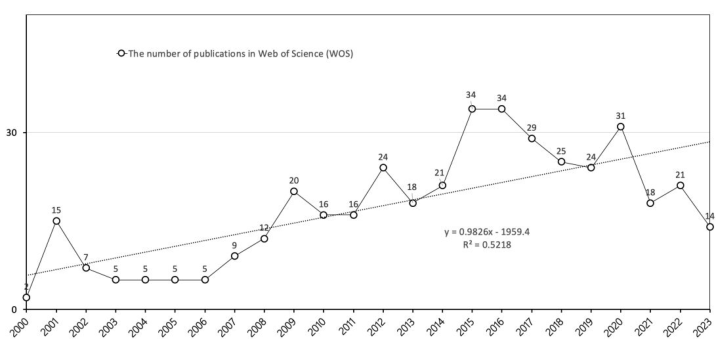
Descriptive Analysis (1) The output of papers related to design semiotics is generally on the rise, with the main output countries are China, Brazil, the United States, the United Kingdom, Italy, and Australia (Figure 1). Among them, China has the largest
The Application and Trends of Semiotics in Design 229
share of relevant research volume, indicating that China attaches great impor- tance to research in this field and has a wide range of application areas. In addition, Research related to design semiotics is distributed, i.e. many schools and organizations are doing related research, but there are no very prominent institutions yet.
Figure 1: Distribution of the number of semiotics in design papers published.
The main countries with a high publication output include the United States, China, England, Italy and Australia. Among them, the United States has the largest share of research in this field (Tab.1). China shows signifi- cant interest in semiotics design research, as indicated by its wide range of applications. Furthermore, the main institutions with high research output include Florida State University, CNRS, and the University of Sydney, each specializing in different aspects of semiotics design. This centralized pattern of research output can be observed in the United States, while in China, research in this field is distributed across multiple institutions, indicating wide participation without any single institution standing out prominently.
Table 1. The number of published papers and the number of citations in the top 5 countries.
Table available in the original PDF paper.
Country Documents Times Cited The People’s Republic of China 112 200 The United States 51 509 Brazil 51 194 England 40 430 Italy 26 89
(2) Nowadays, the research hotspots of Design semiotics include Com- puter Science, Engineering, Education Educational Research, Social Sciences, Business Economics, etc., which are mainly applied to “Provide a semiotic
230 Gu and Fang
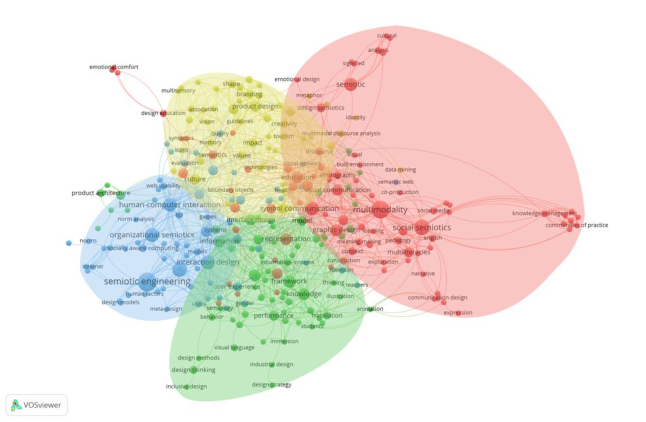
methodology primarily for problem solving”, thus demonstrating its theoret- ical value. We can see that the combination of design semiotics with other approaches mainly involves sensory experience and cognitive science, user interface design, affective design and psychology, making design semiotics an interdisciplinary property (Figure 2).
Cluster 1: “Analogy and Metaphor in Design” originates from Peirce’s concept of metaphor, which reveals the characteristics of the ontology by mapping the correspondence between metaphor and ontology. Metaphor cre- ates new interpretants and realizes meaning through the interaction between the ontology and the interpretant of the metaphor. Metaphor And analo- gies are key to sense-making, redefining new concepts with old expressions, pairing content, and generating new design languages. Gentner and Holyoke separately studied the four stages of analogy mapping: retrieval, map- ping, adaptation, and side effects, provides an in-depth understanding and application of metaphors and analogies to design (Hsu and Schwen, 2003).
Figure 2: Keyword co-occurrence map of semiotics in design.
Cluster 2: As a semiotic computing theory, “shape grammar” can generate formal shapes according to recursive arrangements based on given spatial relationships, thus promoting the development of a series of design research (Eilouti, 2019). Stini pointed out that the theory of “shape grammar” has led to the study of “emergence”, that is, the use of scattered local rules to produce global unexpected forms. This method completely logicalizes and calculates the design process, providing designers with more powerful tools. However, the “shape grammar” theory also has certain limitations. Although it can create new individuals and meanings according to set rules, the meaning of new symbols is entirely generated by computers, and it cannot delve into the multi-layered social meaning of symbols. Therefore, this theory still needs further practice and demonstration in design reflection.
The Application and Trends of Semiotics in Design 231
Cluster 3: In the field of design, the “symbolic interactionism” of social semiotics provides an important perspective for studying communication and negotiation in design conversations (Oak, 2011). Scholars believe that mean- ing is reflected in design conversations, so it is particularly appropriate to use social semiotics to explore symbolic meanings in design conversations (Carter and Fuller, 2016). This involves how designers build, communicate and share knowledge. Mead’s symbolic interactionism illustrates that personal iden- tity develops through interaction with others and inner self-reflection, which provides theoretical support for understanding how participants in design practice manage their own and each other’s knowledge.
Cluster 4: Communication theory in design, Creeley proposed an elaborate model that describes the source of communication for design artifacts as the “design team”, the transmitter as the “product”, the information channel as the “environment”, and the receiver as the “ Senses” and cognitive responses as “destination”. As “communication”, the popular way of design is affor- dance, that is, the physical facts contained in objective objects, which describe the meaning of the external environment to living things and are not affected by the will of living things to the environment. Affordances are considered as the smallest units of meaning and are related to ecological semiotics.
(3) At present, a bulk of influential and highly-cited literature on Design semiotics has been generated. For example, some literature has examined Gender and design cultures in information and communication technologies. Some literature has examined the Semiotic Approach to Information Systems Design. They constitute the classic cases and knowledge base of the appli- cation of Design semiotics and provide a research basis for the subsequent application of Design semiotics (Table 2).
Table 2. Highly cited literature.
Table available in the original PDF paper.
Wos literature Literature source Number of citations Bezerner, J WRITTEN COMMUNICATION 360 Oudshoorn, N SCIENCE TECHNOLOGY & HUMAN VALUES 258 Stamper, R BEHAVIOUR & INFORMATION TECHNOLOGY 161 Chiou, EK HUMAN FACTORS 69 Abrahamson, D EDUCATIONAL STUDIES IN MATHEMATICS 68
CONCLUSION AND DISCUSSION This study uses bibliometric methods to systematically review the theory of design semiotics. By constructing a keyword-citation heterogeneous network and integrating co-word analysis and citation analysis methods, a knowledge graph network of design semiotics was generated. This network not only sys- tematically demonstrates the development and organizational relationships of knowledge units under different branches, but also highlights key theoret- ical research directions in design semiotics such as shape grammar, analogy and metaphor, symbolic interactionism, and design communication theory.
232 Gu and Fang
Through this research, the development context and deep structure of design semiotics are clearly revealed. It is based on the core theory of semiotics, but has developed its own unique research mechanism and formed a relatively “balanced” and “unified” theoretical structural frame- work. This framework not only provides a solid theoretical foundation for design research, but also provides an important reference for exploring new development paths of design semiotics.
In addition, this study also deeply explores the intersection relationship between design semiotics theory and other disciplines through data analysis and literature reading. This not only helps to better understand the nature and characteristics of design semiotics, but also provides specific research examples for exploring the interdisciplinary ontology structure of design research.
It is worth noting that the dynamic evolution and development of the the- oretical structure of design semiotics has important guiding significance for designing creations and design activities. With the changes of the times and the advancement of technology, the theory of design semiotics is constantly developing and improving. This dynamic evolution enables design to better integrate the value orientation given by the times, transcend the constraints of technology and business, and shape meaning at the cultural level.
To sum up, this study not only provides important theoretical support and research reference for the development of the field of design semiotics, but also provides useful inspiration and guidance for the shaping of design practice and cultural value. In the future, we look forward to seeing the application and development of design semiotics theory in more fields and at higher levels.
REFERENCES
Buchanan, R. (1992) Wicked problems in design thinking. Design issues. 8 (2), pp. 5–21. Carter, M. J. and Fuller, C. (2016) Symbols, meaning, and action: The past, present,
and future of symbolic interactionism. Current sociology. 64 (6), pp. 931–961. Crilly, N. (2010) The roles that artefacts play: technical, social and aesthetic functions. Design Studies. 31 (4), pp. 311–344. Eilouti, B. (2019) Shape grammars as a reverse engineering method for the morpho-
genesis of architectural façade design. Frontiers of Architectural Research, 8 (2). pp. 191–200. Hsu, Y.-C. and Schwen, T. M. (2003) The effects of structural cues from multiple metaphors on computer users’ information search performance. International Journal of Human-Computer Studies, 58 (1). pp. 39–55. Oak, A. (2011) What can talk tell us about design?: Analyzing conversation to
understand practice. Design Studies. 32 (3), pp. 211–234. Stamper, R., et al. (2000) Understanding the roles of signs and norms in organizations-a semiotic approach to information systems design. Behaviour & information technology. 19 (1), pp. 15–27. Yakin, H. S. M. and Totu, A. (2014) The semiotic perspectives of Peirce and Saussure: A brief comparative study. Procedia-Social and Behavioral Sciences. 155, pp. 4–8. Zlatev, J. (2015) Cognitive semiotics. International handbook of semiotics. pp. 1043–1067.
LISTED IN THE AHFE DIGITAL BOOKSTORE CATALOGUE
Explore the complete digital volume
Usability and User Experience
Read this individual research paper free through the original publisher, or explore the full digital proceedings book.
ISBN 978-1-964867-32-8
Explore this ISBN in the AHFE Bookstore ↗Listed in the July 2026 bookstore catalogue; search by ISBN to confirm current availability · Digital book purchase optional