Paulo Maldonadoabcd, Fernando Moreira da Silvab, Fábio Teixeirae (2022). Inspædia, Inspiring a Collaborative Intelligence Network: Designing the User Experience. In: Advances in Ergonomics In Design, Usability & Special Populations: Part I. AHFE Open Access, vol. 18. https://doi.org/10.54941/ahfe100806
The main objective of this paper is to present the interface design concept of Inspædia focused on the user experience, to create knowledge in innovation and design and to facilitate collaborative intelligence. We consider innovation in the disciplinary context of the design to inspire new design processes and to expand and diversify the frame of references in order to stimulate ideation in design, as well as to offer to the inspædiers a stimulating interaction and knowledge experience. Whereas Inspædia is malleable enough to inspire and operating a network of collaborative intelligence in the areas of innovation and design - the results achieved are a significant contribution to knowledge in design and (hopefully) to the science of design (since not all knowledge is science).
Inspædia research project is a contribution to support and assist ideation in processes of Innovation and Design and it is the natural development of the PhD thesis Innovation, design et cetera (Maldonado, 2012). Considering that 1) the brain doesn’t work linearly; 2) the success of the processes of innovation and design rests on people’s skills and in the quality of the research developed by them; 3) collaborative intelligence is more productive than discrete intelligence; 4) the people who are involved in processes of innovation and design use the Web and that the younger generation use it almost exclusively; 5) the available online contents are scattered not counting that in most cases their relevance and accuracy is questionable, we developed the conceptual model Inspædia – neologism that joins “inspiration” and “encyclopædia”. The resulting interaction design concept reproduces several interaction features of the platform that will hold knowledge and instigate processes of innovation and design. We made the most of the Web 2.0 and of the enormous potential that networks of people have to readily provide (existing and new) knowledge. We envisaged a possible future for the platform Inspædia, open to the collaboration of many inspædiers who speak at least one of the four languages in which Inspædia platform will be launched. Intelligence, imagination, memory and experience are fundamental for the effectiveness of productive thinking and they need to be continuously stimulated, regardless of the nationality and context of application in the new economic and social paradigm. Inspædia may be the new Agora of knowledge workers, young and old, designers, researchers, professors, artists, curators, architects, entrepreneurs, philosophers, engineers, managers, marketeers, politicians, and design students of the 21st century. The user of Inspædia - the inspædier - is inspired by the flâneur 1 of Benjamin. The Inspædia will be the home of many images and the flâneur's Agora, walking through many links, alone or accompanied. There is more to remember the importance of images for building inspiring narratives in design.
From the Encyclopédie , the Inspædia welcomes the notion of collective endeavor towards knowledge and fits the new paradigm that the network provides: Assuming that the possibilities of interaction between most of the features do not require explanation (which is sufficient for its enunciation) must, however, explain how it ensures that the Inspædia is democratic, collaborative and reliable. The reason lies in the users. We expect three users profiles (which can be grouped together): the permanent observer, the builder of contents and the flâneur. Everyone can pursue an action scrutinizing the contents made available. In this sense all are permanent observers and therefore can/should collaborate to verify the authenticity of the content - although it is the responsibility of the builders of content to validate and implement corrections: all can be flâneurs, but not everyone can be builders of contents. The flâneurs not to exercise the right to be permanent observers are also collaborators, because they leave a "track" that roam the routes, contributing to the tag cloud (Viégas & Wattenberg, 2008).
Description of methods Systematic observation, measurement, and experiment, and the formulation, testing, and modification of hypotheses; Design thinking: discovery>interpretation>ideation>experimentation>evolution (Fierst & Diefenthaler, 2011). Design experimental studies to test the hypotheses; Rapid prototyping; Inquiry (empirical and measurable).
Discussion of results The dissemination of results and discussion aims to inform, promote and stimulate the use of the Inspædia platform and test solutions of interaction design and user centre experience.
The Inspædia prototype
Prototype early and often, making each iterative step a litte more realistic. At some point you are likely to experience that wonderful ‘Ah ha!’ feeling that comes with a creative leap, but that is only an indication that you have moved forward in the detail of the aspect of the design that you are focusing on right them. You will only know that the design is good when you have tried it out with people who will use it and found that they are pleased, excited, motivated, and satisfied with the result (Moggridge, 2007, p. 643).
The implementation of the Inspædia platform lacks on engineering software to enable the features that make available to users and will have a draft design of coherent and visually stimulating interaction. Thus, the prototype presented is an imperfect simulation, that uses an existing software (TheBrain Tecnologies, 2011).
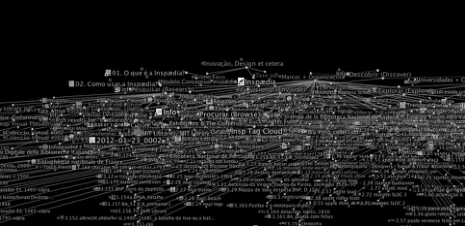
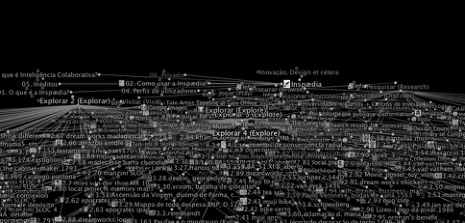
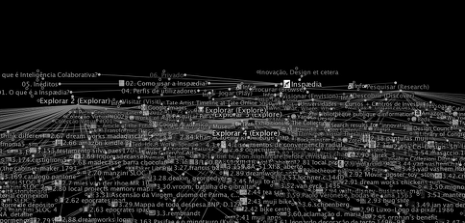
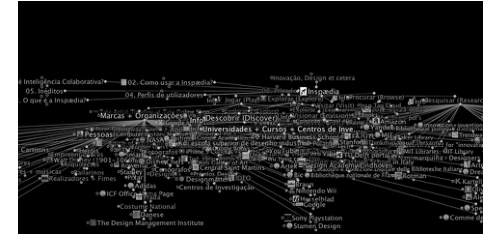
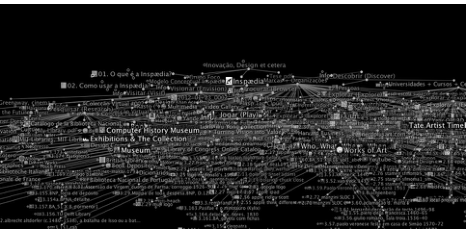
The operationalization of the Inspædia platform goes by for seven interconnected actions: BROWSE; EXPLORE; DISCOVER, RESEARCH; ENVISION; PLAY and VISIT [Figures 1, 2].
Figures 1. Inspædia prototype Source: Maldonado 2012 Users can start from any of the seven interconected actions (which provide a first level of entry), any node, or through two actions: zoom in/out and pan. The Inspædia entry assumes one of four reasons: learning, peering, inquiring, experimenting 2. The relationships are forged because every thing is associated to tags or because it was so determined by the builders of content, ie, if the search is made from the tag cloud of Inspædia or a particular tag all the things associated with that arise tag, enabling the development of new associations 3. The builder of contents will be given the opportunity to register their Inspædia track and associate his name (or nickname); he may come back later to add new content and establish relationships between them. Permanent observers and flâneurs can view these tracks (and even identify their favorite content builders) but they can not register their itineraries in the same way: from their use will be available the track that will contribute to the collective tag cloud.
Returning the tracks, there will be so many layers as so many builders of contents (this feature is not available on the network, at least so far). By overlaying these layers will be able to view and access, in real time, the "new" Inspædia (ie the new content and new relationships). As a result of the use of Inspædia the tree based construction becomes a rhizome. Overlapping layers is, for now, theoretical as it was not possible to test it, given the limitations of the software used.
Looking for tags to sort the contents of Inspædia platform focused on cloud tags of some search engines and blogs. This process guided our selection for the more often wanted tags in areas in which we proposed treating and corresponding innovation, design and constituting nodes and Inspædia contents. The next phase of the process was to exclude from the new cloud all the tags that does not produce sense in the context or where the meaning of which was very similar. Considering the importance of this feature (tagging), it is essential the use of specific software developed to operationalize this idea in Inspædia identical to the features that Wordle offers (Feinberg 2011). The effort to operationalize collaborative intelligence is behind the technology used in tagging 4. Tried to find a solution to allow testing, reducing the number of tags to a minimum and to simplify future using a tag cloud editor type Wordle (Steele & Iliinsky, 2010, pp. 37–58).
The Inspædia platform is not solely focused on the use of tags and tag clouds. The collections of images belong to the most important content of Inspædia, since they are essential for productive thinking 5 - to "see with the mind's eye" (Samuels, 1975) or "see sideways" (Fletcher, 2001): one of the most important factors in innovation and design process consists on individual and/or collective ability to own a set of excellent visual references to trigger and inform processes of productive thinking. These references come from what is known (or what we are given to know) and how we are able to relate them and induce collisions with each other - using the expression of Johanssen (c2004) and Stefik (2006). This process leads to stimuli capable of creating new scenarios, ideas, distinctive concepts or innovative concepts - ie, promotes innovation and design in various sectors, particularly in services (one of the sectors with high growth potential in the future) 6. "Concepts tie thoughts together, from intelligence and bridges between one another, Provide a common point of reference" (Fletcher , 2001, p.73). This process of "linking" implies a wide visual culture and mobilization of divergent thinking. We used a dynamic mind mapping (TheBrain Technologies 2011) 7 to prototype, to make possible the demonstration and to test and validate the Inspædia (through a focus group) 8.
Resuming the seven actions and the description of its functionality.
Figure 3. Inspædia prototype BROWSE action (open to all nodes) Source: Maldonado 2012 BROWSE [Figure 3] is a knowledge tag cloud that through a tag editor graphically points out the most popular tags allowing for quick view (the size of the typeface and the chromatic font weight depends on the number of times a particular tag is clicked or taken for a given input). A listing that includes all the tags that are associated with Inspædia content (in the form of alphabetical list) will be created.
Figures 4, 5. Inspædia prototype: search by tags Source: Maldonado 2012 In the future the collaborators participation will contribute to significantly increase the number of tags (when adding new content and their tags and/or when we add more tags to existing content). It will possible to browse and select the list and select a tag (or more tags) or write a tag (or more than one tag simultaneously) and then perform the search [Figures 4, 5].
It is possible to access the tags track left by other users and follow it to the end or jump to another track. SEARCH action should be used by all the users who start with a certain idea about what they want, making the search by one or multiple tags or following the tracks left by other users. The action SEARCH can direct the search to any of six other actions.
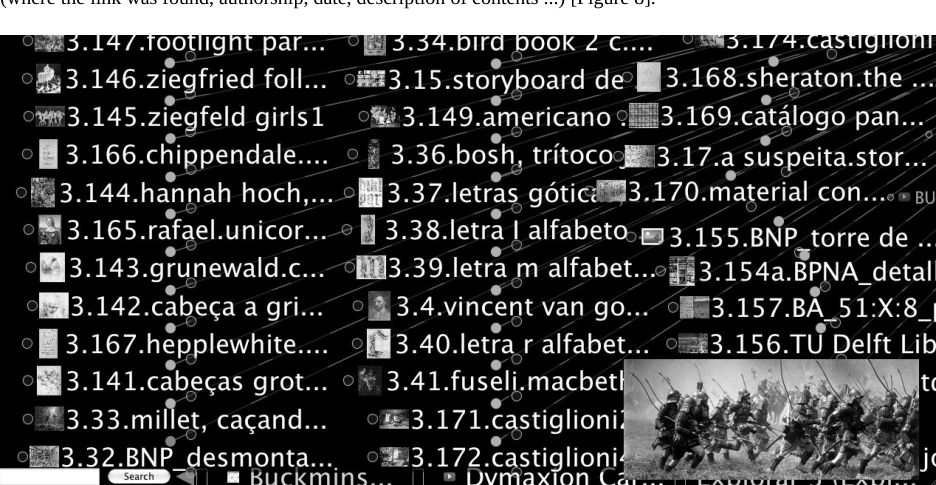
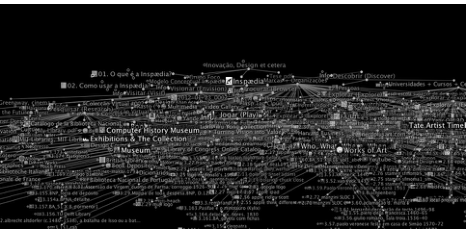
EXPLORE [Figure 6] provides access to all the images that are part of Inspædia (as well as Stamen Design developed for the exhibition SFMoMA ArtScope (MoMA, 2011c) [Figure 7]. That means a random exploration of images - pan, zoom in, zoom out - or a logical operation done through tags. When we enter one or more tags in the field created for this function, associated images arise in loop tags 9. This functionality is not available on the website that inspired us (SFMoMA) but seemed to be very useful. Clicking on the image that arouses the curiosity of the user that will give the access to all the associated content information (where the link was found, authorship, date, description of contents ...) [Figure 8].
Figure 8. Inspædia prototype: EXPLORE by images action (images increase in size when passing the mouse) Source: Maldonado 2012 It is possible to access the trail of images left by other users, jumping from track to track or explore only the most inspiring images, assign them a specific sequence and save them to return later. It is possible to search for images by similarity (as well as Google Images and Yandex) and associate one or more tags to search for images by similarity. This organized images grid mapping will grow when the collaborators begin to load their favorite and inspiring things. The associations between images due to the characteristics of each image and of the tags associated with them. This is an action welcome to the flâneurs "archaeologists", who know to "dig" and reconstruct narratives from their "findings".Figure 9. Inspædia prototype: DISCOVER action (open to all nodes) Source: Maldonado 2012Figure 10. Inspædia prototype: discover > people > inventors (alphabetic order) Source: Maldonado 2012
DISCOVER [Figure 9], lets to navigate through the legacy of many bright minds (artists, scientists, designers, philosophers, architects, composers, engineers, photographers, entrepreneurs, chefs, inventors...) [Figure 10] to access what inspired them. Reconstitutes interrelationships between people, organizations and brands, revealing how knowledge can be potenciated (individual and collectivelly). To get in the DISCOVER action we can scroll through a list of people, organizations and brands or make the selection from what is intended or is accessed through a tag. The use of multiple tags to DISCOVER brings us to the net of relations established within this action (or makes the links to the contents of the other six actions). We suggest this action for the users particulary interested in learning facts and narratives that connect people, organizations and brands. It is suggested to establish new relationships and analogies.
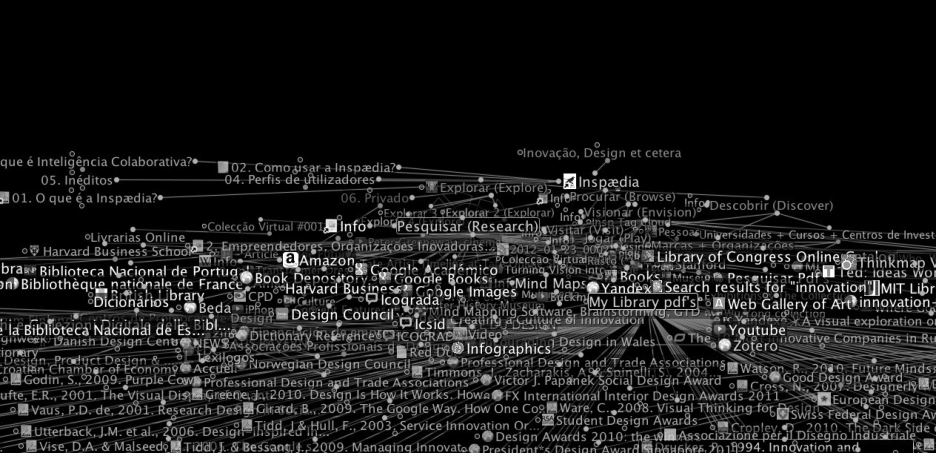
Figure 11. Inspædia prototype: RESEARCH action (open to all nodes) Source: Maldonado 2012 RESEARCH action serach the contents of a infinite online library [Figure 11]. Includes bibliography on innovation, design, management, art, philosophy,..., links to personal libraries, online library catalogs, portals, online dictionaries,... It is a gateway to produced and published knowledge whose access offers conditions and opportunities to develop new knowledge. It is also a gateway to unique content. Enables full reading of works, excerpts from selected texts, aphorisms, et cetera. The search can be done by following search procedures used by online libraries - simple search, advanced search or elaborate search (author, title, date, or not ... using filters such as "and" , "or" and "more"), through tags. We would like to include a feature that would allow to underscore, copy and
paste content. These features are directly related to copyright. This academic prototype is unproblematic as regards the rights of use of the sources used.
Another feature we would like to consider on the RESEARCH action consists on the permission to access, cross- reference and bibliographic listings of each work opening up the possibility of the user to access the relations arising from the crossing of these bibliographic listings. RESEARCH it is about digging into the contents. This action is particularly productive for users who prefers to serch from reliable sources, work and relate them and leaving for another bibliographic listing, providing a new context for research. We expect the contribution of all the collaborators to enable this action include other new things.
ENVISION the future is the aspiration and motivation of the Inspædia users. This opens the possibility to look at the past as leverage for the future, meet other visionaries, their views and/or reinvent the future [Figure 12]. Lets reinvent scenarios (real or virtual) to construct new narratives that contextualize and allows innovation and design. The entry to the ENVISION action is made through tags, aphorisms, texts and images. The ENVISION action establishes relations with all other actions to stimulate the production of many images (imagination). The is the space where the constructors of contents leave their visions of the future (which will become part of a child node of the node envision - trends).
Figure 12. Inspædia prototype: ENVISION action (open to all nodes) Source: Maldonado 2012Figure 13. Inspædia prototype: PLAY action (open to all nodes) Source: Maldonado 2012 PLAY [Figure 13] is an action that allows to view and cross graphically the Inspædia contents in which each row corresponds to one of five classes: design, innovation, inventions, people, social and political facts. By sliding the cursor will appear connections and links, as well as Universal Leonardo (University of the Arts, 2011) [Figure 14]. The temporal arc ends in the present (or in the near future). PLAY opens the possibility of the game between the users, to challenge the limits, the competition and the collaboration to find new relationships and new narratives 10, such as the project An Exquisite Corpse Experiment (Ideo, 2011d).
The game reinforces social interaction and the sharing attitude between users. PLAY action is recommended to the users that want to start from the big picture to visualize the time nodes continuing with successive zooms in and pans to find what they are looking for (or anything that arouses curiosity). Clicking on a specific content generates an automatic zoom out one that relates that thing to other (helping to make the track between them, backwards or forwards). Is it possible to save this track to return later and continue to display and play with the other users. The game promotes a kind of interaction which encourages divergent thinking.
Figure 14. Universal Leonardo Web site Source: www.universalleonardo.org/trail.php?trail=541&work=483
Figure available in the original PDF paper.
Figure 15. Inspædia prototype: VISIT action (open to all nodes) Source: Maldonado 2012 VISIT gives access to many virtual collections of favorite things (as many as the builders of content want to). There are no storage area (invisible things). Everything is available online - poetic and pragmatic lists, books, photographs, films, mind maps, scrapbooks, notebooks, exhibitions, websites, services, products, works of art... [Figure 15]. The virtual collections of favorite things will be identified by the name of the builder of contents (or its nickname).
Figure available in the original PDF paper.
Upon entering the Inspædia, users must register by filling out the user name and a password. Each builder will have the associated content on an automatic scoring system of points, for each new input (tag, link, content, virtual collection). All users can assign points to contributions left by the builders of contents by clicking the like button to access the list and the score of the builders of contents (to see who are the main contributors). The reliability of the contents in Inspædia depend on the efforts of all users (permanent observers). The platform will allow permanent observers to establish direct communication with builders of contents to submit suggestions, recommendations or request corrections. This democratic scrutiny will force the builders of contents to have the utmost rigor in the selection of information to be made available on the network. The prototype Inspædia aims to test some of the features described above and verify that the nodes and the contents are sufficiently inspiring for scribblings implicated in processes of innovation and design. Of all the software that enables the construction of mind maps we've experienced, the TheBrain seemed to be the most suitable, although it has limitations, particularly in terms of interaction and graphical configuration.
The communication design, interaction design and software engineering are currently being developed under the post doctoral design program with Architecture Faculty of Lisbon University / CIAUD, as Special Guest Researcher - Science Without Borders Programm with the Federal University of Rio Grande do Sul and within the research group Innovation, Design and (non)Material Culture at CITAD.
1 Who wanders in the network without a destination previously drawn.
2 The suggestion comes from the 51 letters of IDEO (Moggridge, 2007).
3 “Peering works best when at least three conditions are present: 1) The object of production is information or culture, which keeps the cost of participation low for contributors; 2) Tasks can be chunked out into bite-size pieces that individuals can contribute in small increments and independently of other producers (i.e. entries in an encyclopedia or components of a software program). This makes their overall investment of time and energy minimal in relation to the benefits they receive in return. And, finally, 3) The costs of integrating those pieces into a finished end product, including the leadership and quality-control mechanisms, must be low” (Tapscott & Williams, 2006, p. 70).
4 “Thanks to the pioneering efforts of a number of Web services, the application of collective intelligence is branching out to the way we organize and classify content on the Web, using a grassroots classification system called ‘tagging’. Tagging harnesses a technology called XML to allow users to affix descriptive labels or keywords to content (techies call it ‘metadata’, or data about data). Wired cofounder Kevin Kelly aptly describes a tag as a public annotation – like a keyword or category name that you hang on a file, Web page, or picture. When people tag content collaboratively it creates a ‘folksonomy’, essentially a bottom-up, organic taxonomy that organizes content on the Web […]. Tagging is just getting started, and has already been extended to documents, photos, videos, podcasts, e-mails, blog posts – basically any type of electronic content you can imagine” (Tapscott & Williams, 2006, pp. 41–42).
5 “In the Meno, Socrates demonstrates that ‘all enquiry and all learning are but recollection’.[...] In the Phaido, Socrates speaks characteristically of blindness, of ‘loosing the eye of his mind’ when he warns against the danger of trusting the senses. It is a case of renouncing one kind of perception in order to save another. [...] Aristotle was the first thinker to recognize that substance is nowhere but in individual objects. He thereby furnished the basis for our knowledge that nothing exists beyond individual existences [...]. The Greeks learned to distrust the senses, but they never forgot that direct vision is the first and final source of wisdom. They refined the techniques of reasoning, but they also belived that, in the words of Aristotle, ‘the soul never thinks without an image ’ ” (Tapscott & Williams, 2006).
6 “The rise of services in this new era means that these approaches must change if companies are to be successful and sustainable. Four concepts and practices are critical to this alternative approach or way of thinking that will enable innovation and growth: […] think of your business as a service in order to sustain profitability and achieve new growth. Innovators must co-create with customers to create more meaningful experiences for customers, who will get more of what they really want. Open Innovation accelerates and deepens service innovation and growth by promoting specialization within the customers, suppliers, makers of complementary goods and services, and other third parties surrounding the business, resulting in more choice and variety for customers. Effective services innovation requires new business models that profit from internal innovation initiatives and stimulate external innovation activities that add to the value of their own business” (Chesbrough, 2011, p. 4).
7 “A mind map harnesses the full range of cortical skills - word, image, number, logic, rhythm, color, and spatial awareness - in a single, uniquely powerful technique. In doing so, it gives you the freedom to roam the infinite expanse of your brain” (Buzen cit. in Nast 2006, p.20). About the inventors of mind maps see Software for mindmapping and information organization (2012). The idea arises in 1933, a novel by Charles Williams (1886-1945): “Mightn’t it be a good thing if everyone had to draw a map of his own mind - say, once every five years?” (Williams, 2011, Chapter 1).
8 Mind mapping is the most appropriate mapping for this type of interaction and exploration: “An idea map is a colorful, visual picture of the issue at hand - all on a single sheet of paper. This frees the brain to think, see, and understand in ways that cannot happen with a multipaged linear document of the same information. It breaks the tradition of linear thinking and provides a way for individuals and teams to plan, learn, increase productivity, save time, improve recall, and create using the logic of association and the full range of cortical skills” (Nast 2006, p.2).
9 In the context that means an alignment of images that appear in a circular sequence by the action of a technical process. The term has several applications and finds the best semantic parallel in music, because it means the repetition of a certain sequence of sounds, until the action is terminated.
10 "The term 'game' combines [...] in itself the ideas of limits, freedom and invention. [...] Consider the reality as a game, gaining more ground to certain social customs that turn the pettiness, greed and hatred, is to commit an act of civilization " (Callois, 1990, pp. 11–17).
REFERENCES
Arnheim, R. (1984). Visual thinking. Berkley, CA: University of California Press. Callois, R. (1990). Os jogos e os homens. Lisboa: Cotovia. Chesbrough, H. (2011). Open services innovation: rethinking your business to grow and compete in a new era. San Francisco, CA: Jossey-Bass. Fierst, K., & Diefenthaler, A. (2011). Design Thinking for Educators. Retrieved 16 September 2011, from
http://www.designthinkingforeducators.com/ Fletcher, A. (2001). The art of looking sideways. London: Phaidon Press. Ideo. (2011d). IDEO Labs An exquisite Corpse Experiment. Retrieved 1 September 2011, from http://labs.ideo.com/2011/07/27/an-exquisite-corpse-experiment/ Johansson, F. (c2004). Medici effect: what elephants and epidemics can teach us about innovation. Boston, Mass.: Harvard
Business Press. Maldonado, P. (2012). Inovação, design et cetera. Lisboa: Faculdade de Arquitectura da Universidade Técnica de Lisboa. Moggridge, B. (2007). Designing interactions. Cambridge, MA: MIT Press. MoMA. (2011c). SFMOMA | Explore Modern Art | SFMOMA ArtScope. Retrieved 30 August 2011, from http://www.sfmoma.org/projects/artscope/#r=57&zoom=3&artwork=22639 Nast, J. (2006). Idea mapping: how to access your hidden brain power, learn faster, remember more, and achieve success in
business. Chichester: Wiley. Samuels, M. (1975). Seeing with the mind’s eye: the history, techniques and uses of visualization. New York: Random House. Steele, J., & Iliinsky, N. (2010). Beautiful visualization: looking at data through the eyes of experts. Sebastopol, CA:
O’Reilly. Tapscott, D., & Williams, A. D. (2006). Wikinomics: how mass collaboration changes everything. New York, N.Y: Portfolio. TheBrain Tecnologies. (2011). TheBrain : Mind Mapping Software, Brainstorming, GTD and Knowledgebase Software.
Retrieved 11 December 2011, from http://www.thebrain.com/ University of the Arts. (2011). Universal Leonardo: Leonardo da Vinci online › Welcome to Universal Leonardo. Retrieved 14 December 2011, from http://www.universalleonardo.org/ Viégas, F., & Wattenberg, M. (2008, August). Tag clouds and the case of vernacular visualization. Interactions -
Experiences, People, Technology, 15(4), 49–52. Williams, C. (2011). The place of the lion. Retrieved 5 January 2012, from http://gutenberg.net.au/ebooks06/0601441.txt
LISTED IN THE AHFE DIGITAL BOOKSTORE CATALOGUE
Explore the complete digital volume
Advances in Ergonomics In Design, Usability & Special Populations: Part I
Read this individual research paper free through the original publisher, or explore the full digital proceedings book.
ISBN 978-1-4951-2106-7
Explore this ISBN in the AHFE Bookstore ↗Listed in the July 2026 bookstore catalogue; search by ISBN to confirm current availability · Digital book purchase optional