Peixian Lu, Liang Ma (2024). Support from conversational agent on daily stress for user satisfaction improvement. In: Usability and User Experience. AHFE Open Access, vol. 156, pp. 97–106. https://doi.org/10.54941/ahfe1005419
Daily stress is a universally experienced phenomenon in our modern lives [1]. Studies have shown that cumulative stress in daily life can result in cardiovascular disease [2] and psychological or behavioral disorders, such as depression and anxiety [3]. To regulate stress, social sharing is often used as a method. By talking to others, sharers can gain support that help them cope with their stress events [4]. However, people are not always comfortable sharing their stress events with others, such as the stigmatised issues [5]. In addition, people are not always able to find the right person to talk to. Their friends may be tired of hearing about the same issues [6]. Besides, professional help may be too expensive and require long waits [7].With the widespread use of conversational agent (CA), the CA should provide support for the users who encounter with daily stress to help them get socio-emotional benefits and therefore improve the user satisfaction [8]. At the same time, the gender of the CA should be considered as a factor which influence the user satisfaction of daily stress support.MethodsIn this study, we developed a 2 (CA genders)×3 (types of support) between-subject experiment on user satisfaction of CA with daily stress support function. The CA had two types of gender, including male and female. Three support types included control (without stress support function), stress (with stress detection and support function), and stressor (with stress and stressor detection, and provide support targeted at stressor) groups. So, there were six types of CA in this experiment.Participants (N = 76) were asked to share one personal daily stress experience with a CA, which was assigned from the six CAs randomly and provided support via the Wizard-of-Oz method (a human-operated CA).Results & DiscussionResults showed that participants felt better after sharing with the CA in stress group and stressor group, as evidenced by reduced stress intensity. The interaction experience of participants showed that the likeability, enjoyment, and user satisfaction of stress group were significantly higher than that of control group. While, the user satisfaction of stressor group had no significant difference with that of stress group. For the gender the CA, the female CA achieved higher likeability in control group and stress group. Meanwhile, the female CA achieved higher enjoyment, engagement, and user satisfaction in stressor group.According to the interview after the experiment, the participants in the stressor group proposed more requirements for the targeted advice from CA. They explained that they felt the high intelligent level of the CA. So, they were looking forward for the help from the CA for the solution of their daily stress events.ConclusionAccording to the above results, the support for daily stress from CA can improve the user satisfaction. Between different genders of CA, the female CA is more preferred in this study. What’s more, the CA should provide targeted advice for users with different stressors.Reference[1] Piazza, J. R., Charles, S. T., Sliwinski, M. J., Mogle, J., & Almeida, D. M. (2013). Affective reactivity to daily stressors and long-term risk of reporting a chronic physical health condition. Annals of Behavioral Medicine, 45(1), 110-120.[2] Schubert, C., Lambertz, M., Nelesen, R. A., Bardwell, W., Choi, J. B., & Dimsdale, J. E. (2009). Effects of stress on heart rate complexity—a comparison between short-term and chronic stress. Biological psychology, 80(3), 325-332.[3] Cohen, S., Kessler, R. C., & Gordon, L. U. (Eds.). (1997). Measuring stress: A guide for health and social scientists. Oxford University Press on Demand.[4] Rim ́e, B. (2009). Emotion elicits the social sharing of emotion: Theory and empirical review. Emotion Review, 1(1), 60–85.[5] Smart, L., & Wegner, D. M. (2000). The hidden costs of hidden stigma. In T. F. Heatherton, R. E. Kleck, M. R. Hebl, & J. G. Hull (Eds.), The social psychology of stigma (pp. 220–242). New York: Guildford Press.[6] Forest, A. L., Kille, D. R., Wood, J. V., & Holmes, J. G. (2014). Discount and disengage: How chronic negative expressivity undermines partner responsiveness to negative disclosures. Journal of Personality and Social Psychology, 107(6), 1013–1032.[7] Hunt, J., & Eisenberg, D. (2010). Mental health problems and help-seeking behavior among college students. Journal of Adolescent Health, 46(1), 3–10.[8] Pauw, L. S., Sauter, D. A., van Kleef, G. A., Lucas, G. M., Gratch, J., & Fischer, A. H. (2022). The avatar will see you now: Support from a virtual human provides socio-emotional benefits. Computers in Human Behavior, 136, 107368.
Daily stress is a universally experienced phenomenon in our modern lives (Piazza et al., 2013). Daily stress is the strain caused by challenges of day- to-day living (Piazza et al., 2013). Studies have shown that cumulative stress in daily life can result in cardiovascular disease (Schubert et al., 2009) and psychological or behavioral disorders, such as depression and anxiety (Cohen et al., 1997).
To regulate stress, social sharing is often used as a method. By talking to others, sharers can gain support that help them cope with their stress events (Rimé, 2009). However, people are not always comfortable sharing their stress events with others, such as the stigmatised issues (Major & O’Brien, 2005). In addition, people are not always able to find the right person to talk to. Their friends may be tired of hearing about the same issues (Forest et al., 2014). Besides, professional help may be too expensive and require long waits (Hunt & Eisenberg, 2010).
With the development of conversational agent (CA), the CA should pro- vide support for the users who encounter with daily stress to help them get socio-emotional benefits and therefore improve the user satisfaction (Pauw et al., 2022). Researches have focused on how CA provide support for users who were under negative emotion (Bendig et al., 2022; Pauw et al., 2022). Similarly, CA should provide supportive responses to users facing daily stress for timely stress relief.
Compared with traditional CA without stress detection and support func- tion, it should be examined whether CA with stress detection and support function can help to enhance users’ interaction experience under daily stress. In addition, the response content of CA with support function should be further investigated. Based on the general supportive responses, whether targeted responses with stressors have a positive impact on enhancing user experience. Therefore, this study focused on three support types of CA: with- out stress support function, with stress detection and support function, with stressor detection and stressor-based targeted support function.
At the same time, the gender of CA should be considered as a factor which influence the user satisfaction of daily stress support. Relevant studies have shown that CA gender had an impact on user likeability and satisfaction (Seaborn et al., 2022). Some studies have shown that robots with feminine voices (Chang et al., 2018) were the most liked and favoured. However, there were findings that male synthesised voices were more popular and persuasive than female synthesised voices (Mullennix et al., 2003). Besides, some studies suggested that voices the same with the gender of the user were more favoured (Seaborn et al., 2022). However, the voice gender preference of users during speech interaction with CA under daily stress was still not clear.
In summary, this study investigated the effects of CA gender and support type on user satisfaction. Based on the findings, this study will optimise the interaction capabilities of CA, thereby enhancing user satisfaction and expanding the timely accessibility of stress relief manner for users in their daily lives.
METHODS
In this study, we developed a 2 (CA genders) × 3 (types of support) between-subject experiment on user satisfaction of CA. The CA had two types of gender, including male and female. Three support types included control (without stress support function), stress (with stress detection and support function), and stressor (with stressor detection function, and sup- port targeted at stressor) groups. So, there were six types of CA in this experiment.
Participants In addition to the participants who were excluded due to equipment prob- lems, a total of 76 participants (38 males and 38 females) were retained for this experiment. The mean age of participants was 23.7 years, with standard deviation of 3.6 years. The basic information of the participants is shown in Table 1.
Support From Conversational Agent on Daily Stress for User Satisfaction Improvement 99
Table 1. Basic information of participants.
Table available in the original PDF paper.
Participants Groups Female CA Male CA
Control Stress Stressor Control Stress Stressor Number Male 6 7 6 6 7 6 Female 6 7 6 6 7 6 Age Mean 25.3 24.1 23.1 21.8 23.8 23.9 SD 3.7 3.3 4.1 2.3 4.1 3.4
Procedure The flow of the experiment is shown in Figure 1. All participants signed an informed consent upon arrival at the experimental site. Afterwards, a pre- experiment personal information questionnaire was filled out. During the experiment, participants were asked to communicate and share one personal daily stress experience event with a CA, which was assigned from the six CAs randomly and provided support via the Wizard-of-Oz method (a human- operated CA). After the communication, participants were invited to evaluate the CA. The experimental protocol was reviewed by the Institutional Review Board (IRB) committee of the Institute of Human Factors and Human-System Interaction.
Figure 1: Procedure of experiment.
Figure available in the original PDF paper.
Dependent Variable In this study, the dependent variable of subjective evaluation is user satis- faction. Meanwhile, we analysed the mediator variables, including: social presence, perceived personalisation, favourability, and trust. All variables in this study were measured using 7-point Likert scales.
These mediator variables were selected according to the previous findings as follows:
According to the reciprocity model of social perception, social presence can enhance reciprocal behaviours in human-intelligent agent interac- tions, and therefore facilitate the formation of intimate relationships and improve user satisfaction (Kühne & Peter, 2023).
Perceived personalisation can contribute to service satisfaction and users’ perception of intimacy (Verhagen et al., 2014).
Recent studies have confirmed the importance of favourability and its influence on the enhancement of user-agent relationships and user sat- isfaction (Ashktorab et al., 2020).
100 Lu and Ma
According to the studies of users’ feelings toward agents, trust can enhance the user satisfaction, leading to desired user behaviors (Lee & Yi, 2023).
RESULTS
The results of subjective evaluation were shown in Table 2, with the coeffi- cient of reliability (Cronbach’s α) of each scale used in this experiment.
Table 2. Subjective evaluation results and the Cronbach’s α of each scale.
Table available in the original PDF paper.
Groups Female CA Male CA α Control Stress Stressor Control Stress Stressor
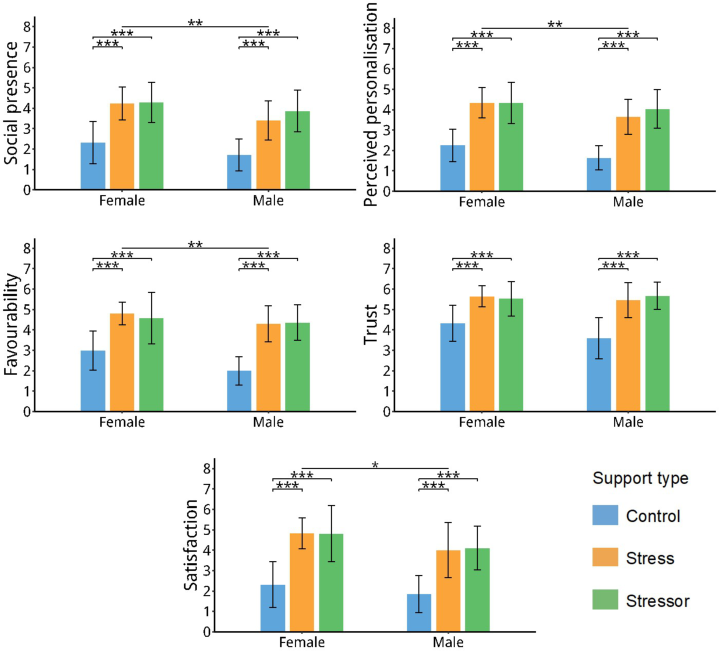
ANOVA Analysis This experiment explored the effect of CA gender and support type on user satisfaction through Two-Way ANOVA (see Table 3). In addition, this experiment used Bonferroni adjustment for post hoc multiple comparisons (see Figure 2).
Table 3. ANOVA analysis results of subjective evaluation.
Table available in the original PDF paper.
Variable Factor F p η2 Social presence Support type 35.489 <0.001*** 0.472 Gender 8.750 0.004** 0.058 Support type × Gender 0.344 0.710 0.005 Perceived personalisation Support type 53.924 <0.001*** 0.578 Gender 8.065 0.006** 0.043 Support type × Gender 0.372 0.691 0.004 Favourability Support type 42.258 <0.001*** 0.513 Gender 7.896 0.006** 0.048 Support type × Gender 1.138 0.326 0.014 Trust Support type 32.909 <0.001*** 0.466 Gender 1.823 0.181 0.013 Support type × Gender 1.751 0.181 0.025 Satisfaction Support type 36.235 <0.001*** 0.484 Gender 6.839 0.011* 0.046 Support type × Gender 0.175 0.840 0.002
Support From Conversational Agent on Daily Stress for User Satisfaction Improvement 101
Figure 2: ANOVA and post hoc analysis of subjective evaluation.
The results of the Two-Way ANOVA showed that there was no interaction effect between CA gender and support type on any of the five dimensions of subjective evaluation.
The main effects of support type were significant on social presence (F(2,70) = 35.489, p < 0.001, η2 = 0.472), perceived personalisation (F(2,70) = 53.924, p < 0.001, η2 = 0.578), favourability (F(2,70) = 42.258, p < 0.001, η2 = 0.513), trust (F(2,70) = 32.909, p < 0.001, η2 = 0.466), and satisfaction (F(2,70) = 36.235, p < 0.001, η2 = 0.484).
Post hoc tests showed that the control group’s social presence (M = 2.02, SD = 0.95), perceived personalisation (M = 1.94, SD = 0.76), favoura- bility (M = 2.50, SD = 0.97), trust (M = 3.96, SD = 1.00), satisfaction (M = 2.08, SD = 1.03) were significantly lower than those of the stress group’s social presence (M = 3.82, SD = 0.97, p<0.001), perceived personali- sation (M = 3.99, SD = 0.86, p<0.001), favourability (M = 4.55, SD = 0.77, p<0.001), trust (M = 5.55, SD = 0.70, p<0.001), satisfaction (M = 4.41, SD = 1.15, p<0.001) and the stressor group’s social presence (M = 4.08, SD = 0.99, p<0.001), perceived personalisation (M = 4.18, SD = 0.97, p<0.001), favourability (M = 4.47, SD = 1.07, p<0.001), trust (M = 5.60, SD = 0.75, p<0.001), satisfaction (M = 4.46, SD = 1.26, p<0.001).
102 Lu and Ma
CA gender had significant main effects on social presence (F(1,70) = 8.750, p = 0.004, η2 = 0.058), perceived personalisation (F(1,70) = 8.065, p = 0.006, η2 = 0.043), favourability (F(1,70) = 7.896, p = 0.006, η2 = 0.048), and satisfaction (F(1,70) = 6.839, p = 0.011, η2 = 0.046). The female CA had significantly higher social presence (M = 3.65, SD = 1.29), perceived personalisation (M = 3.68, SD = 1.28), favourability (M = 4.16, SD = 1.23), and satisfaction (M = 4.03, SD = 1.59) than the male CA’s social presence (M = 3.02, SD = 1.28, p = 0.004), perceived personalisation (M = 3.13, SD = 1.31, p = 0.006), favourability (M = 3.59, SD = 1.36, p = 0.006), and satisfaction (M = 3.36, SD = 1.52, p = 0.011). Whereas CA gender had no significant effect on the evaluation of trust.
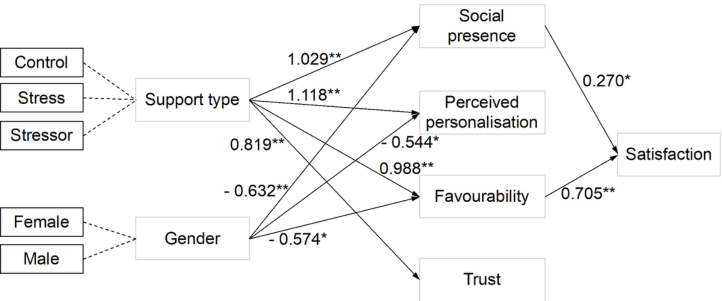
Mediation Analysis In order to investigate the mechanism of user satisfaction evaluation, we used the parallel mediated effects to analyse how the gender and support type of CA influence user satisfaction by social presence, perceived personalisation, favourability, and trust (see Table 4).
Table 4. Mediation analysis results.
Table available in the original PDF paper.
Item c a b a*b c’ Result 1.188** 1.029** 0.270* 0.278** 0.104 Full mediation Support type => Social presence => Satisfaction
1.188** 1.118** 0.207 0.232** 0.104 No significant mediation
Support type => Perceived personalisation=> Satisfaction
1.188** 0.988** 0.705** 0.696** 0.104 Full mediation
Support type => Favourability => Satisfaction Support type => Trust => Satisfaction
-0.671* -0.632** 0.270* -0.170 -0.021 Full mediation
1.188** 0.819** -0.148 -0.122 0.104 No significant mediation Gender => Social presence => Satisfaction -0.671* -0.544* 0.207 -0.113 -0.021 No significant mediation Gender => Perceived personalisation=> Satisfaction
-0.671* -0.574* 0.705** -0.404 -0.021 Full mediation
-0.671* -0.250 -0.148 0.037 -0.021 No significant mediation
Note: * p<0.05; ** p<0.01. c’: Direct effect; a*b: Indirect effect; c: Total effect
The mediation effect analysis showed that the direct effect of support type on user satisfaction was not significant (direct effect c’ was not significant). The support type had significant effects on the social presence, perceived per- sonalisation, favourability, and trust (effect ‘a’ was significant). Meanwhile, the social presence and favourability had significant effects on user satisfac- tion (effect ‘b’ was significant). Therefore, the support type of CA had a
Support From Conversational Agent on Daily Stress for User Satisfaction Improvement 103
significant positive effect on user satisfaction through the mediator variables (social presence and favourability) with full mediation. The higher support type (in the order of control group, stress group, and stressor group) led to the higher social presence and favourability, which in turn led to the higher user satisfaction.
The direct effect of CA gender on user satisfaction was not significant (direct effect c’ was not significant). However, CA gender had significant effects on the social presence, perceived personalisation, and favourability (effect ‘a’ was significant). Meanwhile, the social presence and favourabil- ity had significant effects on user satisfaction (effect ‘b’ was significant). Therefore, CA gender had a significant negative effect (fully mediated) on user satisfaction through the mediators (social presence and favourability). Compared to male CA, the female CA resulted in higher social presence and favourability, and therefore led to higher user satisfaction.
Based on the results of the mediation effect analysis, the paths with signif- icant results are summarised in the mediation model with solid arrows (see Figure 3). Female CA obtained higher user satisfaction than male CA. Mean- while, the higher support type achieved the higher user satisfaction. Both the gender and the support type of CA affected user satisfaction through the mediators: social presence and favourability.
Figure 3: Summary of mediation analysis results.
DISCUSSION
According to participants’ subjective evaluations, users were more satisfied of female CA with stress or stressor support function. With respect to the gender of CA, participants were more satisfied with female CA. The female CA achieved higher social presence, perceived personalisation, and favoura- bility. This finding is consistent with previous results in the literature. The female voice (Chang et al., 2018) and higher-pitched voice (Niculescu et al., 2011) are more preferred. Female voice is rated by users as more pleas- ant (Bazilinskyy & De Winter, 2015) and easier to understand (Bazilinskyy & De Winter, 2017). Regarding the support type of CA, participants rated higher satisfaction for CA with stress or stressor support function than CA
104 Lu and Ma
without stress support function. The subjective evaluation of participants showed that the social presence, perceived personalisation, favourability, trust, and satisfaction of stress group and stressor group were significantly higher than that of control group. While, these variables of stressor group had no significant difference with that of stress group. This result is consis- tent with related findings from previous research that increasing the affective responses of CA can increase usage intention and satisfaction of users (Hong et al., 2017).
In order to investigate the influence mechanism of CA gender and support type on user satisfaction, this study conducted mediation effect analysis with the mediator variables of social presence, perceived personalisation, favoura- bility, and trust. The results showed that CA gender negatively affected user satisfaction through the social presence and favourability (female CA obtained higher user satisfaction than male CA), which was related to the fact that female voice was more preferred than male voice (Chang et al., 2018). Meanwhile, CA’s support type positively influenced user satisfaction through social presence and favourability (the higher stress and stressor sup- port type obtained the higher user satisfaction). In addition, neither of the two independent variables of CA had an effect on user satisfaction through perceived personalisation and trust. Therefore, perceived personalisation and trust might not be the main path through which the CA independent variables influenced user satisfaction in this study.
According to the interview after the experiment, the participants in the stressor group proposed more requirements for the targeted advice from CA. They explained that they felt the high intelligent level of the CA. So, they were looking forward for the help from the CA for the solution of their daily stress events.
CONCLUSION
According to the results of this study, the support for daily stress from CA can improve the user satisfaction. Between different genders of CA, the female CA is more preferred in this study. What’s more, the influence mechanism shows that the CA gender and support type influence user satisfaction through the mediator variables: social presence and favourability. This study provides guidance for the design of stress support of CA. The related findings provide a reference basis for the design of interaction manner between CA and users.
ACKNOWLEDGMENT
This document is the results of the research project funded by the National Natural Science Foundation of China (72171127 and 71942005).
REFERENCES
Ashktorab, Z., Liao, Q. V., Dugan, C., Johnson, J., Pan, Q., Zhang, W., Kumaravel, S., & Campbell, M. (2020). Human-AI Collaboration in a Cooperative Game Setting: Measuring Social Perception and Outcomes. Proceedings of the
Support From Conversational Agent on Daily Stress for User Satisfaction Improvement 105
ACM on Human-Computer Interaction, 4(CSCW2), 1–20. https://doi.org/10. 1145/3415167 Bazilinskyy, P., & De Winter, J. (2015). Auditory interfaces in automated driving: An international survey. PeerJ Computer Science, 1, e13. https://doi.org/10.7717/pe erj-cs.13 Bazilinskyy, P., & De Winter, J. C. F. (2017). Analyzing crowdsourced ratings of
speech-based take-over requests for automated driving. Applied Ergonomics, 64, 56–64. https://doi.org/10.1016/j.apergo.2017.05.001 Bendig, E., Erb, B., Schulze-Thuesing, L., & Baumeister, H. (2022). The Next Generation: Chatbots in Clinical Psychology and Psychotherapy to Foster Men- tal Health – A Scoping Review. Verhaltenstherapie, 32(Suppl. 1), 64–76. https: //doi.org/10.1159/000501812 Chang, R. C.-S., Lu, H.-P., & Yang, P. (2018). Stereotypes or golden rules? Exploring
likable voice traits of social robots as active aging companions for tech-savvy baby boomers in Taiwan. Computers in Human Behavior, 84, 194–210. https://doi.or g/10.1016/j.chb.2018.02.025 Cohen, S., Kessler, R. C., & Gordon, L. U. (1997). Measuring stress: A guide for health and social scientists. Oxford University Press on Demand. Forest, A. L., Kille, D. R., Wood, J. V., & Holmes, J. G. (2014). Discount and dis-
engage: How chronic negative expressivity undermines partner responsiveness to negative disclosures. Journal of Personality and Social Psychology, 107(6), 1013–1032. https://doi.org/10.1037/a0038163 Hong, E., Cho, K., & Choi, J. (2017). Effects of Anthropomorphic Conversational Interface for Smart Home: An Experimental Study on the Voice and Chatting Interactions. Journal of the HCI Society of Korea, 12(1), 15. https://doi.org/10. 17210/jhsk.2017.02.12.1.15 Hunt, J., & Eisenberg, D. (2010). Mental Health Problems and Help-Seeking Behav-
ior Among College Students. Journal of Adolescent Health, 46(1), 3–10. https: //doi.org/10.1016/j.jadohealth.2009.08.008 Kühne, R., & Peter, J. (2023). Anthropomorphism in human–robot interactions: A multidimensional conceptualization. Communication Theory, 33(1), 42–52. http s://doi.org/10.1093/ct/qtac020 Lee, B., & Yong Yi, M. (2023). Understanding the Empathetic Reactivity of Con-
versational Agents: Measure Development and Validation. International Journal of Human–Computer Interaction, 1–19. https://doi.org/10.1080/10447318.2023. 2270665 Major, B., & O’Brien, L. T. (2005). The Social Psychology of Stigma. Annual Review of Psychology, 56(1), 393–421. https://doi.org/10.1146/annurev.psych. 56.091103.070137 Mullennix, J. W., Stern, S. E., Wilson, S. J., & Dyson, C. (2003). Social perception
of male and female computer synthesized speech. Computers in Human Behavior, 19(4), 407–424. https://doi.org/10.1016/S0747-5632(02)00081-X Niculescu, A., Van Dijk, B., Nijholt, A., & See, S. L. (2011). The influence of voice pitch on the evaluation of a social robot receptionist. 2011 International Confer- ence on User Science and Engineering (i-USEr), 18–23. https://doi.org/10.1109/iU SEr.2011.6150529 Pauw, L. S., Sauter, D. A., Van Kleef, G. A., Lucas, G. M., Gratch, J., & Fischer, A.
H. (2022). The avatar will see you now: Support from a virtual human provides socio-emotional benefits. Computers in Human Behavior, 136, 107368. https: //doi.org/10.1016/j.chb.2022.107368
106 Lu and Ma
Piazza, J. R., Charles, S. T., Sliwinski, M. J., Mogle, J., & Almeida, D. M. (2013).
Affective Reactivity to Daily Stressors and Long-Term Risk of Reporting a Chronic Physical Health Condition. Annals of Behavioral Medicine, 45(1), 110–120. https: //doi.org/10.1007/s12160-012-9423-0 Rimé, B. (2009). Emotion Elicits the Social Sharing of Emotion: Theory and Empirical Review. Emotion Review, 1(1), 60–85. https://doi.org/10.1177/ 1754073908097189 Schubert, C., Lambertz, M., Nelesen, R. A., & Bardwell, W. (2009). Effects of stress
on heart rate complexity—A comparison between short-term and chronic stress. Biological Psychology, 8. Seaborn, K., Miyake, N. P., Pennefather, P., & Otake-Matsuura, M. (2022). Voice in Human–Agent Interaction: A Survey. ACM Computing Surveys, 54(4), 1–43. https://doi.org/10.1145/3386867 Verhagen, T., Van Nes, J., Feldberg, F., & Van Dolen, W. (2014). Virtual Customer
Service Agents: Using Social Presence and Personalization to Shape Online Service Encounters. Journal of Computer-Mediated Communication, 19(3), 529–545. https://doi.org/10.1111/jcc4.12066
LISTED IN THE AHFE DIGITAL BOOKSTORE CATALOGUE
Explore the complete digital volume
Usability and User Experience
Read this individual research paper free through the original publisher, or explore the full digital proceedings book.
ISBN 978-1-964867-32-8
Explore this ISBN in the AHFE Bookstore ↗Listed in the July 2026 bookstore catalogue; search by ISBN to confirm current availability · Digital book purchase optional