Liang Ma, Jing Chang (2018). Measurement of Subject-Specific Local Muscle Fatigability. In: Advances in Physical Ergonomics and Human Factors: Part II. AHFE Open Access, vol. 2. https://doi.org/10.54941/ahfe100072
Cumulative muscle fatigue is one of the potential reasons leading to musculoskeletal disorders, and individual differences also result in different muscle fatigue progressions among workers while completing the same physical operation. Determination of subject-specific muscle fatigability could help the assignment of work-rest schedule individually, and further reduce musculoskeletal disorders. In this paper, the subject-specific fatigability is defined, and the features of subject-specific fatigability are proposed. According to the definition, a muscle fatigue model based approach is proposed and compared with conventional methods used to demonstrate fatigability. A novel and efficient method to determine subject-specific fatigue rate is developed based a muscle fatigue model and preliminarily validated by comparing force decline data from the literature.
Local muscle fatigue is defined as “any reduction in the ability to exert force in response to voluntary effort” (Chaffin et al., 1999) or “a loss of maximal force generating capacity” (Vøllestad, 1997), and it is considered to be one of the main risk factors of musculoskeletal disorder (MSD)(Kumar, 2001). Work-related musculoskeletal disorder (MSD) can result in reduction of productivity, huge amount of health compensation, high rate of employee turnover, and sick leaving issues (Ma et al., 2009).
The development of local muscle fatigue has a very complex cellular mechanism (Allen and Lamb, 2008). Metabolic factors and impairment of activation act together to initiate central fatigue and peripheral fatigue in muscles along the pathways of muscle contraction (Chaffin et al., 1999). Different technical approaches have been implemented in revealing information about the process potentially involved in the generation of muscle force, such as electromyography (EMG), low frequency fatigues (LFF), power output, and maximum voluntary contraction (MVC). Those measurements can be either direct or indirect (Vøllestad, 1997).
In industrial application, maximum endurance time (MET) is the most prevalent tool used in job design to determine appropriate work-rest allowance (Rohmert, 1973; El ahrache & Imbeau, 2009). However, those approaches do not provide enough consideration of individual differences among workers (Ma et al., 2013). The same limitation was also found in analysis of EMG signals and force decline.
It is acknowledged that different groups of people may have different muscle characteristics (Mannion et al., 1998; Hicks et al., 2001) and therefore have different muscle fatigue development progress during the same work (Yassierli et al., 2007). Therefore, it is of significance to determine subject-specific fatigability so that it would be promising to use those individual properties to design appropriate work-rest schedule for each individual worker.
SUBJECT-SPECIFIC LOCAL MUSCLE FATIGABILITY There is a clear definition for local muscle fatigue, however few papers define muscle fatigability clearly. Therefore, several terms “fatigability”, “fatigue resistance”, “fatigue rate” and “fatigue susceptibility” are frequently used in the literature to describe different fatigue attributes among different muscles, different muscle groups, and even different groups of subjects.
Therefore, a clear definition of subject-specific muscle fatigability is necessary, and it is proposed as below: “Subject-specific muscle fatigability describes a tendency of a muscle from a given subject to get tired or exhausted, and it should only be determined by the physical and psychological properties of the individual subject. Fatigue resistance and fatigue rate could be used as synonyms”.
In a mathematical form, fatigue can be denoted as F and it is associated with different factors, such as external factors (e.g., workload, environment factors), internal factors (e.g., gender, muscle size), therefore the fatigue could be expressed in Eq. (1).
F=f(external factors, internal factors, t) (1) In ideal conditions, there are some basic features of the fatigability: (1) The fatigability should reveal the nature of different fatigue development procedure, or in other words, the fatigability is a term describing the intrinsic physical capacity to resist fatigue; (2) the fatigability is determined by individual internal factors, such as muscle composition, neuromuscular activation pattern, etc.;(3) The fatigability of a muscle should be insensitive to external factors, or it should be independent from external factors or it should have a weak dependency on external factors; (4) the fatigability should keep stable for a given subject for a certain period.
MEASUREMENT OF LOCAL MUSCLE FATIGABILITY From the literature, there are mainly three approaches to assess the local muscle fatigability. They are: strength reduction, namely the decline rate of maximal voluntary contraction (MVC), the maximum endurance time (MET) and the changing rate of some parameters from surface Electromyography (sEMG) signals.
Force Decline The decrease of MVC is the most direct and valid fatigue measure according to the definition of muscle fatigue. The difference in fatigue development is normally measured by the decline rate of MVC in a fatiguing operation (Yassierli et al., 2007). Pre-fatigue strength and post-fatigue strength are measured, and the difference between both strengths is then analyzed over the endurance duration of the task, and it is often calculated by a fatigue resistance index (see Eq. (2)). This term demonstrates relative descend speed of the muscular strength.
(2) In addition, it is assumed that the MVC declines linearly with time and the slope reveals individual difference in the MVC decline approach. However, it is already known that the force decline in a sustained maximum voluntary contraction or sub-maximum voluntary contraction is not in a linear form, but in a non-linear way (Stephens and Taylor, 1972; Ma et al., 2013). Therefore, the slope in this way could only reveal part of the difference, but it could not depict the procedure with precision. In addition, the submaximal relative load influences the decline of the MVC. The fatigability measured by force decline could not exclude the influence from the relative load.
Maximum Endurance Time The endurance time is “the time taken for a muscle to lose its volitional, sustained force-producing capacity”
(Chaffin et al., 1999). Measuring the MET under a submaximal relative force or maximal voluntary contraction, in a sustained manner or in an intermittent manner, can assess fatigability (Clark et al., 2003; Shih, 2007). Longer endurance time indicates more fatigue resistant for a given group or a given subject.
From a theoretical perspective, this approach is based on a presumption that there is an association between the decline in MVC and the time to exhaustion, and MET could be regarded as an extension of the force decline. Since the change of the relative force is the same and the external load is also controlled at the same relative force level, different lasting durations demonstrate different fatigue. MET has been used in the literature to indicate gender effects in isometric and dynamic muscle contractions (Maughan et al., 1986; Zhang et al., 2012; Clark et al., 2003). It is also found that MET could be joint dependent (El ahrache et al., 2006; Frey Law et al., 2010). Avin & Frey Law (2011) reported significant age effect on endurance time in sustaining relative-intensity tasks as well.
However, due to the same nature as force decline, the MET measurement could not reveal subject-specific properties in the fatigue progression, and MET could only demonstrate the overall performance under a given working condition for a group of population.
Surface Electromyography The EMG amplitude and spectral distribution undergo some changes during muscle fatigue and thus are used to measure local muscle fatigue (Vøllestad, 1997; Farina et al., 2003). The root-mean-square (RMS) and mean power frequency (MNF)/median power frequency (MDF) of EMG signals are the most common indices used to measure muscle fatigue.
It is well acknowledged that during the process of muscle fatigue, the RMS increases while spectrum indices (MDF and MNF) decrease (Petrofsky et al., 1982; Iridiastadi & Nussbaum, 2006; Yassierli & Nussbaum, 2009). Most studies concerning the RMS and MDF/MNF during muscle fatigue report linear changes (Petrofsky et al., 1982). Therefore, the slope from linear regression was often used as indicator of fatigability (Weir et al., 1996), and the shifts in MF (median frequency) were used to demonstrate different fatigability of gender effect (Clark et al., 2003).
However, there are still some issues in using sEMG to measure the fatigability. At first, the linear relationship is debatable. Some studies found that the exponential function fit for the regression of the two measures’ time order give the highest correlation (Hagberg, 1981). Second, the RMS is also affected by the output strength (Moritani et al., 1986). As the muscle strength increase, more motor units (MU) are recruited and the recruited MUs get more excited, leading to higher EMG amplitude. Due to this influence, in some studies, the relationship between RMS and decrease of MVC is relatively poor and sometimes not significant. Considering fatigue is mainly characterized by strength decline, the validity of RMS measures is doubtable (Iridiastadi & Nussbaum, 2006).
Contrast to amplitude, the EMG spectrum is reported to be independent to muscle strength. The tendency of MNF/MDF during fatigue is steadier across studies, indicating more reliable and valid measures. (van Dieen et al., 1998; Moritani et al., 1986). The spectral measures are more reliable but somewhat less sensitive, and this is especially true in low force level fatiguing process. EMG spectral compressions towards lower spectrum are not so considerable and significant as the changes of RMS (Nussbaum, 2001).
The remaining issue in sEMG is the same as in force decline and MET, the influence of external factors are involved while evaluating the change of MF and RMS, and the measurement is strongly task-dependent.
MEASUREMENT OF FATIGABILITY IN MODELLING APPROACH Conventional measurements in fatigability are strength decline rate, maximum endurance time, and MF shifts in EMG. However, those measurements do not exclude the influence from external factors, therefore they have a strength task dependency, and it is difficult to use those methods to directly determine subject-specific fatigability.
Due to the limitations mentioned above, a feasible approach of measuring subject-specific local muscle fatigability would be identification of fatigability from muscle fatigue modeling. This approach can be conducted following this procedure: (1) modeling muscle fatigue using external factors and fatigability from a theoretical perspective; (2) measuring real muscle fatigue progression; (3) identifying fatigability by regressing the real muscle fatigue with the theoretical model.
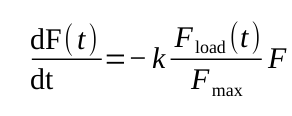
Ma et al. (2009) proposed a model considering the personal fatigability attribute. For a given muscle, the force decline could by described in Eq. (3).
F (t )
Equation reproduced from the original PDF.
Fmax
(3) where F(t) is the remaining maximum muscle strength at time instant t; Fload is the load on the muscle; Fmax is the initial strength of the muscle without fatigue; k is the fatigue rate. This model has been extended to explain group differences among different joints (Ma et al., 2011).
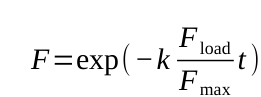
The fatigue model can also describe the muscle fatigue progression under a static sustained submaximal voluntary contraction in an exponential way (see Eq. (4)).
Equation reproduced from the original PDF.
t ) (4) Fmax
Based on the special form of this model (Eq. (4)), subject-specific fatigability was determined by regressing the force decline from a fatiguing operation (Ma et al. 2013). However, the measurement procedure is burdensome due to multiple interruptions for measuring the remaining maximum muscle strength (detailed procedure please refer to Ma et al. (2013), and it could not be easily conducted in field application.
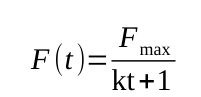
A Simplified Approach and its Preliminary Validation Based on the muscle fatigue model proposed in Ma et al. (2009), one extreme condition could be analyzed under sustained maximum voluntary contraction. Under sustained maximum voluntary contraction, where Fload(t) equals always to F(t), therefore, Eq. (5) can be derived from Eq. (3).
(5)
Equation reproduced from the original PDF.
If the force decline can be measured under sustained maximum voluntary contraction, k could be determined by regressing Eq. (5). In comparison to Eq. (4), this procedure can be conducted without interrupting the fatiguing operation.
A preliminary validation of this approach is conducted by comparing documented fatigue progression under sustained maximum voluntary contraction in the literature. The fatigue data were read from sustained maximum voluntary contraction experiment in Stephens and Taylor (1972). The prediction of MVC decline was calculated with an assumption of k =1 min-1 (Ma et al., 2009; Ma et al., 2011).
Figure 1: comparison between prediction from the simplified fatigue (red dashed line) and experimental data from maximum contraction with normal circulation (modified from Stephens and Taylor, 1972) Comparison between experimental data and prediction from the model is shown in Figure 1. It could be found that the decline of MVC under maximum contraction follows the theoretical prediction with good fitness, and there is no significant difference between predicted force decline and experimental results. Therefore, it is promising to use the simplified approach to determine subject-specific fatigability in a much more efficient way.
Figure available in the original PDF paper.
DISCUSSION
Determination of subject-specific local muscle fatigue is important for industrial application for the purpose of job design and determination of work-rest allowance. Conventional measurements used in the literature are able to reveal the difference in muscle fatigue progression under the same working conditions. However, some external factors may influence the fatigue progression, and the influence from those external factors is not excluded and the results from the literature have a strong task-dependency. Therefore, the nature of individual properties, which may determine the muscle fatigue progression, could not be revealed easily from the conventional measurements.
A theoretical model describing muscle fatigue progression is able to consider underlying basic physiological principles. By regressing an actual muscle fatigue progress, it would be possible to identify some parameters describing subject-specific attributes. In this paper, the new approach is from the simplification of a muscle fatigue model under sustained maximum voluntary contraction, and it provides a possible efficient approach to determine subject-specific fatigue rate. The approach in this paper is only validated by comparing data from the literature, and further experiments are necessary to validate the new approach.In the literature, several models are available describing muscle fatigue progression (Liu et al., 2002; Xia et al., 2008; Ding et al., 2000). Those models, in comparison to the approach mentioned in this paper, include several parameters, which are relatively difficult to identify by measuring only the force decline (e.g., brain effort, muscle activation deactivation drive, etc.).
It should be pointed that central fatigue and peripheral fatigue contribute together to the force decline, and it is possible that individual difference would exist in every step involved in the force contraction, from central neural system to motor unit coordination mechanism. Therefore, it would be promising to determine different subject- specific fatigability along the pathway of force contraction by integrating EMG and EEG or other physiological measurements along with force decline measurement.
CONCLUSIONS
A definition of subject-specific local muscle fatigability is given in this paper, and a novel simplified approach to measure subject-specific fatigability is proposed and preliminarily validated. Further experimental study needs to be conducted to validate the new approach.
ACKNOWLEDGMENTS
This work is supported by the National Natural Science Foundation of China under grant number NSFC 71101079. This project is also supported by Tsinghua University Initiative Scientific Research Program.
REFERENCES
Allen, D. G., Lamb, G. D., & Westerblad, H. (2008). Skeletal muscle fatigue: cellular mechanisms. Physiological reviews, 88(1), 287-332. Avin, K. G., & Frew Law, L. A. (2011). Age-related differences in muscle fatigue vary by contraction type: a meta-
analysis. Physical therapy, 91(8), 1153-1165. Chaffin, D.B., Andersson, G.B.J., & Martin, B.J., 1999. Occupational Biomechanics, 3rd edition. Wiley-Interscience. Clark, B. C., Manini, T. M., Doldo, N. A., & Ploutz-Snyder, L. L. (2003). Gender differences in skeletal muscle fatigability are related to contraction type and EMG spectral compression. Journal of Applied Physiology, 94(6), 2263-2272.
Ding, J., Wexler, A. S., & Binder-Macleod, S. A. (2000). A predictive model of fatigue in human skeletal muscles. Journal of Applied Physiology, 89(4), 1322-1332 El ahrache, K., Imbeau, D., & Farbos, B. (2006). Percentile values for determining maximum endurance times for
static muscular work. International journal of industrial ergonomics, 36(2), 99-108. El ahrache, K. & Imbeau, D. (2009). Comparison of rest allowance models for static muscular work. International Journal of Industrial Ergonomics, 39(1), 73-80. Farina, D., Gazzoni, M., & Merletti, R. (2003). Assessment of low back muscle fatigue by surface EMG signal
analysis: methodological aspects. Journal of Electromyography and Kinesiology, 13(4), 319-332. Frey Law, L. A., & Avin, K. G. (2010). Endurance time is joint-specific: a modelling and meta-analysis investigation. Ergonomics, 53(1), 109-129. Hagberg, M. A. T. S. (1981). Muscular endurance and surface electromyogram in isometric and dynamic
exercise. Journal of Applied Physiology, 51(1), 1-7. Hicks, A. L., Kent-Braun, J., & Ditor, D. S. (2001). Sex differences in human skeletal muscle fatigue. Exercise and sport sciences reviews, 29(3), 109-112. Iridiastadi, H., & Nussbaum, M. A. (2006). Muscle fatigue and endurance during repetitive intermittent static
efforts: development of prediction models. Ergonomics, 49(4), 344-360. Kumar, S. (2001). Theories of musculoskeletal injury causation. Ergonomics, 44(1), 17-47. Liu, J. Z., Brown, R. W., & Yue, G. H. (2002). A dynamical model of muscle activation, fatigue, and recovery. Biophysical journal, 82(5), 2344-2359. Ma, L., Chablat, D., Bennis, F., & Zhang, W. (2009). A new simple dynamic muscle fatigue model and its
validation. International Journal of Industrial Ergonomics, 39(1), 211-220. Ma, L., Chablat, D., Bennis, F., Zhang, W., Hu, B., & Guillaume, F. (2011). A novel approach for determining fatigue resistances of different muscle groups in static cases. International Journal of Industrial Ergonomics, 41(1), 10-18. Ma, L., Zhang, W., Hu, B., Chablat, D., Bennis, F., & Guillaume, F. (2013). Determination of subject-specific
muscle fatigue rates under static fatiguing operations. Ergonomics, 56(12), 1889-1900. Mannion, A. F., Dumas, G. A., Stevenson, J. M., & Cooper, R. G. (1998). The influence of muscle fiber size and type distribution on electromyographic measures of back muscle fatigability. Spine, 23(5), 576-584. Maughan, R. J., Harmon, M., Leiper, J. B., Sale, D., & Delman, A. (1986). Endurance capacity of untrained males
and females in isometric and dynamic muscular contractions. European journal of applied physiology and occupational physiology, 55(4), 395-400. Moritani, T., Nagata, A., & Muro, M. (1981). Electromyographic manifestations of muscular fatigue. Medicine and science in sports and exercise, 14(3), 198-202. Nussbaum, M. A. (2001). Static and dynamic myoelectric measures of shoulder muscle fatigue during intermittent
dynamic exertions of low to moderate intensity. European journal of applied physiology, 85(3-4), 299-309. Nussbaum, M. A. (2009). Effects of age, gender, and task parameters on fatigue development during intermittent isokinetic torso extensions. International Journal of Industrial Ergonomics, 39(1), 185-191. Petrofsky J.S., Glaser, R. M., Phillips, C. A., Lind, A. R., & Williams, C. (1982). Evaluation of the amplitude and
frequency components of the surface EMG as an index of muscle fatigue. Ergonomics, 25(3), 213-223. Rohmert, W. (1973). Problems in determining rest allowances: Part 1: Use of modern methods to evaluate stress and strain in static muscular work. Applied ergonomics, 4(2), 91-95. Shih, Y. C. (2007). Glove and gender effects on muscular fatigue evaluated by endurance and maximal voluntary
contraction measures. Human Factors: The Journal of the Human Factors and Ergonomics Society, 49(1), 110- 119. Stephens, J. A., & Taylor, A. (1972). Fatigue of maintained voluntary muscle contraction in man. The Journal of physiology, 220(1), 1. Van Dieen, J. H., Heijblom, P., & Bunkens, H. (1998). Extrapolation of time series of EMG power spectrum
parameters in isometric endurance tests of trunk extensor muscles. Journal of Electromyography and Kinesiology, 8(1), 35-44. Vøllestad, N. K. (1997). Measurement of human muscle fatigue. Journal of neuroscience methods, 74(2), 219-227. Weir, J. P., McDonough, A. L., & Hill, V. J. (1996). The effects of joint angle on electromyographic indices of fatigue. European journal of applied physiology and occupational physiology, 73(3-4), 387-392. Xia, T., & Frey Law, L. A. (2008). A theoretical approach for modeling peripheral muscle fatigue and
recovery. Journal of biomechanics, 41(14), 3046-3052. Yassierli, Nussbaum, M. A., Iridiastadi, H., & Wojcik, L. A. (2007). The influence of age on isometric endurance and fatigue is muscle dependent: a study of shoulder abduction and torso extension. Ergonomics, 50(1), 26-45. Zhang, Z., Li, K. W., Zhang, W., Ma, L., & Chen, Z. (2012). Muscular fatigue and maximum endurance time
assessment for male and female industrial workers. International Journal of Industrial Ergonomics. doi: 10.1016/j.ergon.2012.08.006
LISTED IN THE AHFE DIGITAL BOOKSTORE CATALOGUE
Explore the complete digital volume
Advances in Physical Ergonomics and Human Factors: Part II
Read this individual research paper free through the original publisher, or explore the full digital proceedings book.
ISBN 978-1-4951-2105-0
Explore this ISBN in the AHFE Bookstore ↗Listed in the July 2026 bookstore catalogue; search by ISBN to confirm current availability · Digital book purchase optional