Saif Al-Qaisia, Fereydoun Aghazadehb, Laura Ikumab (2018). Determination of Forces Required to Open Valves. In: Advances in Physical Ergonomics and Human Factors: Part II. AHFE Open Access, vol. 2. https://doi.org/10.54941/ahfe100061
The objectives of this study are: (1) to determine the effects of handwheel height and angle on valve-operators’ torque production; (2) to recommend maximum acceptable torque (MAT) limits for valve systems that will not exceed operators’ capabilities; and (3) to review and summarize the literature concerning the effects of handwheel height and angle on valve-operators. A total of 60 participants were recruited for this study, including 30 males and 30 females. The handwheel heights included knee, elbow, shoulder, and overhead levels. The handwheel angles included 0o, 45o, and 90o. At each height-angle combination, maximum isometric torque exertions on a handwheel were measured. MAT limits were computed using the 5th percentile torque strength values of the female participants. Depending on the height and angle of the handwheel, the average maximum torque exertions ranged from 51.6 Nm (found at overhead 0o) to 74.9 Nm (found at overhead 45o). The MAT limits ranged between 13.7 Nm and 24.1 Nm, depending on the height and angle of the handwheel. The results of similar studies in the literature and the current research are summarized and compared in one table.
Handwheel-valve operations are common tasks in various industries, including power generation, water supply, petroleum refinement, railway, and chemical and waste industries. The handwheel is used to regulate the flow of material—such as steam, oil, refrigerant, and fly ash—within a valve (Mead, 1986). Handwheels are also used in the railway industry to regulate the movement of rail cars. In a typical plant that generates power or processes materials, there are thousands of handwheels that are either motor operated or manually operated (Wieszczyk et al., 2009). Approximately 50% of the handwheel-valve systems in the field are manually operated (Shih et al., 1997).
In many cases, the torque required to manually turn a handwheel far exceeds operators’ strengths. Parks and Schulze (1998) investigated 336 valves at a petroleum refinery and found that the cracking torque ranged from 100 Nm to 225 Nm. Also, Jackson et al. (1992) measured the cracking torque of 217 valves in a chemical plant and found that 93% of the valves required torques over 400 Nm. On the other hand, the average maximal torque produced by operators was approximately 62 Nm according to Wood et al. (1999/2000) and Schulze et al. (1997), which is far less than 100 Nm, 225 Nm, or 400 Nm.
The disparity between the torque demands in the field and operators’ capabilities poses a great risk of injuries for the operators. Parks and Schulze (1998) conducted data searches on injuries for five downstream facilities of the Phillips Petroleum Company for a 3 year period. Results show that 57% of back injuries and 75% of head, neck, and face injuries were associated with valve operations. Furthermore, valve operations have been described as the most physically demanding task by plant operators (Jackson et al. 1992). Yet, there are no established guidelines with defined torque limits or recommended maximum torques for valve systems.
Another issue in this area of work is that handwheels of various heights and angles can be found in the field. There is no defined or standardized height and angle for handwheels. Handwheels can range anywhere from floor level up to overhead height and even to heights that are unreachable.
Several studies in the literature have investigated the effects of height and angle on operators’ maximum torque exertions, such as Schulze et al. (1997), Wood et al. (1999/2000), Hoff (2000), Attwood et al. (2002), and Wieszczyk et al. (2009); however, the results across these studies are mixed. Some of these studies found the height and angle main effects to be significant, while others did not. For those studies that did detect significant effects, the trends of the maximum torque exertions across the various heights/angles differed between the studies.
Some possible explanations for the mixed results in the literature could be that: not all the studies investigated the same amount of heights; not all the studies investigated the same height levels; heights were evaluated at different angles among the studies; not all angles were considered at every height; and/or the number of participants varied between the studies.
Therefore, the purpose of this research is to conduct a larger more comprehensive study on the effects of handwheel heights and angles on operators’ maximum torque exertions. This research is comprehensive in the sense that more heights and angles are considered with a larger sample of participants, including both males and females. Four handwheel heights and three handwheel angles, as well as their interaction effect, are evaluated. The objectives of this research can be summarized as: (1) to determine the effects of handwheel height and angle on operators’ torque production; (2) to recommend maximum acceptable torque (MAT) limits for valve systems that will not exceed operators’ capabilities; and (3) to review and summarize the literature concerning the effects of handwheel height and angle on valve-operators.
METHODOLOGY
Participants Thirty male and thirty female participants were recruited for this study. Participants were primarily graduate or undergraduate students from the Louisiana State University (LSU) population. The age range was 18 to 37 years for the males and 19 to 36 years for the females. The average age, height, and weight of the male participants were 23.4 years, 177.5cm, and 78.5 kg, respectively. As for the female participants, the average age, height, and weight were 24.2 years, 165.4 cm, and 61.7 kg, respectively.
The Physical Activity Readiness Questionnaire (PAR-Q, British Columbia Ministry of Health) was used to screen participants for cardiac and other health problems, such as dizziness, chest pain, or heart trouble. Prior to the data collection, the experimental procedures and the demands of the testing were explained to the participants and their signatures were obtained on informed consent forms approved by the LSU institutional review board (IRB).
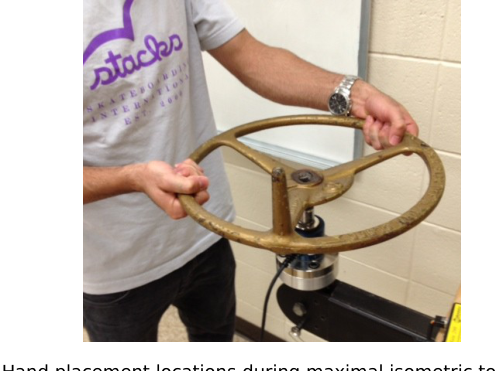
Equipment A 37.4 cm diameter handwheel was used to simulate a handwheel-valve system. The wheel rim is made of metal stock and is rectangular in shape with rounded edges. The height of the rim is 1.65 cm and the width is 2 cm. The handwheel also has a post, which the participants were not allowed to use during the static torque exertions (Figure 1).
Figure 1. Hand placement locations during maximal isometric torque exertions
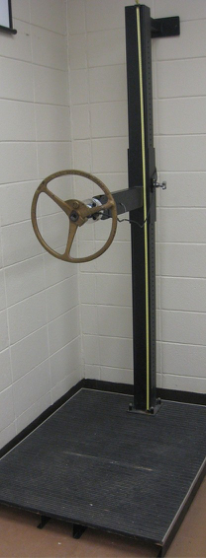
The platform of an isometric strength testing equipment was used to adjust the height and angle of the handwheel (Figure 2). The equipment consists of a horizontal lever arm and a vertical post. The lever arm is assembled on a vertical post, such that it can be moved along the vertical post and clamped at any desired height. The handwheel is attached to the end of the lever arm. The lever arm has 5 holes in a semicircular fashion for adjusting the angle of the handwheel. By placing a pin through one of the holes, the handwheel angle can be fixed. Hence, the orientation of the handwheel can be adjusted to five different planes.
Figure 2. The platform of an isometric strength testing equipment, which allows the adjustment of the handwheel’s height and angle
The handwheel was attached to a Mountz BMX 500F reaction style transducer, which measured the peak isometric torque exertions on the handwheel. It is capable of measuring torques up to 667 Nm. The output of the transducer was displayed on a Mountz Torquemate 2000.
Experimental Task Each participant performed maximum isometric torque exertions on a handwheel at various heights and angles. Participants always ‘opened’ the valve; thus, torque was exerted in a counterclockwise direction. This study defined handwheel height as the distance from the floor to the center of the handwheel. The various heights in this study were set with respect to each participant’s anthropometry as follows:
Overhead height. The height at which the participant had the left upper extremity approximately straight with a shoulder flexion of 135° (Wieszczyk et al., 2009).
Shoulder height. The height at which the handwheel was leveled with the acromion bone.
Elbow height. The height at which the handwheel was leveled with the elbow joint.
Knee height. The height at which the handwheel was leveled with the center of the patella bone. Participants had to squat and bend their trunk forward for this height to where the knees and back were flexed approximately 45o (Wieszczyk et al., 2009).
Within each height, maximal torque exertions were performed at three different angles—0o (horizontally-oriented handwheel), 45o, and 90o (vertically-oriented handwheel). Hence, there were a total of 12 height-angle combinations, and they were randomized to the trials.
Data Collection and Processing Each participant was given an orientation, introducing them to the equipment, data collection procedures, and specifics of the experimental tasks. After the orientation, they were asked to sign the IRB form. Their demographic (age, height, weight, and gender) information was recorded. Then the participants underwent a five-minute warm-up session on a treadmill (Nautilus T914 Commercial Series) at three miles per hour.
Subsequent to the warm-up session, the participants performed maximal isometric torque exertions on a handwheel at four different heights and at three different angles. The participants had to stand with feet firm on the ground at approximately shoulder length apart. They were instructed to grasp the handwheel with the left hand at 135 o from the centerline of the handwheel and the right hand at -45o (or 315o) (Figure 1) (Hoff, 2000). They were told to steadily increase their torque output to their maximum level in 3 to 5 seconds, hold it for 3 seconds, and gradually decrease the force in 3 seconds (Konrad, 2005). At each height and angle, three exertions were performed and the average was recorded. In case of variability greater than 10% between trials, a fourth trial was performed and the average of the closest three values was computed. To avoid muscular fatigue, repetitions were separated by 30 to 60 seconds of rest (Konrad, 2005) and sets were separated by 2 minutes of rest (Caldwell et al., 1974; Sparto et al., 1997; Hummel et al., 2005; Anderson et al., 2008).
Statistical Analysis A four factor split-plot analysis of variance (ANOVA) was used to assess the effects of gender, handwheel height, and handwheel angle on the maximum torque exertions. For all significant effects, post hoc analyses, in the form of Tukey multiple pairwise comparisons (Honestly Significant Difference [HSD]), were performed to determine the source(s) of the significant effect(s). The significance level (α) was set at 5%. Statistical significance was based on calculated p-values.
RESULTS
Maximum Isometric Torque Exertions
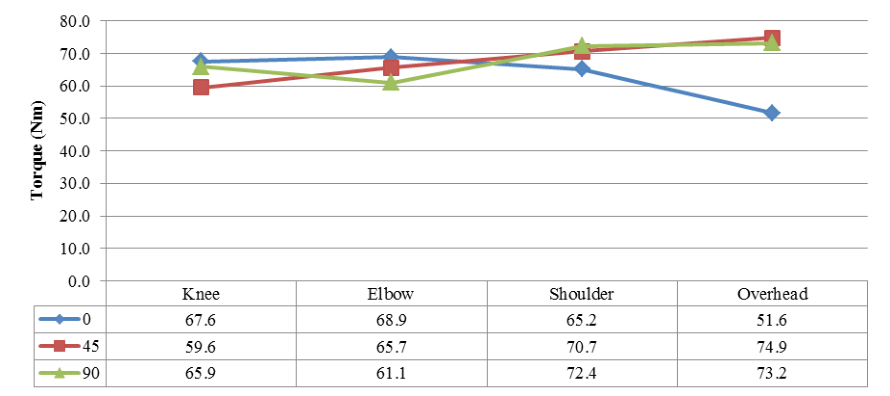
Figure 3 presents a graph of the average maximum isometric torque exertions of the participants at each handwheel height (overhead, shoulder, knee, and elbow) and angle (0o, 45o, and 90o) combination. From the graph, it can be seen that the height associated with the highest torque exertion depends on the angle level being analyzed, and vice
versa. For instance, at 45o, the height level and the maximum torque exertions have a positive relationship, while at 0o, they have an inverse relationship. This finding is supported by the ANOVA test, which found the interaction effect between height and angle to be significant with a p-value less than 0.0001.
Figure 3. The average maximum isometric torque exertions associated with each handwheel height-angle combination
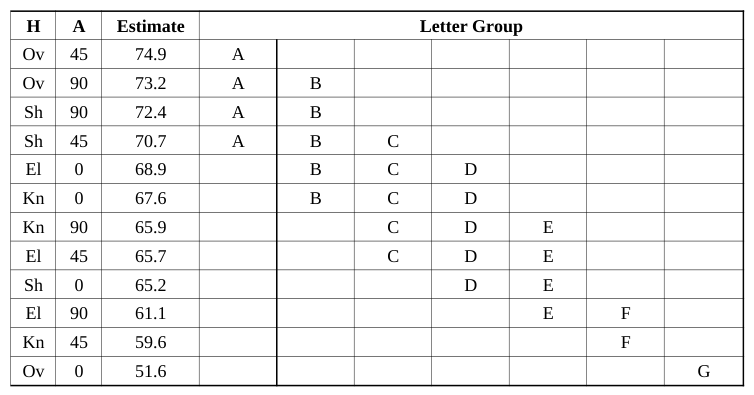
Since the height-angle interaction effect was significant, a Tukey test was performed to determine the sources of the statistical significance in the interaction. Table 1 presents the Tukey results, grouping handwheel height-angle combinations into different letter groups. Handwheel positions in the same letter group indicate that no significant difference exists between them in the average maximum torque exertion; while handwheel positions in different letter groups indicate that a significant difference exists between them in the average maximum torque exertions. The handwheel position associated with the highest maximum torque exertion was at overhead 45o (74.9 Nm). Other height-angle combinations that were not significantly different from overhead 45o were overhead 90o (73.2 Nm), shoulder 90o (72.4 Nm), and shoulder 45o (70.7 Nm), since they all fell in the same letter group A. The lowest maximum torque exertion was found at overhead 0o, which had an average torque of 51.6 Nm. This torque was found to be significantly lower than all the other torques at other handwheel positions.
Table 1. Tukey-Kramer output of the average maximum torque exertions for the interaction effect of handwheel height (H) and angle (A)
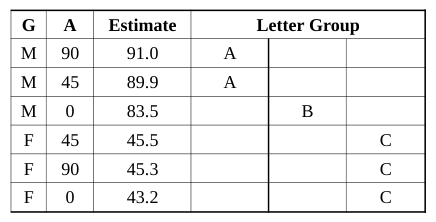
Another interaction effect that yielded a significant p-value was between gender and angle (p = 0.0007). Table 2 presents the Tukey output for this interaction to determine the sources of the statistical significance(s). The male participants exerted significantly higher torques at 90o (91.0 Nm) and 45o (89.9 Nm) oriented handwheels than at 0o (83.5 Nm). The female participants produced approximately equal torques across the different angles with the average torque exertions ranging between 43.2 Nm and 45.5 Nm.
Table 2. Tukey-Kramer output of the average maximum torque exertions for the interaction effect between gender (G) and angle
(A) G A Estimate Letter Group
Regardless of height and angle, the male participants produced significantly higher torque exertions than the female participants (p <0.0001). The average torque exertion for each gender was 88.1 Nm and 44.7 Nm, respectively. The strength capabilities of the males were almost twice that of the females.
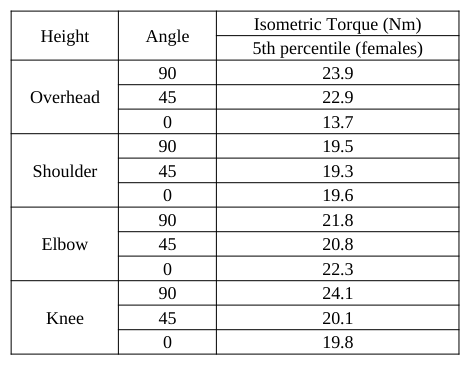
Recommended Maximum Acceptable Torques (MAT) The average torque data collected in this study was used to compute MATs for handwheel-valve systems. First, the 5th percentile torque strength values of the female participants were calculated. Since the interaction effect between handwheel height and angle was significant, calculating one overall torque average to represent all the heights and angles would be misleading. Therefore, the torque percentile values were calculated for each handwheel height and angle combination (Table 3). The 5th percentile values ranged between 13.7 Nm (found at overhead 0o) and 24.1 Nm (found at knee 90o), depending on the height and angle of the handwheel. These percentile values may be thought of as MAT limits for the cracking torque or a single torque exertion on a handwheel. Ultimately, the selection of the appropriate torque limit will depend on the height and angle of the handwheel that is being designed.
Table 3. MAT limits (5th percentile) for different handwheel positions Height Angle Isometric Torque (Nm) 5th percentile (females)
DISCUSSION
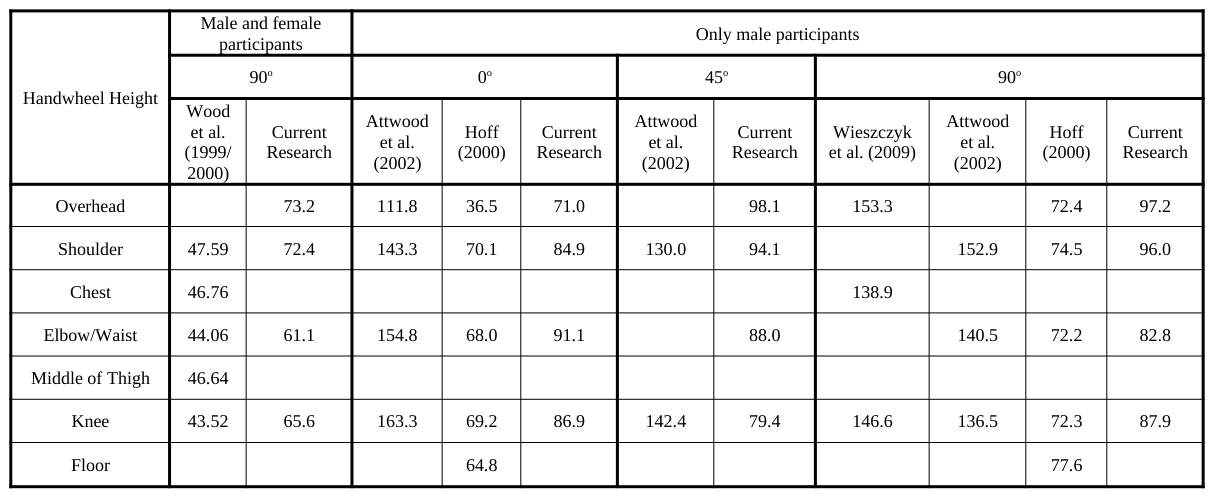
Comparison of Maximum Torque Data in the Current Study and Literature One of the aims of this research was to conduct a comprehensive investigation of the effects of handwheel height and angle on operators’ maximum torque production to address the mixed results in the literature. Wood et al.’s (1999/2000) study is the only research in the literature that investigated both male and female participants’ torque production capabilities on a handwheel-valve, while others recruited only male participants. Therefore, the torque production data in Wood et al.’s (1999/2000) study were compared to the torques produced by the males and females in the current study. Table 4 summarizes the maximum torque measurements from Wood et al.’s (1999/2000) study and the current study for both genders. On the other hand, Hoff (2000), Attwood et al. (2002), and Wieszczyk et al. (2009) used only male participants. Therefore, their torque production data were compared to only the male participants’ data of the current study. Table 4 also summarizes torque production results in these studies and the current study for only male participants.
Height effects at each angle. At 0o in the current study, the average maximum torque produced increased from knee to elbow height, but decreased as the handwheel height was raised further to shoulder and overhead heights. In other words, the average torque peaked at the elbow height handwheel position. On the other hand, Attwood et al.’s (2002) results showed a decline in the average maximum torque as height increased for a 0o handwheel position. In Hoff’s (2000) results, no clear trend was established for the torque production at 0o. The small sample of participants (12 participants) in Hoff’s (2000) research may have hindered the establishment of a trend.
At 45o, the current study found height and the maximum torque to have a positive relationship; as the height level increased, so did the torque production. Attwood et al. (2002) was the only other study that investigated 45o handwheels for isometric torque exertions; however, their investigation was limited to only two height levels, which were knee and shoulder levels. Unlike this study, they found that as the handwheel height increased from knee to shoulder level the torque exertion decreased. A possible explanation as to why the results do not match could be due to different hand placements on the handwheel. The only information regarding hand placement in Attwood et al.’s (2000) research was that operators were required to grasp the handwheel where the wheel and spoke joined. The current research had prevented participants from using the spoke, and asked them to use a hand placement similar to that found in Hoff (2000). A future research may investigate the effects of different hand placements on maximum torque exertions. The findings may explain the differences in the results and will determine the best hand placement for maximal torque production.
At 90o, although no trend can be found (Figure 3), the height at which the maximum torque was produced was almost consistent across studies. In the current research, the highest torque for only males and both genders were found at overhead height (97.2 Nm and 73.2 Nm, respectively) and not far behind was shoulder height (96.0 and 72.4 Nm, respectively). Similarly, in the literature, either shoulder or overhead height was associated with the highest torque. Wood et al. (1999/2000) and Attwood (2002) found that participants were able to exert their highest torques at shoulder level. Overhead height at 90o was not even investigated in either of these studies. Hoff (2000) found floor level to be associated with the highest torque; however, her study was the only research to investigate floor level. Following floor level, shoulder height received the highest average torque. Another study by Wieszczyk (2009) found overhead height associated with the greatest torques. Participants were exerting higher torques at these levels (especially at overhead) possibly from utilizing body weight during torque exertions. After reviewing the literature and the results of the current study, it can be said that, at a 90 o oriented handwheel, overhead level is associated with the highest torques followed by shoulder level.
Angle effects at each height. In the literature, there were only two studies that had investigated the effects of handwheel angle on maximum torque exertions, which were Hoff (2000) and Attwood et al. (2002). At knee height, the current research and Hoff (2000) found 90o to be associated with the highest average torque, while Attwood et al. (2002) found the highest average torque at 0o. At elbow height, the current research and Attwood et al. (2002) found the highest average torque at 0o, while Hoff (2000) found 90o to be associated with the highest average torque. At shoulder height, all the studies, including the current research, found that the 90 o handwheel allowed the highest torque production.
Regarding overhead height, only Hoff (2000) and the current research considered different handwheel angles in their analyses. Hoff (2000) considered only 0o and 90o, while the current research considered both those angles and 45o.
Proceedings of the 5th International Conference on Applied Human Factors and Ergonomics AHFE 2014, Kraków, Poland 19-23 July 2014 Edited by T. Ahram, W. Karwowski and T. Marek
Table 4. A summary of the maximum isometric torque data in the literature and the current research (Nm) Male and female participants Only male participants
https://openaccess.cms-conferences.org/#/publications/book/978-1-4951-2105-0 Physical Ergonomics II (2018)
Proceedings of the 5th International Conference on Applied Human Factors and Ergonomics AHFE 2014, Kraków, Poland 19-23 July 2014 Edited by T. Ahram, W. Karwowski and T. Marek
Both results yielded higher torque exertions at 90o than at 0o. The current research further found that 45o handwheels were associated with even higher torque exertions, but the difference was not detected as statistically significant.
Highest and lowest torques overall. The current research discovered the highest average torque exertion to be at overhead 45o for males alone and both genders (98.1 Nm and 74.9 Nm, respectively). Other handwheel positions that were not statistically different from this value included overhead 90o, shoulder 90o, and shoulder 45o. These handwheel positions allowed greater torque production possibly because participants were able to utilize some of their body weight during the exertions, especially at overhead heights. In general, the lower the work demand is relative to the operator’s maximum strength, the lower is the risk of fatigue or injury. Therefore, a benefit of these handwheel positions is that, at a fixed torque, operators will be working at lower percentages of their maximum capabilities. However, the drawback of these handwheel positions is that they require work at overhead levels, which poses greater risk of shoulder and neck pain (Grieve and Dickerson, 2008; Aghazadeh et al., 2011/2012). A future research may investigate the muscle activities of shoulder, neck, and trunk muscles to explain the loading distribution across different muscles associated with each handwheel position.
Hoff (2000) found the greatest torque exertions at floor 90o (77.6 Nm) – a handwheel position that was not investigated in the current research since it is a rare case in the field. Following floor 90 o, Hoff (2000) found shoulder 90o with the highest torque results (74.5 Nm), which was among the handwheel positions that had the highest average torque in this research. Attwood et al. (2002) found the greatest torque exertions at knee 0o, which does not match the results of this research. The differences could be a result of: the different hand placements used between this research and Attwood et al. (2002); the different populations sampled from (college students vs. process operators); whether participants were allowed to use body weight during overhead exertions or limited only to upper extremity use; or the different handwheel diameters used.
Although overhead 45o allowed high torque productions, overhead 0o was at the other extreme associated with the lowest average maximum torque exertion for males alone and both genders (71.0 Nm and 51.6 Nm, respectively). The average torque at this handwheel position was significantly lower than the torques at the remaining eleven handwheel positions. This finding is supported by the results of Hoff (2000) and Attwood et al. (2002), who also found that overhead 0o associated with the lowest torques. There are two possible explanations for why this handwheel position limits torque production: 1) at this height and angle, participants are in an awkward posture, which reduces force production capability; and 2) unlike when the angle is slanted or vertically-oriented, using a horizontally-oriented handwheel makes it difficult to utilize body weight in the exertions since forces are only exerted in horizontal directions.
Recommended Maximum Acceptable Torque This study computed MATs for handwheel-valve systems using the 5th percentile torque strength values of females. The resulting MATs were quite low, ranging between 13.7 Nm and 24.1 Nm (Table 3). Designing valve systems with such low torque demands may be difficult. However, these torque limits can still be thought of as goals when designing a handwheel-valve system. The torque required to open a valve may be controlled by maintaining the handwheel-valve, keeping it clean, preventing rust, and/or lubricating the handwheel-valve.
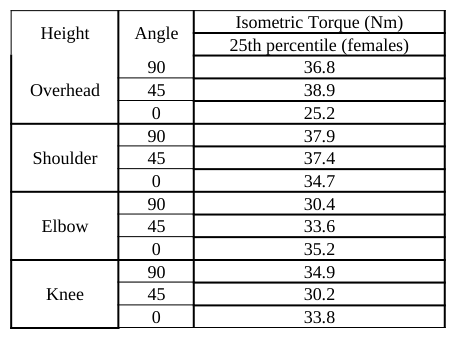
MATs may also be estimated using the 25th percentile strength values of females, instead of using the 5th percentile values. Recommended force limits that accommodate 75% of females (or 25th percentile value), which in turn accommodates most males, have also been acceptable. For example, the committee of experts that developed the revised lifting equation in 1991 selected the psychophysical criterion to ensure that the job demands posed by manual lifting would not exceed the acceptable lifting capacity of about 75% of female operators, which is equivalent to the 25th percentile of females (Waters et al., 1993). This percentile value may not only be more practical in designing handwheel-valve systems but also more fitting because the majority of valve-operators are males. Table 5 presents the 25th percentile torque strength values of the female participants in this study.
The recommended MATs in Tables 3 and 5 are specifically for single torque exertions (cracking torque) on a handwheel. However, if an operator is expected to repetitively turn several handwheels during a day, which is likely the case for a plant operator, then the torque demands should be even less than the acceptable strength for single exertions. To compute a MAT for continuous handwheel actuation, Potvin’s (2012a) equation may be utilized, which uses information on duty cycle (the percentage of time an individual is engaged in effort) to estimate maximum acceptable efforts for repetitive tasks. Potvin’s (2012b) equation demonstrated strong predictive capabilities across 111 combined upper extremity and manual materials handling tasks. By multiplying the 5th or 25th
Proceedings of the 5th International Conference on Applied Human Factors and Ergonomics AHFE 2014, Kraków, Poland 19-23 July 2014 Edited by T. Ahram, W. Karwowski and T. Marek
percentile torque values in this study to the maximum acceptable effort from Potvin’s equation, MATs can be computed for continuous handwheel actuation.
Table 5. MAT limits (25th percentile) for different handwheel positions Height Angle Isometric Torque (Nm) 25th percentile (females)
Limitations Several limitations were recognized during the conduction of this research, including:
Participants were recruited from a student population instead of actual valve-operators. However, the proposed MATs in this study can still be useful as recommended safe limits for novice plant operators.
Participants were sampled only from LSU, which may lead one to think that the results represent only Louisianan valve-operators. However, the majority of the students recruited were either from other states in the U.S. or from different countries. Nevertheless, caution should be used when attempting to generalize the results for other states or countries.
The findings of this study are constrained to handwheels of diameter sizes close to 37.4 cm.
Participants were limited to the hand placement location similar to that in Hoff’s (2000) study. The hand placement location may have an effect on the torque production results.
Future Research The following research are recommended for future work:
Repeat this study, except sampling from a population of experienced valve-operators.
Determine the interaction effects of handwheel height, angle, and diameter on maximum isometric torque exertions.
Investigate the effects of various hand placement locations on a handwheel on isometric torque exertions. The findings may explain the mixed results in the literature and will determine the best hand placement for maximal torque production.
Evaluate different handwheel heights and angles in continuous handwheel actuation.
Use additional measures in evaluating different handwheel heights and angles, such as EMG activity, maximum heart rate, maximum oxygen consumption, Borg-ratings, discomfort ratings, the time to fully open the valve.
Proceedings of the 5th International Conference on Applied Human Factors and Ergonomics AHFE 2014, Kraków, Poland 19-23 July 2014 Edited by T. Ahram, W. Karwowski and T. Marek
CONCLUSIONS
One of the objectives of this research was to determine the handwheel height and angle effects on operators’ torque production. As the handwheel height increased: at 0o, almost a decreasing trend in torque production was found; at 45o, an increasing trend in torque production was found; and at 90o, no trend was established. Therefore, the effect that handwheel height has on torque exertions depends on the handwheel angle.
Overall, the participants produced their greatest torques when the handwheel was set at overhead level with a 45 o angle. The average maximum torque exertion at this handwheel position was 74.9 Nm. Other handwheel positions that were not statistically different from this value included overhead 90o (73.2 Nm), shoulder 90o (72.4 Nm), and shoulder 45o (70.7 Nm). The drawback of these handwheel positions is that they require work at overhead levels, which may pose a risk of developing shoulder and neck musculoskeletal disorders (Grieve and Dickerson, 2008; Aghazadeh et al., 2011/2012). To determine an optimum height and angle for a handwheel, muscle activities of shoulder, neck, and trunk muscles need to also be considered.
Although the highest average torque was found at overhead 45o, overhead 0o was associated with lowest average torque, approximately 51.6 Nm. The average torque at overhead 0o was significantly less than the average torques at the other handwheel heights and angles. This finding indicates that plant operators turning a handwheel at this position will be working at levels closer to their maximum capabilities than at other handwheel positions.
Another objective of this study was to recommend MATs for valve systems that will not exceed operators’ capabilities. To do this, the 5th percentile torque strength values of the female participants were computed at each handwheel height and angle. These values ranged between 13.7 Nm and 24.1 Nm, depending on the height and angle of the handwheel. These torque limits can be thought of as goals when designing handwheel-valve systems to accommodate most of the populations’ strengths.
REFERENCES
Aghazadeh, F., Mokrani, M., Al-Qaisi, S., Ikuma, L., and Hassan, M. (2011/2012). Effect of overhead lifting on neck and shoulder muscle activity and upper extremity joint angles. Occupational Ergonomics, 10(4): 165- 174. Andersen, L.L., Kjaer, M., Andersen, C.H., Hansen, P. B., Zebis, M.K., Hansen, K., & Sjøgaard, G. (2008). Muscle
activation during selected strength exercises in women with chronic neck muscle pain. Journal of the American Physical Therapy Association, 88(6):703-711. Attwood, D.A., Nicolich, M.J., Doney, K.P., Smolar, T.J., & Swensen, E.E. (2002). Valve wheel rim force capabilities of process operators. Journal of Loss Prevention in the Process Industries, 15: 233-239. Caldwell, L.S., Chaffin, D.B., Dukes-Dobos, F.N., Kroemer, K., Laubach, L.L., Snook, S.H., & Wasserman, D.E.
(1974). A proposed standard procedure for static muscle strength testing. American Industrial Hygiene Association Journal, 35(4):201-206. Grieve, J, and Dickerson, C. (2008). Overhead work: identification of evidence-based exposure guidelines.
Occupational Ergonomics, 8(1):53-66. Hoff, E. B. (2000). Ergonomic evaluation of manually operated valves. The Interdepartmental program in Engineering Science, Louisiana State University. Hummel, A., Laubli, T., Pozzo, M., Schenk, P., Spillmann, S., Klipstein, A. (2005). Relationship between perceived
exertion and mean power frequency of the EMG signal from the upper trapezius muscle during isometric shoulder elevation. European Journal of Applied Physiology, 95(4): 321-326. Jackson, A.S., Osburn, H.G., Laughery, K.R., & Vaubel, K.P. (1992). Validity of isometric strength tests for predicting the capacity to crack, open, and close industrial valves. Proceedings of the Human Factors Society 36th Annual Meeting, 688-691. Konrad, P. (2005). The ABC of EMG: A Practical Introduction to Kinesiological Electromyography. USA: Noraxon
Inc. Mead, J.T. (1986). Valve selection and service guide. Troy, MI: Business News. Parks, S.C., & Schulze, L.J.H. (1998). The effects of valve wheel size, operation position and in-line pressures on required torque for gate valves. Process Safety Progress, 17(4): 263-271.
Proceedings of the 5th International Conference on Applied Human Factors and Ergonomics AHFE 2014, Kraków, Poland 19-23 July 2014 Edited by T. Ahram, W. Karwowski and T. Marek
Potvin, J. (2012a). Predicting maximum acceptable efforts for repetitive tasks: an equation based on duty cycle.
Human Factors: The Journal of the Human Factors and Ergonomics Society, 54(2): 175-188. Potvin, J. (2012b). An equation to predict maximum acceptable loads for repetitive tasks based on duty cycle: evaluation with lifting and lowering tasks. Work: A Journal of Prevention, Assessment and Rehabilitation, 41: 397-400. Schulze, L.J.H., Goldstein, D., Patel, A., Stanton, E., & Woods, J. (1997). Torque production using handwheels of
different size during a simulated valve operation task. International Journal of Occupational Safety and Ergonomics, 3(3): 109-118. Shih, Y.C., Wang, M.J.J., & Chang, C.H. (1997). The effect of valve handwheel type, operating plane, and grasping posture on peak torque strength of young men and women. Human Factors, 39(3): 489-496. Sparto, P.J., Parnianpour, M., Marras, W.S., Granata, K.P., Reinsel, T.E., & Simon, S. (1997). Neuromuscular trunk
performance and spinal loading during a fatiguing isometric trunk extension with varying torque requirements. Journal of Spinal Disorders, 10(2):145-156. Waters, T. R., Putz-Anderson, V., Garg, A., & Fine, L. J. (1993). Revised NIOSH equation for the design and evaluation of manual lifting tasks. Ergonomics, 36: 749-776. Wieszczyk, S.M., Marklin, R.W., & Sanchez, H.J. (2009). Height of industrial hand wheel valves affects torque
exertion. Human Factors: The Journal of the Human Factors and Ergonomics Society, 51(4): 487-496. Wood, K.K., Schulze, L.J.H., Chen, J., & Cleveland, T.G. (1999/2000). The effects of handwheel position on torque production capability of operators. Occupational Ergonomics, 2(1): 53-65.
LISTED IN THE AHFE DIGITAL BOOKSTORE CATALOGUE
Explore the complete digital volume
Advances in Physical Ergonomics and Human Factors: Part II
Read this individual research paper free through the original publisher, or explore the full digital proceedings book.
ISBN 978-1-4951-2105-0
Explore this ISBN in the AHFE Bookstore ↗Listed in the July 2026 bookstore catalogue; search by ISBN to confirm current availability · Digital book purchase optional