Semra Serdaroğlu Tigrel, Nigan Bayazıt (2018). Ergonomic Supporting Unit for Invasive Surgery. In: Advances in Physical Ergonomics and Human Factors: Part II. AHFE Open Access, vol. 2. https://doi.org/10.54941/ahfe100049
Maltepe University, Faculty of Architecture and Design, Interior Architecture Marmara Education Village, 34857 Maltepe İstanbul Turkey; ITU Faculty of Architecture, Department of Industrial Design (emeritus) ↗
Background: In health care industry, scientific studies and technological developments are implemented in daily use as soon as possible to save time for the diagnosis and the treatment of the patients. Where as the interest of the caregivers are neglected most of the time.Layout of the operating room and the ergonomic design of the equipment used during surgery should be advance in order to prevent disorders and long-term musculoskeletal illnesses among surgeons. The surgeons’ ‘ease of use’ is ignored most of the time until health problems start to arouse as occupational illness.With the development of technology, endovascular and laparoscopic procedures (minimally invasive surgery) are replacing the conventional open surgeries. Instruments used for laparoscopic surgery are longer in size than the ones used in open surgery. The visual interface is a monitor instead of the site of surgery. Surgeons work in awkward static postures. Lumbar region of the spine of surgeons is affected by the torque, which is caused by the departure angles of the joints of upper extremity especially when the arms are outstretched and unsupported.To evaluate and determine the problems of the working environment in the operation room, a survey is carried out on the basis of ergonomic design. Questionnaires searching for the causing factors of musculoskeletal injuries during operations are made with the surgeons. The surgeon-supporting unit was designed to support upper extremity of the surgeons in a seated position to increase their comfort.Methods: Photographs of the operation team are taken during surgery. Static postures of the surgeons are evaluated with model-based software called PCMAN. Angles of the body parts during procedures are found out and 3D mannequin of a surgeon is formed in solid works. The support is designed around the mannequin. Design vision of the support was to fallow the arm movements of the surgeon while supporting them. Prototype surgeon supporting unit was constructed and tested by ten surgeons. Two of the surgeons tested the supporting unit twice during surgeries.Results: Nine of participating surgeons preferred seated position and seven of them said that using arm support is comfortable. All of the participating surgeons indicated that the horizontal and vertical movements of the support were satisfactory. Eight participants said that vertical stability is satisfactory; four of them said that horizontal stability is satisfactory. Seven participants said that horizontal ease of use is satisfactory.Conclusion: Results of the study indicates that the surgeon should be able to immobilize the supporting unit at a desired horizontal position. Control of the vertical movement was by pedals. Since the surgeons are using other pedaled equipment during surgeries, the vertical movement should be controlled in another way to prevent confusions. Overall evaluation of the study shows that working at a seated position and supporting the arms reduce discomfort of the surgeons.
Ergonomics, as a multi-disciplinary science, investigates and determines the communication and interaction of the working people with their environment; their physical and emotional contact in their working space and evaluates the requirements of worker to be efficient in his work. Surgeons usually work unaware of their uncomfortable postures, and in case they realize; they still try to concentrate on the surgery not to compromise the quality of their work. Working postures of the surgeon are formed by the visual requirements of the process and by the operation of the surgery tools in a limited space. Character of the work (surgery) is not appropriate to relax the muscles by giving short breaks.
When the surgical equipment and operation room planning are poor in case of ergonomic design they may cause disorders and long-term musculoskeletal illnesses among operators (Van Veelen MA, 2003). These illnesses could not be recognized during the first years of the profession, the accumulation occurs over time. By recognizing the Indicators that have been observed previously, the potential risks on the surgeons can be identified and expected drawbacks can be prevented.
The goal of this study is to propose and test an ergonomic supporting unit to increase the comfort of the surgeon during a surgery without blocking the flow of the process.
ERGONOMIC DESIGN International Council of Societies of Industrial Design (ISCID) defines ‘design’ as a creative activity whose aim is to establish the multi-faceted qualities of objects, processes, services and their systems in whole life cycles. Therefore, design is the central factor of innovative humanization of technologies and the curial factor of cultural economic exchange (Bayazıt, 2011). International Ergonomics Association (IEA) has defined ‘ergonomics’ as the scientific discipline concerned with the fundamental understanding of interactions among humans and other elements of a system, and the application of appropriate methods, theory and data to improve human well being and overall system performance (Hendrick, 2000).
Human Factors and Ergonomics Society (HFES) Strategic Planning Steering Committee determined that human factors/ergonomics does, indeed, have a unique technology that have been developed through scientific research over the past 60 years. HFES has labeled that technology as Human-Sytem Interface Technology (HSIT) (Hendrick, 2000). As Hendrick and Kleider stated in 2001, human-system interface technology can be classified into five subparts each with a related design focus, one of them being human-machine interface technology or hardware ergonomics (Karwowski, 2012). This technology takes the form of interface design principles, guidelines, methods and tools to improve the human comfort, and capacity, to protect their health and safety while working.
Anthropometric Data In Design Procedure In a systematic design procedure while using the anthropometric data a particular method is used to determine the percentage of the population to be accommodated (Wickens at al.,2004).
The first approach is design for extremes, physically extreme individuals are considered in the use of anthropometric data. Second approach is design for adjustable range, suggests that designers should design certain dimensions of the equipment or facilities to be adjustable for the individual user. Third approach is the design for the average, used in the design of certain dimensions when it is impractical or not feasible to design for extremes or adjustable range.
In a standard anthropometric data body dimensions are measured separately but there exist combined interactions among the body parts while performing a job. To test the design in case of the requirements of the user, mock-ups or 3D simulators are necessary.
Static Working Posture Workers having musculoskeletal problems because of static postures are due to external forces applied on the body parts. While working human muscle actions may be static or dynamic. In dynamic actions muscles change length and move loads. In static activity muscles remain in the same length to stay stable and prevent movements or support loads (Pheasant, 1991). In static working to balance the outer forces and keep the musculoskeletal system stable, internal forces are exerted by the muscles and ligaments, which are the main cause of musculoskeletal problems. Depending on the duration and repetition of the exertion, musculoskeletal problems increase (Corlet, 2005).
Working postures and external forces are the most important factors determining the shoulder load. When the arm is vertical or supported, ligament force, passive muscle forces and bone contact forces are sufficient to counteract the effect of gravity. When the arm is elevated and unsupported gravity creates a shoulder moment, which must be counteracted by the shoulder muscle. When external forces are applied to the hands by carrying tools or weights load in the shoulder muscles increases (Jensen et al., 2008).
In the case of occupational musculoskeletal injuries the organs or tissues are exposed to prolonged and repetitive mechanical stresses that are considered as risk factors. According to Kumar many studies have reported a strong association between exposure to risk factors and precipitation of injury for neck and shoulder region. These studies are: Fine et al., 1986; Hagberg, 1984., Herberts, et al., 1984; Silverstein, et al., 1986; Westgaard, et al., 1986; (Kumar, 2008).
Working In The Operation Room There are three zones: sterile, non-sterile and circulation in an operation room. The operation table is placed in the middle of the sterile zone. The surgeon, assistant surgeon, scrub-nurse, equipment and instruments of direct contact with the patient are placed in the sterile zone. Non-sterile zone is the place where sterile zone and circulation zone overlap. Surgical performance depends on the optimization of many conditions such as surgeon’s accordance with the technical equipment interface; harmony of the team members; connectivity; tidiness and sterility in the operation room.
Surgeon and team members in the sterile zone can experience problems derived from the general ergonomics of the team and technological configuration. These are postural problems, difficulty with the quality of images, difficulty finding foot-pedals for controlling equipment, movements in front of the monitor displays for guiding surgical action (Healey and Benn, 2008).
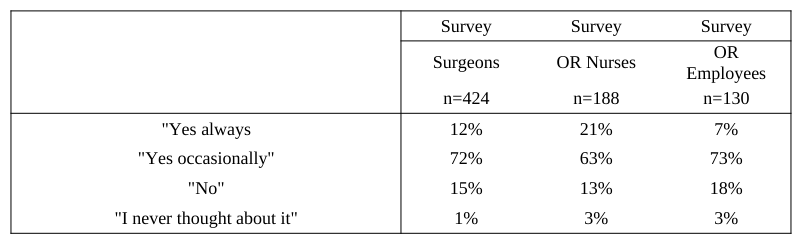
According to their own statements, many of the medical staff members in the OR are forced to work, at least occasionally, in an uncomfortable or painful working posture (see Table 1).
Table 1. Distributions of answers to the question: “In the OR I have to work in an uncomfortable or painful working posture” (Koneczny, 2009).
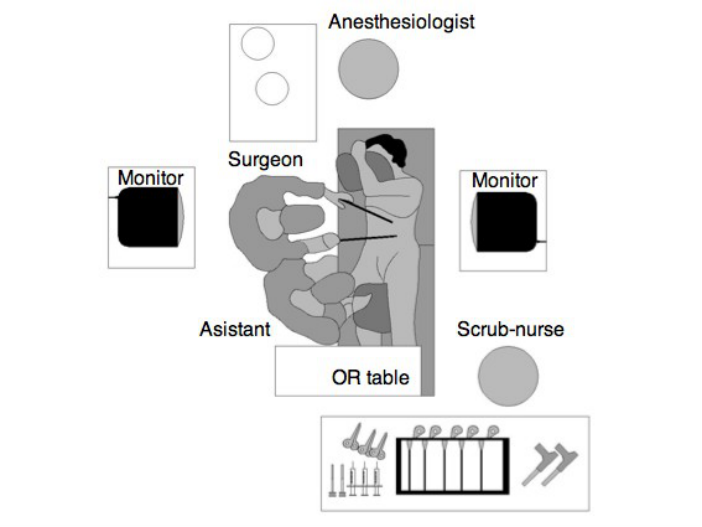
Progress in technology changed most of the equipment used in operations affecting the procedures of surgery. Small robots and equipment that are in use for surgical operations of holding, cutting, removing of organs, which are driven in the patients’ body from small openings with the accompanying camera. This type of surgery is called minimally invasive. As the recovery of the patient is quick and easy, the importance and practice of minimally invasive surgery have increased (see Figure 1.)
Figure 1. OR Plan in Transperitoneal laparoscopic (minimally invasive) Surgery (Gürpınar, 2010).
During minimally invasive surgery the surgeon loose the direct hand and eye contact with the surgical site as he can see the surgery site only by a monitor. Tall surgeons have a horizontal view of the monitor while the shorter ones have to look up to view (Marcos, et al, 2006) (Vereczkei, et al, 2004). The surgeons’ vision is restricted to the point of surgery and his view depends on the angle of the camera. The surgeon does not have the tactile feedback of open surgery due to the length of the shaft of the surgical instruments. Handle designs of the surgical equipment influences the position of hand, axial handles are held within an ulnar wrist deviation causing fatigue, pain and cramps (Grandjean, 1982. in Matern, 2009). Angled ring handles require a radial wrist deviation; rotation of the tip of the instrument requires a large-scale movement of the arm from the shoulder, causing pain and fatigue (Supe, 2010). Besides in laparoscopic (being a minimally invasive surgery) surgeries the freedom of movement of the video camera and the long shafted instruments are limited because they are fixed in the abdominal wall. This forces the surgeon into unnatural and uncomfortable body postures that can affect the outcome of the operation (Matern, 2009).
In laparoscopic surgery use of longer instruments comparing to open surgery, is changing the relation between the height of the surgeon’s hands and desirable height of the operating room table. Industrial ergonomic design recommends a working height about 5 cm below elbow height with an acceptable range of 12.5 cm below to 2.5 cm above elbow height (Konz, 1995. in Berquer, 2002). According to Berquers’ discussion depending on the musculoskeletal discomfort of the surgeons practicing the different heights of OR tables, the performance data demonstrate no significant changes with different table heights (Berquer, 2002). This is not surprising, as human Physical Ergonomics II (2018) performance remains relatively constant, until demands outstrip resources and a rapid decrease in performance occur (Wickens, 1984. in Berquer, 2002). The subjects’ observed postural changes between the different tables were marked (Berquer, 2002).
Tables used for open surgeries is not suitable for laparoscopic surgeries as surgeons perform with arms elevated to shoulders which is fatiguing and can cause long lasting pain or change the angle between the operating tool and forearm which is balanced by excessive bending of the wrist. There is another possibility for surgeon to gain height by standing on a platform which is not a good solution as it makes the room crowded and foot switches may fall down the platform (Matern, 2009). Depending on a questionnaire survey, a bad height of the operating table causes discomfort in the shoulders; a bad monitor height causes discomfort in the neck; foot pedals are hard to control when standing and when they get lost they are hard to find under the table; static posture of the surgeon during minimally invasive surgery causes muscle fatigue (Wauben, et al. 2006).
Surgeons postural problems during surgery in the OR are in the same context as the stress-strain model Workload originating from, task, organization, environment, physical and biomechanical difficulties lead to the same system components.
METHODS
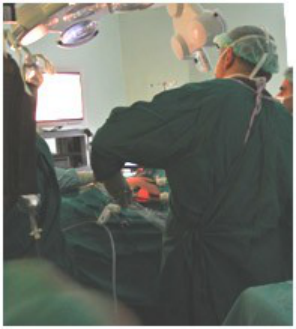
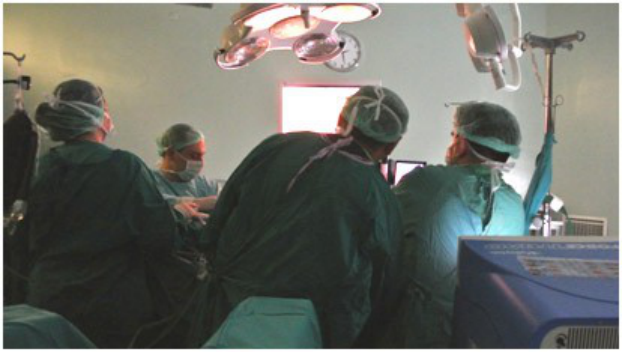
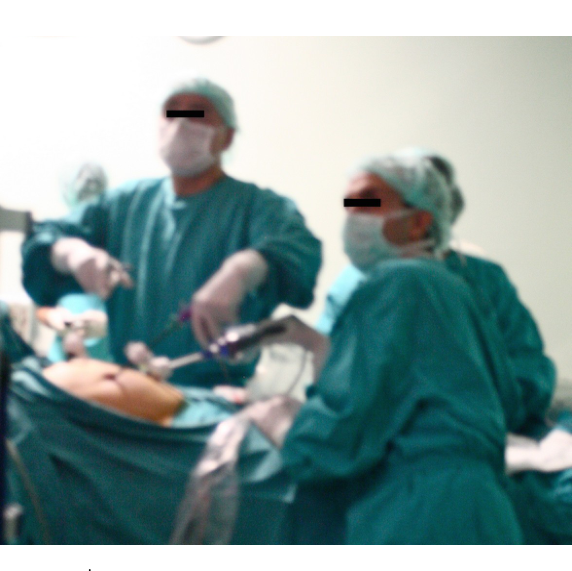
Observation Methods Surveys are done with surgeons searching for the uncomfortable postures during operations and photographs are taken. Elevated arms, awkward body postures and downward or upward bended heads are seen as the main postural problems (see Figure 2.), (see Figure 3.).
Figure 2. Istanbul University-Çapa Medical Faculty Hospital-MIS Surgery.Figure 3. İstanbul University-Çapa Medical Faculty Hospital-MIS Surgery
Static postures of surgeons during surgery are evaluated using photographs (see Figure 4.), angles of body joints diverging from the normal are measured with a model-based software called PCMAN and shown in the graphic (see Table 2.) (Tigrel, 2013).
Figure 4. İstanbul University-Çapa Medical Faculty Hospital-MIS SurgeryTable 2. Angles of body joints diverging from the normal in the surgeons posture of figure 4.
Table available in the original PDF paper.
z x
y z
x z
x y
z x
z x
upper neck right lower arm left upper arm left hand y
0 10 20 30 40 50 60 70
Surgeons’ arms are the most diverging body part from normal and needs supporting. When the surgeons’ arms are elevated, amount of the gravitational force acting is more than in a natural posture because of the moment acting on the arms. Arms are under static stress to balance the gravitational force.
Supporting unit design method and concepts The amount of load, caused by the static posture of the surgeon working in a laparoscopic surgery, can be reduced by supporting the body parts. The surgeons’ working with elevated arms is the focus point of this study. Question is “how a supporting unit can be designed in the context of ergonomics to rest the arms of the surgeon during surgery?” Supporting unit with an armrest, which is moving in accordance with the arm movements. Being a shadow of the moving arm is thought as the ideal design solution (Tigrel, 2013).
Design concepts: -1.Depending on the surgery procedure the unit will be in cooperation with the surgery process; sterile environment; emergency activities and team work.-2.Depending on the operation room environment the unit will be compatible with OR table and surgery equipment.-3.Depending on the surgeon necessities the unit will be adaptable to anthropometric differences; routine of the profession and individual surgeons working practice.
Unit is designed to compromise the positive attributes of both sitting and standing working positions. Sitting working position is preferred because it is more advantageous for the good blood circuit of feet and legs. To keep the reaching capability of the surgeon far and to keep his control on the surrounding high, sitting level is planned as high as possible on a platform, with an adjustable sitting to solve the problems occurring from height differences with the other team members.
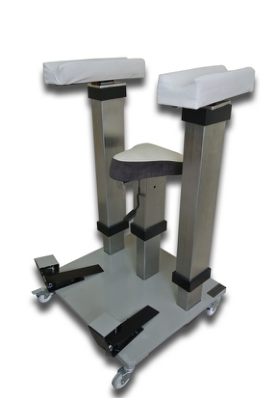
In laparoscopic surgeries, surgeons are working with long equipments; they are keeping their arms elevated, elbows flexed and apart from each other. It is observed that, in order to drive the surgery equipment precisely a unit to rest their arms will be helping. As the surgeon will be holding laparoscopy tools in both hands. The unit’ horizontal movement is designed to be controlled with the easy movements of the lower arms, without having breaks in the smooth movement of the arm rest. Vertical movements of the support are controlled by pedals activating the electric motors inside supporting columns. The seat, the columns with armrests and the pedals are all fixed on to a platform.
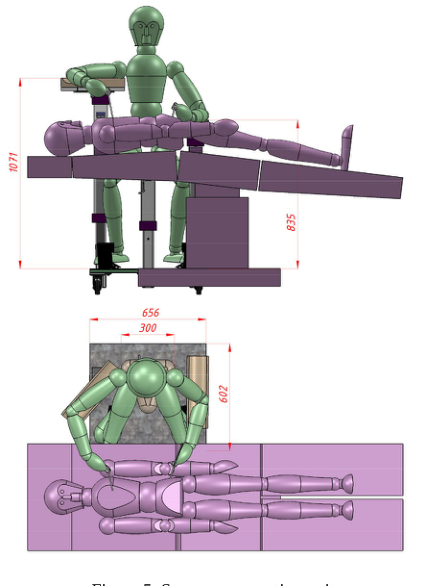
To determine the basic dimensions of the unit, anthropometric dimensions of the 50th European men is used to form a mannequin. Posture of the mannequin is formed depending on surgeons’ posture. Dimensions of the OR table and laparoscopy tools are taken as given standards. Before the design process; the mannequin, OR table and tools are located in the 3D virtual space. Design development is done in the intersection of them (see Figure 5.). A prototype of the unit is constructed (see Figure 6.).
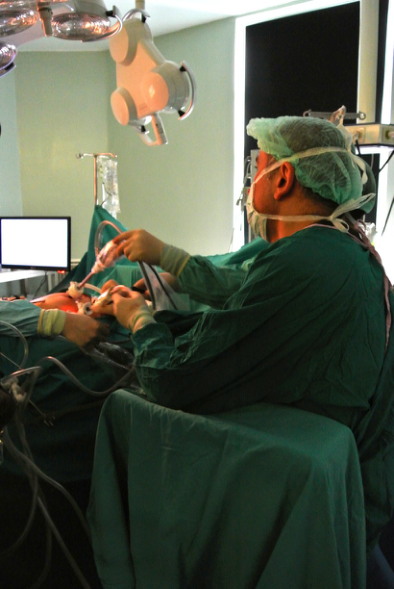
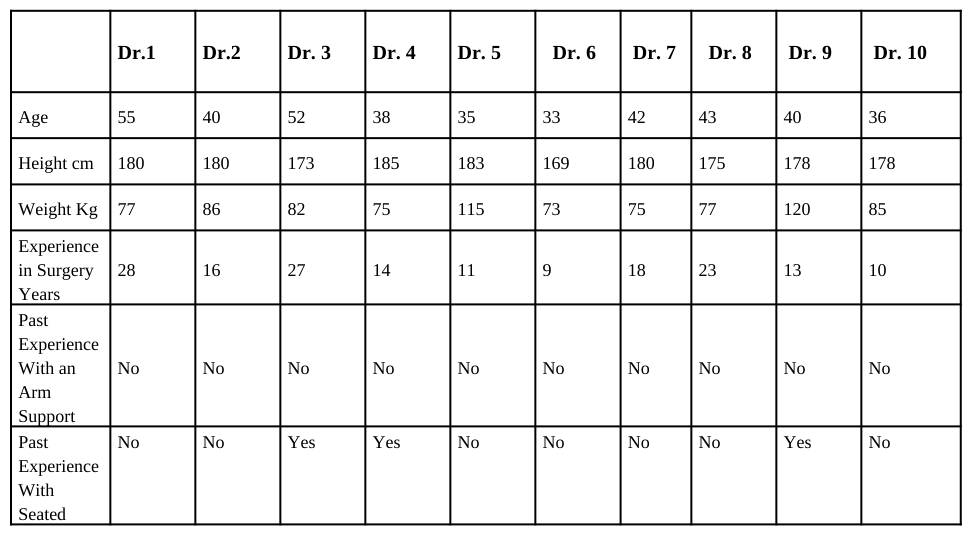
Testing and findings of the prototype-supporting unit Two surgeons tested supporting-unit by twice each of them during surgery, totally four times (see Figure 7., 8.). Eight other surgeons have tested the supporting unit in the operation room with in a laparoscopy surgery scenario. Surgeons tested the supporting unit in case of comfort and easiness. Outcome of the questionnaire is given (see Table 3.).
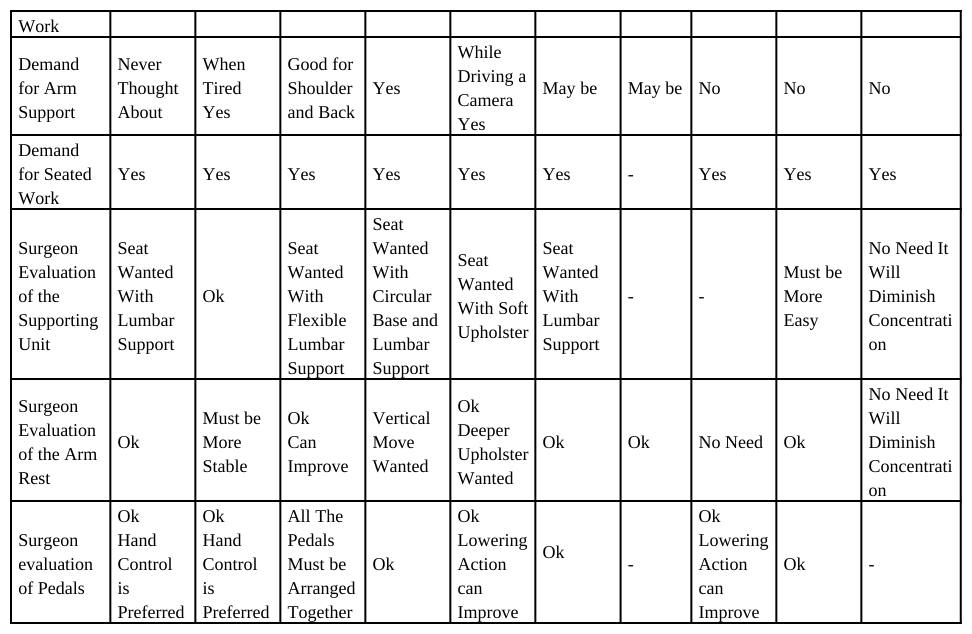
All of the surgeons said that they haven’t used an arm-supporting unit before. They answered the question of “did you wanted to use an arm support?” as “I never thought about it”, ”maybe”, “while holding the camera”, “I would like to use when I am tired”. Two of the surgeons answered as “I would like to use it” and two of them answered as “I would not like to use it”. One of the surgeons said that supporting the arms will reduce the shoulder and back pain. The surgeons who practiced the supporting unit during surgery, wanted the unit to be placed closer to the OR table.
One of the surgeon said that, he is sitting in surgeries that took a long time; one of them said that he is sitting when he is tired; one of them said that he is sitting depending on the position when he is blocking the monitor. One of them said that he is sitting depending on the type of the surgery. One of the surgeons said that he was sitting when he was making surgery outside country. Five others said that they are not sitting while doing a surgery. Nine out of ten surgeons said that they would like to sit while doing a surgery and they wanted a lumbar support for their seat. Two of the surgeons wanted soft upholstery for the seat; one of the surgeons wanted a flexible lumbar support and rotating seat.
Figure 5. Surgeon supporting unitFigure 6. Prototype surgeon supporting unit
Horizontal movements of the arm rests and vertical movements of the columns are found satisfactory. During testing arm rests’ middle and forward positions are preferred. Left and right turning positions of the arm rest are not preferred in the extremes. One surgeon wanted the curvature of upholstery of the arm rest deeper to move it easily. One of the surgeons wanted the arm rest move left and right not by turning but sliding. He also wanted the armrest to tilt up and down in the front and back. Two of the surgeons wanted to control the armrest’s up and down movement by using hands not by pedals. Two of the surgeons said that the pedals may be activated accidentally with the weight of the feet. Test results of the supporting unit are given (see Table 4.).
Figure 7. İstanbul University Cerrahpaşa Medical Faculty Hospital-MIS surgery-testing the supporting unit.
Figure available in the original PDF paper.
Figure 8. İstanbul University Çapa MedicalFaculty Hospital- MIS surgery-testing the supporting unit.Table 3. Outcome of the Questionnaire with the surgeonsTable 4. User (surgeon) evaluation of the prototype-supporting unit
Horizantal control ease sufficient Vertical control ease sufficient
Depending on the evaluation results, control of the vertical movement of the unit is which is done with pedals, found least satisfactory. Horizontal movement stability of the arm rest is found 2nd least satisfactory result. Six out of eight surgeons who wanted seated work, asked for more comfortable upholstery and also for a lumbar support on their own record.
CONCLUSIONS
In this study besides the need for a supporting-unit, the design and construction of the prototype supporting-unit is tested. Surgeons in general prefer seated work and they believe; resting arms will prevent fatigue. They considered the seat primarily in the evaluation of the supporting unit. The prototype-supporting unit was constructed especially for the evaluation of arm support. The seat was not the focus point of the study; it was a secondary element and was not designed as a perfect comfortable seat. When they were asked to try the unit as none of the surgeons experienced before they were uneasy to test the unit. A vertically and horizontally moving arm support needs practice before using. They used to use pedals to activate surgery equipment so it was unusual for them to drive the vertical movement of an arm support with pedals.
Surgeons all said that supporting unit can be preferable in long lasting surgeries on their own record. Desire to use an arm support and to make a surgery in a seated position does not depend on the surgeon’s age, weight and experience, it depends on the type of surgery, duration, equipment used and surgeons practice. The surgeons who practiced the supporting unit during surgery wanted the unit to be placed closer to the OR table, this may indicate that design of a seat and arm support must be more compatible with the OR table. Control of the pedals and the movement of the armrest must be more stable to be reliable; it is observed that surgeons hesitate to use them. They wanted to fix it in a chosen position. It was the first attempt for the surgeons to practice an arm-rest which is moving in accordance with the arm. It is believed that if surgeons practice the supporting unit more they are going to get used to it, and going to evaluate it in a much more positive manner.
REFERENCES
Andersson, G. B. J. (1981). Epidemiologic aspects of low back pain in industry.Spine, 6, 53 Bayazıt, N., (2011). Endüstri Tasarımı Temel Kavramları. İstanbul İdeal KültürYayıncılık. Berquer, R., Smith, W. D., Davis, S. (2002). An ergonomic study of the optimum operating table height for laparoscopic surgery.
Surgical Endoscopy, 16, 416-421 Chaffin, D. B., Andersson, G. B. J., Martin, B. J. (1999). Occupational Biomechanics, New York: John Wiley and Sons. Corlet N. (2005). “Static Muscle Loading And The Evaluation Of Posture”, in: Evaluation of Human Work, Wilson, J. R., Corlet N. (Eds.), New York: Taylor and Francis. Gürpınar, Ö., Haliloğlu, A., H. (2010). “Ürolojik Laparoskopik Cerrahide Kullanılan Ekipmanlar ve Operasyon Odasının
Dizaynı”, Türk Üroloji Seminerleri, 1, 126-133. Healey, A.N., Benn, J. (2009). Teamwork enables remote surgical control and a new model for a surgical system emerges.
Cogition Technology and Work model,11, 255-265. Hendrick, H. W., (2000). The Technology of Ergonomics. Theoretical Issues in Ergonomics Science. Vol.1. No. 1. Hendrick, H. W., Kleiner, B. M., (2001). Macroergonomics: An Introduction to Work System Design. Santa Monica: HFES Publication Jensen, C., Laursen, B., Sjogaard, G. (2008). “Shoulder And Neck”, Biomechanics in Ergonomics, Kumar, S. (Ed.) London:
Taylor and Francis. Karwowsski, W. (2012). “The Discipline Of Human Factors And Ergonomics”, in: Human Factors and Ergonomics. Salvendy, G. (Eds.) Hoboken, NJ: John Wiley and Sons Keyserling, W.M., Chaffin, D.W. (1986). “Occupational Ergonomics – Methods to Evaluate Physical Stress on the Job”, Annual
Review of Public Health, 7, 77–104.
Koneczny, S. (2009). “The operation room: Arckitectural condititions and potential Hazards”, Work, 33, 145-164, IOS press. Koneczny, S. Matern, U. (2004). “Instruments for the evaluation of ergonomics in surgery”, Minimally İnvasive Therapy and Allied Technologies,13,167-177. Kumar, S. (2008). ”Selected Theories of Musculoskeletal Injury Causatıon”, Biomechanics in Ergonomics, Kumar, S. (Ed.).
London: Taylor and Francis. Matern, U. (2009). “Ergonomic Deficiencies In The Operating Room: Examples From Minimally Invasive Surgery”. Work, 33,165-168, IOS Press Pennel, I., Ferrel, C., Coello, Y., Orliaguet, JP. (2002). Sensormotor control in teleoperation: theoretical end ergonomic
considerations. Travail Humain, 65:29-58. Pheasant, S.T. (1991). Ergonomics Work and Health, London : Macmıllan Press. Supe, A.V., Kulkarni, G.V., Supe, P.A. (2010). Ergonomics in laparoscopic surgery. Journal of Minimal Access Surgery, V: 6, 2, 31-36. Tigrel, S. (2013). “Ameliyatlarda Cerrahlar İçin Ergonomik Destek Ünitesi Geliştirilmesi.” Doktora Tezi. İTÜ. Fen Bilimleri
Enstitüsü. İstanbul. Vereczkei, A., Feussner, H., Negele, T., Fritzche, F,. Seitz, T,. Bubb, H.,Horvath, Ö. (2004 ). Ergonomic assesment of the static stress confronted by surgeons during laporoscopic cholecystectomy. Macaristan: Department of Surgery, Faculty of Medicine, Universit of Pécs, Wauben, L.S.L.G., Van Veelen, M.A., Gossot, D., Goossens, R.H.M. (2006). “Application Of Ergonomic Guidelines During
Minimally Invasive Surgery: a questionary survey of 284 surgeons”, Surgical Endoscopy, 20: 1268-1274, Springer. Wickens C., Lee J., Liu, Y., Becker, S. G. (2004). “An introduction to Human Factors Engineering,” New York : Pearson, Prentice Hall
LISTED IN THE AHFE DIGITAL BOOKSTORE CATALOGUE
Explore the complete digital volume
Advances in Physical Ergonomics and Human Factors: Part II
Read this individual research paper free through the original publisher, or explore the full digital proceedings book.
ISBN 978-1-4951-2105-0
Explore this ISBN in the AHFE Bookstore ↗Listed in the July 2026 bookstore catalogue; search by ISBN to confirm current availability · Digital book purchase optional