Atsushi Endo, Chieko Narita, Koji Kuroda, Yuka Takai, Akihiko Goto, Yutaro Shimode, Hiroyuki Hamada (2018). Eye Movement Analysis on Observation Method “Mitate” of Urushi Craftspeople. In: Advances in Physical Ergonomics and Human Factors: Part II. AHFE Open Access, vol. 2. https://doi.org/10.54941/ahfe100050
Urushi crafts is one of the Japanese traditional crafts. If Urushi crafts works are broken, they can be used over and over again by repainting Urushi or sprinkling metallic powders. When they are repaired, their conditions, materials and techniques need to be understood in order to be repaired correctly. Expert Urushi craftspeople can gain an insight into these characteristics by the naked eye, and can repair correctly. In this study, it was aimed to examine the eye movement of the Urushi craftspeople when they looked at the Urushi crafts works. And then eye movements were measured for expert and non-expert Urushi craftspeople and students studying Urushi crafts technique. As the results, it was considered that the expert had more balanced look at each part of the work than the non-expert and students.
Urushi crafts is one of the Japanese traditional crafts. Now it is called “Japanese lacquer” or “Oriental lacquer” in English-speaking countries, but it had been called “japan” in the past. It has a 9000-year-old history in Japan, and a 1200-year-old history in Kyoto. Urushi crafts technique has been succeeded without a break. There are many techniques in Urushi crafts making process. The one of feature of Urushi crafts in Kyoto is “Maki-e”. Maki-e is considered the technique that had developed only in Japan. Maki-e is one of various decoration techniques. Urushi is used to draw picture on the surface of Urushi works in Maki-e technique. And before the Urushi hardens, metal powder like golden powder is used to paint a pattern on Urushi works.
Urushi crafts is representative of Japanese traditional crafts for these reasons. Urushi painting and Maki-e decoration of these Urushi crafts works were removed by usage for many years. Expert Urushi craftspeople have repaired and restored them correctly by gain an insight into their conditions, materials and techniques. They can understand the contained information by watching the works. This observation method is called “Mitate”. Figure 1 showed the image of Mitate. Mitate is performed with the naked eye.
Figure 1. Image of Mitate.
Figure available in the original PDF paper.
Various eye movement analyses were made until today. For example, there was a study on characteristics recognition based on eye movement analysis (e.g. Sugimoto, Takai and Goto, 2013). Eye movement of Japanese traditional crafts was measured on “Kana-ami (Japanese wire net fabrication)” and so on (e.g. GOTO, TAKAI et al, 2012). However, there were hardly any attempts on Urushi crafts. In the previous study, the observation actions in Mitate were divided into 7 actions (e.g. ENDO, NARITA et al, 2013), but eye movement had not been measured until now. This study aimed to analysis the effect to Mitate with different years of experience. Eye movement in Mitate was measured and examined because Mitate is conducted by the naked eye.
MEASUREMENTS Subjects
Table 1 showed the information of subjects. There were 18 subjects in this study. Subject A was expert Maki-e craftspeople. He was 57 years old, and had 39 years of experiences. Subject B and C were non-expert Maki-e craftspeople. Their age was about 30 years old, and their years of experience was about 10 years. Subject D - G were non-expert Maki-e craftspeople. Their age was 20’s and 30’s, and their years of experience was about 5 years. Subject H - R were the student studying Urushi crafts techniques. Their age was 20’s and 10’s, and their years of experience was about 1 - 3 years.
Table 1: Information of subjects.
Table available in the original PDF paper.
Subject A B C D E F G H I Sex Male Female Female Male Female Female Female Female Female Age 57 32 31 34 29 28 23 21 24
Years of Urushi crafts
39 years 12 years and 2 months 9 years and 6 months 6 years and 6 months 5 years and 2 months 4 years and 2 months 4 years and 2 months 3 years and 2 months 3 years and 2 months experience Student studying Student studying Urushi crafts Urushi crafts Job Maki-e craftspeople Maki-e craftspeople
Maki-e craftspeople
Maki-e craftspeople
Maki-e craftspeople
Maki-e craftspeople
Maki-e craftspeople Subject J K L M N O P Q R
Sex Female Female Female Female Female Female Male Female Female Age 21 20 21 23 28 20 20 19 23 Years of Urushi crafts
3 years and 2 months 3 years and 2 months 3 years and 2 months 2 years and 6 months 1 years and 2 months 1 years and 2 months 1 years and 2 months 1 years and 2 months 1 years and 2 months experience Student studying
Student studying Student studying
Student studying Student studying
Student studying Student studying
Student studying
Job Student studying Urushi crafts Urushi crafts
Urushi crafts Urushi crafts
Urushi crafts Urushi crafts
Urushi crafts Urushi crafts
Urushi crafts
Work for This Study
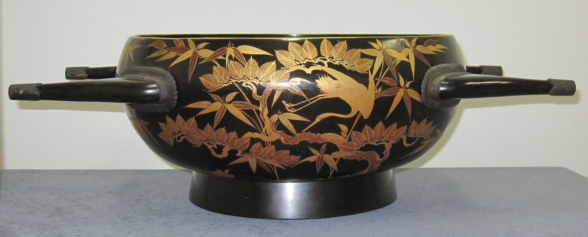
Figure 2 showed a work for this study. Four-handled basin with Maki-e decoration was used in this study. It was made in Edo period (300 - 400 years ago). Urushi was painted in whole area of the work, and its surface was decorated with golden powder by Maki-e technique. The cranes, turtles, pines and bamboos were designed in this work. These were one of the auspicious omens motifs in Japan.
Figure 2. Image of Four-handled basin with Maki-e decoration [Collection of Costume Museum, Kyoto].
Measurement Conditions Mitate was conducted in a fluorescent lighted room. Four-handled basin with Maki-e decoration was placed on a desk. Points of focus were not specified, and order subject to talk about information from the work point by point. Allow subject to hold and move the work in order to conduct Mitate easily. When subject hold or move the work, require wear of glove in order to protect it. Time limit of Mitate was approximately 30 minutes, because its time was adequate to get the information from the work.
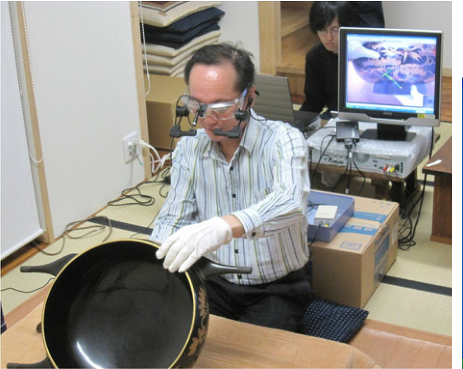
Mitate was recorded by the digital video camera. Time and remark points were analyzed through a movie of Mitate. Eye movement was measured to analyze the checking part of the work when the subjects conducted Mitate. Figure 3 showed an image of eye movement measurement. Measurement device “Talk Eye II” (Takei Scientific Instruments Co.,Ltd.) was used in this study. Sampling rate was 30 Hz. Subject wore dedicated goggles for eye movement measurement. This goggle irradiated eyes with a feeble infrared ray, and measured eye movement by taking a reflected infrared ray. Figure 4 shows the measurement screen on the personal computer. Dots and lines were shown in this screen, it is represented a line of sight.
Figure 3. Image of eye movement measurement. Figure 4. Trajectory image of eye movement.
RESULTS
Total Time and Remark Time of Mitate
Figure 5 showed a total time of Mitate in each subject. Total time of expert (Subject A) was the longest in all subjects. Figure 6 showed the average of the total time in each subject’s group with different years of Urushi crafts experience. It was about 1000 seconds in the case of the expert. It was about 660 seconds in the non-expert with about 10 years of experience (Subject B and C), it was about 590 seconds in the non-expert with about 5 years of experience (Subject D - G), it was about 430 seconds in the student with about 3 years of experience (Subject H - M) and it was about 230 seconds in the student with about 1 year of experience (Subject N - R).
1200
1000
800
600
400
Total time of Mitate (sec)
200
0
A B C D E F G H I J K L M N O P Q R
Subject
Figure 5. Total time of Mitate in each subject.
Figure available in the original PDF paper.
1200
1000
800
600
400
Average of total time (sec)
200
0
Expert Non-expert with Non-expert with
Student with
about 10 years about 5 years
Student with about 3 years about 1 year
experiences experiences
experiences experiences
Figure 6. Average of the total time in each subject’s group with different years of Urushi crafts experience.
Figure available in the original PDF paper.
Figure 7 showed the ratio of remark time to the total time in each subject. The ratio of the expert was the highest in all subjects. Figure 8 showed the average ratio of remark time to the total time in each subject’s group with different years of Urushi crafts experience. Expert (Subject A) spent about 82 % of his total time of Mitate making remarks for the work. Non-experts with about 10 years of experience (Subject B and C) spent about 50 % of their total time, non-expert with about 5 years of experience (Subject D - G) spent about 40 % of their total time, student with about 3 years of experience (Subject H - M) spent about 32 % of their total time, student with about 1 year of experience (Subject N - R) spent about 32 % of their total time.
100
90
80
70
60
50
40
30
Ration of remark time (%)
20
10
0
A B C D E F G H I J K L M N O P Q R
Subject
Figure 7. Ratio of remark time to the total time in each subject.
Figure available in the original PDF paper.
100
90
80
70
60
50
40
30
20
Average ratio of Remark time (%)
10
0
Expert Non-expert with Non-expert with
Student with
about 10 years about 5 years
Student with about 3 years about 1 year
experiences experiences
experiences experiences
Figure 8. Average ratio of remark time to the total time in each subject’s group with different years of Urushi crafts experience.
Figure available in the original PDF paper.
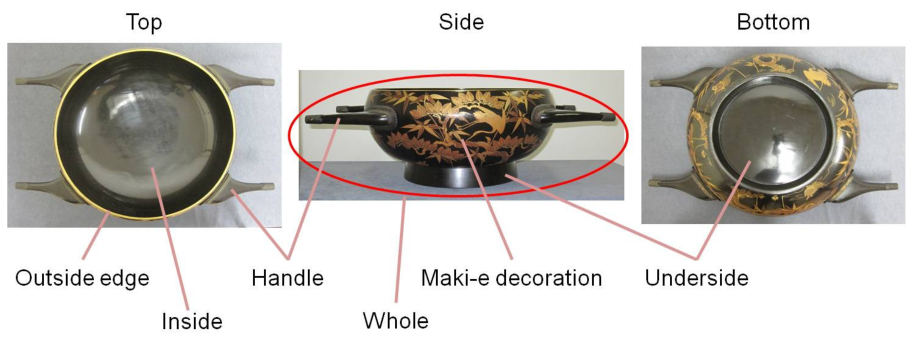
Checking Time of Each Part of the Work Checking parts were divided into following 7 parts of the work. Figure 9 showed the part of the work.
In eye movement measurement, Subject D, K, L and N were excluded from the analysis because their results could not be used for inappropriate setting of eye movement device.
Figure 10 showed the checking time of each part of the work in each subject. Figure 11 showed the ratio of checking time of each part of the work to total time of Mitate in each subject. Checking time of Maki-e decoration was the longest in all subjects, there was a lot of individual variation in the case of each part of the work among all subjects.
Checking time of each part of the work(sec)
1
A B C E F G H I J M O P Q R
Subject
Figure 10. Checking time of each part of the work in each subject.
Figure available in the original PDF paper.
90%
80%
70%
etc.
60%
Maki-e decoration Outside edge
50%
Handle Underside
40%
Inside
Ratio of checking time (%)
Whole
30%
20%
10%
0%
A B C E F G H I J M O P Q R
Subject
Figure 11. Ratio of checking time of each part of the work to total time of Mitate in each subject.
Figure available in the original PDF paper.
Figure 12 showed the ratio of checking time of Maki-e decoration of the work to total time of Mitate in each subject. Figure 13 showed the average ratio of checking time of Maki-e decoration of the work to the total time in each subject’s group with different years of Urushi crafts experience. Non-experts with about 5 years of experience (Subject E - G) spent the highest ratio of their total time of Mitate checking the work. Students with about 1 year of experience (Subject O - R) spent the lowest ratio of their total time. Expert spent lower ratio of his total time than the non-expert.
100
90
80
70
60
50
40
Ratio of checking time (%)
30
20
10
0
A B C E F G H I J M O P Q R
Subject
Figure 12. Ratio of checking time of Maki-e decoration of the work to total time of Mitate in each subject.
Figure available in the original PDF paper.
100
90
80
70
60
50
40
30
Average ratio of checking time (%)
20
10
0
Expert Non-expert with Non-expert with about 10 years about 5 years
Student with about 3 years experiences Student with about
1 year experiences
experiences experiences
Figure 13. Average ratio of checking time of Maki-e decoration of the work to the total time in each subject’s group with different years of Urushi crafts experience.
Figure available in the original PDF paper.
Figure 14 showed the ratio of checking time except Maki-e decoration of the work to total time of Mitate in each subject. Figure 15 showed the average ratio of checking time except Maki-e decoration of the work to the total time in each subject’s group with different years of Urushi crafts experience. Students with about 1 year of experience (Subject O - R) naturally spent the highest ratio of their total time of Mitate checking the work. Non-experts with about 5 years of experience (Subject E - G) spent the lowest ratio of their total time.
100
90
etc. Outside edge Handle Underside Inside Whole
80
70
60
50
40
Ratio of checkingtime (%)
30
20
10
0
A B C E F G H I J M O P Q R
Subject
Figure 14. Ratio of checking time except Maki-e decoration of the work to total time of Mitate in each subject.
Figure available in the original PDF paper.
100
90
80
70
60
50
40
30
Average ratio of checking time (%)
20
10
0
Expert Non-expert with Non-expert with about 10 years about 5 years
Student with about 3 years experiences Student with about
1 year experiences
experiences experiences
Figure 15. Average ratio of checking time except Maki-e decoration of the work to the total time in each subject’s group with different years of Urushi crafts experience.
Figure available in the original PDF paper.
DISCUSSIONS As the year of experience became longer, the time of Mitate became longer. In the same way, as the year of experience became longer, the ratio of remark time to the total time of Mitate became higher. Especially, expert spent about 80 % of his total time of Mitate making remarks about the work. Expert can understand much information from the work by conducting Mitate, and he also can put the characteristics of the work into words.
Checking time of the Maki-e decoration of the work was the longest in each subject. In other words, it seemed that they made the largest remarks in the case of the Maki-e decoration when they conducted Mitate. This was one of the factors that Maki-e decoration stood out against other Urushi crafts techniques, and there was much information in Maki-e decoration. Furthermore subjects of this study specialized in Maki-e decoration technique of Urushi crafts techniques, they drew little attention to Urushi painting, base coat and so on. This was also one of the factors that have the most effect on the longest time of Mitate checking the Maki-e decoration of the work. Despite such a background, the ratio of checking time of Maki-e decoration of the work to the total time of Mitate was about 50 % in the case of the students with about 1 year of experience. And then as the year of experience became longer, the focus on the Maki-e decoration became higher for craftspeople. This is a training period of Maki-e technique for craftspeople with short year of experience. It seems that craftspeople focus on the Maki-e technique because they also intend to make Mitate a better experience of Maki-e technique. On the other hands, the ratio in the non-expert with about 10 years experience was lower than the non-expert with about 5 years of experience, student with about 3 years of experience and student with about 1 year of experience. The ratio in the expert was the lowest in all subjects. Expert has a think about how to make the work, when he conducts Mitate. It seems that the craftspeople need to focus on the other part except Maki-e decoration for getting various information in order to understand the characteristics of the work. Non-experts with about 10 years of experience has adequate techniques, they ought to come to be able to focus on the other part except Maki-e decoration like the expert.
CONCLUSIONS
In this study, how to look at the work was examined when Urushi craftspeople understand the characteristics of the work by measuring the eye movement on Mitate of Urushi craftspeople. Expert observed not only Maki-e decoration but also the other part of the work with balance for understanding various characteristics of the work. In this way, expert can make a same work with original work. After learning the Urushi crafts techniques enough, it seems that non-expert can repair the broken work and restore to original state by appropriately observing the other part of Maki-e decoration and getting to know more about information of the work.
ACKNOWLEDGMENT
Four-handled basin with Maki-e decoration is collection of the Costume Museum in Shimogyo-ku, Kyoto. We express our sincere gratitude to the Costume Museum.
REFERENCES
Takuya Sugimoto, Yuka Takai, Akihiko Goto (2013), “COMPARISON OF POLISHING PROCESS FOR METALLOGRAPHIC PREPARATION BY MEANS OF ANALYSIS OF EYE MOVEMENT”, Proceedings of 13th Japan International SAMPE Symposium and Exhibition (JISSE-13), Paper ID 2415, pp.1-6 Akihiko GOTO, Yuka TAKAI, Tomoko OTA, Hiroyuki HAMADA, Ken-chi TSUJI (2012), “Analysis of operation and eye
movement concerning master of wire net”, Advances in Ergonomics in Manufacturing, CRC Press, pp.205-210 Atsushi ENDO, Chieko NARITA, Riho SUZUKI, Koji KURODA, Yuka TAKAI, Akihiko GOTO, Yutaro SHIMODE (2013), “STUDY ON “MITATE” OF URUSHI CRAFTSPEOPLE WITH DIFFERENT YEARS OF EXPERIENCES”, Proceedings of 13th Japan International SAMPE Symposium and Exhibition (JISSE-13), Paper ID 2416, pp.1-5
LISTED IN THE AHFE DIGITAL BOOKSTORE CATALOGUE
Explore the complete digital volume
Advances in Physical Ergonomics and Human Factors: Part II
Read this individual research paper free through the original publisher, or explore the full digital proceedings book.
ISBN 978-1-4951-2105-0
Explore this ISBN in the AHFE Bookstore ↗Listed in the July 2026 bookstore catalogue; search by ISBN to confirm current availability · Digital book purchase optional