Keisuke Takeuchi, Kimi Ueda, Hirotake Ishii, Hiroshi Shimoda (2025). Modeling cognitive behavior of human errors based on ACT-R: Design of color cued operation switching task. In: Human Error, Reliability, Resilience, and Performance. AHFE Open Access, vol. 173, pp. 27–33. https://doi.org/10.54941/ahfe1006278
Although the mechanization of labor and the automation of work have been advancing in recent years, accidents caused by human error continue to occur. To prevent such accidents, it is essential to identify human errors and understand their underlying mechanisms. One common approach in research is to conduct experiments using cognitive tasks to measure human error and analyze its mechanisms based on the obtained data. However, few studies have attempted to understand the data generation process by simulating the rules governing measurement data using cognitive models. Therefore, this study aims to construct a cognitive model using the ACT-R cognitive architecture and to develop a cognitive task for measuring cognitive behavior and human error. Furthermore, by conducting experiments with the developed cognitive task, we will examine whether it is possible to measure cognitive behavior when human error occurs. Specifically, we designed a cognitive task in which participants perceive two displays, each showing two numbers in a predetermined order, perform arithmetic operations, and input their answers using a keyboard. The task incorporates four colors for the displayed numbers (green, purple, red, and black), with each color corresponding to a different arithmetic operation. To achieve precise measurement, a video camera was placed between the two displays to capture the participants’ faces from the front, enabling accurate eye-gaze tracking. A total of six undergraduate and graduate students aged 18 to 29, all enrolled at Kyoto University, participated in the experiment. The experiment was conducted individually, and each participant completed the cognitive task seven times, including practice trials. By comparing the results with those of previous studies, we confirmed that the error rate was significantly improved.
Although the mechanization of labor and the automation of work have been advancing in recent years, accidents caused by human error remain persistent. One approach to preventing such accidents is to analyze their causes and conduct risk assessments. To achieve this accurately, it is essential to identify human errors and understand their underlying mechanisms in accidents (Noroozi, 2013).
Research in this area has been conducted within the field of cognitive science, which explores the nature of intelligence through the lens of information processing (Fotta, 2005; Lebière, 1994). Specifically, experiments have been designed to measure human error, aiming to identify
and elucidate its mechanisms based on the obtained results (Junghwan, 2016; Jo, 2012). However, few studies have attempted to use cognitive models based on cognitive architecture to simulate the rules governing measurement data generation and to understand the underlying cognitive mechanisms.
Cognitive models, such as those proposed by Robert (2007), can predict human responses, brain activation patterns, and the relationship between cognition and behavior. Leveraging these capabilities, studies have been conducted to investigate the mechanisms of human cognitive state changes by constructing cognitive models using ACT-R based on empirical data (Dianita, 2022; Ueda, 2022). ACT-R (Adaptive Control of Thought-Rational) is a cognitive architecture developed to define fundamental cognitive and perceptual operations, based on the theory that human behavior consists of a sequence of these basic operations. Cognitive architecture serves as a framework for translating cognitive processes into computational models, which can be implemented as executable software on a computer. Much of ACT-R’s theoretical foundation is derived from cognitive psychology experiments, brain imaging studies, and cognitive science principles. ACT-R consists of modules, which function as nearly independent components that replicate various brain functions, and buffers, which represent the state of the brain at a given moment. In ACT-R, human knowledge is categorized into two types: declarative knowledge, which can be explicitly verbalized (e.g., “the sum of one and two is three”), and procedural knowledge, which is about actions such as keyboarding. By utilizing procedural knowledge to replicate cognitive processes, ACT-R enables the simulation of cognitive mechanisms involved in perception, decision-making, and learning.
The purpose of this study is to develop a cognitive task capable of measuring cognitive behavior and human error, serving as a foundation for constructing a cognitive model using ACT-R. Additionally, through experiments with the developed cognitive task, we aim to confirm whether cognitive behavior can be effectively measured during human error occurrences.
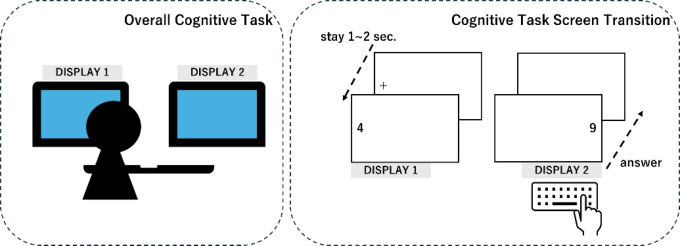
COGNITIVE TASK FOR HUMAN ERROR In a previous study (Takeuchi, 2024), a simple addition task was designed to accurately measure both response time and eye movements. A key feature of this task is the inclusion of eye movement tracking, which enables the generation of response time data corresponding to the detailed solution process. This capability allows ACT-R to replicate the measured response time. However, the cognitive task used in the previous study had a low human error rate, which made it unsuitable for error analysis. Accordingly, this study aims to develop a cognitive task that induces human errors, building upon a task used in prior studies, and to validate its utility through experimental evaluation. Figure 1 provides a schematic diagram of the developed cognitive task. Similar to the previous study, response time and eye movements are measured using two displays and a keyboard. In this task, participants view two single-digit numbers presented on the edges of each display in a predetermined order—from left to right—and input the result of
Modeling Cognitive Behavior of Human Errors Based on ACT-R: Design of Color 29
an arithmetic operation using the keyboard. The left and right numbers are positioned as far apart as possible within the participant’s field of vision to ensure that responses are made solely with eye movements while maintaining a forward-facing posture. The numbers are displayed in four colors: green, purple, red, and black. The arithmetic operations required depend on the color of the numbers:
Green or purple: They should calculate the last digit of the sum of the two numbers and press the corresponding key.
Red or black: They should calculate the difference between the two numbers and press the corresponding key.
The numbers presented are selected based on a probability matrix that determines the digit pairings for each condition. The probability value in each cell determines the likelihood of each digit pair being presented. The digit pair to be displayed is chosen according to the probability values assigned to each cell. After the participant inputs a response, the next question does not immediately appear. Instead, the number on the right disappears, and the screen transitions to a waiting phase displaying a fixation cross at the previous position of the left-side number. This screen remains for a random duration between 1,000 and 2,000 milliseconds before the next question is presented. By instructing participants to focus on the fixation cross, the system prevents them from modifying their solution strategies in the middle of the task. Additionally, the system plays a series of short-duration, high-pitched click sounds while the question is displayed. Furthermore, to introduce time constraints, the system forcibly terminates the problem after a set duration with a buzzer sound, transitioning them to the waiting screen. Based on the previous studies, the time limit for each question was set to 1.25 seconds, as this time pressure is expected to increase the likelihood of human error. A video camera was positioned between the two displays to capture participants’ faces from the front, enabling highly accurate measurement of eye gaze using an image processing method.
Figure 1: Overview of the cognitive tasks developed.
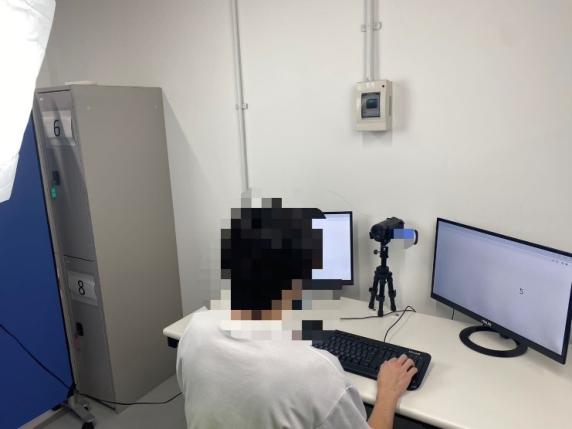
EVALUATION EXPERIMENT To confirm that the developed cognitive task effectively induces human error and allows for the measurement of cognitive behavior when errors occur, an experiment was conducted with six participants, each of whom was joined individually. They were undergraduate and graduate students, consisting of two males and four females, aged 18 to 24 years (M = 21.67, SD = 1.89). Each participant was allocated approximately two hours for the experiment. The experiment consisted of a practice session followed by a measurement session. In the practice session, participants completed one set of 200 questions to familiarize themselves with the task. In the measurement session, they completed six sets of the same cognitive task, each consisting of 200 questions. Each set included 80 questions with numbers displayed in green and purple, requiring addition, and 20 questions with numbers displayed in red and black, requiring subtraction. To ensure consistency in response strategies, participants were instructed to look at the left number first and then shift their gaze to the right number before responding. They were also required to fixate on the leftmost cross until the next question appeared. Additionally, they were instructed to avoid looking at the numeric keypad and maintain a forward-facing posture throughout the task. If the number of incorrect or omitted responses exceeded a predefined threshold, participants were required to restart the set from the beginning. A five-minute break was provided between sets to recover from fatigue.
Figure 2: Scene of the experiment.
RESULTS
To ensure data reliability, the first 10 questions of each set were excluded from the analysis, as participants may not have been fully engaged with the cognitive task during this period. Additionally, since the previous study
Modeling Cognitive Behavior of Human Errors Based on ACT-R: Design of Color 31
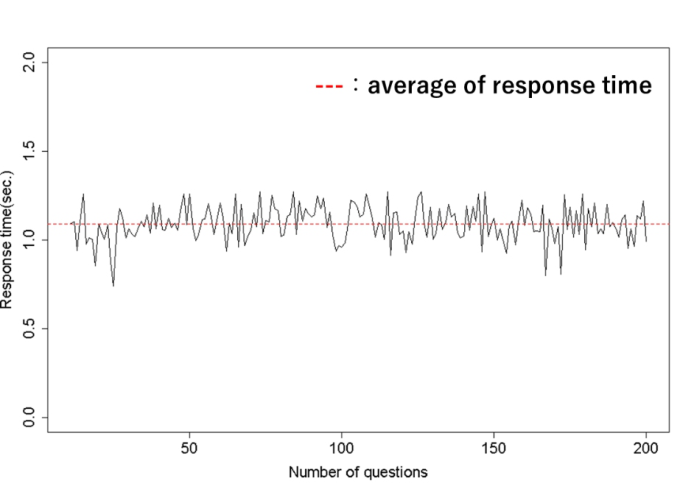
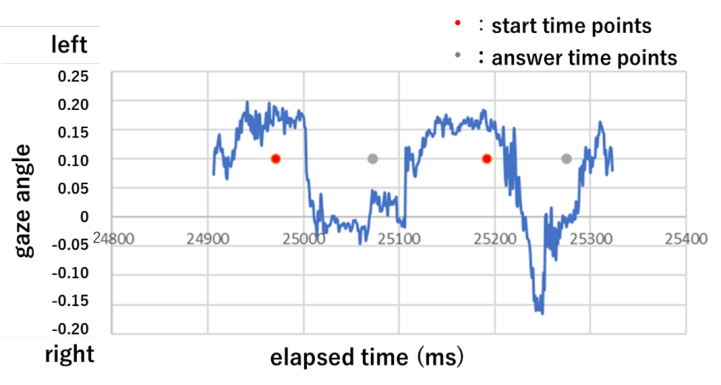
did not include forced termination conditions, we compared the mean correct response rate and mean error rate between the two studies. The previous study reported a significantly higher mean correct response rate of 97.7% (SD = 0.5) and a lower mean error rate of 2.3% (SD = 0.5). In contrast, when using the developed cognitive task, participants exhibited a mean correct response rate of 76.2% (SD = 11.1) and a mean error rate of 16.1% (SD = 11.7). These results indicate that the newly developed cognitive task successfully induced more human errors, making it a suitable tool for analyzing error mechanisms. Furthermore, the task enabled the measurement of response time and eye movements, which are essential for constructing a cognitive model using ACT-R. Table 1 presents the average correct response rate, error rate, and forced termination rate per set for each participant in the experiment with the developed task. Table 2 summarizes the correct and incorrect response rates for each participant in the previous study. Figure 3 shows an example of the time series data of response times measured to evaluate the reproduction accuracy of the cognitive model. In this figure, the vertical axis represents the response time, the horizontal axis represents the trial number, and the red dashed line indicates the average response time.Furthermore, Figure 4 presents a portion of the recorded gaze transitions used to capture detailed response processes. In this figure, the vertical axis shows the horizontal angle of the gaze vector (with upward values indicating leftward gaze and downward values indicating rightward gaze), while the horizontal axis represents the elapsed time in milliseconds. Red dots indicate the onset of each trial, and gray areas indicate the timing of response inputs.
Table 1: Results from experiments using the developed cognitive tasks.
Table available in the original PDF paper.
Participant No.
Average Number of Correct Answers
Average Number of Incorrect Answers
The Average Number of Questions Forcibly Terminated
Figure 3: Time series data of reaction times obtained from experiments using the developed cognitive tasks.Figure 4: Time series data of eye movement obtained from experiments using the developed cognitive tasks.
DISCUSSION
We developed a cognitive task designed to induce human error and measure cognitive behavior essential for constructing a cognitive model using ACT-R. To validate its effectiveness, we experimented with six participants, examining whether the task successfully induced human error and allowed
Modeling Cognitive Behavior of Human Errors Based on ACT-R: Design of Color 33
for the measurement of cognitive behavior during error occurrence. The results showed an average correct response rate of 76.2%, an average error rate of 16.1%, and an average forced termination rate of 7.7%. In contrast, the previous study reported a significantly higher correct response rate of 97.7% and a lower error rate of 2.3%. These findings confirm that the developed cognitive task effectively induces human error. Additionally, the experiment demonstrated that the task enables the measurement of response time and eye movement, consistent with previous studies.
However, the current study is limited by its small sample size of six participants. Moreover, constructing a cognitive model using ACT-R requires a detailed hypothesis regarding the mechanisms underlying human error. Future research will involve expanding the dataset by conducting additional experiments with the developed cognitive task. By analyzing the measurement results, we aim to formulate hypotheses, grounded in cognitive science, regarding the mechanisms responsible for human error. Based on these hypotheses and experimental data, we will develop an ACT-R cognitive model that replicates cognitive behavior during error occurrence. Through model simulations, we seek to identify and elucidate the mechanisms of human error and predict its likelihood, contributing to a deeper understanding of error generation processes.
REFERENCES
Alireza Noroozi, Nima Khakzad, Faisal Khan, Scott MacKinnon, Rouzbeh Abbassi.
(2013): The role of human error in risk analysis: Application to pre- and post- maintenance procedures of process facilities, Reliability Engineering & System Safety, Volume 119. Michael E. Fotta, Michael D. Byrne, Michael S. Luther, Allen Hamilton. (2005): Developing a Human Error Modeling Architecture (HEMA), Human Computer International 2005. Christian Lebière, John R. Anderson, Lynne M. Reder. (1994): Error Modeling in
the ACT-R Production System, Proceedings of the Sixteenth Annual Conference of the Cognitive Science Society. Kim Junghwan, Myung, Rohae. (2016): A Predictive Model of Situation Awareness with ACT-R, Journal of the Ergonomics Society of Korea, Volume 35(4). Seongsik Jo, Rohae Myung, Daesub Yoon. (2012): Quantitative prediction of
mental workload with the ACT-R cognitive architecture, International Journal of Industrial Ergonomics, Volume 42(4). Anderson John Robert. (2007). How Can the Human Mind Occur in the Physical Universe, Oxford University Press, New York. Orchida Dianita, Rieko Yamamoto, Kimi Ueda, Hirotake Ishii, Hiroshi Shimoda,
Fumiaki Obayashi. (2022). ACT-R Intellectual Cognitive Models on Individual’s Different Strategy to Perform a Simple Mathematical Task, AIE, Volume 13. Kimi Ueda, Ryuhei Sakamoto, Hirotake Ishii, Hiroshi Shimoda, Fumiaki Obayashi, Junya Morita. (2022). Examining the Mechanism of Concentration on Intellectual Works by Simulation Using Cognitive Architecture, IHSI, Volume 22. Keisuke Takeuchi, Kimi Ueda, Hirotake Ishii, Hiroshi Shimoda. (2024) A Study on a Model of Cognitive Behavior during Simple Addition Tasks Using Cognitive Architecture, 22nd Triennial Congress of the International Ergonomics Association.
LISTED IN THE AHFE DIGITAL BOOKSTORE CATALOGUE
Explore the complete digital volume
Human Error, Reliability, Resilience, and Performance
Read this individual research paper free through the original publisher, or explore the full digital proceedings book.
ISBN 978-1-964867-49-6
Explore this ISBN in the AHFE Bookstore ↗Listed in the July 2026 bookstore catalogue; search by ISBN to confirm current availability · Digital book purchase optional