Reika Abe, Kimi Ueda, Hirotake Ishii, Hiroshi Shimoda (2025). Design of a programming workshop to update gender bias in engineering among adults. In: Human Interaction and Emerging Technologies (IHIET-AI 2025): Artificial Intelligence and Future Applications. AHFE Open Access, vol. 161, pp. 519–529. https://doi.org/10.54941/ahfe1005944
One of the SDGs where progress has been notably slow in Japan is "Achieving Gender Equality" [1]. In this context, a 2021 survey by OECD [2] pointed out that the percentage of female tertiary entrants into the fields of engineering, manufacturing, and construction in Japan was 16%, the lowest among OECD countries. A survey conducted in Japan also revealed that mechanical engineering and computer science are often perceived as unsuitable occupations for women [3]. One proposed initiative to tackle this issue is encouraging female teenage students to participate in programming workshops. So far, programming materials designed specifically for girls have been proposed [4]. However, in addition to these initiatives, it is also necessary to engage with the older generations, who can significantly impact their career choices. The purpose of this study was to design a new programming workshop attracting female adults who are unfamiliar with programming and to evaluate its effectiveness in reducing the stereotype. The workshop was designed to create sensor-activated message cards that emit music using a programming kit. Women tend not to get interested in science fields due to the difficulty in imagining practical applications [5]. Similarly, there is a possibility that providing a new point of view by connecting programming with subjects that are familiar with daily life, especially for women could be a solution. In this study, message cards, which were often used for presents were focused on. Through this workshop, participants can experience how programming enables them to add new and unique features to ordinary message cards. Additionally, while message cards that play sound when opened have become popular in shops recently, this workshop offers them the experience of creating such innovative items by themselves. In addition to gaining such new knowledge, this workshop includes the process of decorating cards, aiming to enhance the engagement of female adults. Through this workshop, it was hypothesized that participants could feel programming more accessible and achievable for them. As for the preliminary design study, several female adults participated, and their perceptions of programming were evaluated through quantitative surveys and open-ended descriptions. The beginner-friendliness of the workshop design was also asked. This paper reports each of their impressions and suggests approaches to reduce the gender gap. [1] Sachs, J. D., et al. (2024) The SDGs and the UN Summit of the Future. Sustainable Development Report 2024. Dublin: Dublin University Press.[2] Organisation for Economic Co-operation and Development (2021) "Japan", in Education at a Glance 2021: OECD Indicators. OECD Publishing.[3] Ikkatai, Y., et al. (2020) Gender-biased public perception of STEM fields, focusing on the influence of egalitarian attitudes toward gender roles. Journal of Science Communication, 19(1). [4] Basiglio, S., et al. (2024) The Impact of the ‘Coding Girls’ Program on High School Students’ Skills, Awareness and Aspirations. CESifo Economic Studies.[5] Smail, B. (1984). Girl-friendly Science: Avoiding Sex Bias in the Curriculum. Longman.
According to Japan’s 2024 Sustainable Development Report (Sachs et al., 2024), one of the goals where progress has been notably slow in Japan is “Achieving Gender Equality”. A 2021 survey by the Organisation for Economic Co-operation and Development (OECD, 2021) highlighted that the percentage of female tertiary entrants in the fields of engineering, manufacturing, and construction in Japan was 16%, the lowest among OECD countries (OECD average = 26%). This data underscores the need for significant efforts to encourage female participation in these traditionally male-dominated fields.
To increase female participation in these fields, it is crucial to encourage teenage female students to choose career paths in these areas. It is known that their career choices are influenced not only by their personal interests but also by the attitudes of adults around them, such as parents and teachers. In a survey conducted in Japan for 1,086 respondents (aged from 20 to 69) to investigate the public perception of gender roles, mechanical engineering and computer science were often perceived as unsuitable occupations for women (Ikkatai et al., 2020). It has been suggested that changing such negative images, could increase further support for teenage female students choosing engineering fields (Ikkatai et al., 2019). Thus, it is essential to implement
initiatives not only to foster early interest in engineering among female students such as programming workshops targeting them (e.g., Basiglio et al., 2024), but also to improve the attitudes of surrounding adults. Furthermore, since mothers’ opinions are known to have a particularly strong influence on female students’ decisions to pursue science and engineering (Inoue, 2019), targeting female adults could be especially necessary. However, there has been little research on initiatives targeting them.
This study aimed to design a programming workshop for female adults who were unfamiliar with programming, with the goal of improving their negative perceptions of engineering. As the first stage of this study, the images they had regarding programming and the electronic devices operated by it were investigated, and how these images could have changed through women-oriented workshops was examined. This paper reports the outcomes of the impressions held by adult female participants in a women-focused workshop and discusses considerations for designing future workshops.
WORKSHOP DESIGN Overview of the Workshop
The workshop was designed to be approachable and enjoyable for females. It has been said that females tend not to get interested in science fields due to the difficulty in imagining practical applications (Smail, 1984). Therefore, by connecting programming to subjects that are familiar with daily life, it could be possible to provide a new point of view for them.
In this workshop, message cards, which were often used for presents were focused on. The workshop was designed to create sensor-activated message cards that emit music using a programming kit. Through this workshop, participants can experience how programming enables them to add new and unique features to ordinary message cards. Additionally, while message cards that play sound when opened have become popular in shops recently, this workshop offers them the experience of creating such innovative items by themselves by learning several basic programming syntaxes. In addition to gaining such new knowledge, this workshop includes the process of decorating cards, aiming to enhance the engagement of females.
Workshop Contents To make it easier for adults to participate, a short but achievable workshop of about an hour was designed. Its process is shown below.
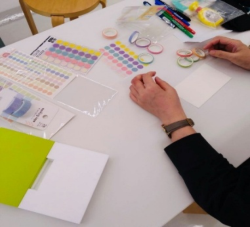
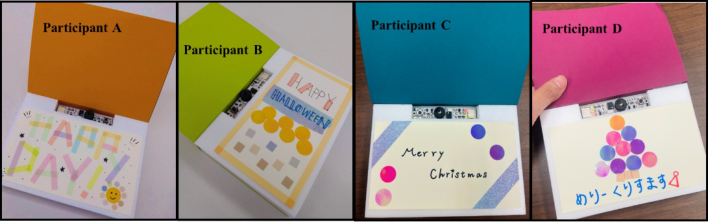
STEP 1: Decoration Initially, participants were instructed to decorate cards freely using prepared stickers and colored pens. The image of the card decoration is shown in Figure 1. A plastic box was provided, and participants decorated the paper to be attached to it. This step encourages participants to personalize their message cards, making them uniquely their own and inducing familiarity.
Design of a Programming Workshop to Update Gender Bias 521
Figure 1: Card decoration.
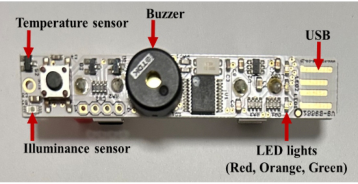
STEP 2: Programming Next, participants programmed the message cards to emit sound and light when opened. Each participant was provided with a computer and a programming tool. The programming tool used was the Measurement Control Programmer (Vstone Co., Ltd., 2020), an electronic device measuring 12 mm (W) × 68 mm (D) as shown in Figure 2. This small circuit board is equipped with input features such as a temperature sensor and an illuminance sensor, as well as output features such as LED lights and a sound buzzer. It was used by inserting it into the groove portion of the message card. Using dedicated software: Beauto Builder P, participants can create programs that utilize the onboard sensors to read environmental data, such as temperature or brightness, and to control the LED lights and sound output. In this workshop, participants programmed the device to detect brightness levels using the illuminance sensor, and upon exceeding a predefined brightness threshold, to emit sound and light.
Figure 2: Device features.
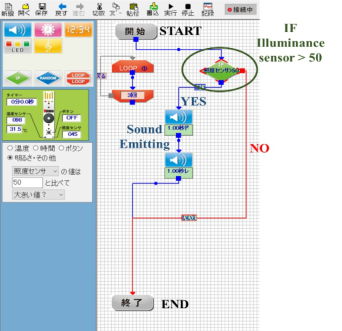
To create sound-emitting message cards, participants followed the programming steps below. First, participants were instructed to arrange icons so that sound was emitted when the illuminance increased, using the “IF”icon as shown in Figure 3. The threshold value in the “IF”icon was set individually by monitoring the illuminance sensor’s real-time readings. Next, participants downloaded the program shown in Figure 3 to the device and tested its functionality. When the start button was pressed, the program played a sound if the environment was bright and remained silent if it was dark. However, this program only executes once when the start button is pressed.
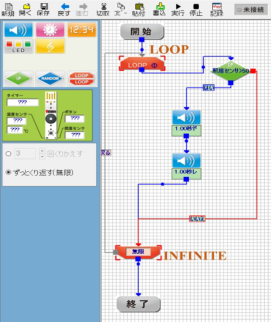
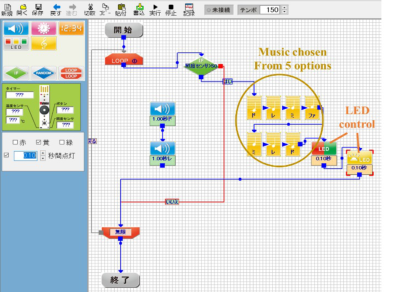
To address this limitation, participants were instructed to use a “LOOP”icon, as shown in Figure 4, so the light sensor continuously reads values while the message card is opened and closed. The program was then downloaded to the device again, and its functionality was re-tested. Through this process, participants were encouraged to learn the functions of the “IF” and “LOOP” icons. Finally, participants selected one melody from five prepared options and arranged the program according to the corresponding pitch pattern. They could also customize the LED icons to the desired places. This process enabled participants to program the message card so that, upon opening, it emitted the selected melody and customized LED lights.
Figure 3: Illuminance detection with IF icon.Figure 4: Repeat with LOOP icon.
STEP 3: Video Recording Each participant recorded a video of their completed project using their smartphones. This activity was intended to enhance participants’ sense of accomplishment by documenting their finished creations.
Design of a Programming Workshop to Update Gender Bias 523
Figure 5: Customize of music and LED lights.
WORKSHOP IMPLEMENTATION Workshops were held twice in November 2024 to evaluate the possibility of its effectiveness. The study design was approved by the Ethics Review Committee of the Graduate School of Energy Science, Kyoto University in advance. Each workshop had 2 participants, making a total of 4 participants. The participants were females aged from 40s to 50s. The schedule of the workshop is shown in Table 1.
Table 1. Workshop schedule.
Table available in the original PDF paper.
Contents Time
15 min
Experimental explanation and informed consent Questionnaire before the workshop
10 min
STEP 1: Card decoration 10 min STEP 2: Programming for illuminance sensor, sound, and LED lights 25 min STEP 3: Video shooting for finished works 5 min Questionnaire after the workshop Honorarium Procedure
EVALUATION Questionnaire Before the Workshop
To investigate participants’ experiences and their pre-existing impressions of programming and electronic circuit boards operated by it, the following 8 items shown in Table 2 were asked before the workshop.
Table 2. Question items before the workshop.
Table available in the original PDF paper.
No. Question Item Answer Format Multiple choice A1 Do you use a computer regularly in your daily life? Choose from “Use it daily”, “Use it several times a week”, or “Hardly use it”.
(Continued)
Table 2. Continued No. Question Item Answer Format
Table available in the original PDF paper.
Multiple choice
A2 Do you have any experience with programming? Choose from “Do it regularly”, Have tried it a few times”, or “Have never tried”.
Open answer
A3 What images do you have about programming? Open answer A4 What images do you have of the electronic circuit boards shown in Figure 2?
Multiple choice
A5 Do you think many female students would be interested in programming to control electronic circuit boards? Choose one on the 7-point scale from 1 (strongly disagree) to 7 (strongly agree).
Multiple choice
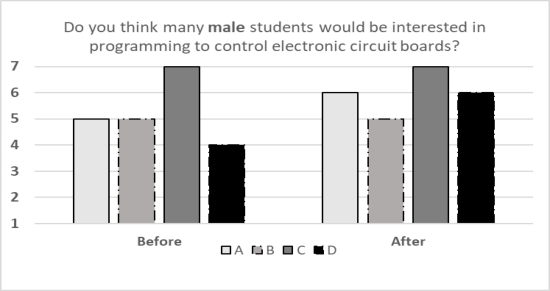
A6 Do you think many male students would be interested in programming to control electronic circuit boards? Choose one on the 7-point scale from 1 (strongly disagree) to 7 (strongly agree).
A7 Have you ever sent a message card? Choose from “Multiple times”, “Once or twice”, or “Never” Multiple choice
Multiple choice A8 Have you ever seen or received a musical message card that plays music when opened? Choose from “Yes” or “No”.
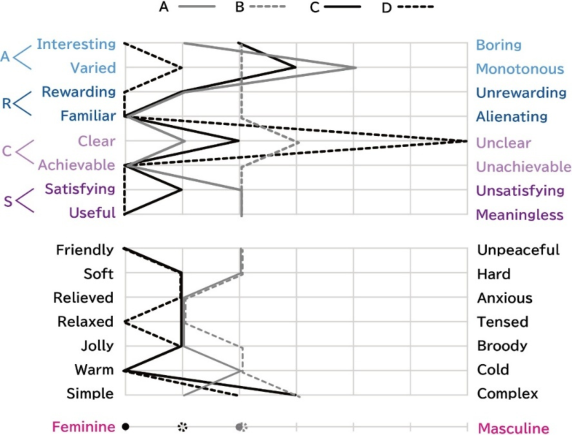
Questionnaire After the Workshop After the workshop, participants’ impressions of the workshop were assessed using the Semantic Differential (SD) method, which measures an individual’s impressions of a subject using pairs of contrasting adjectives. As shown in Figure 7, 16 items were evaluated. 8 adjective pairs related to intrinsic motivation from the ARCS model (Kogo and Suzuki, 2000) were included. The ARCS model is a framework to capture learners’ intrinsic motivation from four aspects: Attention (A), Relevance (R), Confidence (C), and Satisfaction (S), and these were evaluated using two questions for each. Additionally, 7 items related to the perceived friendliness of the robot (Yoshida et al., 2015) and 1 item assessing whether the workshop was perceived as “masculine” or “feminine” were included. These 16 items were presented in a randomized order on the questionnaire.
Furthermore, to investigate changes in participants’ images after the workshop, 5 items with open-answer and multiple-choice questions shown in Table 3, were also asked.
Table 3. Question items after the workshop.
Table available in the original PDF paper.
No. Question Item Answer Format Open answer B1 If there are any aspects of your pre-existing images of programming that have changed, please describe them.
Open answer
B2 If there are any aspects of your pre-existing images of electronic circuit boards that have changed, please describe them.
B3 (Same item with A5) Multiple choice B4 (Same item with A6) Multiple choice B5 If there are any additional comments, please describe them. Open answer
Design of a Programming Workshop to Update Gender Bias 525
RESULTS
Completed Works Participants A and B extended the Card Decoration activity, in Step 2 of Table 1, by 10 minutes. Other activities proceeded as scheduled. The completed works of each participant are shown in Figure 6. They created original designs for the card exteriors and completed their programming works as instructed.
Figure 6: Pictures of completed works.
Participants’ Experience Before the Workshop Question items A1, A2, A7, and A8 were questions about participants experience. For Question A1, Participants A and B answered “Use it daily”, Participant C answered “Use it several times a week”, and Participant D answered “Hardly use it”. For Question A2, all participants answered “Have never tried.” For Question A7, Participant A answered “Once or twice,” and the other participants answered “Multiple times.” For Question A8, all participants answered “Yes.”
Although individual differences in the frequency of computer use were observed, all participants had no prior programming experience and were familiar with message cards.
Perceived Impression of the Workshop With SD Method The result of the perceived impression evaluation using the SD method is shown in Figure 7. Regarding the 8 items related to ARCS, Participant A rated the workshop as relatively Monotonous, and Participant D strongly rated it as Unclear. For these two items, other participants responded on the center or the left side. However, compared to other items, responses in these two items tended to lean relatively more to the right.
For the following 8 items, Participants B and C responded on the center for the Simple-Complex item. For the other items, all participants responded on the left side.
Figure 7: Perceived impression evaluation.
Changes in the Image of Programming and Electronic Circuit Boards The image of programming was asked before the workshop in Question A3, and after the workshop in Question B1. Each participant’s answer is shown below as (A3) →(B1).
Participant A: Difficult, hard to understand, requires specialized knowledge.
→It was easy to understand.
Participant B: Calculations, challenging, something I wish I could do.
→While the image of carefully following detailed instructions hasn’t changed, I realized that the final product requires creativity.
Participant C: Filled with symbols, looks complicated, related to games, popular among today’s elementary school students.
→My previous impression of programming languages was confusing, but this experience made programming approachable and enjoyable.
Participant D: Not something I hear about often, so it seems difficult.
→It was simple, educational, and fun.
Except for Participant B, the participants’ negative impressions, such as difficulty, shifted to positive impressions, such as simplicity and enjoyment. However, Participant B’s negative impressions did not improve significantly. In a post-workshop interview, Participant B explained that while the workshop itself was easy, she was not able to imagine how to program what she wanted to create.
The image of the electronic circuit board operated by programming in the workshop was asked before the workshop in Question A4, and after the workshop in Question B2. Each participant’s answer is shown below as (A4) →(B2).
Design of a Programming Workshop to Update Gender Bias 527
→They are small, but depending on how they’re used, they offer various possibilities.
Participant C: Seems complicated.
→No significant change.
Participant D: A familiar term, but I don’t really understand it.
→When I tried working with them, I found them simpler than I had thought.
Participant B’s impression of scare changed to one of expectation, and Participant D’s impression of uncertainty shifted to simplicity. On the other hand, Participant A mentioned its size and didn’t express significant positive impressions, and Participant C’s impression remained unchanged.
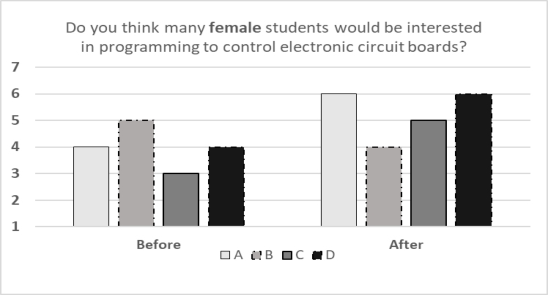
Changes in the Image of Students’ Interest The image of female students’ interest before the workshop was asked in Question A5, and after the workshop in Question B3. Its result is shown in Figure 7. Similarly, the image of male students’ interest was also asked in the following questions, and its result is shown in Figure 8. Overall, before the workshop, the values of female students tended to be lower. After the workshop, participants A and D showed an increase to the same levels of male students, while participant C rated lower than male students. Participant B, rated female students’ interest lower after the workshop compared to before.
Figure 8: The image of female students’ interest.
An Open Answer Question for Any Additional Comments In Question B5, Participants A and C comment that the text on the programming icon is too small to read.
Figure 9: The image of male students’ interest.
DISCUSSION
In this study, a programming workshop was introduced to females with no prior experience by having them create message cards, a product familiar to them. Negative preconceived notions about programming and electronic circuit boards were observed, such as perceptions that they were difficult, intimidating, and that female students were less likely to show interest compared to male students. However, the workshop tended to shift these perceptions in a more positive direction. In the perceived impression evaluation with the SD method, the workshop was recognized for being friendly and feminine, and this might have contributed to a change in the participants’ views.
However, Participant B’s perception of programming remained negative, stating after the workshop that programming seemed even less appealing to female students. According to her post-workshop interview, while she could follow the instructions to complete the programming tasks, she found it difficult to imagine how to program what she wanted to create. In addition, in the perceived impression evaluation with the SD method, the workshop tended to be rated as “monotonous” side. This may suggest the need to include more open-ended content that stimulates creativity. Furthermore, the workshop tended to be rated as “complex” and “unclear”. It might be possible that these impressions could improve by encouraging deeper understanding by steps that allow participants to express their own ideas through programming.
CONCLUSION
This study investigated generational perceptions of programming and electronic circuits and examined how these perceptions could be changed through a workshop. It was indicated that participants tended to have negative impressions before the workshop, highlighting the need to work on improving such perceptions withapproachable workshops. Future research could focus more on what elements should be included to foster positive impressions. Additionally, participants pointed out that the small text size on the programming interface made it difficult to read. Enhancing the
Design of a Programming Workshop to Update Gender Bias 529
workshop to be more user-friendly in such aspects would be essential for its improvement.
ACKNOWLEDGMENT
The authors express their heartfelt gratitude to Murata Manufacturing Co., Ltd., who financially supported this work by joint research funding. The authors would also like to acknowledge Vstone Co., Ltd. for generously providing the programming tools.
REFERENCES
Basiglio, Stefania. Del Boca, Daniela and Pronzato, Chiara. (2024) The Impact of the ‘Coding Girls’ Program on High School Students’ Skills, Awareness and Aspirations, CESifo Economic Studies. Ikkatai, Yuko. Inoue, Atsushi. Kano, Kei. Minamizaki, Azusa. Mckay, Euan and
Yokoyama, M. Hiromi. (2019) Parental egalitarian attitudes towards gender roles affect agreement on girls taking STEM fields at university in Japan, International Journal of Science Education Volume 41 Issue 16 pp. 2254–2270. Ikkatai, Yuko. Minamizaki, Azusa. Kano, Kei. Inoue, Atsushi. Mckay, Euan and Yokoyama, M. Hiromi. (2020) Gender-biased public perception of STEM fields, focusing on the influence of egalitarian attitudes toward gender roles, Journal of Science Communication Volume 19 Issue 1. Inoue, Atushi. (2019) The Association Between Parents’ Math-Gendered Stereotypes
and Daughters’ Major Choices in Natural Science, Proceedings of the 43rd Annual Meeting of the Japanese Society for Science Education, pp. 9–12. Kogo, Chiharu and Suzuki, Katsukaki. (2000). An analysis of the structure of course evaluation items based on ARCS motivation model (2), Proceedings of ICCE/ICCAI 2000, 8th International Conference on Computers in Education/In- ternational Conference on Computer-Assisted Instruction 2000, pp. 1577–1158. Organisation for Economic Co-operation and Development. (2021) “Japan”, in
Education at a Glance 2021: OECD Indicators. OECD Publishing. Sachs, D. Jeffrey. Lafortune, Guillaume and Fuller, Grayson. (2024) Sustainable Development Report 2024. Dublin: Dublin University Press. Smail, Barbara. (1984). Girl-friendly Science: Avoiding Sex Bias in the Curriculum.
Expression for Intimate Communication Corresponding to the Physical Distance and Contact between Human and Robot, EAI Endorsed Transactions on Creative Technologies Volume 3 Issue 7.
LISTED IN THE AHFE DIGITAL BOOKSTORE CATALOGUE
Explore the complete digital volume
Human Interaction and Emerging Technologies (IHIET-AI 2025): Artificial Intelligence and Future Applications
Read this individual research paper free through the original publisher, or explore the full digital proceedings book.
ISBN 978-1-964867-37-3
Explore this ISBN in the AHFE Bookstore ↗Listed in the July 2026 bookstore catalogue; search by ISBN to confirm current availability · Digital book purchase optional