Orchida Dianita, Keisuke Takeuchi, Kimi Ueda, Hirotake Ishii, Hiroshi Shimoda, Fumiaki Obayashi (2023). The Influence of Worker’s Motivation on Intellectual Concentration by ACT-R Cognitive Models. In: Intelligent Human Systems Integration (IHSI 2023): Integrating People and Intelligent Systems. AHFE Open Access, vol. 69, pp. 168–174. https://doi.org/10.54941/ahfe1002834
IntroductionThe purpose of this study is to examine the worker’s motivation effect on intellectual concentration by an experiment and a cognitive process simulation. By utilizing the Adaptive Control of Thought-Rational (ACT-R) concept, it helps to understand the cognitive models of the different motivational condition. ACT-R is one of the prevalent cognitive architectures that mainly differ the cognitive process into production modules and declarative modules.Several studies have been investigating the human cognitive performance in respect of others factors such as working environments. Inspirited by previous studies, this study has explored the human motivational factors that might influence intellectual concentration. Additionally, exploring the differences in workers’ individual problem-solving strategy is one of the alluring factors in this study given the differences in motivational conditions.MethodsFive participants were recruited for the experiment the range of their ages between 18-22 years old as a pilot study. The simple summation mathematical task was given during the experiments and shows two numbers on the left side and right side of the monitor screen. They were asked to answer the problem by pressing the numerical keyboard and the answering time was automatically recorded on the experiment program. The eye gaze movements were recorded and analyzed during the experiments. In this study, the participants performed the task under two different motivational conditions. The first condition was set to create the urge to finish the task immediately which generates high motivation to finish the task as fast as they can. The other condition was set in a neutral condition which the participants could perform at their own pace without a rush. From this experiment, approximately 3000 answering time data and 900.000 frames of the eye gaze movement were gathered and analyzed.ResultsThe different motivational conditions influenced the user’s task performance, showing a statistical difference in the user’s answering time in a high motivational and neutral conditions (p < 0.01). The distribution of the answering time follows the log-normal distribution shapes shown by both conditions.The participants performed different strategies in the cognitive task. Following the ACT-R modules, in general, the identified eye gaze patterns are divided into 2 patterns. The first pattern follows the production rules: (1)find-left-number, (2)attend-left-number, (3)encode-left-number, (4)retrieve-left-number, (5)find-right-number, (6)attend-right-number, (7)encode-right-number, (8)waiting-for-start-back, (9)attend-start-back, summation, and (10)keyboard-click. On the other hand, the second pattern follows the production rules: (1)find-left-number, (2)attend-left-number, (3)encode-left-number, (4)retrieve-left-number, (5)find-right-number, (6)encode-right-number, (7)summation, keyboard-click, (8)waiting-for-start-back, and (9)attend-start-back.In the different motivational conditions, the pattern’s appearance is altered. For participants 1, 3, and 5 the second patterns were dominant during the high motivational condition. Some irregular patterns arouse in the last 5 minutes of the task. This condition might due to the degradation of the user’s cognitive performance when the user feels tired and it might be the time duration that affected their cognitive performance. The results of this study might enlighten future research on cognitive performance by proposing a new method of eye gaze pattern identification on ACT-R cognitive models.
The purpose of this study is to examine the worker’s motivation effect on intellectual concentration by an experiment and a cognitive process simula- tion. By utilizing the adaptive control of thought-rational (ACT-R) concept, it helps to understand the cognitive models of the different motivational con- dition. ACT-R is one of the prevalent cognitive architectures that mainly differ the cognitive process into production modules and declarative modules (Anderson, 1996; Anderson et al., 2004; Ritter et al., 2018).
Motivation constitutes the composed of psychological mechanism perfor- med by individuals or groups to appoint a certain behaviour and endure with it (Mclnerney, 2019). Several theories describe the human’s motivatio- nal concept such as the self-determination theory which distinct the intrinsic and extrinsic motivation (Deci and Ryan, 2000). Some paramount aspects of the human’s motivation could helps describing the various human demeanor, differences on individual characteristics to completing the works, and con- jecture on the variety of the learning process (Lafrenière et al., 2012; Peters et al., 2018; Shahri et al., 2020). Therefore, in the study to investigate the intellectual performance, it is also important to considering the individual’s motivation.
Several studies have been investigating the human cognitive performance in respect of others factors such as working environments (Kitayama et al.,
The Influence of Worker’s Motivation on Intellectual Concentration 169
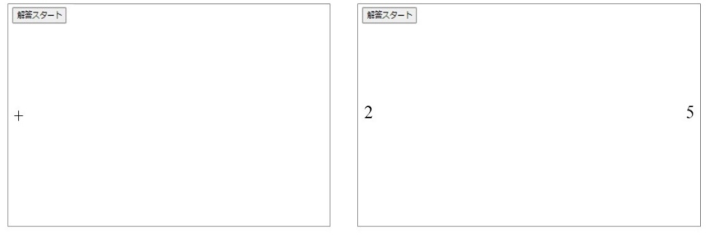
Figure 1: Task screen monitor.
2022; Ueda et al., 2022b, Ishii et al., 2018, Ueda et al., 2017) and utilize the index of concentration ration (Ueda et al., 2022a; Yamamoto et al., 2021). Inspirited by previous studies, this study has explored the human motiva- tional factors that might influence intellectual concentration. Additionally, exploring the differences in workers’ individual problem-solving strategy is one of the alluring factors in this study given the differences in motivational conditions.
METHODS
Five participants were recruited for the experiment in which the range of their ages were between 18–22 years old (mean = 23,2 years old, male = 3) as a pilot study. The simple summation mathematical task was given during the experiments. At first, the plus sign appears on the left side and participants were instructed to look at the sign. Secondly, two digits appear on the left side and right side of the monitor screen. Figure 1 shows the task screen. They were asked to answer the first digit of the summation of the two digits by pressing the numerical keyboard and the answering time was automatically recorded on the experiment program. They were asked to repeat to answer the above summation task.
The cognitive mechanism of the user’s performance is elucidated by the ACT-R concepts which mainly classifies the models into procedural and declarative knowledge (ACT-R Software, 2019). The eye gaze movements were recorded and analyzed during the experiments by utilizing Open- Face software (OpenFace, 2022) and video playback by QuickTime Player program (QuickTime Player, 2016). The eye gaze pattern movement were extracted from the output of OpenFace data which contain the horizon- tal axis eye movement. In the horizontal axis eye movements, the positive numbers indicate the gazing movement to the right side, and vice versa.
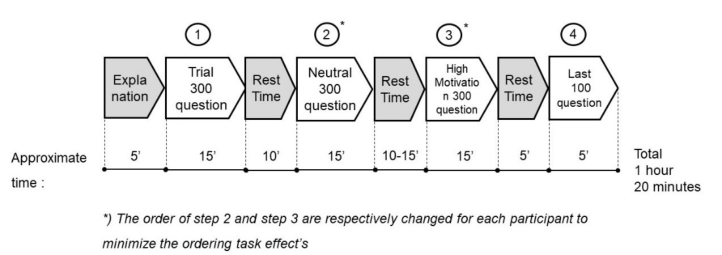
In this study, the participants performed the task under two different moti- vational conditions. The first condition was set to create the urge to finish the task immediately which generates high motivation to finish the task as fast as they could. The other condition was set in a neutral condition which the participants could perform at their own pace without a rush. The design
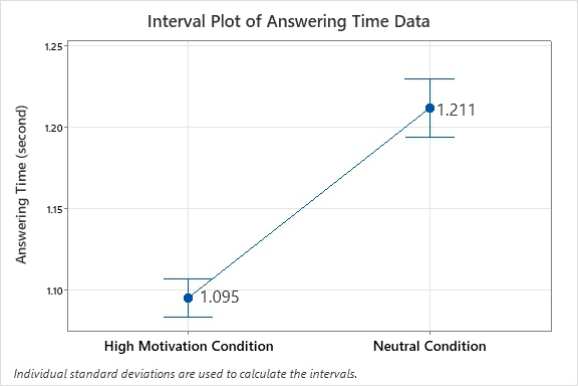
Figure 2: The design of experiment procedures.Figure 3: The interval plot of answering time in a high motivational condition and neutral condition.
of the experiment is shown in Figure 2. From this experiment, approxima- tely 3000 answering time data and 900.000 frames of the eye gaze movement were collected and analyzed.
RESULTS
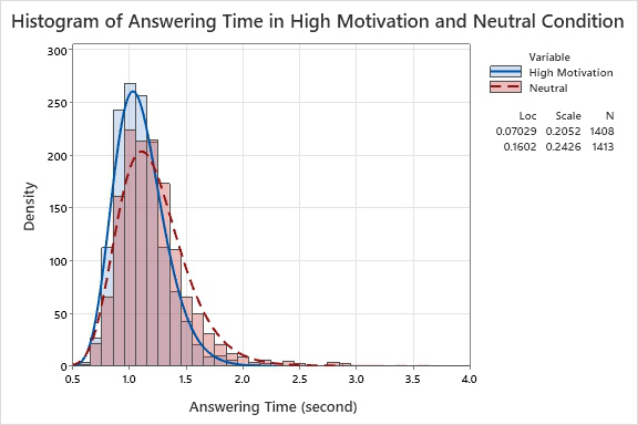
The different motivational conditions influenced the user’s task performance. Paired samples t-test showing a statistical difference in the user’s answering time between high motivational and neutral conditions (p < 0.01). Figure 3 shows the interval plot of answering time data in a high motivation condition and neutral condition. The distribution of the answering time seems to fol- lows the log-normal distribution shapes shown by both conditions as shows in Figure 4.
The participants performed different strategies in the cognitive task. Fol- lowing the ACT-R modules, in general, the identified eye gaze patterns are divided into 2 patterns. Utilizing the eye gaze movement patterns and
The Influence of Worker’s Motivation on Intellectual Concentration 171
Figure 4: The distribution of answering time in a high motivational condition and neutral condition.
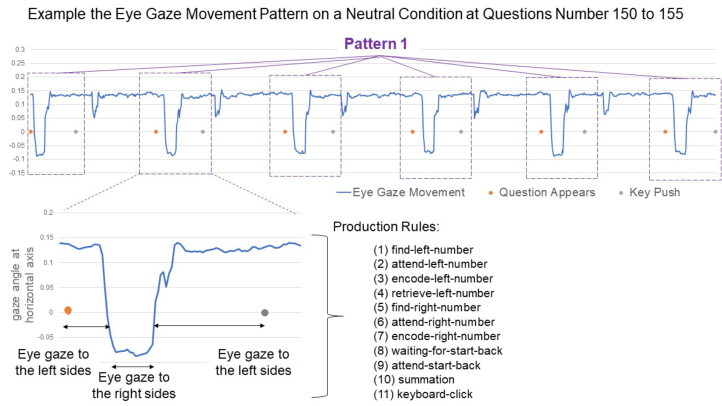
determining the answering time, helps to differentiate the individual’s stra- tegy for gazing the eye moves back to the first place then performed the answering acts or do the answering acts then return the eye gaze to the first place. Each pattern is distinguished based on the production rules formed in the ACT-R programming modules. In the first pattern, the participants’ cognitive process follows the process states starting from (a) finding the number on the left side of the screen and then memorizing the left side number, after that (b) the participants alter the gaze into the right side to find the second number and memorize it, then (c) the eye gaze moved back to the left side again, and finally (d) the participants pressing the numerical answering keyboards. The ACT-R production rules code for the first patterns translated into (1) find-left-number, (2) attend-left-number, (3) encode-left-number, (4) retrieve-left-number, (5) find-right-number, (6) attend-right-number, (7) encode-right-number, (8) waiting-for-start-back, (9) attend-start-back, (10) summation, and (11) keyboard-click. Figure 5 shows the first pattern examples.
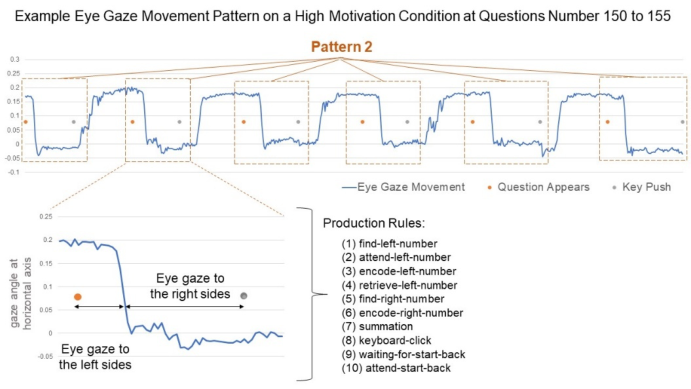
On the other hand, the second eye gaze patterns follow the stages start from (a) finding the number on the left side and then memorize the num- ber, next (b) shift the gaze to the right side to find the second number and memorize it, subsequently (d) the participants push the answer’s key- board, and then (c) the participants look back on the left side again. The second pattern written in code of the production rules such as: (1) find- left-number, (2) attend-left-number, (3) encode-left-number, (4) retrieve-left- number, (5) find-right-number, (6) encode-right-number, (7) summation, (8) keyboard-click, (9) waiting-for-start-back, and (10) attend-start-back. The eye gaze pattern shows in Figure 6.
Figure 5: Pattern 1 of the eye gaze movement.Figure 6: Pattern 2 of the eye gaze movement.
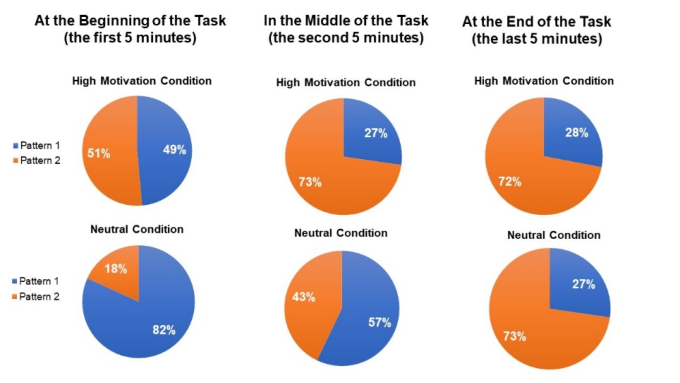
In the different motivational conditions, the pattern’s appearance is alte- red. For participants 1, 3, and 5 the second patterns were dominant during the high motivational condition. Some irregular patterns aroused in the last 5 minutes of the task. In the limited amount of time starting from the appea- rance of the digits to the keyboard push, the eye gaze movements were going back and forth from left to right which produced the irregular patterns. This condition might due to the degradation of the user’s cognitive performance when the participants felt tired and it might be the time duration that affected their cognitive performance. The percentages of the eye gaze patterns in the beginning, middle, and at the end of the task are shown in Figure 7.
The Influence of Worker’s Motivation on Intellectual Concentration 173
Figure 7: Percentage of the eye gaze patterns appearance during the experiments.
CONCLUSION
In this study, the worker’s motivation shows an impact on intellectual concen- tration. However, further investigation might be needed to explore the significant implication of a greater number of participants recruited.
Subsequently, the individual’s different strategy is also an interesting topic to investigate. As resulted in this study that the participants show different strategies under different motivational conditions. Additionally, the duration time of the task might also influence the user to utilize different strategies and the effect of fatigue might influence the result in a long duration of the task.
For future work, creating the ACT-R model and parameters value based on the results of the eye gaze movement analysis might be taken into considera- tion. Furthermore, developing the advanced ACT-R model has the potential benefit in the development of a robust model for general purposes of cognitive performances.
The results of this study might enlighten future research on cognitive per- formance by proposing a new method of eye gaze pattern identification on ACT-R cognitive models. It is highly recommended to explore different cognitive tasks and individual’s different conditions which might increase the repertoire of knowledge in the field of cognitive science.
REFERENCES
ACT-R Software. (2019). Lisp ACT-R Tutorial [software]. Carnegie Mellon University. http://act-r.psy.cmu.edu/software/ Anderson, J. R. (1996). ACT: A Simple Theory of Complex Cognition. American
Psychologist, 51(4), 355–365. Anderson, J. R., Bothell, D., Byrne, M. D., Douglass, S., Lebiere, C., and Qin, Y. (2004). An Integrated Theory of the Mind. Psychological Review, 111, 1036–1060.
Apple QuickTime Player. (2016). QuickTime [application program]. Retrieved from https://support.apple.com/downloads/quicktime (accessed on June 21, 2022) Bothell, D. (2021). ACT-R 7.26+ Reference Manual. Retrieved from Carnegie Mel-
lon University: http://act-r.psy.cmu.edu/actr7.x/reference-manual.pdf (accessed on June 21, 2022). Deci, E. L. and Ryan, R. M. (2000). The “what” and “why” of goal pursuits: human needs and the self-determination of behaviour. Psychological Inquiry, 11:4, 227–268. Ishii, H. Kanagawa, H., Uchiyama, Y., Miyagi, K., Obayashi, F., and Shimoda, H.
(2018). Intellectual Productivity Under Task Ambient Lighting. Lighting Research and Technology, 50, 237–252. Kitayama, K., Dianita, O., Ueda, K., Ishii, H., Shimoda, H., Obayashi, F. (2022).
Micro-Refresh to Restore Intellectual Concentration Decline During Office Work: An Attempt at Quantitative Effect Evaluation. Human Factors, Business Mana- gement and Society, 56, 191–195. Lafrenière, M-A, K., Verner-Filion, J., and Vallerand, R. J. (2012). Development and validation of the gaming motivation scale (gams). Personality and Individual Differences, 53, 827–831. Mclnerney, D. M. (2019). Motivation. Educational Psychology, 39:4, 427–429. MultiComp Lab OpenFace. (2018). OpenFace [application program]. Retrie-
ved from http://multicomp.cs.cmu.edu/resources/openface/ (accessed on June 21, 2022). Peters, D., Calvo, R. A., and Ryan, R. M. (2018). Designing for motivation, engagement and wellbeing in digital experience. Frontiers in Psychology, 9, 797. Ritter, F. E., Tehranchi, F., and Oury, J. D. (2018). ACT-R: A Cognitive Architecture
for Modeling Cognition. WIREs Cognitive Science, 1-19. Shahri, A., Hosseini, M., Taylor, J., Stefanidis, A., Phalp, K., and Ali, R. (2020).
Engineering digital motivation in business: a modelling and analysis framework. Requirements Engineering, 25, 153–184. Ueda K., Sakamoto, R., Ishii, H., Shimoda, H., Obayashi, F., and Morita, J. (2022).
Examining the Mechanism of Concentration on Intellectual Works by Simu- lation Using Cognitive Architecture. Applied Human Factors and Ergonomics International. Ueda K., Shimonaka, S., Shimamura, Y., Furuta, M., Miyagi, K., Shimoda, H., Ishii, H., Obayashi, F., and Taniguchi, K. (2017). Objective and Quantitative Evaluation of Intellectual Productivity under Control of Room Airflow. The 6th Annual International Conference on Cognitive and Behavioral Psychology, 128–135. Singapore. Ueda, K., Yumura, K., Ishii, H., Shimoda, H., Obayashi, F. (2022). An Analysis of
the Effect of Integrated Thermal Control on Cognitive Task Performance Using Time-Series Changes in Intellectual Concentration. Human Factors, Business Management and Society, 56, 205–210. Yamamoto, R., Sakamoto, R., Ueda, K., Ishii, H., Shimoda, H., Obayashi, F., and Morita, J. (2021). A Study on Simulation of Intellectual Concentration Based on Cognitive Architecture. International Symposium on Socially and Technically Symbiotic Systems.
LISTED IN THE AHFE DIGITAL BOOKSTORE CATALOGUE
Explore the complete digital volume
Intelligent Human Systems Integration (IHSI 2023): Integrating People and Intelligent Systems
Read this individual research paper free through the original publisher, or explore the full digital proceedings book.
ISBN 978-1-958651-45-2
Explore this ISBN in the AHFE Bookstore ↗Listed in the July 2026 bookstore catalogue; search by ISBN to confirm current availability · Digital book purchase optional