Kimi Ueda, Kohei Yumura, Hirotake Ishii, Hiroshi Shimoda, Fumiaki Obayashi (2023). Effect of the intermittent aroma stimuli on work performance: analysis using the drop point of time-series intellectual concentration. In: Intelligent Human Systems Integration (IHSI 2023): Integrating People and Intelligent Systems. AHFE Open Access, vol. 69, pp. 677–682. https://doi.org/10.54941/ahfe1002890
With the rapid development of information society, the importance of knowledge work is increasing. Such knowledge work performance has been evaluated in various ways. The authors have developed and used CTR (Concentration Time Ratio), which is a performance evaluation index based on the ratio of time spent concentrating on a cognitive task for a total task conducted time. Although work concentration changes from moment to moment due to fatigue accumulation, distraction, and other factors, CTR ignored the time-series changes in performance while conducting the task.In this study, a new analysis method was applied to evaluate the effect of intermittent aroma stimuli on work performance, which was evaluated previously by CTR [1]. Totally 88 answering time data of the comparison task [2] that 22 participants performed 2 sets each in 2 conditions, with-aroma and without-aroma were included. Comparison task is a cognitive task developed to evaluate the workers’ intellectual concentration during conducting the task, which requires numerical and language processing, comparison and judgement [2]. Time series data of concentration were generated using the method used in our previous study [3]. In the with-aroma condition, aroma stimuli were presented for 10 seconds every 5 minutes. Therefore, the time window was decided to be relatively shorter to capture short-term temporal variation in concentration on task. We focused on the drop points of concentration. The drop points represent the timing at which the participants restarted concentrating and solving the cognitive task after slowing down due to fatigue accumulation or other factors while conducting the task. In other words, it is expected that there are more drop points when they were unable to maintain their concentration during the task time.When comparing sets conducted at the same time in two aroma conditions, in the group in which the average concentration value improved in the with-aroma condition (n=26), the average number of drop points was higher in the without-aroma condition. On the other hand, in the group in which the average concentration value decreased in the with-aroma condition (n=18), the average number of drop points was higher in with-aroma condition. It was suggested that for the participants whose concentration were improved by the intermittent aroma-stimuli, the occurrence of drop points was suppressed in with-aroma condition.[1] Kimi Ueda, et al.: An Objective and Quantitative Evaluation of Intermittent Aroma Stimuli on Intellectual Concentration. AHFE 2020 International Conference, pp.245-251, 2020.[2] Kimi Ueda, et al.: Development of a new cognitive task to measure intellectual concentration affected by room environment, ICHES2016 Nagoya, 2016.[3] Kimi Ueda, et al.: An Analysis of the Effect of Integrated Thermal Control on Cognitive Task Performance Using Time-Series Changes in Intellectual Concentration. AHFE 2022 International Conference. vol 56. pp. 205–210.
With the rapid development of information society, the importance of kno- wledge work is increasing. Various methods have been applied to discuss workers’ performance and it is known to be affected by workplace envi- ronment (Al Horr et al. 2016). The authors have been focused on workers’ intellectual concentration to evaluate workers’ performance and developed CTR (Concentration Time Ratio) (Ishii et al. 2018). CTR is a performance evaluation index based on the ratio of time spent concentrating on a cognitive task for a total task conducted time. Although concentration on work chan- ges from moment to moment due to fatigue accumulation, distraction, and other factors, CTR ignored the time-series changes in performance while con- ducting the task. Thus, the authors have been trying to analyze the effect of workplace environment on workers’ concentration by analyzing time-series changes of concentration (Ueda et al. 2022).
In this study, a new analysis that focusing on the drop-point of time- series concentration was applied to evaluate the effect of intermittent aroma stimuli on work performance, which was evaluated previously by CTR
(Ueda et al. 2020). The objective of this study is to discuss about how the intermittent aroma stimuli affect on the workers’ concentration based on the analysis of drop-point of time-series concentration.
METHOD
Experimental Conditions: With- and Without-aroma Conditions In the experiment (Ueda et al. 2020), two experimental conditions: with- and without-aroma conditions were provided to participants and their per- formance and subjective expression were evaluated and compared by CTR and questionnaires.
In the with-aroma condition, aroma stimuli were presented for 10 seconds every 5 minutes. Lemon fragrance was provided as aroma stimuli since it is known to have positive effect in aromatic usage and other studies supports its possibility of cognitive performance improvement (Igarashi et al. 2014, Kawakami et al. 1999, Narae et al. 2022, Du et al. 2022). AROMASTIC (Sony, OE-AS01): a small spot aroma diffuser using dry air blower to pro- vide scented airflow was used to expose the lemon aroma directly to each participant. In the without-aroma condition, AROMASTIC was driven but with no fragrance oil, so that scentless airflow was provided in the same time interval as with-aroma condition.
Data Analysis In the experiment (Ueda et al. 2020), 22 participants performed 2 sets each in 2 conditions, with-aroma and without-aroma, so that totally 88 answering time data of the 30-minutes comparison task were analyzed.
Participants joined the experiment continuous 3 days: the first day was conducted as a practice day to make them accustomed to the experimental schedules and the second day and third day were conducted to get the cogni- tive task answering time data. Half of the participants conducted two sets of the task under with-aroma condition on the second day and without-aroma condition on the third day, and the other participants experienced in oppo- site sequence to make counter balance. Comparison task (Ueda et al. 2016) is a cognitive task developed to evaluate the workers’ intellectual concen- tration during conducting the task, which requires numerical and language processing, comparison and judgement.
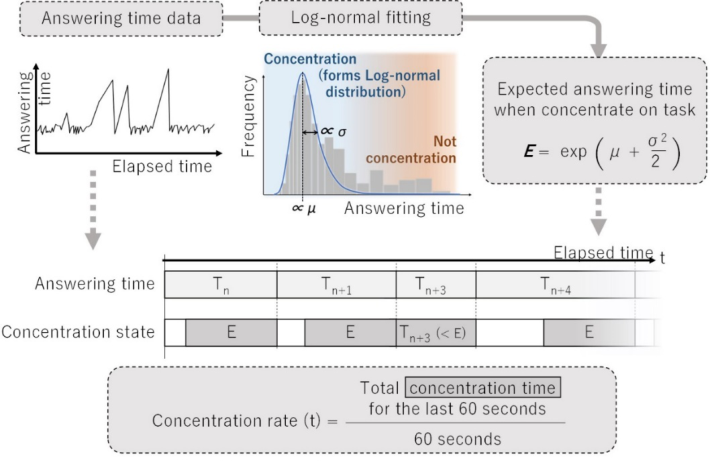
Time-series data of concentration were generated using the method used in our previous study (Ueda et al. 2022). Since aromatic environment was fluctuated during conducting task in with-aroma condition, the time win- dow of concentration rate calculation was changed shorter to be 60 seconds to capture short-term temporal variation in concentration on task. Figure 1 shows the brief explanation about the time-series concentration.
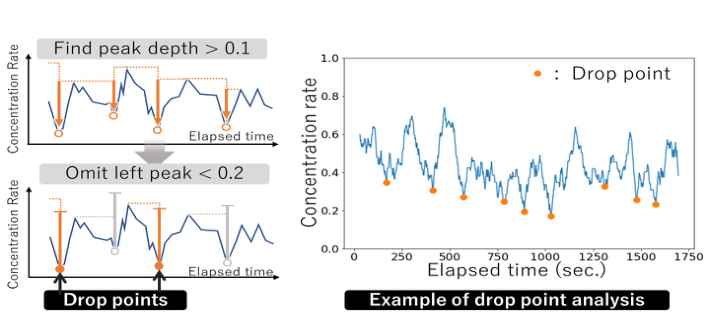
Based on the generated time-series data of concentration, drop points were found and counted by the method shown in Figure 2. The drop points repre- sent the timing at which the participants restarted concentrating and solving the cognitive task after slowing down due to fatigue accumulation or other factors while conducting the task. In other words, it is expected that there
Effect of the Intermittent Aroma Stimuli on Work Performance 679
Figure 1: Time-series concentration data generation method (Ueda et al. 2022).Figure 2: Finding method of drop points of the time-series concentration and example results of drop point analysis.
are more drop points when they were unable to maintain their concentration during the task time. In addition, the average value of time-series concen- tration in each set were also calculated to check the effect of intermittent aroma-stimuli over entire time of each set. It would be similar value of CTR which previously used to show the effect of aroma (Ueda et al. 2020), so that it would be expected that the average value under with-aroma condition is higher than without-aroma condition similar with previous analysis results.
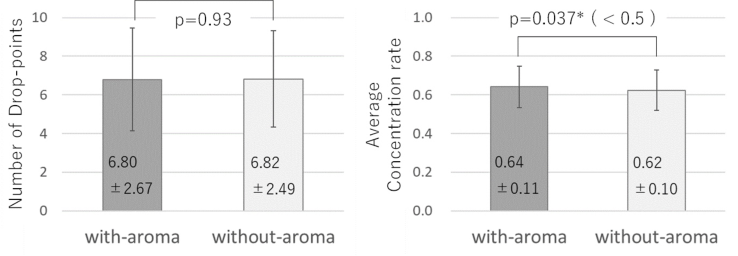
RESULTS AND DISCUSSIONS The Average values of the number of drop-points and the average concentra- tion rate under with- and without-aroma conditions are shown in Figure 3.
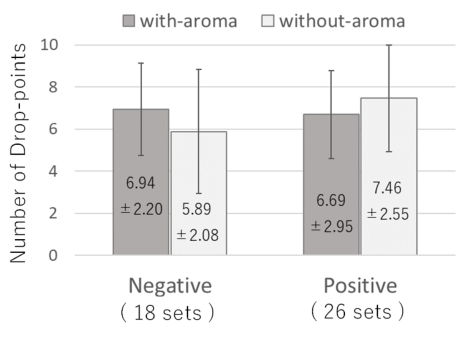
Figure 3: Average values of the number of drop-points (left) and the average concen- tration rate (right) under with- and without-aroma conditions. The p-value were calculated by paired t-test.Figure 4: Average values of the number of drop-points in each group under with and without-aroma conditions.
As a result of paired t-test, the average concentration rate was marginally significantly higher under the with-aroma condition, which was expected from our previous result (Ueda et al. 2020). It would also support that inter- mittent aroma stimuli improved workers’ concentration over entire time of working time.
When comparing the average concentration rate between the task sets con- ducted at the same time period under with- and without-aroma conditions, average concentration rate of with-aroma condition was higher in 26 sets than that of without-aroma condition, and lower in 18 sets. Thus, the for- mer group (n = 26 sets) was named the positive set group as the set that the aroma stimuli improved workers’ entire concentration. The latter group (n = 18 sets) was named the negative set group.
Average values of the number of drop-points in positive and negative set groups under with- and without-aroma conditions are shown in Figure 4. The results of two-way ANOVA are shown in Table 1, which was calculated with type-III sum of squares because of its unbalance numbers of data.
Effect of the Intermittent Aroma Stimuli on Work Performance 681
There was no significant effect based on the p-value of ANOVA, but small effects were shown in the single factor between the negative and positive set groups and the interaction effect. The figure shows that the negative group had fewer drop-points in the without-aroma condition and the posi- tive group had fewer drop-points in the with-aroma condition. This suggests that participants might be likely to lose their concentration when they didn’t concentrate on task so much, and they might be more likely to lose their concentration when they got negative effect from the intermittent aroma stimuli.
SUMMARY In this study, the effects of the intermittent aroma stimuli to improve wor- kers’ performance was newly examined based on an analysis focusing on drop-points, which are the timing of breaks in concentration, using time- series data of participants’ concentration on a task. The results suggest that intermittent aroma stimuli might have reduced the number of drop- points which means the break in concentration was suppressed, especially in tasks in which concentration was promoted by intermittent aroma sti- muli. Results provided the possibility of intermittent aroma stimuli could improve workers’ performance by suppressing the concentration decline, which contributes to a discussion of previous results (Ueda et al. 2020) from a new aspect of time-series change of intellectual concentration. On the other hand, since it could be interpreted from the results that the aroma stimuli break concentration more frequently when workers got adverse effect in entire working time, it is important to adjust aroma stimulation for each individual to prevent adverse effects in order to improve overall workers’ performance.
ACKNOWLEDGMENT
This work was supported by JSPS KAKENHI Grant Number 18J20603.
REFERENCES
Al Horr, Y., Arif, M., Kaushik, A., Mazroei, A., Katafygiotou, M., & Elsarrag, E.
(2016). Occupant productivity and office indoor environment quality: A review of the literature. Building and environment, Volume 105, pp. 369–389. Choi, N., Yamanaka, T., Takemura, A., Kobayashi, T., Eto, A., & Hirano, M. (2022).
Impact of indoor aroma on students’ mood and learning performance. Building and Environment, Volume 223, 109490. Du, B., Schwartz-Narbonne, H., Tandoc, M., Heffernan, E. M., Mack, M. L., & Siegel, J. A. (2022). The impact of emissions from an essential oil diffuser on cognitive performance. Indoor air, Volume 32 No. 1, e12919. Igarashi, M., Ikei, H., Song, C., & Miyazaki, Y. (2014). Effects of olfactory sti-
mulation with rose and orange oil on prefrontal cortex activity. Complementary therapies in medicine, Volume 22 No. 6, pp. 1027-1031. Ishii, H., Kanagawa, H., Shimamura, Y., Uchiyama, K., Miyagi, K., Obayashi, F., & Shimoda, H. (2018). Intellectual productivity under task ambient lighting. Lighting Research & Technology, Volume 50 No. 2, pp. 237–252. Kawakami, M., Aoki, S., & Ohkubo, T. (1999). A study of “fragrance” on wor-
king environment characteristics in VDT work activities. International journal of production economics, Volume 60, pp. 575–581. Ueda, K., Shimoda, H., Ishii, H., Obayashi, F., & Taniguchi, K. (2016) Development of a new cognitive task to measure intellectual concentration affected by room environment, proceedings of The Fifth International Conference on Human-Environment System, Nagoya. Ueda, K., Takekawa, W., Shimoda, H., Ishii, H., Obayashi, F., Kumazaki, H.
(2021). An Objective and Quantitative Evaluation of Intermittent Aroma Stimuli on Intellectual Concentration. In: Ayaz, H., Asgher, U. (eds) Advances in Neu- roergonomics and Cognitive Engineering. AHFE 2020. Advances in Intelligent Systems and Computing, Volume 1201. Ueda, K., Yumura, K., Ishii, H., Shimoda, H., Obayashi, F. (2022). An Analysis of the Effect of Integrated Thermal Control on Cognitive Task Performance Using Time-Series Changes in Intellectual Concentration. In: Vesa Salminen (eds) Human Factors, Business Management and Society. AHFE (2022) International Conference. AHFE Open Access, Volume 56.
LISTED IN THE AHFE DIGITAL BOOKSTORE CATALOGUE
Explore the complete digital volume
Intelligent Human Systems Integration (IHSI 2023): Integrating People and Intelligent Systems
Read this individual research paper free through the original publisher, or explore the full digital proceedings book.
ISBN 978-1-958651-45-2
Explore this ISBN in the AHFE Bookstore ↗Listed in the July 2026 bookstore catalogue; search by ISBN to confirm current availability · Digital book purchase optional