Naoki Sugiyama, Tomoko Ota, Akihiko Goto (2023). Quality analysis of images between expert and beginners taken by drone. In: Usability and User Experience. AHFE Open Access, vol. 110, pp. 86–91. https://doi.org/10.54941/ahfe1003180
The use of drones provides a variety of images and video footage that we have not seen before. In non-destructive inspection, on the other hand, it is necessary to obtain an accurate image of the inspection area. The quality of the image is important because the image is used for inspection.In this study, expert and beginners drone pilots operated a drone to photograph the three subjects in the designated areas. Three subjects were photographed by different conditions. The quality of the photographs obtained was compared. The results showed that expert pilot were more likely than beginners to ensure that the subject was in the centre of the picture taken. In addition, distances between drone and subjects were set in almost the same position by expert.
Drones are mainly used for aerial photography. How a photograph is taken depends greatly on the techniques of the pilot, and the method varies from person to person. The techniques of an expert pilot are tacit knowledge that is difficult to present into words. Therefore, non-expert pilots spend a lot of time acquiring these techniques. In order to make such tacit knowledge explicit, the technique of expert and beginners was compared. In this paper, the difference in the quality of photographs taken by an expert and beginners with a drone was investigated. The quality of photographs is considered to vary greatly depending on the type of camera and post processing. Hence, two parameters were introduced for evaluating the quality of photographs; one was the position of the subject within the camera frame and another was the distance between the subject and drone. The consideration is that adjusting the subject in the centre of the camera frame will result in a good quality image. The positional relationship between the centre of the camera frame and the centre of the subject was used. In addition, the closer drone got to the subject, the better the quality of the image was considered. Distances of the drone and subject were assessed to calculate the areas of subjects. It is based on the consideration that the shorter the distance between the camera and the subject, the larger the area of the subject.
Quality Analysis of Images Between Expert and Beginners Taken by Drone 87
METHOD
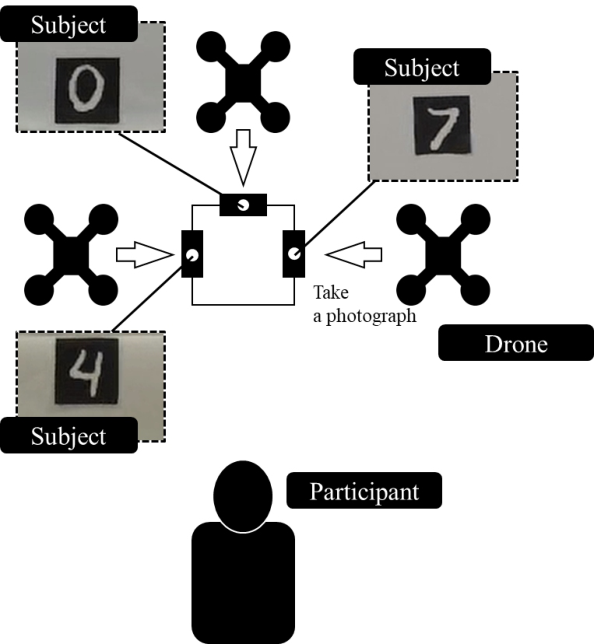
The participants were 1 expert with drone qualification and 4 beginners. All dominant hands were right-handed. Three photographs were taken per sub- ject. The drone was used MAVIC MINI which was manufactured by DJI. Mode of operational method was mode 1. Mode 1 is mainly operational method in Japan (SUZUKI, 2018). The participants took photographs of sub- jects while checking the iPhone on which the drone’s field-of-view camera was projected. The subject was a 32mm x 32mm sticker with handwritten num- bers. The stickers were painted black to facilitate image processing, and the numbers were written in white. Three types of numbers, 0, 4, and 7, were pre- pared. Each subject was photographed under different conditions. Figure 1 shows positional relation of participants, drone and subjects.
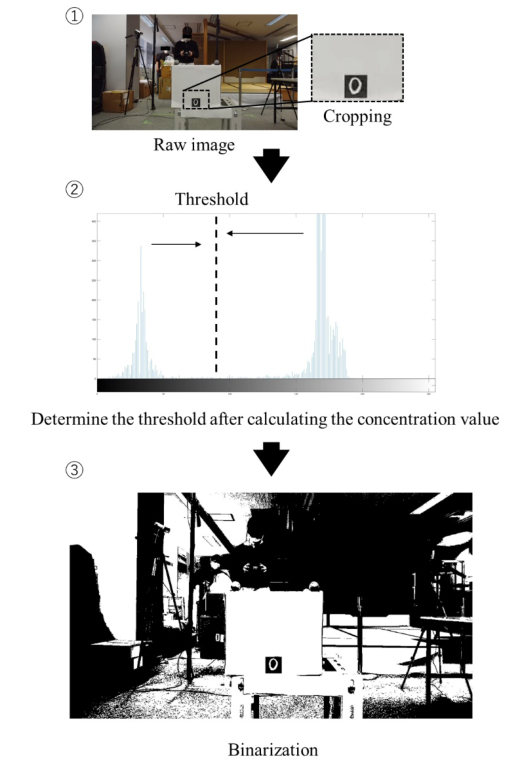
The photographs taken were binarized in order to separate the subjects and the rest of them. Figure 2 shows the flow of binarization processing.
The flow was defined as follows: x The object and its surroundings were cut out from the raw image. y A histogram of density values was calcula- ted for the clipped image, and the threshold was determined by the mode method. z Binarization processing was performed with the threshold value determined for the raw image.
Figure 1: Positional relation of participants, drone and subjects.Figure 2: Flow of binarization processing.
The positional relationship between the centre of the camera frame and the subject was used as a comparison of photographs by experts and beginners. The distance (Lc: length of centre) representing the positional relationship was calculated from the two positions by the Pythagorean Theorem. Since the size of the camera frame is 1280 × 720, the centre of the camera frame is set to 640 and 360. The centre of the subject is half of the maximum height and width in the binarized number area. Accordingly, the origin of image was the centre of camera frame. A small Lc value means that the subject is taken in the centre of the camera frame. For example, an Lc value of zero means that the centre of the camera frame and the centre of the subject match, that is, the subject is in the centre of the camera frame. In contrast, a large Lc value means that the subject is far from the centre of the camera frame.
In addition, the distances from the drone to subjects was examined. A drone does not stop completely due to move own wings. Accordingly, the
Quality Analysis of Images Between Expert and Beginners Taken by Drone 89
(a) Expert
(b) Beginner1
(c) Beginner2
(d) Beginner3
(e) Beginner4
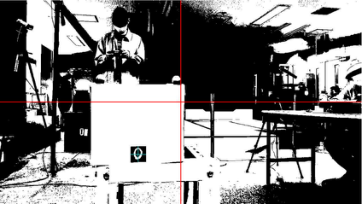
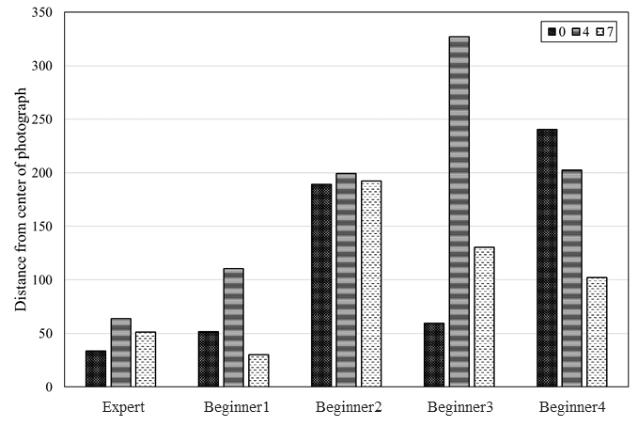
Figure 3: Examples of photographs taken by the expert and beginners.Figure 4: Distances between centre of the subjects and its frame camera in all photographs.Figure 5: Ab of the subjects.
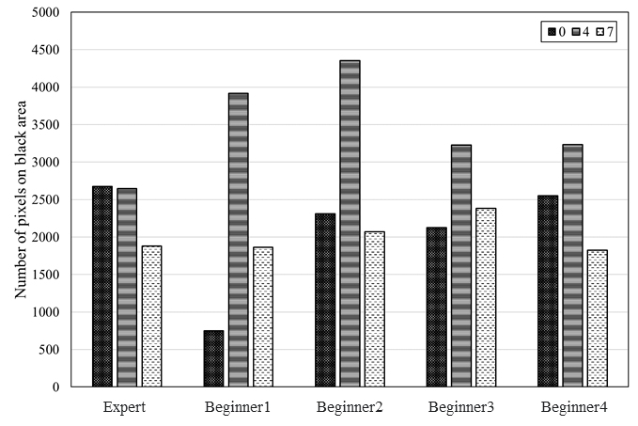
timing taking photographs of the subjects was not known. The positional relation a drone and subjects was estimated to count the area of the subjects. The area (Ab: Area of Black) of this subject is the part of the sticker filled in black, and the numbers written in white are omitted. Ab was obtained to count the number of black pixels (false values).
Quality Analysis of Images Between Expert and Beginners Taken by Drone 91
RESULTS
Figure 3 shows the examples of photographs taken by the expert and begin- ners. The red plus indicates the centre of the camera frame and the blue plus indicates the centre of the subject.
Expert took the subject in the centre of the camera frame. Beginner1 and Beginner3 were also took in the same way as the expert. However, the subject of the photograph was small compared to others by Beginner1.
Figure 4 shows the distances between centre of the subjects and its frame camera(Lc) in all photographs.
The expert took three photographs with almost same distance. In other words, the subjects were captured near the centre of frame camera even under different conditions. Figure 5 shows the Ab of the subjects.
Since the number written on the image is different, Ab is also different accordingly.
However, the expert had almost no change in Ab compared to Beginners. It is considered that expert are taking at almost the same position of drone.
CONCLUSION
The differences in photographs between expert and beginners through image processing was examined in this paper and following results were obtained;
Expert’s Lc and Ab value was similarity in all photographs.
From LC, the photographs were taken with the subject adjusted at the center of the frame camera by expert.
From Ab, the positional relationship between drone and subject was almost the same.
REFERENCES
Hideo Suzuki. “A Proposal on a Syllabus of “Drone Safety Engineering”in an University Class: Toward Will-be Drone Pilots and Drone Operating Managers”. Journal of Tokyo University of Information Sciences, Vol.22, No.1, pp. 123–131, 2018. Naoki Sugiyama, Tomoko Ota, Akihiko Goto. “Analysis of techniques in operating
a drone”. Mechanical Engineering Congress, 2022 Japan (MECJ-22).
LISTED IN THE AHFE DIGITAL BOOKSTORE CATALOGUE
Explore the complete digital volume
Usability and User Experience
Read this individual research paper free through the original publisher, or explore the full digital proceedings book.
ISBN 978-1-958651-86-5
Explore this ISBN in the AHFE Bookstore ↗Listed in the July 2026 bookstore catalogue; search by ISBN to confirm current availability · Digital book purchase optional