Daniel HK Chow (2018). Effects of Load Carriage on Lumbopelvic Motor Control. In: Advances in Physical Ergonomics and Human Factors: Part II. AHFE Open Access, vol. 2. https://doi.org/10.54941/ahfe100064
Load carriage has become a concern in many industrialized countries and problems of musculoskeletal pain and stress on spinal structures due to load carriage have been widely reported. Various studies have been conducted to investigate the etiology of back pain due to load carriage. As people with low back pain exhibit abnormal spinal control, effects of load carriage on spinal control have been investigated in static upright stance. However, its effect on dynamic spinal control is not clear. In this study, the effects of load carriage on dynamic spinal control were investigated. Lumbopelvic movement control of 12 healthy female volunteers was quantified whilst performing a reaching task under four loading conditions, i.e. no load, carrying backpack of 5%, 10% and 15% body weight (BW). It was shown that lumbopelvic coordination was less in-phase and more variable during load carriage of 10% and 15%BW in forward reaching movement, suggesting greater alteration in spinal motor control at heavier weights. As abnormal movement strategies tend to increase the risk of spinal injury, pragmatic approaches should be considered to eradicate the adverse effect of heavy load carriage on spinal motor control.
Load carriage has been a concern in many industrialized countries as it was shown to be highly associated with load back pack (van Vuuren et al., 2007; Waddell, 1996). Various studies have been conducted to investigate the etiology of back pain due to load carriage. Carrying a load in form of a backpack has been found to decrease muscle activity of the erector spinae (Motmans et al., 2006) with decreased lumbar lordosis (Chow et al., 2005). As people with low back pain was shown to exhibit abnormal spinal control (Hodges and Moseley, 2003), effects of load carriage on spinal control have been investigated in static upright stance (Chow et al., 2007). However, its effect on dynamic spinal control has not yet been investigated. The purpose of this study was to evaluate the kinematic effects of load carriage on spinal motor control under dynamic conditions. Motor control is defined as the ability to regulate movement. According to the principles of dynamical systems theory, movement patterns are arisen from synergistic organization of the neuromuscular system (Kurz and Stergiou, 2004). Movement patterns are the result of individual muscles and neuro-pathways collectively working together to achieve a functional outcome that meets the requirements of the system (Kelso and Fuchs, 1995). Silfies et al. (2009) quantified lumbopelvic control differences between patients with low back pain and asymptomatic controls using inter-segmental coordination and pattern variability. Movement variability was quantified in terms of mean absolute relative phase (MARP) and deviation phase (DP) denoting the degree of in-phase relationship between two segments and the degree of variation in movement pattern, respectively (Silfies et al., 2009). In this study, the kinematic effect of load carriage on lumbopelvic coordination was assessed by the functional reach test (Duncan et al., 1990) with subjects under conditions of no load, and backpack carriage of 5%, 10% and 15% body weight (BW).
METHODOLOGY
Experimental Details Twelve healthy female volunteers without any history of musculoskeletal disorders were recruited. Subjects were advised not to participate in any intense physical activity the day prior to the experiment. Ethical consent was obtained from each subject prior to the experiment. Reflective markers were affixed to the subjects’ lumbar spine and pelvis as well as the dominant side at the ulna head, greater trochanter and lateral condyle. Coordinates of the markers were monitored by a motion analysis system at 100 Hz (Vicon Nexus, Oxford Metrics, Oxford, UK). Lumbopelvic movement of each participant in performing forward reaching task was assessed under four loading conditions, i.e. no load, carrying a dummy backpack of 5%, 10% and 15% BW, in randomized order and with rest given between tests. The dummy backpack consisted of a reversed U-shape frame to allow markers attached to the subject’s back to be seen by the motion analysis system. Standard functional reach test was used to determine the maximal reaching distance of each subject under each loading condition. Target was set at half of the maximum reaching distance in performing the forward reaching task. Subjects were required to complete each reach in 6s (3s forward, 3s back) with the aid of a metronome and measurements were made in both forward and backward movements.
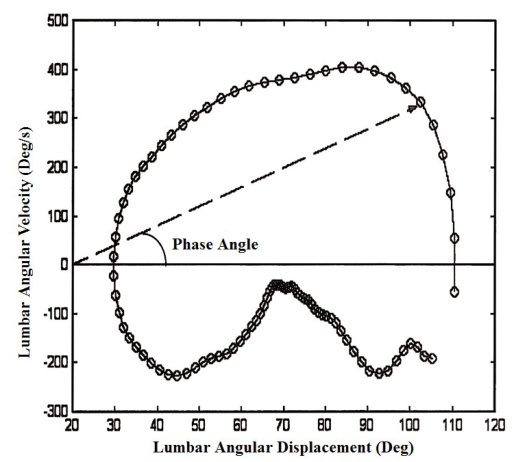
Data Analysis The acquired data were low-pass filtered with cutoff frequency at 6 Hz (DiGiovine et al., 2000). Data of each repetition was resampled and normalized to 50 points for forward motion and 50 points for backward motion. Lumbopelvic coordination was quantified by a phase plot by plotting the angular displacement against angular velocity of the lumbar and pelvis (Figure 1).
Figure 1. Determination of the phase angle of the lumbar spine.
Phase angle of each data point throughout the entire motion was determined. A continuous relative phase was determined as the absolute difference between phase angles of the lumbar and pelvis (Silfies et al., 2009). Differences between continuous relative phase curves were quantified by two additional parameters, namely Mean Absolute Relative Phase (MARP) and Deviation Phase (DP) (Stergiou et al., 2001). MARP was determined as the average of the relative phase values over the continuous relative phase curve, where a lower MARP value would indicate a more in-phase relationship of the segments and a higher MARP value would indicate a more out-of-phase relationship (Silfies et al., 2009). Deviation phase was defined as the average of standard deviations of the ensemble continuous relative phase curve points. A lower DP value would indicate more stable movement pattern and a higher DP value would indicate more variation in movement pattern (Silfies et al., 2009). The results were compared using one-way repeated measure analysis of variance (IBM SPSS Statistics 20, Inc., Chicago, IL, IBM, USA) with level of significance was set at p<0.05 and Bonferroni criterion was adopted for post-hoc comparisons.
RESULTS
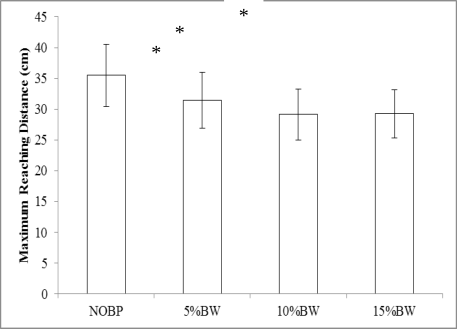
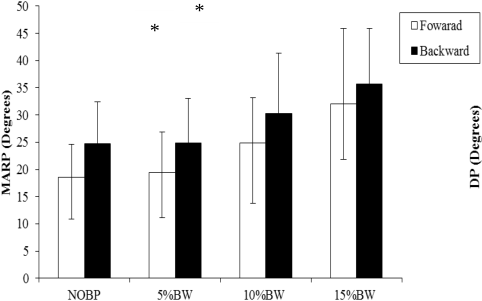
The mean (SD) age, body weight and height of the subjects were 20.9 (1.3) years, 50.9 (5.3) kg, and 158.4 (5.0) cm, respectively. A significant decrease in the maximum reaching distance with load was observed (p<0.001). The maximum reaching distances at 5%, 10% and 15%BW were significantly less than that of the unloaded condition (Figure 2). In forward reaching motion, there was a significant increase in both MARP and DP with load with p<0.001 and p=0.005, respectively (Figure 3). MARP in forward reaching motion when the subjects were carrying a load of 10% and 15% BW were significantly larger than that of the unloaded condition. DP in forward reaching motion at 15% BW load carriage was significantly larger than that of the unloaded condition. There was no significant change in MARP and DP with load in backward return motion with p=0.156 and p=0.052, respectively (Figure 3).
* * *
Figure 2. Maximum reaching distance significantly decreased with load (*for P<0.05)
* * * *
Figure 3. MARP (left) and DP (right) at different loading conditions in forward and backward motion (* for P<0.05).
DISCUSSION & CONCLUSIONS Forward reaching task was employed as the standardized movement to investigate the effects of load carriage on dynamic spinal control in this study. Functional reaching distance has been used clinically for evaluating balance control stability (Duncan et al., 1990). Lack of balance can cause excessive loads on the spine due to over activation of muscles for maintaining equilibrium. As there was a significant decrease in maximum reaching distance with load, balance control was significantly affected by load carriage.
It was evident that lumbopelvic coordination was less in-phase and became variable during load carriage of 10% and 15% BW only in forward reaching movement. This finding revealed that greater alteration in trunk motor control at heavier weights and there was a greater tolerance for load carriage in backward return motion. While load carriage in form of a backpack was shown to may alter movement control, further study is required to confirm whether this alteration contributes towards back pain or not. Nevertheless, as abnormal movement strategies tend to increase the risk of spinal injury, pragmatic approaches should be considered to eradicate the adverse effect of load carriage on spinal motor control.
REFERENCES
Chow, D. H., Kwok, M. L., Au-Yang, A. C., Holmes, A. D., Cheng, J. C., Yao, F. Y., et al. (2005), “The effect of backpack load on the gait of normal adolescent girls”, Ergonomics, 48(6), 642-656. Chow, D. H., Leung, K. T., Holmes, A. D. (2007), “Changes in spinal curvature and proprioception of schoolboys carrying
different weights of backpack”, Ergonomics, 50(12), 2148-2156. DiGiovine, C. P., Cooper, R. A., DiGiovine, M. M., Boninger, M. L., Robertson, R. N. (2000), “Frequency analysis of kinematics of racing wheelchair propulsion”, IEEE Trans Rehabil Eng, 8(3), 385-393. Duncan, P. W., Weiner, D. K., Chandler, J., Studenski, S. (1990), “Functional reach: a new clinical measure of balance”, J
Gerontol, 45(6), M192-197. Hodges, P. W., Moseley, G. L. (2003), “Pain and motor control of the lumbopelvic region: effect and possible mechanisms”, J Electromyogr Kinesiol, 13(4), 361-370. Kelso, J. A., Fuchs, A. (1995), “Self-organizing dynamics of the human brain: Critical instabilities and Sil'nikov chaos”, Chaos,
5(1), 64-69. Kurz, M. J., Stergiou, N. (2004), “Does footwear affect ankle coordination strategies?” J Am Podiatr Med Assoc, 94(1), 53-58. Motmans, R. R., Tomlow, S., Vissers, D. (2006), “Trunk muscle activity in different modes of carrying schoolbags”, Ergonomics, 49(2), 127-138. Silfies, S. P., Bhattacharya, A., Biely, S., Smith, S. S., Giszter, S. (2009), “Trunk control during standing reach: A dynamical
system analysis of movement strategies in patients with mechanical low back pain”, Gait & Posture, 29(3), 370-376. Stergiou, N., Jensen, J. L., Bates, B. T., Scholten, S. D., Tzetzis, G. (2001), “A dynamical systems investigation of lower extremity coordination during running over obstacles”, Clin Biomech (Bristol, Avon), 16(3), 213-221. van Vuuren, B., van Heerden, H. J., Becker, P. J., Zinzen, E., Meeusen, R. (2007), “Lower back problems and work-related risks
in a South African manganese factory”, J Occup Rehabil, 17(2), 199-211. Waddell, G. (1996), “Low back pain: a twentieth century health care enigma”, Spine (Phila Pa 1976), 21(24), 2820-2825.
LISTED IN THE AHFE DIGITAL BOOKSTORE CATALOGUE
Explore the complete digital volume
Advances in Physical Ergonomics and Human Factors: Part II
Read this individual research paper free through the original publisher, or explore the full digital proceedings book.
ISBN 978-1-4951-2105-0
Explore this ISBN in the AHFE Bookstore ↗Listed in the July 2026 bookstore catalogue; search by ISBN to confirm current availability · Digital book purchase optional