Xiao Meng, Liang Ma (2025). Nurses scheduling under epidemic crises: balancing demand coverage and nurse fatigue. In: Human Factors in Design, Engineering, and Computing. AHFE Open Access, vol. 199, pp. 1529–1540. https://doi.org/10.54941/ahfe1006964
During epidemic crisis (EC) situations, meeting urgent medical demands is crucial. However, medical staff, especially nurses, often experience more fatigue due to sharply increasing workloads and irregular shifts during EC. The sustained pandemics exacerbate the fatigue issue and further cause higher turnover and understaffing of nurses, which may jeopardize the whole healthcare system. It is essential to adopt a prudent scheduling method that can balance urgent demands and nurse fatigue during epidemic crises. This paper aims to provide a solution considering the balance of nurse fatigue and the satisfaction of demands for a nurse scheduling problem during epidemic crises. We used the bio-mathematical model of fatigue (BMMF) to predict the fatigue of nurses and constructed a mixed-integer nonlinear programming (MINLP) problem for scheduling the time slots for nurses. Then, we conducted a computational experiment simulating the nurse scheduling problems during EC situations to compare the performance of the model we built and the other classic scheduling methods. Our results indicate that, compared to the other modified classic scheduling methods under crisis emergencies, our approach taking account of the BMMF in nurse scheduling during EC leads to less nurse fatigue and better balances the fatigue and the urgent demands. Given the considerable fatigue experienced by nurses in EC emergencies, this scheduling method considering fatigue can balance demands and protect nurses with less fatigue, which is highly beneficial for nurses’ well-being in EC emergency situations. Our solution offers practical strategies for meeting significant demands and reducing nurse fatigue during epidemic crises and emergencies.
The COVID-19 pandemic significantly impacted and presented challenges to healthcare systems and raised new concerns about the staffing and scheduling of nurses during epidemic crises (EC). During an EC, medical tasks need to be completed in a timely manner, otherwise, it will cause greater losses of lives. Sufficient manpower and other medical resources are important to guarantee that medical care can be delivered to patients in a timely manner. However, due to the specific temporal-spatial traits of an EC, those prerequisites could not be satisfied easily. In addition, due to the widespread occurrence of infectious diseases, it is difficult to gather medical staff quickly from nearby
areas to fill in the gap of manpower in the area since all the hands are tied in nearby areas as well, which makes it more difficult to manage nurses’ fatigue and health during an EC. Understaffing and subsequent nurses’ fatigue become one of the major issues during an EC.
With the increasing exceptional workload and prolonged emergencies, healthcare staff are losing their rest time and facing acute and chronic fatigue during the epidemic crisis (Liu et al., 2020). As reported by the WHO regarding occupational health and safety (World Health Organization, 2021), the risks of fatigue for healthcare workers have been significantly amplified by the COVID-19 pandemic, with longer shifts, more urgent tasks, and increased workload taking harm on their physical and mental health (Sagherian et al., 2023, Mo et al., 2020). What follows is that the turnover of nurses became higher since COVID-19, which is a global healthcare system issue (Falatah, 2021; Labrague and Los Santos, 2021).
Regulations and laws have already established limits to working hours to handle the fatigue risk of nurses. In addition, there are different available fatigue management tools to solve nurse scheduling problems (NSP) and to establish schedules under normal and routine circumstances. However, these models and fatigue management systems do not consider the problems during ECs with the distinct temporal-spatial traits and work features, and thus cannot resolve the scheduling problems with distinct tasks and human resources properly (Amindoust et al., 2021; Havaei et al., 2021; R. Liu et al., 2022; Sasangohar et al., 2020). It is critical to develop a scheduling method to reduce nurse fatigue and meanwhile meet emergency demands as much as possible during an EC. The key issue is the balance and trade-off between demand coverage and nurse fatigue. In this paper, we employ bio- mathematical models of fatigue (BMMF) in the nurse scheduling problem during an EC, assessing nurses’ fatigue levels by considering their sleep and work schedules to formulate optimal nurse schedules. The objective is to ensure that nurses can fulfill the required tasks during the epidemic while maintaining their fatigue levels at an acceptable level.
Problem Description We established a problem of nurse scheduling in epidemic crisis situations and modelled a real-world problem during Covid-19. During an outbreak in a certain block of a city, patients need to be transferred and treated as soon as possible, and nurses need to be arranged to complete a certain amount of work within limited few days. In this case, the task demand reaches a high level that the nurses cannot cover by a normal scheduling and arrangement. The medical service department needs to arrange human resources, and it is most important to complete urgent time-limited work in a short time. In this case, the physical and mental health and safety of nurses also need to be considered, especially the lack of sleep and acute fatigue caused by a large amount of work in a short period of time.
In this problem, we arrange the working hours of the nurses so that the tasks in each period are completed as many as possible, and at the same time, reducing the overall fatigue of the participating nurse. In addition,
Nurses Scheduling Under Epidemic Crises: Balancing Demand Coverage 1531
this problem allocates personnel according to the needs of each period and quantitatively predicts the fatigue of nurses, which can make the use of human resources more efficient. Here we use the SAFTE (Sleep, Activity, Fatigue, and Task Effectiveness) model to predict and estimate nurse fatigue (Hursh et al., 2004).
According to the problem of nurse scheduling, some of the assumptions are as follows:
1) Nurses have the same work ability and work preferences; 2) The nurses’ rest is guaranteed outside of work, and other factors do not affect work and rest;
3) The work intensity for each nurse during each period is consistent.
MINLP Model: Flexible Nurse Scheduling Model Considering BMMF We model the problem as a mixed-integer nonlinear programming (MINLP) problem. The model arranges working hours and sleep for nurses to cover the demands and minimize the overall fatigue. A limited number of nurses I needs to arrange work in the epidemic emergency response with a range of T which is a set of hours, and the number of nurses required for the task at time t is dt. xi,t is a binary variable indicating whether nurse i is scheduled to work at time t. xstart
i,t and xend
i,t are binary variables indicating whether nurse i starts or ends a period of work at time t. yi,t is a binary variable indicating whether nurse i is scheduled to sleep at time t. ystart
i,t and yend
i,t are binary variables indicating whether nurse i starts or ends sleeping at time t. xout
t ∈Z is an integer variable as the uncovered demand at time t.
Objective Function The objective function is considering maximizing the alertness of nurses and the coverage of demands. Eq. (1) is the goal to maximize the number of covered tasks and to maximize the overall alertness of the nurses at the same time. SPi,t is the alertness level denoted as in Eq. (2). f({SPi,t}i∈I,t∈T) is a function of the alertness level of nurses under the corresponding schedule to represent the overall alertness of nurses, which can represent the overall fatigue level. Here f calculates the average minimal alertness of the nurses as the overall level and M is a big integer to ensure the demands are covered as much as possible.
X
xout
max f({SPi,t}i∈I,t∈T) −M
t (1) t∈T
Eq. (2) is the calculation of the alertness level with the alertness model SAFTE by Hursh et al. (2004), composed of circadian process Eq. (4) and homeostatic process Eq. (5). Eq. (2) is the estimated alertness level at time t under the current schedule based on the SAFTE model, where SP is defined in (3) by C (circadian process) and A (homeostatic process). Circadian process controls the drive to sleep composed of a 24-h rhythm process and a 12-h rhythm process, where p is the peak time of 24h rhythm with a value of 18h, p ′ is the relative peak time of 12-h rhythm with a value of 3h and β is
1532 Meng and Ma
the relative amplitude of 12-h rhythm with a value of 0.5. The homeostatic process controls the performance during awakening and its decline rate. The homeostatic process declines by a rate K with a value of 30 units/h during awakening and recovers exponentially by rate τd with a value of 4.2h, where As is a weighting constant with a value of 1.235. In Eq. (4) SP is composed of A and C, where ζ and η are both weighting factors, with a value of 0.07 and 0.05 respectively. The constants are established referencing the study by Peng et al. (2018).
Equations and mathematical formulas are available in the original paper PDF.
′
t −p −p
Scheduling Constraints This part the constraints finds the shifts that meet the basic principles referred to the studies by Liu et al. (2022) and Brunner et al. (2009). Eq. (6) is the constraint trying to make the demand at time t (dt) satisfied, and xi,t is a binary variable that is 1 when nurse i is scheduled to work at time t; xout
t is defined as the uncovered demand at time t. In Eq. (7)–(14) xstart
i,t , xend
i,t ,
ystart
i,t , yend
i,t defines the start and end time of each work and sleep activity, for example a work start at time t and end at t′ then xstart i,t = 1, xend i,t = 1 and otherwise 0; Eq.(15)–(16) defines the minimum and maximum duration (Tshift and Tshift) of a single work; Eq. (17)–(18) defines the minimum and maximum duration of a single sleep (Tsleepand Tsleep). Eq. (19)–(21) describe the basic constraints on work and rest during the day and night.
A schedule is feasible when:
X
xi,t + xout
xstart
xstart
i,t + 1 + xend
Nurses Scheduling Under Epidemic Crises: Balancing Demand Coverage 1533
The Other Two Models Compared In order to demonstrate the effectiveness of our model, we attempt to compare the flexible nurse scheduling model considering BMMF (Model 1, NSBF) with other models that address nurse shifts by hours and demands without fatigue consideration under the same epidemic crisis. We modified a flexible nurse scheduling model with shift duration constraints (Model 2, NSDC). This model is based on NSBF Eq. (1–21) without the expressions of BMMF and adding the constraints Eq. (23–25). The objective function is to maximize the number of covered tasks Eq. (22). The constraints control the nurse fatigue by at least 24 hours of rest after night shifts Eq. (23), rest after normal shifts Eq. (24), and work time limits for each day Eq. (25).
1534 Meng and Ma
In addition, in order to simulate the real-world problem, we modified the model above as nurse scheduling under task pressure (Model 3, NSTP) here which prioritizes the completion of all tasks under the constraint of time limits and gives relatively less consideration to the nurses’ fatigue. Compared with model 2, Model 3 modified the constraint Eq. (23) so that nurses should only rest for at least 12 hours after a night shift. Besides, constraints Eq. (24) and Eq. (25) are deleted, resulting in more relaxed time-related nurse fatigue constraints. We assume that during real-world conditions under task pressure, such constraints are more reasonable and common to achieve the coverage of the tasks.
X max −
xout
t (22) t∈T
24 X
xshift
s.t. yend
xend
i,t + 1
t∈Td
Computational Results We simulated the data that nurses need to be urgently dispatched to areas with severe situations for treatment in the Covid-19 pandemic, and randomly generated 100 sets of data with the following parameters (Table 1):
Table 1: Parameters of simulated cases during an epidemic crisis emergency.
Table available in the original PDF paper.
Parameters Description Value I Number of nurses 12 t0 Start time of scheduling 0 tend End time of scheduling Uniform (240, 600) Tshift Minimal duration of a shift 3h Tshift Maximal duration of a shift 8h Tsleep Minimal duration of a sleep 6h Tsleep Maximal duration of a sleep 8h dt Demands of hour t Uniform (2,8)
The scheduling process involved the participation of 12 nurses and offered flexible scheduling based on the demands within a short period lasting from 10 to 25 days. The hourly demand was randomly generated according to a uniform distribution, resulting in a total demand of high workload and
Nurses Scheduling Under Epidemic Crises: Balancing Demand Coverage 1535
intensity for the 12 nurses. Here f in the objective function was set as the average minimal alertness of the nurses as the overall fatigue level.
To solve the MINLP, the model is built in Python 3.9.6, with Intel Core i9- 10885H CPU 2.4GHz and 32G RAM. NSDC and NSTP are solved by MIP solver Gurobi 9.1.2. And since NSBF is nonlinear, we use Gurobi to find feasible solution set and search the optimal solution by a conditional enumeration algorithm. The basic information and running efficiency of the solutions are shown in Table 2.
Table 2: Comparison of three models on the simulated cases on work-related indicators and alertness indicators during total schedule and during work.
Table available in the original PDF paper.
NSBF: Flexible Scheduling Considering BMMF
NSTP: Scheduling Under Task Pressure
NSDC: Scheduling with Shift Duration Constraints
0.25 0.04 0.38 0.02 0.08 0.02
Mean SD Mean SD Mean SD Proportion of unsatisfied demand
8.01 0.29 6.63 0.17 9.91 0.32
Average work length per day (h)
60 2.63 56.42 2.71 45.4 3.67
Average alertness (%) 88.4 0.68 87.48 0.69 81.57 1.02 Average minimal alertness (%)
97.21 0.91 95.82 1.77 86.27 3.23
Alertness above 70% (%)
47.74 4.63 44.24 3.23 24.01 2.61
Alertness above 90% (%)
86.97 1.11 86.84 0.98 80.28 1.21
Average alertness during work (%)
61.96 3.41 59.08 3.7 45.89 3.74
Average minimal alertness during work (%)
93.47 2.48 91.79 2.65 80.77 3.8
Alertness above 70% during work (%)
49.9 6.38 48.33 4.71 25.78 3.37
Alertness above 90% during work (%)
57.13 5.68 0.37 <0.01 0.25 <0.01
Average CPU time cost per instance (second)
NSBF proposed in this study has a higher level of demands meeting. In NSBF a mean proportion of 0.25 demands were not met, which is significantly lower than the mean proportion of 0.38 by NSDC (p < 0.01). Although NSTP does not consider nurse fatigue, there is still a 0.08 proportion of unmet demands. The mean work length per day relates to the demand coverage, where a longer work time represents a better demand coverage. In the cases NSBF has an average work length of 8.01h, and 6.63h, 9.91h for NSDC and NSTP respectively. Here NSBF has a longer work length
1536 Meng and Ma
and better demand coverage than NSDC, and does not arrive the demand coverage of NSTP. Next the fatigue of the nurses will be compared between the models.
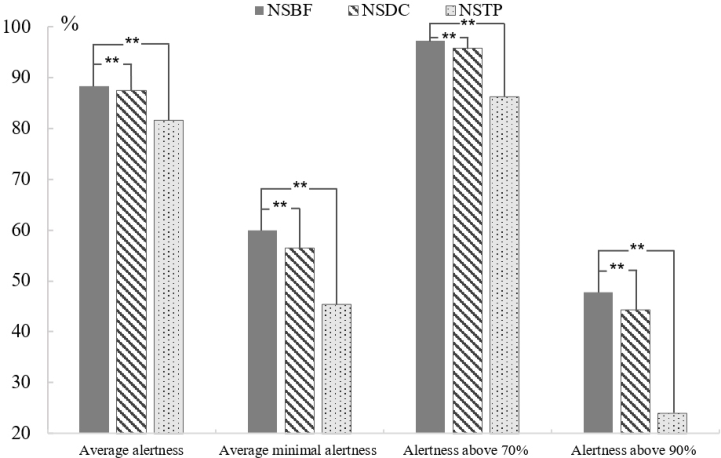
A paired t-test was used to compare the performance of the three methods (Table 3). The results indicate that the scheduling method proposed in this study (NSBF) exhibits significantly higher levels of nurse alertness (mean = 88.49%) than NSDC (mean = 87.48%, p < 0.01) and NSTP (mean = 81.57%, p < 0.01). In terms of the minimal alertness across the schedule, NSBF (mean = 60.00%) also has a higher level than NSDC (mean = 56.42%, p < 0.01) and NSTP (mean = 45.40%, p < 0.01). The alertness level of 70% is a point of sleeping, and the nurses should go sleep when alertness is under 70%. In NSBF, the percentage of alertness above 70% (mean = 97.21%) was higher than NSDC (mean = 95.82%, p < 0.01) and NSTP (mean = 86.27%, p < 0.01). Alertness of 90% is a point that the nurses have good concentration on the work. Percentage of alertness above 90% by NSBF (mean = 47.74%) was higher than NSDC (mean = 44.24%, p < 0.01) and NSTP (mean = 24.01%, p < 0.01). Figure 1 shows the alertness indicators among the three models.
Figure 1: Comparison of three models on alertness indicators: average alertness, average minimal alertness, percentage of work hours with alertness above 70%, and percentage of work hours with alertness above 90%. Note: *· p < 0.1, ∗p < 0.05, ∗∗p < 0.01. The data without marks have no significant different.
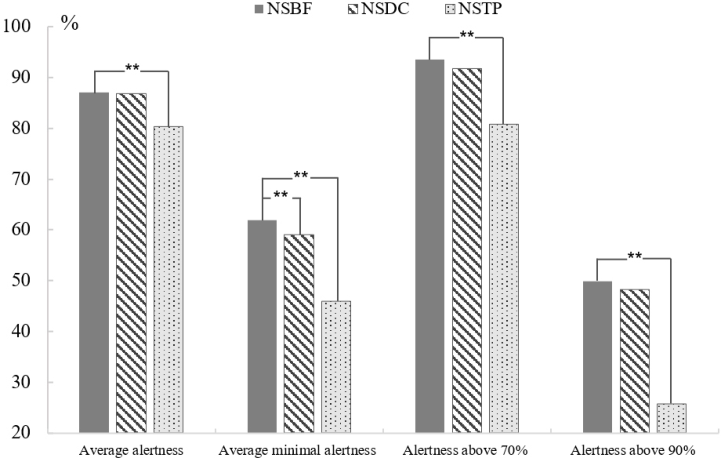
In terms of the fatigue level during work, we also compare the indicators of alertness among the models. NSBF exhibits higher levels of nurse alertness during work (mean = 86.97%) than NSDC (mean = 86.84%, p > 0.1) and NSTP (mean= 80.28%, p < 0.01). In terms of the minimal
Nurses Scheduling Under Epidemic Crises: Balancing Demand Coverage 1537
alertness across the schedule during work, NSBF (mean = 61.96%) also has a higher level than NSDC (mean = 59.08%, p < 0.01) and NSTP (mean = 45.89%, p < 0.01). The percentage of alertness above 70% and 90% during work in NSBF (mean = 93.47%; mean = 49.90%) was higher than NSDC (mean = 91.79%, p > 0.1; mean = 48.33%, p > 0.1) and NSTP (mean = 80.77%, p < 0.01; mean = 25.78%, p < 0.01). Figure 2 shows the alertness indicators during work among the three models.
Figure 2: Comparison of three models on alertness indicators during work. Note: *p < 0.1, ∗p < 0.05, ∗∗p < 0.01. The data without marks have no significant different.
DISCUSSION
Value of BMMF on Nurse Emergency Scheduling We utilized the BMMF to quantitatively forecast the fatigue of nurses in situations of emergency heightened demand, thereby bring out a schedule that minimizes nurse fatigue while still maintaining the necessary level of labor force in high-intensity work scenarios. BMMF based on neurobiology can precisely estimate the relation between wake-sleep activities and performance and the new model can find a better solution that balances demand and fatigue in this scenario applying BMMF. Although few studies demonstrate the application of BMMF in emergency medical field, the prediction effectiveness and the help on reducing the fatigue and promoting the performance in the scheduling have been verified in several fields. The two models compared represent the scheduling method under normal conditions (NSDC), and the scheduling method that prioritizes task coverage (NSTP) during an EC emergency. Compared with NSDC, NSBF improved the task
1538 Meng and Ma
demand coverage and reduced nurse fatigue. Compared with NSTP, NSBF sacrificed the coverage of some demands and reduced the fatigue of nurses.
In the situation where the demand is urgently needed to be met, the previous scheduling method rarely has a feasible solution, or temporarily ignores the rest and fatigue of the personnel to meet the demand, resulting in acute fatigue to the personnel working overtime, especially in shift work. NSTP expresses the method to cover more demands regardless of fatigue. But at higher task demand levels, the NSTP results, while meeting most demands, reached unacceptable levels of fatigue. Here in the computation results, the average minimum alertness level of NSTP was 45.4%, and under normal working conditions, it is necessary to go to sleep when it is lower than 70%. There were 20% of the working hours below the level of alertness of 70%, and only 25% of the working hours exceeded the level of alertness of 90%. Although NSBF had 17% less demand coverage than NSTP that did not consider the fatigue, NSBF had a significant improve in fatigue indicators. NSBF improved 7% in average alertness, 15% in minimal alertness, 9% in the percentage of alertness above 90% and 23% in percentage above 70%. NSTP completed more tasks in the short term, but the results showed poor work performance, low alertness, and severe fatigue throughout the crisis emergency cycle, which led to nurse health problems and medical accidents, and led to increased turnover rates, influencing the stability of the healthcare system in the long term. Nurses experience fatigue due to the shortage of nursing staff, and it is essential to prevent the nurse fatigue from exacerbating the shortage, leading to long-term adverse effects. In our approach, nurses assume a heavier workload than usual, while minimizing fatigue and reducing its further impact. This strategy aims to address a balance between short- term and long-term work objectives, with the goal of addressing the conflict between demand and fatigue as effectively as possible.
Managerial Insights In the early stages of an EC, a method similar to NSTP is usually adopted in the case of insufficient manpower, increasing the working hours of nurses to complete more tasks. However, nurse fatigue should also be an important consideration. Increased nurses’ working hours, whiles completing more tasks in the short term, can lead to nurse fatigue risks and long-term healthcare system problems caused by nurse turnover, which also occurred in the COVID-19 epidemic. In our computational cases, the task pressure is high, and the nurses fatigue caused by NSTP scheduling reached an unacceptable level. NSBF balanced fatigue and tasks, and completed the demand as much as possible while at the same time ensured the nurse fatigue at a low level. In reality, NSTP leads to serious nurse fatigue under heavy workload and insufficient manpower. Thus, the coverage of short-term tasks and the sustainability of long-term missions should be balanced and the overall work arrangement of nurses should be more sustainable, where the result of NSBF could be more balanced with better performance.
For managers, it’s important to build the emergency medical team to fill the emergency demands under epidemic crises. However, in the
Nurses Scheduling Under Epidemic Crises: Balancing Demand Coverage 1539
face of severe shortages, the challenge lies in balancing the coverage of task completion while ensuring sustainability, and protecting healthcare staff’s communication, rest, and welfare. Unpredictable workloads, lack of recognition, and inadequate compensation are the primary factors driving their decisions to leave the job. To provide scientific and reasonable scheduling for nurses, reducing uncertainty and fatigue is crucial. Scientific scheduling not only benefits nurses but also ensures that patients have access to sufficient and safe healthcare resources, meeting their needs during epidemic crises (Cho et al., 2016).
Limitations An important limitation of this study is the crucial role of accurate demand estimation and forecasting in crisis emergency nurse scheduling. The accurate allocation of personnel according to demand is imperative for enhancing human resource utilization and reducing nurse fatigue. However, in crisis emergency situations, it can be challenging to estimate demand accurately, given the limited time for calculating working periods and determining the required number of nurses with minimal loss. Hence, the accuracy of demand forecasting is critical in optimizing work efficiency, performance, and the physical and mental health of nurses during crises and emergencies. Studies have focused on demand analysis and forecasting in emergency situations, and forecasts of demand and crisis occurrence can be made based on methods such as big data, information science, and data science (Asadzadeh et al., 2020). The model developed in this study is reliant on accurate demand forecasting. With the uncertain and dynamical demands, the model in this study may address the problem by solving short-term emergency issues and modifying the demands dynamically.
CONCLUSION
We constructed an MINLP problem to schedule the time slots for nurses under short-term epidemic emergencies during ECs when there is severe nurse under-staffing. We utilized the bio-mathematical model of fatigue (BMMF) to predict nurse fatigue and incorporated fatigue as a critical aspect in the NSP. Due to the spatial and temporal characteristics of ECs, medical demand is urgent and nurses are understaffed. Nurses often experience more fatigue due to sharply increasing workloads and irregular shifts. Sustained pandemics exacerbate the fatigue issue, further causing higher turnover and understaffing of nurses, which may jeopardize the entire healthcare system. Our proposed solution led to less nurse fatigue and better balanced the fatigue and urgent demands, thereby protecting the long-term emergency capability of the healthcare system. Additionally, a nurse supplement mechanism should be established to fundamentally address the issues of nurse fatigue and demand coverage.
1540 Meng and Ma
ACKNOWLEDGMENT
This work was supported by the National Natural Science Foundation of China [grant numbers 72171127 and 72192822].
REFERENCES
Amindoust, A., Asadpour, M., Shirmohammadi, S., 2021. A Hybrid Genetic Algorithm for Nurse Scheduling Problem considering the Fatigue Factor. Journal of Healthcare Engineering 2021, 1–11. Asadzadeh, A., Pakkhoo, S., Saeidabad, M. M., Khezri, H., Ferdousi, R., 2020.
Information technology in emergency management of COVID-19 outbreak. Informatics in Medicine Unlocked 21, 100475. Brunner, J. O., Bard, J. F., Kolisch, R., 2009. Flexible shift scheduling of physicians.
Health Care Management Science 12, 285–305. URL: http://link.springer.com/ 10.1007/s10729–008-9095–2, doi: 10.1007/s10729–008-9095–2. Cho, E., Lee, N. J., Kim, E. Y., Kim, S., Lee, K., Park, K. O., Sung, Y. H., 2016. Nurse staffing level and overtime associated with patient safety, quality of care, and care left undone in hospitals: A cross-sectional study. International Journal of Nursing Studies 60, 263–271. Falatah, R., 2021. The Impact of the Coronavirus Disease (COVID-19) Pandemic on
Nurses’ Turnover Intention: An Integrative Review. Nursing Reports 11, 787–810. Havaei, F., Ma, A., Staempfli, S., MacPhee, M., 2021. Nurses’ Workplace Conditions Impacting Their Mental Health during COVID-19: A Cross-Sectional Survey Study. Healthcare 9, 84. Hursh, S. R., Redmond, D. P., Johnson, M. L., Thorne, D. R., Belenky, G., Balkin, T. J.,
Storm, W. F., Miller, J. C., Eddy, D. R., 2004. Fatigue models for applied research in warfighting. Aviation, space, and environmental medicine 75, A44– A53. Labrague, L. J., & de Los Santos, J. A. A., 2021. Fear of Covid-19, psychological distress, work satisfaction and turnover intention among frontline nurses. Journal of Nursing Management 29, 395–403. Liu, Q., Luo, D., Haase, J. E., Guo, Q., Wang, X. Q., Liu, S., Xia, L., Liu, Z., Yang, J.,
Yang, B. X., 2020. The experiences of health-care providers during the COVID-19 crisis in China: A qualitative study. The Lancet Global Health 8, e790–e798. Liu, R., Fan, X., Wu, Z., Pang, B., Xie, X., 2022a. The Physician Scheduling of Fever Clinic in the COVID-19 Pandemic. IEEE Transactions on Automation Science and Engineering 19, 709–723. Mo, Y., Deng, L., Zhang, L., Lang, Q., Liao, C., Wang, N.,... & Huang, H,
2020. Work stress among Chinese nurses to support Wuhan in fighting against COVID-19 epidemic. Journal of nursing management 28, 1002–1009. Peng, H. T., Bouak, F., Wang, W., Chow, R., Vartanian, O., 2018. An improved model to predict performance under mental fatigue. Ergonomics 61, 988–1003. Sagherian, K., Steege, L. M., Cobb, S. J., Cho, H., 2023. Insomnia, fatigue and
psychosocial well-being during COVID-19 pandemic: A cross-sectional survey of hospital nursing staff in the United States. Journal of clinical nursing 32, 5382–5395. Sasangohar, F., Moats, J., Mehta, R., Peres, S. C., 2020. Disaster Ergonomics: Human Factors in COVID-19 Pandemic Emergency Management. Human Factors 62, 1061–1068. World Health Organization, 2021. COVID-19: Occupational health and safety for
health workers: interim guidance.
LISTED IN THE AHFE DIGITAL BOOKSTORE CATALOGUE
Explore the complete digital volume
Human Factors in Design, Engineering, and Computing
Read this individual research paper free through the original publisher, or explore the full digital proceedings book.
ISBN 978-1-964867-75-5
Explore this ISBN in the AHFE Bookstore ↗Listed in the July 2026 bookstore catalogue; search by ISBN to confirm current availability · Digital book purchase optional