Jinghuan Xu, Yulin Zhao (2026). Narrative Design Method Innovation: Exploring Paths to Enhance the Story Connotation and User Experience of Cultural and Creative Products. In: Usability and User Experience. AHFE Open Access, vol. 232, pp. 47–57. https://doi.org/10.54941/ahfe1008034
Cultural and creative products serve as vital vehicles for cultural dissemination, where the articulation of narrative substance and its connection to user experience constitute the core driver of value enhancement. However, contemporary design in this field is hampered by prevalent issues: homogenized narrative formats and insufficient emotional resonance between story and user, which impede effective cultural transmission.Focusing on innovating narrative design methodology, this study aims to enhance the narrative depth and user experience of cultural and creative products. Employing a triangulated framework—encompassing literature review, questionnaire surveys, and case study analysis—we clarify the current applications and dilemmas of narrative design in these products and investigate the intrinsic relationships between narrative elements, design techniques, and user experience.This research delineates innovative pathways in design methodology across three dimensions: narrative structure, emotional expression, and interaction modes. Integrating theories from semiotics and affective design, it explores the linkages between narrative meaning, design approach, and user engagement. By decoding the symbolic significance of cultural elements, the study formulates targeted narrative design strategies for cultural products.Through design practice and validation with representative products, this work provides actionable methodological insights for narrative design in this domain. It seeks to propel the evolution of cultural and creative products from mere "cultural symbol presentation" towards "story-driven emotional communication," thereby paving the way for novel applications of narrative design within visual communication.
The deep integration of the digital economy and national cultural development strategies has fundamentally transformed the role of cultural and creative products. They have evolved beyond mere functional items or symbolic representations into vital mediums that carry cultural memory, transmit intrinsic values, and foster emotional connections with users. As consumer expectations rise alongside evolving aesthetic sensibilities, demand is shifting decisively from “functional utility” towards “emotional resonance”
48 Xu and Zhao and “meaningful consumption” (Chen, Deng, & Shi, 2023). This paradigm shift places a premium on the depth of narrative, coherence of storytelling, and quality of interactive experience embedded within products, positioning them as a crucial conduit for affective communication between designers and consumers.
Nevertheless, a significant portion of current cultural and creative products remains plagued by persistent shortcomings: homogenized narratives, the clumsy juxtaposition of cultural symbols, a disconnect between storylines and user needs, and superficial interactive experiences. These limitations severely hinder the effective translation of cultural value into user perception, ultimately constraining the product’s communicative power and long-term vitality.
Narrative design has emerged as a strategic methodological framework, guiding the focus of design from “object” to “story,” thereby extending its purpose from fulfilling basic needs to addressing users’ deeper psychological and spiritual aspirations (Chen et al., 2023). A critical gap persists in the form of a robust, quantitative framework for evaluating the efficacy of narrative design interventions, making their impact difficult to substantiate (Wei, Zhou, & Zhao, 2021). As the core nexus linking cultural essence, product form, and user experience, the innovativeness of narrative design methodology directly dictates a product’s emotive power and the depth of user engagement. This raises pivotal questions: How can we break free from conventional narrative frameworks to construct systems that possess both cultural depth and contemporary relevance? How can methodological innovation transform users from “passive recipients” into “active participants,” deepening their cultural understanding and identification through interaction?
To address these questions, this study integrates methodologies from design anthropology with contemporary interaction technologies, centering on the core proposition of “narrative design method innovation.” Our objectives are three fold: to explore effective pathways for enhancing the narrative substance of cultural and creative products; to discuss practical strategies for leveraging design anthropological approaches to excavate and optimize user experience; to provide theoretical insights for the creative transformation and innovative development of cultural resources. Ultimately, this work aims to empower cultural and creative products to achieve their fundamental goal: accurately conveying cultural connotations while authentically meeting the evolving spiritual demands of consumers.
Literature Review
Cultural and creative products are high-value-added goods developed through the intellectual and technical input of creators. They involve the creative enhancement of cultural resources and artifacts utilizing modern technological means, realized through the development and application of intellectual property. Cultural identity constitutes the essential core of these products, as they carry traditional culture, regional characteristics, or national spirit, thereby enhancing consumers’ sense of cultural identity and belonging (Setlhatlhanyo, Marope, Moalosi, & Sealetsa, 2018).
Narrative Design Method Innovation: Exploring Paths to Enhance the Story Connotation 49 In terms of product typology, cultural and creative products primarily encompass three major categories: tourism souvenirs, entertainment/art derivatives, and corporate cultural products. Driven by cultural revitalization and consumption upgrading trends, the core value of these products has shifted from mere “transplantation of cultural symbols” towards the dual objectives of “disseminating cultural connotations” and “enhancing user experience” (Amaro, Ferreira, & Henriques, 2020). Consequently, market competition increasingly focuses on the depth of narrative content and the innovativeness of the user experience. With its rapid expansion, China’s cultural and creative industry has become a core engine for GDP growth in many regions and a critical arena for the competition of national cultural soft power (Liu & Zhao, 2024).
Product narrative uses “story” as the central thread, with product function, material, form, and usage mode as constituent elements. The design process is treated as a narrative expression process, with the product serving as a medium to connect users, thereby enhancing the product’s appeal and the user’s emotional experience (Yin, Zhu, & Zhang, 2025).
Within the cultural product sector, narrative design is not merely an additive combination of product and story text. Rather, it utilizes product form, function, interaction modes, and usage scenarios to “narratively connect cultural symbols.” This approach proves more effective than simply accumulating elements in enabling users to internalize cultural meanings and establish cultural identity (Zhang, Shi, & Gu, 2023).
Current research on narrative design for cultural products exhibits three prominent trends. First, a transition from “one-way narration” to “interactive narrative.” Traditional static story presentation methods are increasingly inadequate for user needs. Scholars argue that narrative design must balance cultural heritage with innovation, and that product narratives should be rooted in cultural context while possessing future adaptability (Setlhatlhanyo et al., 2018).
Second, an extension from “designer-led” to “user co-creation.” Methods such as user research and participatory design are employed to involve consumers in establishing story themes and plotting plot, thereby uncovering latent user needs, shortening the distance between designer and user, and optimizing the user experience fit of cultural products (Geng & Duan, 2024).
Third, a notable trend of interdisciplinary integration. Integrating the creative practice of design with the observational analysis of anthropology can provide novel pathways for innovation in cultural product design methodologies, achieving dual enhancement of cultural narrative depth and user experience (Geng & Duan, 2024).
Concurrently, the extant body of research exhibits several pronounced deficiencies. First, a pervasive issue of narrative homogenization exists, where the majority of products engage only in superficial adaptations of well-known traditional allusions, failing to incorporate narratives from niche cultural sources or contemporary lived experiences. Second, a persistent disconnect is observed between narrative content and product functionality. Current scholarship has yet to establish definitive criteria for assessing the compatibility between cultural symbols and product forms or to propose
50 Xu and Zhao methodologies that prevent the misuse of symbols. This ambiguity often results in designer bias, which can obstruct the user’s comprehension of the intended core narrative (Wei, Zhou, & Zhao, 2021). Third, the experiential depth offered by many products remains inadequate. Interactive narrative implementations are frequently confined to basic operational feedback mechanisms, lacking the sophisticated design required for immersive and sustained engagement. Fourth, and most critically, there is a notable absence of a rigorous, quantitative evaluation framework, rendering the purported effectiveness of narrative design interventions largely unverifiable in empirical terms (Wei, Zhou, & Zhao, 2021).
As the fundamental vehicle for cultural transmission, symbols constitute the basic building blocks of narrative design in cultural and creative products. Semiotic theory provides a robust scientific methodology for the precise translation and application of cultural elements. The Morrisian frameworkanalyzes signs across three dimensions: semantics, pragmatics, and syntactics, thereby foregrounding the context-dependent generation of meaning. A comprehensive design approach, therefore, must concurrently consider a symbol’s semantic origin, its pragmatic emotional resonance with users, and its syntactic fit within the overall product morphology.
Despite offering a systematic toolkit for cultural extraction, the application of semiotics in design contexts remains fraught with limitations. First, the extraction process itself often lacks formalized, granular procedures. The common pitfall of “inadequate cultural trace” during the translation of elements necessitates deeper ethnographic investigation to ensure interpretive fidelity. Furthermore, imprecise definitions of the signifier- signified correspondence frequently lead to a loss or distortion of intended cultural meaning in the final product (Ji, Zhang, & Gao, 2025). Second, the prevailing focus is disproportionately placed on the extraction of visual symbols, while non-visual elements—such as behavioral rituals, performative acts, or auditory cues—are routinely neglected. Third, the validation of extracted symbols from the user’s perspective is often omitted, resulting in a symbolic language that fails to elicit the desired emotional or cognitive response from the target audience.
Design anthropology integrates the immersive, interpretative methodologies of anthropology with human-centered design principles. Ethnography, as its core research instrument, employs fieldwork and sustained participant observation to excavate the deep-seated meanings embedded within cultural practices and to uncover latent user needs. This process acts as a critical conduit, channeling authentic cultural substance into the design workflow and thereby bridging the gap between cultural fidelity and user experience compatibility (Murphy, 2015). Its application in cultural product development manifests in two primary modalities:Deep Contextual Inquiry: Utilizing methods such as participatory observation, in-depth interviews, and life- history documentation within authentic cultural milieus to decode the implicit cultural logics that underpin surface-level symbols.
Full-Process Integration: This model embeds anthropological insights throughout the design lifecycle. Involving consumers directly in the design
Narrative Design Method Innovation: Exploring Paths to Enhance the Story Connotation 51 and fabrication process significantly enhances their sense of engagement, interaction, and personal connection to the product (Hwang, Kim, Lee, & Kim, 2019). Ultimately, maintaining competitiveness, particularly in sectors like tourism, demands design and production strategies marked by flexibility and innovation to adapt to dynamic market trends (Swanson & Horridge, 2006). The ubiquity of social media and advancing interactive technologies have introduced transformative vectors for narrative dissemination and user engagement in the cultural product domain. Their integration with design centers on two core functions—“narrative amplification” and “participatory interaction”—yielding several key pathways.
By constructing multi-platform content matrices, they enable the widespread diffusion of cultural narratives. On short-video platforms , content formats such as craft demonstrations, designer dialogues, and dramatized cultural stories transform product backgrounds into engaging, visual narratives that stimulate user interest. On lifestyle and review platforms, high- quality graphical and textual analyses that decode symbolic meanings and contextualize usage scenarios leverage algorithmic recommendation systems to precisely target communities of cultural enthusiasts (Wei et al., 2021). This paradigm of “content seeding and narrative propagation” effectively cultivates user awareness and appreciation of the product’s story prior to the point of purchase.
The foundational tenet of user experience design is “empathy grounded in deep user research.” Product efficacy must be validated through rigorous usability testing rather than relying on designer intuition alone (Išoraitė & Gulevičiūtė, 2025). Social media facilitates the construction of a dynamic, tripartite network connecting designers, users, and cultural practitioners, thereby infusing the narrative design process with co-creative energy. Live-streaming interactions allow for real-time user feedback on narrative elements and participation in design decisions via polls. Brand-led online campaigns encourage users to share their product experiences and cultural interpretations, generating valuable user-generated content and secondary narrative propagation.
Social media and related technologies enable a seamless closed-loop model of “online discovery, offline engagement, and online sharing.” For instance, incorporating technologies like Augmented Reality (AR) in souvenir design can significantly boost visitor engagement and emotional investment. Establishing dedicated experiential zones that employ such technologies provides opportunities for innovative and interactive encounters (Hidayat, Novica, Puspitasari, & Daud, 2021).
A review of the literature confirms a widespread intent to integrate local cultural symbols into product design. However, there is considerably less discourse concerning the concrete, replicable methodologies for acquiring these design elements, or on the specific mechanisms that trigger deep-seated resonance and identification within the potential consumer. Synthesizing the analysis above, three persistent, interconnected methodological gaps are evident:
52 Xu and Zhao First, the process of symbol extraction typically lacks a robust, tripartite validation mechanism that sequentially verifies cultural source accuracy, user perception fidelity, and practical application feasibility, leading to compromised narrative integrity.
Second, while valuable, the incorporation of ethnographic methods from design anthropology often remains fragmented, applied in isolated phases rather than being woven into a coherent, end-to-end design methodology.
Third, the application of social media and interactive technology is frequently relegated to the later stages of “experience augmentation and marketing dissemination,” lacking deep, structural integration with the foundational narrative and symbolic design phases. This results in a jarring disconnect where technological features feel appended rather than intrinsically woven into the cultural core of the product.
This study, therefore, is positioned to address these gaps. It aims to leverage a deliberately interdisciplinary perspective to propose, articulate, and validate optimized design pathways for cultural and creative products that are both culturally resonant and experientially compelling.
Methodology
This study employed a systematic literature review as its foundational methodology. The primary objectives were to systematically synthesize core theories, research paradigms, and practical applications within the intersecting fields of narrative design, semiotics, design anthropology, digital interactive technology, and user experience in cultural and creative products; This synthesis provided the scientific basis for designing the questionnaire dimensions, structuring the case analysis framework, and formulating the proposed innovative methodological pathways.
The research structured around the continuum of “cultural excavation → symbolic translation → narrative construction → experience enhancement.”
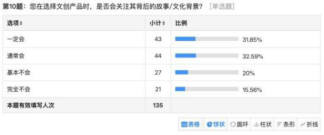
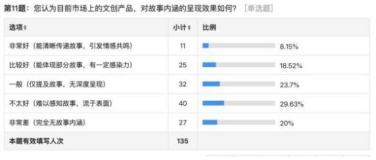
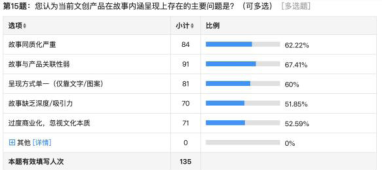
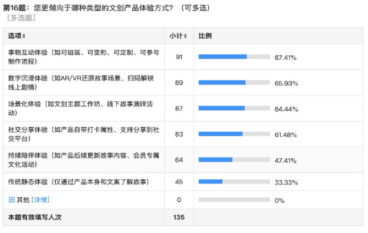
Surveying 135 consumers (Figure 1-4) revealed that 64.44% prioritize narrative depth, validating the need to move beyond superficial symbol application.
User Perception of Narrative Importance: At the user level, 64.44% of respondents indicated they always or usually pay attention to the story behind a cultural product (Figure 1). Furthermore, 25.93% considered narrative depth a decisive factor in their purchase decision. This data substantiates the study’s foundational premise that “narrative substance is a core competitive advantage for cultural products.”
Identified Deficiencies in Current Products: Regarding existing problems, 59.63% of users found it difficult to perceive any story or felt products lacked substantial connotation, 67.41% reported a weak connection between the narrative and the product itself (Figure 2), and 60% cited overly simplistic presentation methods (Figure 3). These results directly pinpoint the core shortcomings of traditional narrative design—namely, “haphazard symbol accumulation, narrative-product disconnect, and shallow user experience”—providing empirical justification for the proposed directions of improving semiotic extraction and deepening ethnographic integration.
Narrative Design Method Innovation: Exploring Paths to Enhance the Story Connotation 53 Receptiveness to Proposed Innovations: In terms of potential solutions, 67.41% of respondents expressed positive recognition of interactive experience design (Figure 4), aligning with the participatory design approach aimed at strengthening emotional connection. Support was also evident for technology integration: 65.93% showed interest in digitally immersive experiences, and 47.41% desired extended post-purchase engagement. These figures validate the feasibility and user demand for the front-loaded integration of digital interactive technologies in the design process.
Figure 1: Will people pay attention to the story or cultural background behind it?Figure 2: What do you think of the presentation effect of the cultural and creative products currently available in the market regarding the interpretation of the story’s essence?Figure 3: What do you think are the main problems regarding the presentation of story content in current cultural and creative products?Figure 4: Which type of cultural and creative product experience do you prefer?
54 Xu and Zhao This study employed a comparative case analysis method to examine two distinct cultural and creative products available on the market. The selected cases were analyzed to deconstruct and evaluate the application of narrative design principles in practice.
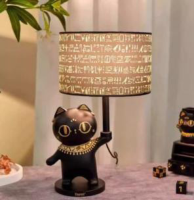
A semiotic analysis, grounded in Charles Sanders Peirce’s triadic model, was conducted to decipher the narrative encoding of the “Gayer-Anderson Cat” (Figure 5) product line. The analysis revealed a sophisticated translation from a historical artifact into a contemporary cultural IP through layered symbolic operations.
The ‘Gayer-Anderson Cat’ demonstrates successful semiotic extraction, translating cultural motifs (e.g., the Eye of Ra) into a marketable icon. However, its narrative remains fixed and object-centric, lacking the dynamic interaction proposed in our framework.
Figure 5: Gayer-Anderson cat.
Figur 6: AR cultural mineral water.
Case Study II: “Butterfly Spring” AR Cultural Mineral Water (Figure 6): Technology-Frontloaded Immersive Narrative Design This case exemplifies an immersive narrative design approach where Augmented Reality (AR) technology was integrated as a core, foundational component of the design process, rather than a supplementary feature added post-production.
Symbolic Condensation and Narrative Focus: The product’s narrative is anchored in the dual themes of “natural legend” and “intangible cultural heritage.” The bottle’s surface art transforms butterfly wing textures into a stylized emblem, while ripple patterns are engraved into the cap, using visual symbols to directly convey the core imagery of the “butterfly transformation legend.” This approach aligns with the lightweight usage context of bottled water and lowers the cognitive threshold for user engagement.
Narrative Design Method Innovation: Exploring Paths to Enhance the Story Connotation 55 Synthesizing the findings, we propose a methodology framework (Table 1) that integrates semiotic precision with anthropological depth to bridge the gap between cultural authenticity and user engagement
Table 1. Research methodology framework.
Table available in the original PDF paper.
Research Phase Methodology Procedures and Objectives Data Sources / Sample
Literature Review
Phase 1: Theoretical Construction
Academic journals, conference papers, and design theory books.
Systematically review Semiotics (Peirce’s Triangle), Design Anthropology, and trends in Cultural & Creative Product design to establish the theoretical foundation.
Phase 2: Demand Validation
Questionnaire Survey
Equation reproduced from the original PDF.
Distribute structured questionnaires to collect user demand data. Validate the correlation between narrative design and emotional engagement.
Phase 3: Empirical Analysis
Product observation, user reviews, design team interviews, sales data.
Case Study Conduct in-depth analysis of two representative cases: 1. The British Museum “Cat” Series (Traditional Symbol Translation) 2. Butterfly Spring AR Mineral Water (Digital Narrative & Interaction)
CONCLUSION
The transition from “symbol accumulation” to “anthropological co-creation” addresses a fundamental flaw in traditional design. Conventional approaches often terminate at the superficial extraction and visual collage of cultural symbols, resulting in products devoid of underlying cultural logic. To transcend this limitation, our study proposes a narrative reconstruction path grounded in design anthropology. This involves employing fieldwork and ethnographic observation within settings such as intangible cultural heritage (ICH) workshops and folk ritual sites. The objective is to excavate the implicit sense of ritual and story archetypes concealed behind explicit symbols, thereby ensuring narrative cultural authenticity. Moving further, this research discards the “designer-centric” paradigm in favor of constructing a tripartite co-creation mechanism involving designers, cultural inheritors, and target users . Through formats like collaborative workshops, user emotional needs are integrated from the conceptualization phase, enabling narrative themes to achieve precise alignment with contemporary aesthetic preferences. This shift from “one- way output” to “pluralistic co-creation” transforms cultural narrative from a cold display of symbols into a dynamic carrier imbued with emotional resonance and contemporary relevance.
56 Xu and Zhao In conclusion, the innovative value of this research lies in constructing a systematic and operational narrative design methodology encompassing “deep excavation – scientific assessment – technological enablement.” This framework facilitates an industry-wide transition from the superficial “presentation of cultural symbols” to the deeper paradigm of “story-driven emotional communication.” Looking forward, future research could explore the application of AIGC in personalized narrative generation and investigate narrative adaptive design within cross-cultural contexts to address the diverse challenges of globalization. This multidimensional, integrated narrative design approach holds significant promise as a key engine for cultural and creative products to achieve both profound connotation deepening and experiential enhancement.
ACKNOWLEDGMENT
I am deeply grateful to my advisor, Professor Zhao. From refining the research topic and constructing the analytical framework to inspiring methodological approaches and making meticulous revisions, Professor Zhao has guided me through every critical stage with rigorous academic attitude, profound expertise, and unwavering patience.
REFERENCES
Amaro, S., Ferreira, B. M., & Henriques, C. (2020). Towards a deeper understanding of the purchase of souvenirs. Tourism and Hospitality Research, 20(2), 223–236. Chen, J., Deng, R., & Shi, D. (2023). Narrative design research review. Design, 15,
64–66. Cui, W., Wang, Y., Liu, Z., & Qu, H. (2020). Text-to-Viz: Automatic generation of infographics from proportion-related natural language statements. IEEE Transactions on Visualization and Computer Graphics, 26(1), 906–916. Geng, H., & Duan, J. (2024). Review and reflection on the development of design
anthropology. Design, 37(16), 91–93. Hidayat, I., Novica, D., Puspitasari, D., & Daud, K. (2021). Collecting the memories: The potential of augmented reality souvenirs in agro-tourism. KnE Social Sciences, 339–346. Hwang, E., Kim, J., Lee, J. C., & Kim, S. (2019). To do or to have, now or later, in
travel: Consumption order preference of material and experiential travel activities. Journal of Travel Research, 58(6), 961–976. Išoraitė, M., & Gulevičiūtė, G. (2025). User experience design in the context of experiential marketing. Entrepreneurship and Sustainability Issues, 12(4), 87–95. https://doi.org/10.9770/h4444238684 Ji, Y. H., Zhang, S. H., & Gao, H. H. (2025). Design of cultural elements of Weifang
kites based on Morris semiotics. Packaging Engineering, 46(12), 495–505. Liu, L., & Zhao, H. (2024). Research on consumers’ purchase intention of cultural and creative products: Metaphor design based on traditional cultural symbols. PLOS ONE, 19(5), e0301678. Murphy, K. M. (2015). Swedish design: An ethnography. Cornell University Press. Setlhatlhanyo, K. N., Marope, O., Moalosi, R., & Sealetsa, O. J. (2018). Developing
creative product designs inspired by ethnic cultural heritage: A case study of design students at the University of Botswana. FormAkademisk, 11(6), 1–13.
Narrative Design Method Innovation: Exploring Paths to Enhance the Story Connotation 57 Swanson, K., & Horridge, P. (2006). Travel motivations as souvenir purchase
indicators. Tourism Management, 27(4), 671–683. Wei, Y., Zhou, X., & Zhao, Z. (2021). Research on the narrative design of tourism cultural and creative products. Design, 1, 8–10. Yin, X., Zhu, Y., & Zhang, T. (2025). Research on product narrative design based
on Chinese narrative theory. Design, 38(17), 89–93. https://doi.org/10.20055/j. cnki.1003-0069.002908 Zhang, Y., Shi, X., & Gu, W. (2023). A study on the value and practical strategies of narrative design. Art Education Research, 79–81.
LISTED IN THE AHFE DIGITAL BOOKSTORE CATALOGUE
Explore the complete digital volume
Usability and User Experience
Read this individual research paper free through the original publisher, or explore the full digital proceedings book.
ISBN 979-8-950676-08-6
Explore this ISBN in the AHFE Bookstore ↗Listed in the July 2026 bookstore catalogue; search by ISBN to confirm current availability · Digital book purchase optional