Paulo Eduardo Hauqui Tonin, Maria Rita Ferrara, Elton Moura Nickel (2026). Bridging Senses and Systems: Designing Multisensory User Experiences in Omnichannel Fashion Retail. In: Usability and User Experience. AHFE Open Access, vol. 232, pp. 260–269. https://doi.org/10.54941/ahfe1008054
This study examines how multisensory experience design can support cohesive, human-centered user journeys in omnichannel fashion retail, with a focus on usability, user experience (UX), and human factors. In response to accelerated digitalization, online and physical channels are conceptualized as interconnected socio-technical systems with complementary roles: digital platforms prioritize efficiency and information access, while physical stores enable embodied, multisensory, and affective engagement. Sensory experience is proposed as a bridging mechanism that positions the store as a multisensory anchor within fragmented omnichannel journeys. The research is based on an integrative qualitative literature review spanning experience design, environmental psychology, marketing, multisensory perception, interaction design, ergonomics, and human–computer interaction, complemented by contemporary retail cases. Findings indicate that the orchestration of visual, tactile, olfactory, auditory, thermal, and spatial cues shapes emotional states, perceived comfort, spatial legibility, and approach–avoidance behavior, while also supporting usability, wayfinding, and cognitive ease. The study proposes a systems-oriented framework structured around sensorial modalities, omnichannel touchpoints, and experiential objectives, offering conceptual and practical contributions for future research and design practice.
The contemporary landscape of fashion retail has been significantly reshaped by accelerated digitalization, shifting consumer behaviors, economic volatility, and the structural impacts of the COVID-19 pandemic. Rapid adoption of digital platforms has transformed expectations regarding convenience, immediacy, and personalization (Grewal et al., 2017; Pantano et al., 2020), while global crises have reinforced preferences for safety, experience-rich environments, and hybrid modes of interaction (Sheth, 2020). Within this context, physical retail spaces—particularly in fashion—face increasing pressure to justify their relevance amid declining foot traffic and rising demands for experiential differentiation.
Consequently, brick-and-mortar stores are being repositioned from transactional venues to immersive environments capable of fostering emotional connection and multisensory engagement (Bhatnagar & Syam, 2014; Received January 27, 2026; Revised March 31, 2026; Accepted April 15, 2026; Available online July 20, 2026
Bridging Senses and Systems 261 Bäckström & Johansson, 2017). The shift from multichannel to omnichannel retail, understood as the integration of physical and digital touchpoints into cohesive customer journeys (Gallino & Moreno, 2014), further exposes experiential discontinuities across channels. While digital platforms prioritize efficiency and scalability, they often lack the sensory and affective qualities inherent to in-person interaction. This study argues that omnichannel retail should be understood as the integration of distinct but interdependent systems, each with its own technological, operational, and experiential logic (Brynjolfsson et al., 2013; Saghiri et al., 2017): digital systems are data- driven and visually oriented, whereas physical retail enables embodied, multisensory, and socially situated experiences (Hagberg, 2016).
Accordingly, the research asks: how can sensory experience design function as a bridging mechanism between digital and physical retail systems to enhance experiential continuity, emotional coherence, and brand consistency across omnichannel fashion journeys? The study addresses a gap in omnichannel strategy by reframing the physical store as a multisensory interface that anchors brand identity. Through an interdisciplinary literature review, the article develops an integrative framework and design guidelines for sensorial brand experiences in fashion retail, and concludes by outlining directions for future research.
Methodology
This study adopts a qualitative, integrative literature review to establish a theoretical foundation for a sensorial brand experience framework tailored to omnichannel fashion retail. This approach enables the synthesis of interdisciplinary perspectives from sensory marketing, experience design, consumer behavior, and retail strategy, supporting a comprehensive understanding of multisensory experience across physical and digital systems (Torraco, 2005). The review followed a structured protocol. Peer-reviewed material was retrieved from databases including Scopus, Web of Science, and Google Scholar, using keywords such as “sensory branding”, “sensory marketing”, “omnichannel retail”, “experience design” and “fashion retail”. Sources were selected based on conceptual rigor and relevance to the research objectives. The literature was then analyzed through thematic coding to identify recurring constructs, frameworks, and applied insights, with particular attention to experiential strategies in fashion and lifestyle retail. These insights informed the development of an original framework and a set of strategic guidelines for designing integrated sensorial experiences across physical and digital channels. Although empirical data were not collected, methodological rigor was ensured through synthesis and critical interpretation of established knowledge.
LITERATURE REVIEW
The Strategic Shifting of Physical Stores The relationship between e-commerce and physical retail in the fashion sector has progressively evolved from competition to complementarity, reflecting
the increasing complexity of consumer behavior in digitally mediated societies. This transformation has been widely discussed in the literature as a structural reconfiguration of retail systems, in which physical and digital environments assume distinct yet interdependent roles within omnichannel ecosystems (see Table 1).
Table 1: Comparative overview: physical vs. digital systems in fashion retail.
Table available in the original PDF paper.
Dimension Physical System (Store, Built Environment)
Digital System (E-commerce / Platforms)
Core Function Sensory engagement, symbolic staging, emotional connection
Interaction Type Multisensory (visual, tactile, auditory, olfactory), face-to-face, embodied Time and Space Bound by store location and operating hours
Ubiquitous access (24/7, multi- device, global) High through algorithms, browsing history, behavioral data
Personalization High with trained staff and tech- assisted services (e.g., RFID, AR, apps) Technologies Used RFID, smart mirrors, appointment- based apps, AR/VR, environmental sensors
AI, machine learning, recommendation engines, CRM, big data analytics
Symbolic Value High: Enables brand storytelling, immersive staging, materiality
Medium: Relies on UI/UX design, digital narratives
Omnichannel Role Emotional and sensorial anchor; initiates or deepens brand relationship
Scalable personalization engine; data collector; entry point for purchase Nike.com & app, Gucci Vault, Zara online, Farfetch platform
Notable Examples Nike House of Innovation, Gucci Garden, Zara app scheduling, Farfetch Store of the Future
These dynamics were intensified by the COVID-19 pandemic, which accelerated digital adoption while reinforcing expectations for safety, personalization, and seamless online–offline transitions (Hagberg et al., 2016; Anica-Popa et al., 2021). Consequently, physical retail spaces— particularly in fashion—have been repositioned from transactional venues to sites of brand embodiment, multisensory engagement, and social interaction. Omnichannel retailing has emerged as a strategic response to this shift. Unlike multichannel approaches that operate in parallel silos, omnichannel strategies integrate digital, physical, mobile, and social touchpoints into cohesive customer journeys (Grewal et al., 2009; Gallino & Moreno, 2014; Roggeveen et al., 2016).
In fashion retail, this integration goes beyond operational alignment to include experiential coherence across the entire customer journey, from pre-purchase to post-purchase stages. This shift is supported by advances in artificial intelligence (AI; data-driven systems that simulate
Bridging Senses and Systems 263 human intelligence), machine learning (ML; algorithms that learn from data), and predictive analytics (methods used to anticipate consumer behavior) (Grewal et al., 2017; Anica-Popa et al., 2021). Within this context, physical stores are increasingly understood as experiential anchors that stabilize and enrich omnichannel systems. Technologies such as radio- frequency identification (RFID; wireless product-tracking technology), smart mirrors (interactive digital displays), mobile applications (interfaces enabling customer–store interaction), and data-driven personalization (algorithmic content adaptation) allow algorithmic intelligence to merge with embodied sensory interaction. Industry cases—including Nike House of Innovation, Zara’s technology-enabled stores and Farfetch’s Store of the Future— demonstrate how physical environments complement digital platforms by reinforcing emotional engagement, narrative depth, and brand coherence across the customer journey.
Multisensory Experience in Fashion Retail Multisensory experience constitutes a core dimension of experiential differentiation in fashion retail. Within the experience economy (Pine & Gilmore, 1999), brands increasingly compete through immersive and memorable encounters rather than products alone. Schmitt’s (1999) experiential marketing framework and subsequent research in experience design and multisensory perception emphasize the deliberate orchestration of sensory stimuli as a driver of affective response, memory, and meaning (Norman, 2004, 2013; Pallasmaa, 2005; Krishna, 2012). Foundational models from environmental psychology provide further grounding. The PAD model (Mehrabian & Russell, 1974) explains how environmental stimuli influence emotional states and approach–avoidance behavior, while Bitner’s (1992) servicescape framework positions spatial layout, ambient conditions, and signage as determinants of consumer perception and satisfaction.
Turley and Milliman’s (2000) classification of retail atmospheric stimuli into visual, auditory, olfactory, tactile, and thermal domains offers a practical structure for sensory design. In fashion retail, tactile interaction is particularly salient, as haptic engagement enhances psychological ownership and purchase intention in hedonic categories such as apparel (Peck & Wiggins, 2006). Visual, olfactory, and auditory cues further contribute to mood modulation, brand expression, and memory formation (Lindstrom, 2012; Spangenberg et al., 2006). Collectively, these perspectives position multisensory orchestration as a strategic mechanism for emotional engagement, symbolic differentiation, and brand coherence rather than a purely aesthetic concern (Gentile et al., 2007; Lindstrom, 2012). In omnichannel contexts, sensory experience increasingly extends beyond the physical store through digital translation and augmentation, reinforcing continuity across platforms (Petit, Velasco & Spence, 2019; Spence, 2020).
Reimagining Experience Through Technology Despite the growth of digital retail, online interfaces remain limited in their ability to deliver fully embodied multisensory experiences, privileging visual
and cognitive interaction over tactile, olfactory, and thermal perception (Krishna, 2012; Hultén, 2017). This digital–sensory gap is widely recognized in the literature as a central challenge of omnichannel retail, while also revealing opportunities for technological augmentation of sensory experience (see Table 2). As a result, physical stores retain a critical role as sites of sensory authenticity, where materiality, atmosphere, and affective engagement can be directly experienced (Manzano et al., 2012; Spence, 2020). To address this gap, fashion retailers increasingly adopt hybrid strategies in which technology augments—rather than replaces—physical experience.
Three domains are central to this process: augmented reality (AR; digital overlays in physical environments), artificial intelligence (AI; data-driven systems for adaptive personalization), and digital twins (virtual replicas used for simulation and synchronization). AR supports virtual try-ons and interactive content, with emerging applications incorporating spatial audio and haptic feedback to enhance sensory engagement. AI dynamically modulates sensory stimuli—such as lighting, sound, or scent—based on contextual and behavioral data (Grewal et al., 2017), while digital twins enable multisensory continuity across physical and digital touchpoints.
Table 2: Strategic challenges and opportunities in sensorial integration for omnichannel fashion retail.
Table available in the original PDF paper.
Challenge Opportunity
Strategic Dimension Sensory Fidelity Digital channels lack touch, scent, temperature
Use AR/VR with haptics and spatial audio to simulate immersive sensory experiences
Emotional Continuity
Fragmented experiences across channels
AI-driven personalization to maintain emotional tone across physical and digital interfaces
Brand Authenticity
Risk of disconnect between online and offline brand perception
Use physical stores as sensory anchors and reinforce them digitally via digital twins or immersive content
Consumer Engagement
Reduced attention span and cognitive overload in digital contexts
Story-driven, sensory-rich digital storytelling to deepen emotional connection
Accessibility and Inclusion
Sensory design may not consider neurodiverse or differently abled consumers
Employ adaptive sensory environments powered by AI and inclusive design principles
Scalability Difficult to scale sensory richness across all retail points
Leverage modular sensorial components and replicate via digital platforms
Experiential Cohesion
Disjointed or inconsistent sensory messaging across touchpoints
Develop integrated sensorial codes and narratives that can be translated consistently across channels
Industry cases illustrate these strategies. Burberry links tactile in-store interaction with digital storytelling through QR codes (quick response codes connecting physical products to digital content). Gucci Garden extends
Bridging Senses and Systems 265 immersive physical environments into digital platforms such as Roblox (an interactive virtual world), translating visual and narrative cues for digitally native audiences. Zara integrates app-based in-store services (mobile applications for scheduling and stock visibility), reducing cognitive load and enabling deeper sensory engagement. Collectively, these cases exemplify a convergent design paradigm in which digital systems amplify physical sensory narratives rather than compete with them. At the same time, the literature highlights persistent challenges, including limited sensory fidelity, risks of overstimulation, and potential experiential manipulation (Spence, 2020). These concerns reinforce the need for a human-centered approach in which technologies augment perception without undermining authenticity (Norman, 2004, 2013). The key challenges and opportunities associated with this integration are summarized in Table 2.
RESULTS
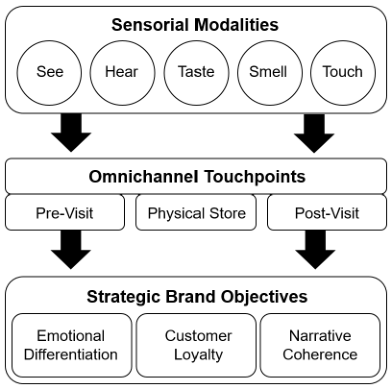
The results of this study are consolidated in a systems-oriented framework for omnichannel fashion retail (Figure 1), developed through the synthesis of interdisciplinary literature and contemporary retail cases. The framework positions sensory experience as a strategic and connective element within omnichannel brand systems, structuring its application across three interdependent axes: Sensorial Modalities, Omnichannel Touchpoints, and Strategic Brand Objectives. The Sensorial Modalities axis encompasses visual, auditory, olfactory, tactile, and gustatory channels, understood as orchestrated inputs that shape perception, emotion, and meaning rather than isolated atmospheric variables. This axis reflects insights from multisensory perception and experience design research, which emphasize emotional resonance, memory encoding, and embodied interaction as core components of experience (Mehrabian & Russell, 1974; Krishna, 2012; Pallasmaa, 2005; Norman, 2004, 2013). In fashion retail, this orchestration materializes brand values through texture, light, sound, scent, and spatial composition.
Figure 1: A systems-oriented framework for omnichannel retail.
The Omnichannel Touchpoints axis maps how sensory strategies unfold across the customer journey, including pre-visit (e.g., digital browsing, social media, mobile apps), in-store (physical immersion and interaction), and post- visit (e.g., personalized communication and loyalty programs). The emphasis lies on translating and synchronizing sensory cues across channels to avoid experiential fragmentation and support narrative continuity (Gallino & Moreno, 2014; Roggeveen et al., 2016).
The Strategic Brand Objectives axis aligns sensory interventions with intended outcomes such as emotional differentiation, symbolic recognition, customer loyalty, and experiential coherence. Sensory experience is thus framed as an intentional mechanism of brand signaling embedded within broader brand systems and customer experience strategies (Lindstrom, 2012; Manzano et al., 2012). To operationalize the framework, Table 3 presents a set of strategic guidelines derived from cross-analysis of theory and practice (e.g., Zara, Farfetch). These guidelines translate the framework into actionable principles for professionals working across fashion design, branding, retail operations, and experience design.
Table 3: Guidelines for designing integrated sensorial brand experiences in omnichannel fashion retail.
Table available in the original PDF paper.
Framework Axis Guideline Application Example Sensorial Modalities Ensure the brand’s sensory identity is distinct, intentional, and coherent across all platforms.
COS conveys simplicity and serenity through minimalist visuals and tactile materials.
Link each sensory input to the emotional tone and symbolic meaning of the brand.
Hermès reinforces exclusivity through refined textures, warm lighting, and quiet spaces.
Avoid overstimulation by calibrating contrast and harmony across modalities.
Zara combines neutral palettes with selective scent zoning to structure the experience.
Omnichannel Touchpoints
Extend sensory cues from physical to digital in a consistent and meaningful way.
Burberry uses QR codes to connect physical products with digital storytelling.
Craft sensory arcs that evolve through the stages of the customer journey.
Gucci Garden offers seamless immersion from physical installations to the Roblox world.
Apply AI to personalize sensory inputs based on customer profiles and behavior.
Smart mirrors or music variations based on dwell time and shopper typology.
Strategic Objectives
Define KPIs for emotional engagement and sensory impact.
Measure variation in store performance based on atmosphere and ambiance metrics.
Embed sensory design into broader brand systems and CX strategy.
Coordinate UX, CRM, and store design teams to align sensory codes across touchpoints.
Align every sensory intervention with brand storytelling goals.
Uniqlo maintains a consistent tone through sound, layout, and product presentation.
Bridging Senses and Systems 267
DISCUSSION
The proposed framework extends existing literature on omnichannel retail, multisensory experience, and experience design by framing the shift from multichannel to omnichannel not merely as a technological evolution, but as a structural reconfiguration of retail systems (Brynjolfsson et al., 2013; Saghiri et al., 2017). The findings reinforce this perspective by showing that experiential coherence depends on the alignment of sensory, technological, and organizational dimensions across touchpoints. The framework’s emphasis on Sensorial Modalities builds on environmental psychology and multisensory branding research. Foundational models such as the PAD framework (Mehrabian & Russell, 1974) and the servicescape concept (Bitner, 1992) explain how environmental stimuli shape emotional states and approach–avoidance behaviors, while multisensory studies highlight the role of sensory congruence in memory and brand attachment (Krishna, 2012; Lindstrom, 2012; Spence, 2020). By integrating these perspectives into a systems-oriented model, the study extends their relevance from isolated store atmospheres to omnichannel brand ecosystems. Examples such as Hermès’ tactile restraint and COS’s sensory minimalism illustrate how controlled sensory orchestration functions as symbolic brand communication.
The Omnichannel Touchpoints axis aligns with literature emphasizing journey continuity as a determinant of customer experience (Grewal et al., 2009; Gallino & Moreno, 2014). Empirical cases—including Burberry’s QR-enabled storytelling, Zara’s app-based in-store services, and Farfetch’s Store of the Future—demonstrate how sensory cues and data-driven personalization can be synchronized across channels, positioning physical stores as experiential anchors within digitally mediated systems (Hagberg et al., 2016; Sheth, 2020). The Strategic Brand Objectives axis further links sensory approaches to brand identity and narrative coherence. Consistent with experiential marketing theory (Schmitt, 1999) and the experience economy perspective (Pine & Gilmore, 1999), the findings suggest that multisensory environments contribute to meaning-making and symbolic differentiation, as exemplified by Gucci Garden’s immersive brand universe extended into digital platforms such as Roblox. At the same time, the discussion acknowledges limitations identified in recent literature. Digital sensory surrogates often lack fidelity and risk overstimulation or manipulation (Spence, 2020), reinforcing the need for a human-centered approach in which technology augments rather than replaces human perception (Norman, 2004, 2013).
CONCLUSION
This article has demonstrated that sensory experience constitutes a central strategic resource in omnichannel fashion retail, enabling emotional engagement, narrative coherence, and experiential differentiation across increasingly complex brand systems. Through an interdisciplinary synthesis of literature and real cases, the study reaffirmed the enduring relevance of physical retail spaces as sites of embodied, multisensory brand experience within digitally mediated ecosystems. Rather than becoming obsolete, physical stores emerge as sensory anchors that validate, enrich, and humanize
omnichannel journeys. The proposed framework contributes to theory and practice by articulating how sensorial modalities, omnichannel touchpoints, and strategic brand objectives can be systematically aligned. By framing sensory experience as a systemic design logic rather than an atmospheric afterthought, the framework offers a cohesive structure for designing meaningful and emotionally resonant brand experiences across channels.
For practitioners, the findings highlight the need for cross-functional collaboration among design, UX, branding, technology, and retail operations teams to ensure sensory coherence and narrative consistency. Nonetheless, the conceptual nature of the framework calls for empirical validation. Future research should examine how specific sensory configurations influence consumer cognition, emotion, and behavior in real-world omnichannel contexts, employing experimental studies, field observations, and UX evaluation methods. Further inquiry is also needed into the evolving role of technologies such as artificial intelligence, augmented reality, and digital twins in adapting, personalizing, and scaling sensory experiences. Advancing sensory approaches in omnichannel fashion retail ultimately depends on closer collaboration between academia and industry, fostering retail ecosystems that are not only digitally integrated, but also sensorially intelligent and human-centered.
REFERENCES
Anica-Popa, I., Anica-Popa, L., Rădulescu, C., & Vrîncianu, M. (2021). The integration of artificial intelligence in retail: Benefits, challenges and a dedicated conceptual framework. Amfiteatru Economic, 23(56), 120–136. Bäckström, K., & Johansson, U. (2017). An exploration of consumers’ experiences
in physical stores: Comparing consumers’ and retailers’ perspectives in past and present time. The International Review of Retail, Distribution and Consumer Research, 27(3), 241–259. Bhatnagar, A., & Syam, S. S. (2014). Allocating a hybrid retailer’s assortment across retail stores: Bricks-and-mortar vs online. Journal of Business Research, 67(6), 1293–1302. Bitner, M. J. (1992). Servicescapes: The impact of physical surroundings on customers
and employees. Journal of Marketing, 56(2), 57–71. Brynjolfsson, E., Hu, Y. J., & Rahman, M. S. (2013). Competing in the age of omnichannel retailing. MIT Sloan Management Review, 54(4), 23–29. Gallino, S., & Moreno, A. (2014). Integration of online and offline channels in retail:
The impact of sharing reliable inventory availability information. Management Science, 60(6), 1434–1451. Gentile, C., Spiller, N., & Noci, G. (2007). How to sustain the customer experience: An overview of experience components that co-create value with the customer. European Management Journal, 25(5), 395–410. Grewal, D., Levy, M., & Kumar, V. (2009). Customer experience management in
retailing: An organizing framework. Journal of Retailing, 85(1), 1–14. Grewal, D., Roggeveen, A. L., & Nordfält, J. (2017). The future of retailing. Journal of Retailing, 93(1), 1–6. Hagberg, J., Sundström, M., & Egels-Zandén, N. (2016). The digitalization
of retailing: An exploratory framework. International Journal of Retail & Distribution Management, 44(7), 694–712.
Bridging Senses and Systems 269 Hultén, B. (2017). Branding by the five senses: A sensory branding framework. Journal
of Brand Strategy, 6(3), 281–292. Krishna, A. (2012). An integrative review of sensory marketing: Engaging the senses to affect perception, judgment and behavior. Journal of Consumer Psychology, 22(3), 332–351. Lindstrom, M. (2012). Brand sense: Sensory secrets behind the stuff we buy. Free
Press. Manzano, R., Gavilán, D., Avello, M., Abril, C., & Serra, T. (2012). Marketing sensorial: Comunicar con los sentidos en el punto de venta. Pearson Educación. Mehrabian, A., & Russell, J. A. (1974). An approach to environmental psychology.
MIT Press. Norman, D. A. (2004). Emotional design: Why we love (or hate) everyday things.
Basic Books. Norman, D. (2013). The design of everyday things: Revised and expanded edition.
Basic Books. Pallasmaa, J. (2005). The eyes of the skin: Architecture and the senses. Wiley. Pantano, E., Pizzi, G., Scarpi, D., & Dennis, C. (2020). Competing during a pandemic?
Retailers’ ups and downs during the COVID-19 outbreak. Journal of Business Research, 116, 209–213. Peck, J., & Wiggins, J. (2006). It just feels good: Customers’ affective response to touch and its influence on persuasion. Journal of Marketing, 70(4), 56–69. Petit, O., Velasco, C., & Spence, C. (2019). Digital sensory marketing: Integrating
new technologies into multisensory online experience. Journal of Interactive Marketing, 45, 42–61. Pine, B. J., & Gilmore, J. H. (1999). The experience economy: Work is theatre & every business a stage. Harvard Business Press. Roggeveen, A. L., & Nordfält, J., & Grewal, D. (2016). Do digital displays enhance
sales? Journal of Retailing, 92(1), 1–9. Saghiri, S. S., Wilding, R., Mena, C., & Bourlakis, M. (2017). Toward a threedimensional framework for omnichannel. Journal of Business Research, 77, 53–67. Schmitt, B. H. (1999). Experiential marketing: How to get customers to sense, feel,
think, act, and relate to your company and brands. Free Press. Sheth, J. (2020). Impact of COVID-19 on consumer behavior: Will the old habits return or die? Journal of Business Research, 117, 280–283. Spangenberg, E. R., Sprott, D. E., Grohmann, B., & Tracy, D. L. (2006). Gender-
congruent ambient scent influences on approach and avoidance behaviors in a retail store. Journal of Business Research, 59(12), 1281–1287. Spence, C. (2020). Sensehacking: How to use the power of your senses for happier, healthier living. Viking. Torraco, R. J. (2005). Writing integrative literature reviews: Guidelines and
examples. Human Resource Development Review, 4(3), 356–367. Turley, L. W., & Milliman, R. E. (2000). Atmospheric effects on shopping behavior: A review of the experimental evidence. Journal of Business Research, 49(2), 193–211.
LISTED IN THE AHFE DIGITAL BOOKSTORE CATALOGUE
Explore the complete digital volume
Usability and User Experience
Read this individual research paper free through the original publisher, or explore the full digital proceedings book.
ISBN 979-8-950676-08-6
Explore this ISBN in the AHFE Bookstore ↗Listed in the July 2026 bookstore catalogue; search by ISBN to confirm current availability · Digital book purchase optional