Elton Moura Nickel, Flávio Anthero Nunes Vianna Dos Santos, Patrícia Teixeira Parrela, Isadora Pedreira De Assis (2024). Systematic Gathering of Requirements for Macroergonomic Analysis and Design for Organizations in Brazil. In: Human Interaction and Emerging Technologies (IHIET 2024). AHFE Open Access, vol. 157, pp. 614–623. https://doi.org/10.54941/ahfe1005521
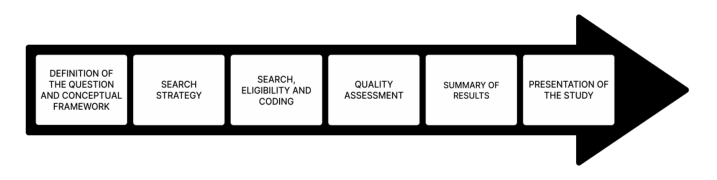
Around the world, several organizations benefit from studies on Macroergonomics. This area of research proposes methods and tools for optimizing socio-technical systems, through the analysis and design of work systems, so that they are suitable for human beings. As a concept, sociotechnical systems refer to interactions between humans and technology, which can be as simple as a single individual using a hand tool or as complex as a multinational organization. In this way, Macroergonomics becomes an important resource for the success of organizational management because it is centered on the human being, that is, it systematically considers professional and psychosocial characteristics in the design or redesign of work systems, thus being a humanized approach in the allocation of functions and tasks. At the same time, it is observed that the main macroergonomic methods currently available in the literature were designed at a specific time and context, in this case, predominantly in the 90s and to mainly meet the demand of North American companies. Therefore, the objective of this paper is to present the process of obtaining requirements that support better performance of macroergonomic analysis and design activities, so that they adequately cover organizations in Brazil. To achieve this objective, the main method used in this research, both for data collection and analysis, was the Systematic Literature Review (SLR), which included the investigation of studies already published in indexed databases about the use of macroergonomic methods in Brazilian organizations. The Systematic Literature Review (SLR) method used was divided into six stages: 1) Definition of the research question and conceptual framework; 2) Search strategy; 3) Search, eligibility and coding; 4) Quality assessment; 5) Summary of results and; 6) Presentation of the study. The result obtained and presented in this paper is a compilation of peer-reviewed scientific studies, which were analyzed with the purpose of identifying the main characteristics, as well as the benefits and/or limitations of macroergonomic methods applied in different organizations in the last two decades. The analysis carried out generated conclusions that made it possible to draw up a list of requirements so that macroergonomic analysis and design activities can be conducted appropriately in this specific context. It is expected that these results will be useful to support the construction of a new methodological approach in the context of organizational management that meets the needs of organizations in Brazil more fully.
Systematic Gathering of Requirements for Macroergonomic Analysis and Design 615
INTRODUCTION
Macroergonomics, or Organizational Ergonomics, makes up, together with Physical Ergonomics and Cognitive Ergonomics, the three major fields of activity in Ergonomics today, as established by the International Ergonomics Association - IEA. This area of knowledge deals with the optimization of socio-technical systems, including their organizational structures, policies and processes (IEA, 2023). As a concept, sociotechnical systems refer to interactions between humans and technology, which can be as simple as a single individual using a hand tool or as complex as a multinational organization. Thus, Macroergonomics values the criteria for an effective approach to the design of work systems, which involve a more integrated project, a humanized approach to the task and consideration of the socio- technical characteristics of organizations. This area of knowledge emerges with a top-down approach to sociotechnical systems for the design of work systems and defines the specifications for the design of the general work system, for the design of human-work, human-machine and human-software. Above all, Macroergonomics is human-centred, because it systematically considers professional and psychosocial characteristics in the design of the work system, being a humanized approach in the allocation of functions and tasks (Hendrick and Kleiner, 2002).
At the same time, it appears that researchers in this area in Brazil currently have a relatively old bibliography, which is predominantly from the 90s, as a reference to methods and tools for use in macroergonomic analysis and design. Furthermore, there is a greater dissemination of foreign case studies that were successful through the implementation of the methodology in the field of Macroergonomics and only incipient studies in Brazil. Added to this, certain organizational tools were designed in commercial software format that aim to assist with specific problems in North American organizations and are not available to the general public or, when they are, they are systems with outdated technology (Hendrick and Kleiner, 2002; Stanton et al., 2005). Therefore, this investigation is based on the assumption that both the teaching field of Macroergonomics in Brazil and national organizations can benefit from the implementation of improvements if an updated methodological foundation is established and adapted to organizational needs and strategies, aiming at analysis and the design of your work systems. Another research confirms this hypothesis. For example, Shahnavaz, Helali and Emami (2000) talk about the need for more Macroergonomics studies in the context of developing countries and Lawson et al. (2021) explains that Macroergonomics emerged in the West to address the American context and then presents the challenges and solutions for applying it in developing countries.
Therefore, given this gap, this paper proposes to present a process for systematically gathering requirements that aims to provide the basis for proposing a new methodological approach in the area of Macroergonomics that meets the needs of organizations in Brazil.
METHOD
This study adopts bibliographical research as the main technique for data collection and analysis. According to Marconi and Lakatos (2010, p. 166), “bibliographical research is not a mere repetition of what has already been said or written on a certain subject, but rather allows the examination of a topic under a new focus or approach, reaching innovative conclusions”. In the case of this research, the innovative conclusions result in the identification of requirements for the development of a methodological approach that encompasses macroergonomic analysis and design activities in a way that is more appropriate to the reality of organizations in Brazil. This result will be obtained from the systematic study on the use of macroergonomic methods in national organizations that have already been published.
Given the above, it was decided to carry out a Systematic Literature Review (SLR), which is the main method presented in this paper. In fact, Saunders, Lewis and Thornhill (2012) argue that any research project should consider carrying out a systematic review of the available literature as one of its steps. Thus, although there are several methods for carrying out systematic reviews, such as those available in Khan et al. (2003), Cooper, Hedges and Valentine (2009), Smith et al. (2011) and Gough, Oliver and Thomas (2012), this study adopted an adaptation of the integrated method proposed by Dresch, Lacerda and Júnior (2015), whose steps can be seen in Figure 1.
Figure 1: Method for systematic literature review (adapted from Dresch, Lacerda and Júnior, 2015, p. 146).
The authors of the method explain that SLR should be used to “map, find, critically evaluate, consolidate and aggregate the results of relevant primary studies on a specific research question or topic” (Dresch, Lacerda and Júnior, 2015, p. 142). The same authors also clarify that the SLR should make it possible to identify gaps to be filled, resulting in a coherent report or a synthesis. Thus, this synthesis must be much more than a mere compilation of the different elements researched, but it is expected that it will result in new knowledge. Therefore, in order to systematize the search for this new knowledge, the following topic presents the results obtained from conducting the steps of the proposed method.
Systematic Gathering of Requirements for Macroergonomic Analysis and Design 617
RESULTS
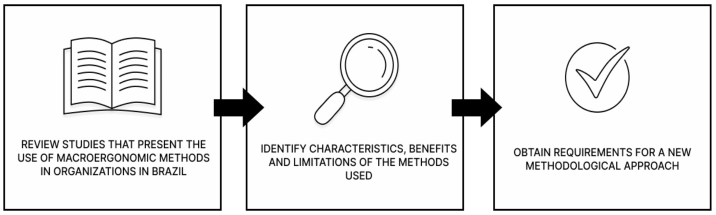
Definition of the Question and Conceptual Framework The first stage in carrying out this systematic review was the definition of the central research theme, which involves explaining the review question and defining the scope of the review through the development of a conceptual framework. Thus, based on the objectives of the present study, the review question can be presented as follows: What are the main characteristics that a macroergonomic analysis and design method should have to address the specificities of current organizations in Brazil? Based on this fundamental question, the conceptual framework was developed, which reveals how it will be answered through research, as shown in Figure 2.
Figure 2: Conceptual research framework (developed by the authors).
The three procedures presented in the previously defined conceptual framework make up the structure of a systematic review classified as an aggregative review, as it is a closed question that seeks to test a theory based on the collection of empirical observations using a hypothetical-deductive method, in which the results of primary studies are aggregated to obtain results (Dresch, Lacerda and Júnior, 2015). Thus, once the research question and conceptual framework have been defined, the search strategy will be detailed.
Search Strategy The first step in a search strategy is defining the search sources and terms to be used. For this research, according to the conceptual framework, studies that presented the use of macroergonomic methods in organizations in Brazil should be reviewed. Therefore, it was decided to limit the search sources to the main Brazilian databases that provide peer-reviewed scientific research: the Catalog of Theses and Dissertations and the Periodicals Portal of CAPES (Coordination for the Improvement of Higher Education Personnel of the Education Ministry). In these databases, the following search terms were used, in Portuguese: “Macroergonomics” OR “Organizational Ergonomics” AND “Method” OR “Methodology”.
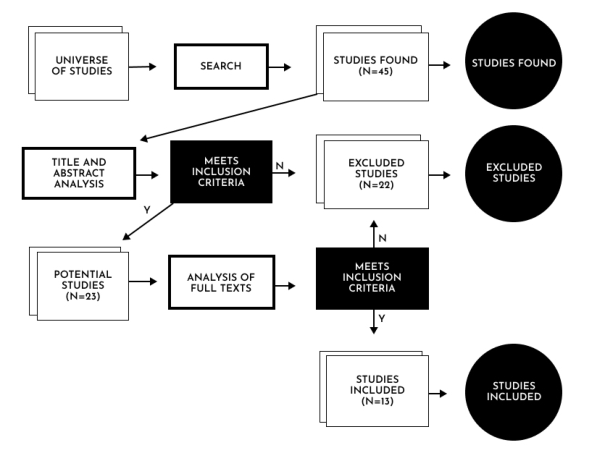
Based on the results found, inclusion criteria were applied, with the aim of verifying whether the analysed work actually presented the use or application of at least one macroergonomic method in an organization in Brazil. This
information was obtained by reading the title and summary of the paper or monograph.
Search, Eligibility and Coding After defining the search strategy, we moved on to its operationalization, that is, to search for primary studies, their selection and coding for subsequent evaluation, synthesis and presentation of results. This process is presented in Figure 3.
Based on the research included in this systematic review, a more in-depth analysis of the content was carried out in order to identify the characteristics, benefits, and/or limitations of the methods used in each study.
Figure 3: Search, eligibility and coding process (adapted from Dresch, Lacerda and Júnior, 2015, p. 154).
Quality Assessment The validity of the results produced from this systematic review also involves assessing the quality and relevance of the research, which must consider the selected primary studies and the review process in a more holistic way. Thus, with the purpose of minimizing study bias and considering all possible contributions from the databases researched, information already validated by the scientific community in this specific field was added. For example, when reading the included studies in full, two important references were used to help define the set of macroergonomic methods to be considered for this research. Initially, the work of Stanton et al. (2005), which presents 15 methods that are part of the section called Macroergonomic Methods, being one of the most complete compilations of methods available and validated
Systematic Gathering of Requirements for Macroergonomic Analysis and Design 619
by the literature in the area. Additionally, the paper by Ferreira, Merino and Figueiredo (2017) was used as a reference for research in Brazil, who carried out a review of traditional literature to identify the main methods used in Organizational Ergonomics.
Summary of Results
Table 1 presents a summary of the results obtained in this Systematic Literature Review (SLR).
Table 1. Summary of SLR results (developed by the authors).
Table available in the original PDF paper.
Reference and method(s) Considerations about the method(s) Simoni and Zerbetto (2010)
Applied in a construction company, the MWA method proved to be efficient in implementing an ergonomics program in the company. However, it was found that, in conjunction with the PE method, ergonomic demands are more easily identifiable compared to simple observation, with better interpretation and organization of the company’s diagnosis.
Macroergonomic Work Analysis (MWA) and Participatory Ergonomics (PE) Sampaio and Souza (2012)
Interviews and Questionnaires
Applied in a restaurant, the results of the methods allowed us to conclude that the concepts, techniques and tools of macroergonomics can only be applied and implemented to their fullest when they are recognized by the manager as indispensable for the well-being of workers and for improving their performance. Furthermore, there was a need to develop a more detailed questionnaire to better monitor workers. Campos and Oliveira (2013) Macroergonomic Design (MD)
Applied in a plastic recycling company, the method was defined as efficient for the study objectives as it was participatory in nature. However, despite having seven steps, only the first two steps of the method were carried out. The application of the method and the generalization of the results were limited to just one company. It was suggested to use it in conjunction with other methodologies. Andrade (2016) Focus Groups Applied in a public educational institution, the use of the method proved to be adequate for the purposes of the study. Records of satisfaction and dissatisfaction in relation to the organizational environment could be perceived. The limitation of the research was that it did not address motivation in reference to the individual’s behaviour or personal satisfaction. The need to carry out studies with other methods for a complete macroergonomic approach was perceived. Bischoff (2018)
Macroergonomic Analysis of Structure (MAS)
Applied to clothing manufacturing companies, the results of the method did not present concrete actions to be taken by the company, but indicated the type of path that can guide decisions in order to obtain positive transformations in its organizational structure. Although MAS was considered flexible and versatile, it was realized that no change is easy in the business context, requiring time to adapt and carry out training and simulations. Silva (2018) Macroergonomic
Analysis of Structure (MAS) and HiTOP Analysis
Applied to Startups, the methods did not prove to be completely suitable for this type of company, making it difficult for the interviewed managers to understand the objectives of the methods. The MAS was considered more suitable for an initial analysis of organizations. The HiTOP Analysis was considered complex and time-consuming to apply, but it helped in the allocation of employees to tasks and training. Both methods were considered complete, but would need to be simplified for greater efficiency.
Table 2. Summary of SLR results (developed by the authors).
Table available in the original PDF paper.
Reference and method(s) Considerations about the method(s) Wojcikiewicz (2018)
Participatory Ergonomics (PE) and Macroergonomic Organizational Questionnaire
Applied in a public educational institution, the methods proved to be complete and versatile, allowing not only the collection of data on organizational discrepancies, but also data on satisfaction and performance. The MOQS was considered easy to apply, but generated a large amount of data. With the PE method, it was found that participants’ satisfaction increases due to the feeling of responsibility and power to change.
Survey (MOQS) Mejias-Herrera (2018)
Participatory Ergonomics (PE)
Applied at a biotechnology institute, it was found that the method must be used by people trained, not only in ergonomics, but in the procedure itself. The benefits of the application were not quickly realized and the participation of all hierarchical levels of the organization was recommended for greater effectiveness. Goya (2019) Interviews and Questionnaires Applied to coworking spaces, the methods are not limited to numerical representation, maintaining the focus on deepening the understanding of a group or organization. It was noticed that in-person visits were more efficient, as physical spaces could be better analysed and people felt more comfortable expressing themselves. The study was limited to the results obtained in the interviews and consisted of an initial approach to solving the problems. Pires (2020)
Interviews and Questionnaires
Applied to urban space, macroergonomic methods needed to be combined with other methodological approaches to obtain satisfactory results in this specific context. Although the studied city environment was considered as an organization, the study proved to be complex to be approached with traditional macroergonomics tools. Nascimento (2021) Macroergonomic
Analysis of Structure (MAS)
Applied in marketing companies, the method was considered flexible and subjective. However, it was found that, without the support of other studies to develop the research materials and methods, it would not be possible to obtain the necessary data. There were also doubts about the number of workers who should be interviewed, as it was noticed that the greater the number of workers interviewed, the greater the detail of the information obtained. Oliveira (2021) Interviews and Questionnaires Applied to nursing teams, the methods used were limited to specific instruments in the health area and did not support a complete macroergonomic analysis. On the other hand, the research results were statistically significant and can be generalized, although working conditions are peculiar in each occupational environment. Girardi (2022)
Macroergonomic Analysis of Structure (MAS)
Applied in a health rehabilitation centre, the method helped to identify the interaction between the specific structure of the organization and the ideal way of working. However, it was found that the assessment of sociotechnical variables and the degree of importance attributed to them is a subjective process that requires training and experience in conducting organizational assessments. It was also noted that the time required to apply the MAS varies depending on the scope of the organization.
As shown in Table 1, from the thorough analysis of each study, it was possible to identify the characteristics, benefits, and/or limitations of the macroergonomic methods used – this information is included in the column “considerations about the method(s)”. Thus, from the compilation and analysis of this information, it is possible to generate requirements for a methodological approach that is more suitable for organizations in Brazil.
Systematic Gathering of Requirements for Macroergonomic Analysis and Design 621
Presentation of the Study All the methods presented have basically the same objective: to help an organization carry out, even partially, an analysis and a possible macroergonomic design or redesign. With this objective, the main result of this paper is now presented, that is, a list of requirements for the elaboration of a new methodological approach to analysis and macroergonomic design for organizations in Brazil, based on the studies carried out:
Use Participatory Ergonomics (PE) as the main approach to macroergonomic analysis and design;
People’s participation must occur at all hierarchical levels;
The same methodological approach must analyse both the processes and the organizational structure;
Provide for the participation of senior management as a requirement for implementing a macroergonomic program;
In addition to presenting the stages, the tasks required in each stage must be detailed and support tools suggested to carry them out;
Indicate which stakeholders can participate in each application stage;
The best practices of the main macroergonomic methods available should be adopted, but in a more intuitive and less complex way;
Indicate the application step by step, without depending on the analyst’s level of experience;
Although the results monitoring process is constant and based on continuous improvement, the application of the methodological approach must be simple and quick;
A new macroergonomic method must be flexible enough to adapt to different types of organizations.
CONCLUSION
This paper presented the description of a process for obtaining requirements to support better performance of macroergonomic analysis and design activities that are adapted to organizations in Brazil. To achieve this objective, a Systematic Literature Review (SLR) was carried out, which included the investigation of studies already published in indexed databases on the use of macroergonomic methods in Brazilian organizations, as well as the presentation of considerations about these methods.
For future work, we intend to create a new methodological approach based on the requirements obtained, thus meeting the existing demand in the research context. Therefore, faced with such a gap, what this research proposed to develop were the methodological foundations that support a complete macroergonomic approach, in order to contemplate in a cohesive and easy-to-apply manner the activities of macroergonomic analysis and design, both of structures and of organizational processes. To achieve this, the proposal was limited to the requirements and management strategies of organizations in the contemporary Brazilian scenario.
ACKNOWLEDGMENT
The authors would like to acknowledge FAPESC (2023TR632) for the financial support.
REFERENCES
Andrade, M. F. P. (2016). A condição do trabalho na relação entre satisfação e frustração em ambiente público de ensino superior sob olhar da ergonomia organizacional. 2016. 125 f. Mestrado Profissional em Ergonomia. Universidade Federal de Pernambuco. Bischoff, B. M. (2018). Macroergonomia na cadeia da moda: diagnóstico de
comunicação em empresas com fabricação descentralizada. 2018. 355 f. Dissertação (Mestrado) – Programa de Pós-Graduação em Design, Universidade do Estado de Santa Catarina, Florianópolis. Campos, G. C. and Oliveira, P. G. (2013). Macroergonomia aplicada em postos de trabalho de uma empresa de reciclagem mecânica de plástico. GEPROS - Gestão da Produção, Operações e Sistemas, Bauru, Ano 8, abr-jun/2013, no. 2, pp. 83–94. Cooper, H. M.; Hedges, L. V. and Valentine, J. C. (2009). The handbook of research
synthesis and meta-analysis. London: Sage. Dresch, A.; Lacerda, D. P. and Antunes Júnior, J. A. V. (2015). Design science research: método de pesquisa para avanço da ciência e tecnologia. Porto Alegre: Bookman. Ferreira, A. S.; Merino, E. A. D. and Figueiredo, L, F, G. (2017). Methods used in
organizational ergonomics: literature review. Human Factors in Design, vol. 6, no. 12, pp. 58–78. Girardi, E. O. L. (2022). Ergonomia organizacional para prevenção do abandono de tecnologia assistiva em centros especializados em reabilitação. 2022. 100 f. Dissertação (Mestrado) – Programa de Pós-Graduação em Design, Universidade do Estado de Santa Catarina, Florianópolis. Goya, J. Y. L. (2019). A importância dos espaços colaborativos universitários para a
formação do designer. 2019. 117 f. Mestrado em Design. Universidade Estadual Paulista Júlio de Mesquita Filho (Bauru). Gough, D.; Oliver, S. and Thomas, J. (2012). An introduction to systematic reviews.
London: Sage. Hendrick, H. W. and Kleiner, B. M. (2002). Macroergonomics: Theory, methods, and applications. New Jersey: Lawrence Erlbaum Associates. IEA. International Ergonomics Association. (2023). Available at: <https://iea.cc/>.
Accessed on: 10 Dec. 2023. Khan, K. S. et al. (2003). Five steps to conducting a systematic review. Journal of the Royal Society of Medicine, vol. 96, no. 3, pp. 118–121. Lawson, G. et al. (2021). Participatory ergonomics in industrially developing
countries: A literature review. International Journal of Mechanical Engineering Technologies and Applications, vol. 2, no. 1, pp. 53–59. Marconi, M. A. and Lakatos, E. M. (2010). Fundamentos de metodologia científica.
7. Ed. – São Paulo: Atlas. Mejias-Herrera, S. H. (2018). Las herramientas de intervención ergonómica: consideraciones conceptuales y experiencias prácticas en Cuba y Brazil. Ingeniería Industrial, vol. 39, no. 1, pp. 3–14. Nascimento, M. F. (2021). Ergonomia organizacional no home-office: A análise
macroergonômica na comunicação interna de equipes de marketing. 2021. 225 f. Dissertação (Mestrado) – Programa de Pós-Graduação em Design, Universidade do Estado de Santa Catarina, Florianópolis.
Systematic Gathering of Requirements for Macroergonomic Analysis and Design 623
Oliveira, B. R. (2021). Ergonomia organizacional e saúde: condições de trabalho e presenteísmo em enfermagem hospitalar. 2021. 130 f. Mestrado em Enfermagem. Universidade do Estado do Rio de Janeiro, Rio de Janeiro. Pires, G. D. (2020). Abordagem da macroergonomia no espaço urbano: fatores que
influenciam na percepção de qualidade. 2020. 119 f. Dissertação (Mestrado) – Programa de Pós-Graduação em Design, Universidade do Estado de Santa Catarina, Florianópolis. Sampaio, C. P. and Souza, J. (2012). A Macroergonomia na melhoria das condições de trabalho com ênfase nos aspectos de liderança: estudo de caso com AMT em um restaurante. Projetica, vol. 3, no. 1, pp. 79–95. Saunders, M.; Lewis, P. and Thornhill, A. (2012). Research Methods for business
students. 6. Ed. London: Pearson Education. Shahnavaz, H.; Helali, F.; Emami, K. H. (2000). Macroergonomics in Industrially Developing Countries-Case Study Iran. In: Proceedings of the Human Factors and Ergonomics Society Annual Meeting. Sage CA: Los Angeles, CA: SAGE Publications. Silva, L. D. (2018). Um estudo sobre a viabilidade da abordagem macroergonômica
na análise organizacional de startups em Florianópolis-SC. 2018. 143 f. Dissertação (Mestrado) – Programa de Pós-Graduação em Design, Universidade do Estado de Santa Catarina, Florianópolis. Simoni, C. G. and Zerbetto, C. A. A. (2010). Análise macroergonômica em uma empresa da construção civil. Projetica, vol. 1, no. 1, pp. 47–67. Smith, V. et al. (2011). Methodology in conducting a systematic review of systematic
reviews of healthcare interventions. BMC Medical Research Methodology, vol. 11, no. 1, p. 15. Stanton, N. et al. (2005). Handbook of human factors and ergonomics methods.
Boca Raton, CRC Press LLC. Wojcikiewicz, F. A. (2018). Ergonomia participativa: uma análise macroergonômica para o desenvolvimento da arquitetura organizacional de laboratórios de ensino. 2018. 121 f. Dissertação (Mestrado) – Programa de Pós-Graduação em Design, Universidade do Estado de Santa Catarina, Florianópolis.
LISTED IN THE AHFE DIGITAL BOOKSTORE CATALOGUE
Explore the complete digital volume
Human Interaction and Emerging Technologies (IHIET 2024)
Read this individual research paper free through the original publisher, or explore the full digital proceedings book.
ISBN 978-1-964867-33-5
Explore this ISBN in the AHFE Bookstore ↗Listed in the July 2026 bookstore catalogue; search by ISBN to confirm current availability · Digital book purchase optional