Aïsha Sahaï, Onoriu Puscasu, Natacha Métayer (2024). Age-Based Differences in Pedestrians’ Feeling of Trust and Safety When Crossing in Front of a Real Communicating Self-Driving Car During Daytime or Nighttime. In: Human Interaction and Emerging Technologies (IHIET 2024). AHFE Open Access, vol. 157, pp. 94–104. https://doi.org/10.54941/ahfe1005468
Publisher statistics will load when you open Metrics.
AHFE OPEN ACCESS OPEN ACCESS CONFERENCE PROCEEDINGS PAPER
Age-Based Differences in Pedestrians’ Feeling of Trust and Safety When Crossing in Front of a Real Communicating Self-Driving Car During Daytime or Nighttime
The introduction of self-driving cars (SDCs) onto public roads will raise challenging issues to ensure traffic fluency. One of these is to guarantee pedestrians feel safe and confident when encountering this new type of vehicle in order to promote pedestrian crossing in front of SDCs. Hence, the aim of the study was to investigate the impact of different types of external Human-Machine Interfaces (eHMIs) indicating the yielding behaviour of a SDC on pedestrians’ feeling of safety and trust. Thirty-four participants (19 young adults aged 22-41 and 15 older adults aged 63-80) volunteered to take part in the experiment. Participants were requested to cross in front of a real SDC which gave way to them on a crosswalk. The SDC was equipped with devices that could send different types of eHMI signals. In the hourglass condition, two displays located in front of the SDC were showing a luminous hourglass when the SDC yielded (daytime and nighttime tests). In the safety zone condition, projectors were sending a cyan light signal onto the ground around the SDC when it yielded (nighttime tests). In the no eHMI condition, none of the above-mentioned signals were shown. The participants were not informed in advance about the presence of the eHMI signals or their meaning. After each crossing, they were asked to rate their level of trust (on a Likert scale from 1- no trust at all to 7- totally in trust) and their level of safety (on a Likert scale from 1- not secure at all to 7- totally secure) during their crossing in front of the SDC. Finally, semi-directive interviews were lead in order to gather additional information such as the cues used by the participants in their crossing decision-making, other than the eHMIs signals. Our results showed high levels of self-reported trust and safety overall. Moreover, a significant main effect of the age group indicating a stronger level of trust during the crossing of the older adults as compared to the young adults was found. However, no significant effect of the age group nor of the type of eHMI signal were found on the participants’ feeling of safety during their crossing. In addition, no significant effect of the type of eHMI signal was found on the participants’ level of trust during their crossing. Yet, the analysis of the semi-directive interviews revealed that the young adults were likely to use more implicit communication cues exhibited by the SDC during the nighttime tests as compared to the daytime tests while the older had a more conservative crossing decision-making strategy during both daytime and nighttime tests. These findings provided understanding elements of pedestrians’ crossing experience with regards to communicating SDCs in realistic conditions.
Age-Based Differences in Pedestrians’ Feeling of Trust and Safety 95
INTRODUCTION
Self-driving cars (SDCs) are vehicles equipped with automated driving features capable to monitor the driving environment (e.g., detection of the surrounding pedestrians) and to manage the lateral and longitudinal control of the vehicle (e.g., to stay in the lane or to yield) (Society of Automotive Engineers, 2021). This automation of driving allows the human inside the vehicle to discharge her/himself from the driving activity. Hence, the non- verbal communication cues (e.g., eye contact, gestures, postural changes) traditionally used by the human drivers in order to express their driving intentions to pedestrians (Rasouli et al., 2017; Sucha et al., 2017) may no longer be present. Even more, visual communication with in-vehicle drivers could be merely dismissed by pedestrians when they would face SDCs (Sahaï et al., 2022). This is particularly at risk as this can lead to the misunderstanding of the situation thereby generating a feeling of uncertainty among the pedestrians (Lagström & Lundgren, 2015; Palmeiro et al., 2018) and cause them to make unsafe decision-making.
To overcome this lack of human non-verbal communication, the use of external Human-Machine Interfaces (eHMIs) has been proposed to make vehicles communicate themselves about their intentions such as yielding or turning for example. The eHMIs signals could be of different forms such as text-based or symbolic light signals located on the SDC, to light projections on the road, or to vibrotactile information transmitted by personal wearable devices connected to the vehicle (Bazilinskyy et al., 2019; Cœugnet et al., 2017; De Clercq et al., 2019). Interestingly, there is some evidence that the presence of eHMI signals could improve the pedestrian crossing experience when facing SDCs. Indeed, the presence of an eHMI signal in the form of light bands placed in front of the SDC and indicating the yielding intention of the SDC was shown to enhance the pedestrians’ perceived trust towards the SDC and stimulate their crossing in front of the SDC, especially when the eHMI signal turned on before the SDC started to decelerate (Kaleefathullah et al., 2020). Similarly, both text- based and symbolic light eHMI signals emitted on displays were shown to enhance the pedestrian feeling of safety to cross when they encountered a yielding automated vehicle, particularly when the eHMI signal was turned on before the vehicle started to decelerate or at the beginning of the deceleration (De Clercq et al., 2019). In the same vein, it has been shown that the pedestrians’ degraded perception of safety when facing an inattentive driver could be mitigated by the presence of an eHMI signal in the form of a light band (Faas et al., 2021). However, in the authors’ study, the eHMI signal was on continuously with the aim to indicate the automated driving mode of the SDC. Yet, although the pedestrians could well understand that they should not wait for communication cues from the driver, the yielding intention of the SDC was not clearly stated by the eHMI signal, which could generate poor situation awareness, while this latter was shown to be positively correlated with the quality of decision-making (Stanners & French, 2005). Taken together, these findings suggested that eHMI signals may foster pedestrian crossing in front of SDCs by removing the uncertainty about the
intention of the SDC and generating a stronger feeling of safety and trust, although there is no clear consensus about the best eHMI signal to emit so far.
Moreover, prior investigations focusing on the pedestrian experience with SDCs has mainly included young adults as participants (e.g., De Clercq et al., 2019; Kaleefathullah et al., 2020; Lagström & Lundgren, 2015; Palmeiro et al., 2018). However, the European Road Safety Observatory indicated that in 2020, older adults over 65 years olds were overrepresented in pedestrian fatalities (European Commission, 2021). This must be related to the older adults’ frail perceptual-motor skills coupled with their less efficient crossing strategies (Tournier et al., 2016; Wilmut & Purcell, 2022). Consequently, older adult pedestrians could be considered as especially vulnerable road users and should be given special attention with the forthcoming fleet of new mobility objects such as SDCs.
Finally, it should be noted that pedestrians are at higher risk of collision during nighttime compared to daytime (Uttley & Fotios, 2017). However, to our knowledge, no study to date has examined the pedestrians’ subjective crossing experience in front of a real SDC during nighttime.
In this context, we aimed at investigating age-based differences in pedestrians’ feeling of trust and safety when crossing on track in front of a real communicating SDC during either daytime or nighttime.
METHODS
Participants Nineteen young adults (10 women, 9 men) aged between 22 and 41 (mean = 30, S.D.=5.46 years) and 15 older adults (5 women, 10 men) aged between 63 and 80 (mean = 70.13, S.D.=5.24 years) took part in the experiment. Among them, 19 participants completed daytime tests (7 young adults and 12 older adults) while 15 participants completed nighttime tests (12 young adults and 3 older adults). All participants had normal or correct- to-normal vision and gave their informed consent before participating in the experiment.
Materials
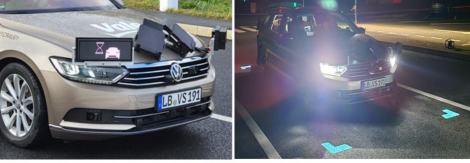
The SCD was a vehicle equipped with the Valeo Drive4U autonomous driving system. This system has the ability to keep the vehicle within a lane, to detect surrounding pedestrians (using cameras and lidars) and to give way if necessary. Moreover, the SDC was supplied with left and right front displays that could show a 17x12 cm luminous hourglass coupled with a car and projectors that could send 44 cm cyan light brackets onto the ground around the vehicle (see Figure 1). The eHMI signals which bared the message that the vehicle was waiting were designed taking into account the ISO TR 23049 standard recommendation to avoid communicating guidance.
Age-Based Differences in Pedestrians’ Feeling of Trust and Safety 97
Figure 1: Types of eHMI signals provided by the self-driving car. Left: a luminous hourglass was shown on front displays. Right: a safety zone was shown onto the ground.
Procedure One week before the day of the experiment, the participants were asked to fill out a sociodemographic survey. During the experiment, the participants were asked to walk on the sidewalk for 10 meters before arriving at a crosswalk. They were told that at this crosswalk, they would have to reach the opposite sidewalk by crossing the street and that they would encounter a SDC during their crossing. A stop sign located just in front of the crosswalk and a stop line drawn just after the crosswalk were present on the SDC’s path. The experiment was conducted in a fenced curved track so that the behaviour of the SDC’s was not visible before the participants arrived at the pedestrian crossing. Each participant carried out the experiment either during the daytime or at nighttime.
In the hourglass condition, after giving way and coming almost to a stop, the SDC was showing an hourglass coupled with a car as a yielding eHMI signal. In the safety zone condition, after giving way and coming to a stop, the SDC was showing brackets around the SDC as a yielding eHMI signal. In the no eHMI condition, no eHMI signal was sent by the SDC. The hourglass and the no eHMI conditions were used for both daytime and nighttime tests. Conversely, the safety zone condition was used only for the nighttime tests. During all nighttime tests, the track was lit by street lamps. Each daytime participant completed eight crossings (2 eHMI conditions x 4 repetitions) while each nighttime participant completed nine crossings (3 eHMI conditions x 3 repetitions). The order of the trials was counterbalanced between participants.
After each crossing in front of the SDC, the participants were asked to rate their feelings of trust (on a Likert scale from 1- no trust at all at all to 7- totally in trust) and safety during their crossing (on a Likert scale from 1- not secure at all to 7- totally secure). Finally, semi-directive interviews were led at the end of the experiment with each participant in order to gather additional information such as the detection of the eHMI signals, the understanding of the eHMI signals if seen, and the cues used for their crossing decision-making, other than the eHMIs signals.
RESULTS
Feeling of Trust and Safety The data of the participants who reported not having seen the signals were excluded from the analyses. Hence, the potential interactions effect between the participants’ age group and the eHMI signal type were not analysed due to low remaining sample sizes per condition (see Table 1).
Table 1. Detection rate of the eHMI signals by age group and by moment of the day.
Table available in the original PDF paper.
Young adults Older adults Day Night Day Night
Hourglass 6/7 7/12 6/12 1/3 Safety zone 11/12 2/3
In order to investigate the effect of the participants’ age group (young adults, older adults) on the perceived levels of trust and safety during their crossings, the Wilcoxon Mann-Whitney test was computed on the participants’ mean trust scores and mean safety scores with the age group as a factor. A significant main effect of the participants’ age group indicating a stronger level of trust for the older adults was found (meanyoung=5.41 (STD = 1.08), meanolder=5.99 (STD = 1.14), W=258.5, p=.049, see Figure 2). However, no significant main effect of the participants’ age group was found on the participants’ mean safety scores (meanyoung=5.50 (STD = 1.15), meanolder=5.54 (STD = 1.12), W=374.5, p=.93). In other words, the older adults’ perceived level of trust when crossing in front of the SDC was stronger compared to those of the young adults, while both age groups reported an equivalent level of safety when crossing in front of the SDC.
Moreover, in order to investigate the effect of the moment of the day (daytime, nighttime) on the participants’ levels of trust and safety during their crossings, the Wilcoxon Mann-Whitney test was computed on the participants’ mean trust scores and mean safety scores with the moment of the day as factor. No significant main effect of the moment of the day was found on the participants’ mean trust scores (meandaytime=5.66 (STD = 1.16), meannighttime=5.54 (STD = 1.07), W=460, p=.64) or on the participants’ mean safety scores (meandaytime=5.49 (STD = 1.17), meannighttime=5.53 (STD = 1.12), W=419.5, p=.89). In other words, the participants’ perceived levels of trust and safety when crossing in front of the SDC did not differ depending on the moment of the day.
Besides, for the daytime participants subset, the effect of the eHMI signal type (off, hourglass) on the perceived levels of trust and safety during the crossings were assessed by computing the Wilcoxon signed rank test on the participants’ mean trust scores and mean safety scores with the eHMI signal type as factor. No significant main effect of the eHMI
Age-Based Differences in Pedestrians’ Feeling of Trust and Safety 99
signal type was found on the participants’ mean trust scores (meanoff=5.63 (STD = 1.14), meanhourglass=5.70 (STD = 1.22), W=26, p=.92) or on the participants’ mean safety scores (meanoff=5.38 (STD = 1.31), meanhourglass=5.59 (STD = 1.04), W=35.5, p=.14). In other words, the participants’ perceived levels of trust and safety when crossing in front of the SDC during the day did not differ depending on the presence of the eHMI signal sent by the SDC.
In addition, for the nighttime participants subset, the effect of the eHMI signal type (off, hourglass, safety zone) on the perceived levels of trust and safety during the crossings were assessed by computing the Kruskal-Wallis test on the participants’ mean trust scores and mean safety scores with the eHMI signal type as factor. No significant main effect of the eHMI signal type was found on the participants’ mean trust scores (meanoff=5.05 (STD = 1.22), meanhourglass=5.14 (STD = 1.05), meanzone=5.73 (STD = 1.21), Hdf = 2=1.72, p=.42) or on the participants’ mean safety scores (meanoff=5.11 (STD = 1.20), meanhourglass=5.14 (STD = 1.25), meanzone=5.62 (STD = 1.42), Hdf = 2=1.03, p=.60). In other words, the participants’ perceived levels of trust and safety when crossing in front of the SDC during the night did not differ depending on the presence or the type of eHMI signal sent by the SDC.
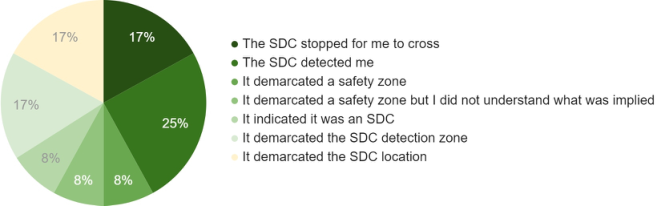
Understanding of the eHMI Signals When asked about the meaning of the eHMI signals during the semi-directive interviews, the yielding intention of the SDC in the hourglass condition was mentioned by 23% (3 of 13) of the daytime participants’ answers and adapted to 63% (5 of 8) of the nighttime participants’ answers (see Figure 2). Moreover, the yielding intention of the SDC in the safety zone condition was mentioned by adapted to 17% (2 of 12) of the nighttime participants’ answers (see Figure 3). It should be noted that a single participants’ answer for the understanding of the eHMI signal could be counted in more than one response categories. Yet, for all eHMI signals the majority of participants had at least a close interpretation of the meaning.
Figure 2: Understanding of the eHMI signal in the hourglass condition for the daytime participants subset (left) and the nighttime participants subset (right). Dark green denotes precise understanding. Lighter green shades denote a close interpretation by the participant.Figure 3: Understanding of the eHMI signal in the safety zone condition.
Cues for the Crossing Decision-Making In the hourglass condition, among the 20 participants who reported having seen the eHMI signal, 4 of 12 daytime participants (2 young adults and 2 older adults) and 5 of 8 nighttime participants (4 young adults and 1 older adult) reported having used this signal as a cue in their decision to cross. In the safety zone condition, among the 12 participants who reported having seen the eHMI signal, 3 young adults and 1 older adult reported having used this signal in their decision to cross.
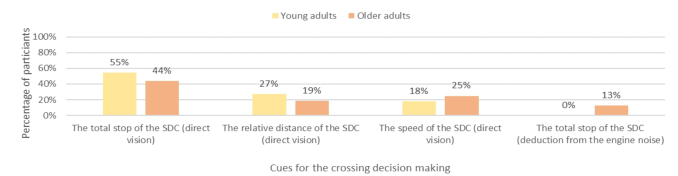
Furthermore, other than the eHMIs signals, within the daytime participants subset, the cues used for the crossing decision-making were almost the same for the two age groups and essentially vision-based. The cue the most used, other than the eHMI signal, was the visually checked total stop of the SDC both for the young adults (at 55%) and the older adults (at 44%, see Figure 4).
Figure 4: Percentage of participants’ cues used for the crossing decision-making during the daytime.
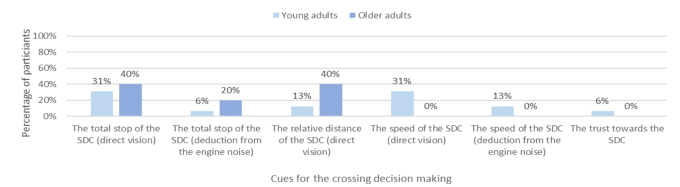
By contrast, within the nighttime participants subset, the cues used for the crossing decision-making were both vision-based and audition-based. Moreover, the young adults used more cues than the older adults for their crossing decision-making. The cue the most used, other than the eHMI signal, was the total stop of the SDC visually checked both for the young adults (at 31%) and the older adults (at 40%). Additionally, and in the same proportions, the young adults mostly used the visually checked SDC speed for their crossing decision-making (at 31%) while the older adults mainly used the visually checked relative distance of the SDC (at 40%, see Figure 5).
Age-Based Differences in Pedestrians’ Feeling of Trust and Safety 101
Figure 5: Percentage of participants’ cues used for the crossing decision-making during the nighttime.
DISCUSSION AND CONCLUSION The aim of this study was to investigate age-based differences in the pedestrians’ feeling of trust and safety when crossing in front of a real communicating SDC during either daytime or nighttime. Both young and older adults were asked to cross in front of a yielding SDC that could emit different types of eHMI signals, and to rate their feeling of trust and safety during the crossings.
Our results showed overall strong levels of trust and safety when the participants crossed in front of the SDC. Yet, we found that the older adults’ level of trust was stronger compared to those of the young adults. Although it was not assessed, it could be possible that the older adults in the experiment were less aware of the potential failures and risks of emerging automotive technologies as compared to the younger adults, which would explain their greater feeling of trust during their crossings in front of the SDC.
Moreover, our results revealed intriguingly that the participants levels of trust and of safety did not differ daytime compared to nighttime, despite the deterioration of visibility in this latter case. This could be due to the presence of the crosswalk on the ground that led the participants to feel safe and confident during all circumstances given that any approaching vehicle is obliged to stop when a pedestrian is entering a crosswalk. Hence, the approaching SDC could be expected to follow the traditional right-of-way (Meeder et al., 2017) regardless of the moment of the day.
Regarding the impact of the different types of eHMI signals, our findings suggested no impact of the presence or the type of eHMI signal sent by the SDC on the participants’ levels of trust and safety. This result was consistent with virtual reality work showing no impact of eHMI signals such as a smile, a traffic light or a handwave presented on front displays on pedestrians’ crossing decision confidence (Holländer et al., 2019). By contrast, when dealing with safety, we did not succeed at showing a positive impact of any type of eHMI signal in real-word conditions as opposed with virtual reality work (De Clercq et al., 2019). A possible explanation would be that the onset of the eHMI signals in the current study was too late in order to significantly influence trust and safety feelings. Indeed, in each condition, the eHMI signals were emitted when the yielding SDC was almost at a stop. Thus, vehicle kinematics could have played a more important role than the explicit communication of the SDC in establishing trust and a safety feeling.
Likewise, it has been shown that eHMI signals had little influence on the participants’ feeling of safety to cross when the eHMI signal was emitted after the beginning of the vehicle’s deceleration (De Clercq et al., 2019).
Finally, the semi-directive interviews analysis confirmed that implicit communication cues embodied in the SDC’s behaviour still played a role in the participants crossing decision-making. More in detail, we found that the implicit communication cues used in the participants’ crossing decision- making were mostly vision-based during the daytime (e.g., the visually assessed total stop and relative distance of the SDC). However, there was a mix of both vision-based and audition-based implicit cues during the nighttime (e.g., the total stop of the SDC assessed with the help of the engine noise), likely to compensate for the loss of visibility in darkness. This was in line with the existing scientific literature indicating that implicit cues communicated by the vehicle’s kinematics could be enough to grasp the intention of automated vehicles (Palmeiro et al., 2018; Dey et al., 2021; Lee et al., 2021). However, our findings went a step further indicating that implicit communication remained an important cue with ageing on the one hand, and both during the daytime and nighttime on the other hand. Furthermore, our data showed that the young adults were more likely to use a wider range of implicit communicative cues from the SDC during the nighttime as compared to the daytime. By contrast, the older adults seemed to adopt a more conservative crossing decision-making strategy by using almost the same implicit communicative cues during the daytime and during the nighttime.
To conclude, this study put forward the crossing experience of young and older pedestrians during their encounter with a real SDC. It highlighted the importance of making understandable eHMI signals in order to come into play in pedestrians’ crossing decision-making, especially when the SDCs will be present in complex road traffic and will generate traffic uncertainties. Indeed, in the current study, the eHMI signal was better understood and thereby had a greater rate of use in the crossing decision making in the hourglass condition than the safety zone condition. In addition to that, the day/night environmental conditions seemed to have an impact on the precise understanding rate of the eHMI signal, as a higher proportion of the nighttime participants had a precise understanding of the eHMI signal in the hourglass condition. This shed light the importance of context in understanding an eHMI signal and suggests that pedestrian needs might be different during nighttime as compared to daytime. Moreover, it should be emphasized that the pedestrian crossing experience is closely dependent on individual factors such as social norms and culture for instance (Rasouli & Tsotsos, 2019). Nevertheless, pedestrians might not be reluctant to cross in front of SDCs as high levels of trust and safety could be experienced. Importantly, this study has focused on the feeling of safety and trust experienced by pedestrians, but an objective video-based behaviour analysis is in progress as well as the investigation of other key parameters of the user experience such as eHMI acceptance. Moreover, an additional nighttime study can be done in order to increase the sample size of participants. Yet, future investigations must involve more complex crossing scenarios to fit with
Age-Based Differences in Pedestrians’ Feeling of Trust and Safety 103
the real-word traffic conditions (e.g., plurality and mix of road user types present on the track, open-road).
ACKNOWLEDGMENT
This project has received funding from the European Union’s Horizon 2020 research and innovation programme under grant agreement No 101006664. The sole responsibility of this publication lies with the authors. Neither the European Commission nor CINEA – in its capacity of Granting Authority – can be made responsible for any use that may be made of the information this document contains.
The authors would like to thank Théa Cosnier (VEDECOM Institute) for her active assistance with the data collection, and colleagues from Valeo Kronach site (Valeo Brain division) for their assistance with the self-driving car.
REFERENCES
Bazilinskyy, P., Dodou, D., & De Winter, J. (2019). Survey on eHMI concepts: The effect of text, color, and perspective. Transportation research part F: Traffic psychology and behaviour, 67, 175–194. Cœugnet, S., Dommes, A., Panëels, S., Chevalier, A., Vienne, F., Dang, N. T., &
Anastassova, M. (2017). A vibrotactile wristband to help older pedestrians make safer street-crossing decisions. Accident Analysis & Prevention, 109, 1–9. De Clercq, K., Dietrich, A., Núñez Velasco, J. P., De Winter, J., & Happee, R. (2019).
External human-machine interfaces on automated vehicles: Effects on pedestrian crossing decisions. Human factors, 61(8), 1353–1370. Dey, D., Matviienko, A., Berger, M., Pfleging, B., Martens, M., & Terken, J.
(2021). Communicating the intention of an automated vehicle to pedestrians: The contributions of eHMI and vehicle behavior. IT-Information Technology, 63(2), 123–141. European Commission (2021) Facts and Figures Pedestrians. European Road Safety Observatory. Brussels, European Commission, Directorate General for Transport. Faas, S. M., Stange, V., & Baumann, M. (2021). Self-driving vehicles and pedestrian
interaction: Does an external human-machine interface mitigate the threat of a tinted windshield or a distracted driver?. International Journal of Human– Computer Interaction, 37(14), 1364–1374. Holländer, K., Colley, A., Mai, C., Häkkilä, J., Alt, F., & Pfleging, B. (2019, October). Investigating the influence of external car displays on pedestrians’ crossing behavior in virtual reality. In Proceedings of the 21st International Conference on Human-Computer Interaction with Mobile Devices and Services (pp. 1–11). Kaleefathullah, A. A., Merat, N., Lee, Y. M., Eisma, Y. B., Madigan, R., Garcia, J.,
& Winter, J. D. (2020). External human–machine interfaces can be misleading: An examination of trust development and misuse in a CAVE-based pedestrian simulation environment. Human factors, 64(6), 1070–1085. Lagström, T., & Lundgren, V. M. (2015). AVIP-Autonomous vehicles’ interaction with pedestrians: An investigation of pedestrian-driver communication. Chalmers University of Technology.
Lee, Y. M., Madigan, R., Giles, O., Garach-Morcillo, L., Markkula, G., Fox, C.,... & Merat, N. (2021). Road users rarely use explicit communication when interacting in today’s traffic: Implications for automated vehicles. Cognition, Technology & Work, 23, 367–380. Meeder, M., Bosina, E., & Weidmann, U. (2017, May). Autonomous vehicles:
Pedestrian heaven or pedestrian hell. In 17th Swiss Transport Research Conference (pp. 17–19). Palmeiro, A. R., van der Kint, S., Vissers, L., Farah, H., de Winter, J. C., & Hagenzieker, M. (2018). Interaction between pedestrians and automated vehicles: A wizard of Oz experiment. Transportation research part F: traffic psychology and behaviour, 58, 1005–1020. Rasouli, A., Kotseruba, I., & Tsotsos, J. K. (2017, June). Agreeing to cross:
How drivers and pedestrians communicate. In 2017 IEEE Intelligent Vehicles Symposium (IV) (pp. 264–269). IEEE. Rasouli, A., & Tsotsos, J. K. (2019). Autonomous vehicles that interact with pedestrians: A survey of theory and practice. IEEE transactions on intelligent transportation systems, 21(3), 900–918. Sahaï, A., Labeye, E., Caroux, L., & Lemercier, C. (2022). Crossing the street in front
of an autonomous vehicle: An investigation of eye contact between drivengers and vulnerable road users. Frontiers in psychology, 13, 981666. Society of Automotive Engineers (2021). Taxonomy and definitions for terms Related to driving automation systems for on-road motor vehicles (J3016_202104 (pp. 1–41). Society of Automotive Engineers. Stanners, M., & French, H. T. (2005). An empirical study of the relationship between
situation awareness and decision making. Sucha, M., Dostal, D., & Risser, R. (2017). Pedestrian-driver communication and decision strategies at marked crossings. Accident Analysis & Prevention, 102, 41–50. Tournier, I., Dommes, A., & Cavallo, V. (2016). Review of safety and mobility issues
among older pedestrians. Accident Analysis & Prevention, 91, 24–35. Uttley, J., & Fotios, S. (2017). The effect of ambient light condition on road traffic collisions involving pedestrians on pedestrian crossings. Accident Analysis & Prevention, 108, 189–200. Wilmut, K., & Purcell, C. (2022). Why are older adults more at risk as pedestrians?
A systematic review. Human factors, 64(8), 1269–1291.
LISTED IN THE AHFE DIGITAL BOOKSTORE CATALOGUE
Explore the complete digital volume
Human Interaction and Emerging Technologies (IHIET 2024)
Read this individual research paper free through the original publisher, or explore the full digital proceedings book.
ISBN 978-1-964867-33-5
Explore this ISBN in the AHFE Bookstore ↗Listed in the July 2026 bookstore catalogue; search by ISBN to confirm current availability · Digital book purchase optional