Yemao Man, Emmanuel Brorsson, Petra Bjorndal (2023). Human-Machine Interaction Challenges for Bridge Operations in Large Passenger Ships and Future Improvements from The Deck Officers' Perspective. In: Human Factors in Transportation. AHFE Open Access, vol. 95, pp. 730–739. https://doi.org/10.54941/ahfe1003858
Technological bridge solutions have been implemented to improve safety and efficiency, but deck officers still face challenges in their daily use of these tools. Prior maritime human factors research has primarily focused on investigating issues such as workload, stress, teamwork, and situation awareness in ship operations, with limited attention given to the integration work, dynamic context, and factors on the system design level. Through interviews with maritime experts and field studies on two large Baltic passenger ships, this study examines the human-machine interaction challenges in today's bridge operations and identified areas for improvement. The results do not only explore the integration challenges imposed on the mariners, but also identify several contextual and system factors that contribute to these challenging bridge operations: dynamic situations and uncertainties, potentially conflicting goals, trust issues, lack of tool support and standardization. Suggestions for future improvements to bridge systems from the deck officers' perspective are also presented, with a focus on supporting proactivity, trust, context-awareness, and system integration. A few system design reflections were also made to fathom the challenges and inform potential future design directions. The study provides a thorough understanding of human-machine interaction challenges in bridge operations, which sets a foundation for future design and deployment of human-centered integrated bridge systems.
Maritime navigation can be seen as a complex socio-technical system (Grech 2008) involving automation systems which are capable of sensing, produ- cing and storing large amounts of data. Increasing automation solutions in turn pose challenges to navigators’ situation awareness and workload (Sarter and Woods 1995, Grech, Horberry et al. 2002, Lützhöft and Dekker 2002). In an analysis of 192 marine occurrences reported to Transportation Safety Board of Canada (TSB) between 1998-2018, interface design as well as non- standardized system layout were found to be prominent contributing factors to accidents (Gauthier, Kruithof et al. 2019). As a result of technological advancements, the role of maritime navigators is shifted towards monitoring
Human-Machine Interaction Challenges for Bridge Operations 731
and planning, while surveillance and execution are in many cases offloaded to automated systems (Conceição, Carmo et al. 2018). Although bridge systems do have an increased ability to integrate information (Jurdzinski 2018), the integration may not fully address the new role’s demands. Prior studies sug- gest that navigators can involve themselves into integration work (Lützhöft and Nyce 2008). In order to design future human-centered bridge systems, it is crucial to comprehend the underlying challenges of Human-Machine Interaction (HMI) on ship bridges, as well as the specific requirements and limitations of the users and the technology within the navigational context.
RELATED WORK
Prior research in the maritime human factors domain looks closely at vari- ous challenges that seafarers face onboard ships, including issues related to workload, fatigue, stress, ship operations, ill-designed systems, teamwork, and communication (Hetherington, Flin et al. 2006, Grech 2008, Shanahan 2010). A crucial aspect to consider is the interaction between humans and technology, which has been extensively studied with diverse research (Endsley 1988, Lee and See 2004, Hollnagel 2011, Hancock, Jagacinski et al. 2013) that can be applied to the maritime domain. Examples include using concepts such as human error (Lützhöft and Dekker 2002), situation aware- ness (Man, Weber et al. 2018, Pazouki, Forbes et al. 2018), trust (Aylward, Weber et al. 2020), system resilience (Praetorius, Hollnagel et al. 2015) etc.
Human-system integration is a critical aspect of human-technology inte- raction research, yet there is limited research that focuses on the integration challenges faced by deck officers in their daily practices, including the underl- ying contextual and system factors. The study from Lützhöft and Nyce (2008) have highlighted that modern bridge technologies require mariners to per- form some sort of integration work, as machines cannot communicate in ways that officers find useful (Lützhöft 2004). Other recent studies point out the issues with non-standardized design (Gauthier, Kruithof et al. 2019, Nordby, Gernez et al. 2022). However, these studies have only partially exa- mined the contextual or system factors that contribute to these challenges. Additionally, they have not sufficiently included the needs and perspectives of the end users regarding potential future improvements of bridge systems. This paper aims to address these gaps and set a foundation for human-centered design of future bridge systems.
METHODS
The majority of the study subjects were either on-duty master mariners wor- king on board two Ro-Ro (roll on - roll off) passenger ferries in the Baltic Sea (n = 13, all men), or actively working in the maritime domain on-shore as nautical instructors or in shipbuilding management (n = 4, all men). All master mariners were interviewed and observed during active duty on the ship bridges. The prepared semi-structured interview protocol involved topics such as maneuvering, monitoring, harboring, and administrative tasks, by covering current practices, challenges, and future perspectives. Observations
of the master mariners were also carried out on the bridges to observe how they interact with different technological tools. The produced field study data was investigated in an inductive thematic analysis (Clarke 2006) by initi- ally transcribing and coding the material in MAXQDA 20201 after which codes were extracted to a shared digital workspace to categorize the data into various themes.
RESULTS AND DISCUSSION
Human-Machine-Interaction Challenges and Contextual Factors Integrating Synthesizing and Prediction in a Dynamic Environment An evident interaction challenge onboard ships was found in dynamic envi- ronments where there are multiple vessels in close proximity to each other. If a vessel changes its speed or heading unexpectedly, it can show another inten- tion and thus affect the trajectory and potential collision course of the other vessel. In these situations, deck officers must monitor the actions of the sur- rounding vessels, predict the development of the situation based on various information, as well as their experience and navigation regulations in order to avoid a collision or other safety hazard. In congested waters this may require a high level of cognitive resources such as mental effort and attention. The presence of leisure boats in the archipelago areas, which are more unpredi- ctable in their movements and actions according to the deck officers, adds an additional layer of complexity and make situation even more stressful.
Another crucial factor that can characterize the dynamic environments is the effect of wind on navigation, which can affect the speed, heading, stabi- lity and trajectory of the vessel. Deck officers talked that they often closely monitor wind direction and strength and use their own experience to make decisions about how to compensate the wind’s impact on the vessel’s move- ment. This is essential in archipelago and harbor areas where there is limited maneuvering space and thus requires the deck officers responsive to fast changing conditions.
Topography is another indispensable factor that contributes to the dyna- mics and complicate navigators’ decision-making processes. For example, navigating through an archipelago can present some unique challenges due to the presence of multiple islands and waterways. The islands in the archipelago area can block the view of the navigator, leading to limited visibility. The nar- row channels that the vessels must navigate through requires precise steering and maneuvering. Additionally, the water depth can vary significantly. When the vessel is navigating in shallow water, it must use more energy to main- tain its speed due to increased drag on the hull, therefore speed adjustment becomes necessary for energy efficient navigation.
An officer needs to prioritize safety by slowing down the vessel or chan- ging course to avoid a potential collision, but this may also impact the time schedule and increase energy consumption. Balancing the potentially confli- cting goals of safety, punctuality, and energy efficiency can be challenging in such a dynamic environment. It was observed that these trade-offs are not 1MAXQDA software for content analysis: https://www.maxqda.com/content-analysis
Human-Machine Interaction Challenges for Bridge Operations 733
always easy to navigate sometimes, nevertheless it is crucial for the officers to get support in understanding and synthesizing all these factors so that they can plan and act early (such as adjusting the vessel’s course or speed to take advantage of favorable wind conditions or avoiding shallow water and collision where possible).
However, the study reveals that when the officers are synthesizing a large amount of information from various sources, it is a cognitively demanding process without getting sufficient proactive decision support from the current integrated bridge systems. The dynamic nature makes conventional predi- ction support like plotting the vectors for surrounding vessels less reliable for indicating their intention. In an archipelago and a harbor area, the wind can be affected by the presence of land masses, which can create local wind patterns that can change quickly and are difficult to be picked up by onbo- ard sensors in advance. Overall, the observed bridge systems have limited ability to accurately consider and account for the constantly changing con- text and conditions that impact a vessel’s safety and energy efficiency. This leaves deck officers responsible for manually integrating, synthesizing and predicting information in order to make informed maneuvering decisions.
Distractive Work Environment With Fragmented Information and Controls Alarms can be an important source of information for deck officers, but they are also distractive by nature. The officers mentioned that some alarms communicate information that they already know (e.g., Closest Point of Approach alarms) or the annoying alarms that arenot relevant at the ope- rating stage that they are in. One additional challenge is that infrequent alarms can be difficult for officers to comprehend and identify the origin of, which can further divert their attention from their primary navigational duties. During the field study, the authors observed a scenario in which the entire bridge crew came together to locate a false sprinkler alarm on board.
In addition to the distracting alarm issues, the bridge also faces a chal- lenge of interoperability. The trend of being inundated with information that is increasingly dispersed and fragmented was observed during the field study. The environment is overwhelmed with many systems and equipment from different manufacturers that provide isolated information that is relevant to the operation of the vessel. One example is that various means, inclu- ding meteorological reports, onboard sensors, navigation charts and maps, radio communication and visual lookout, can provide essential navigational information regarding weather and topography. Integrating these fragmented pieces of information can be a challenging task for the officers, particularly for those who are lessexperienced, when they need to prioritize targets or tasks within a short timeframe. At present, there is a lack of supportive tool on board ships that would make this integration process easier.
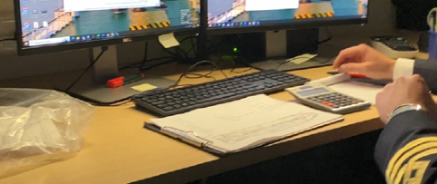
The field study also discovered that information and controls being distri- buted across multiple bridge systems often require the officers to move from one location to another to “make it work”. For instance, some operati- ons were observed to be performed in specific positions or in specific ways because not all the information or assistive tools are integrated or within reach. As Fig. 1 shows, an officer is using a calculator to plan cargo, writing
Figure 1: In the back bridge area, an officer is using a calculator to calculate stability for cargo planning.
the numbers on a piece of paper, and then manually transferring them to a different computer to calculate stability.
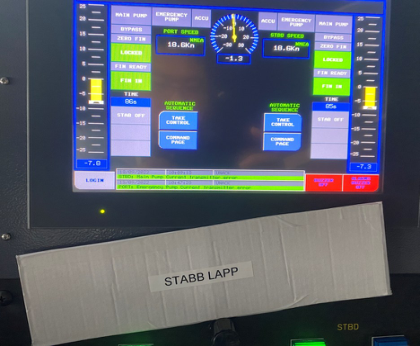
While some officers mentioned the lack of standardization in controls and displays can lead to an increase in the amount of training needed, the study also identified that they are very flexible in developing their own worka- rounds to bridge the gap between the systems. One example observed is the use of a cardboard label as a reminder for the officers to remember to deactivate the stabilizing fins when they are not needed (see Fig. 2). This workaround is necessary because the fin control system is positioned fur- ther away from the more accessible navigational systems and they are not integrated, as they are from different manufacturers. As a result, the officers must “manually integrate” the systems by constructing a physical represen- tation within their sight. The lack of interoperability between the systems is making information more distributed and fragmented, creating additional cognitive and physical demands for the users. This illustrates how even sta- cking isolated human-cantered design systems can be a hindrance to system safety, efficiency, or user experience. Although local adaptation may solve the issues, it might actually increase the risk of a larger system failure (Dekker 2011).
Figure 2: Use of a cardboard label as a reminder for remembering to deactivate the stabilizing fins.
Human-Machine Interaction Challenges for Bridge Operations 735
Trust Issues Trust issues were also identified to be a pain point on the ship bridges, leading to reduced usage or reliance on certain systems. During mooring a captain was observed to verbally communication with another deck officer (essen- tially counting down the markings on the quay) to confirm the distance to the right docking position.When asked if it would be acceptable to deploy an automation system to literally read the meters, he expressed concern that the machine may fail at some point even though the probability is low. These trust related phenomenon are commonly seen in the shipping industry (Lüt- zhöft and Dekker 2002) and in this case it is about the user’s confidence in the system’s capabilities and reliability.
Usability Issues The field study also concluded that the officers have difficulties using the bridge systems at times due to various usability issues. In addition to its connection to standardization, the system design was observed as lacking interaction design considerations. One example is the systems can require specific interactions that are cumbersome to perform frequently, such as changing course requires using a trackball on a screen rather than physi- cal buttons, and switching between autopilot, manual, and tandem modes requires more interactions than the navigators are accustomed to. Another factor is software glitches, e.g., when a user clicks and drags the ECDIS/Ra- dar screen to view a different area, the contents in the field of view frequently automatically reset back to the ship center.
User Suggestions The deck officers’ suggestions on future improvement of the bridge systems were also collected and they resonated with the forementioned issues. An emerging theme is about getting more proactive decision-making support from the digital systems. Today, the officers rely more on their own capa- bilities to understand the dynamic environment, estimate how the situations will develop and navigate the ship accordingly. Many conventional naviga- tional tools are used for tactical purposes, such as assisting maneuvering in close-quarter situations. The mariners expect to have more proactive decision-making support tools that allow for strategic maneuvering early. As an officer mentioned, “making very subtle change in speed or course very early on so the situation did not even develop to COLREG (Convention on the International Regulations for Preventing Collisions at Sea) situation at all”. By anticipating potential issues with proactive support, the offi- cers would have improved situation awareness and alleviate the stress and uncertainty that can come with navigating a ship in challenging conditions.
Another key recommendation is to design and develop more context-aware and intelligent bridge systems that have the capability to understand the cur- rent situation and provide dynamically updated information, so that the user can have access to the information they need at the exact moment. The system should be adaptive, taking into account different phases of navigation, such
as port maneuver, pilotage, fully open waters and restricted waters. The offi- cers have expressed appreciation for having simplified, relevant information provided to them, which also applies to alarm design. Context-aware systems would help reduce the cognitive load on the users, allowing them to focus on the most important task at hand. Some have even suggested that the bridge systems should have the ability to learn, follow up on what the user is using and provide information accordingly.
Regarding the issue of data being dispersed across multiple systems and the workaround practices being used, the officers have expressed a desire for more collaborative work from the manufacturers to standardize the systems in order to improve safety, efficiency, and user experience. Some have sug- gested that in order to increase interoperability, there is a need for the development of “a standard of standards” for equipment manufacturers to follow. Additionally, there have been suggestions for improvements to bridge layout design, such as having all equipment within reachable distances to make it easier to manage information and focus on tasks.
A few participants have emphasized the importance of trust and reliability in the design and implementation of bridge systems. With more automated solutions being introduced onboard, some have expressed the need for the bridge systems to have transparency and clarity to help users understand the limitations of automation. Examples of this include clear indicators of the automation’s plans and defined operating limits for the ship’s equipment.
System Design Reflections An outstanding challenge identified from the field studies is the deck offi- cers are performing integrating work in various ways to cope with dynamic situations on the bridge, where the contextual factors are complicated, nee- ded information is fragmented, and technology is isolated at present. This is essentially human users “constructing a functioning whole out of parts” either mentally or using artefacts (Lützhöft and Nyce 2008). This effort can be demanding and may lead to new risks. For example, when there is a system failure, the users could focus on the technology rather than the task (Bødker 1996). A theoretical framework that can be used to further understand the con- stituents of such HMI process and approach system design is distributed cognition, in which human operators constantly coodinate between inter- nal cognitive resources and external structures in the environment (Hollan, Hutchins et al. 2000). It suggests that the design work should not just look at the cognitive demands and processes but also thoroughly consider the context in which technology is used. This implies:
1. A holistic perspective to understand the bridge socio-technical system to approach its future vision - who the operators are, what their roles and responsibilities are, what dynamic environmental factors make their work difficult, what products are in place, and how they are integrated with each other and how they are used in practice etc.
2. A human-centered approach where the user’s experience, needs and con- textual knowledge should drive the design and development of technology.
Human-Machine Interaction Challenges for Bridge Operations 737
To ensure that the technology is useful and usable, it is important to consider the human, technical, and system aspects of integration readiness in system design. Endeavors in standardization (Man, Lundh et al. 2018, Gauthier, Kruithof et al. 2019, Nordby, Gernez et al. 2022) and system transparency (Aylward, Weber et al. 2022) are essential steppingstones.
From the practical perspective, Lützhöft and Nyce (2008) highlighted that the idea of having machines to be “situated” or “context-aware” is unreali- stic. However, with the rapid advance in artificial intelligence (Kabir, Hoque et al. 2015, Rawson and Brito 2021, Palma, Godoy et al. 2022), we believe it is becoming increasingly feasible to design and develop such tools that are better able to understand and adapt to their context or pattern of use and provide more accurate predictive information.
CONCLUSION
The work has closely examined today’s human-technology interaction chal- lenges deck officers experience during bridge operations and gathered their suggestions for improvements. Field studies were conducted through obse- rvations and interviews with master mariners during active duty on two large passenger ships in the context of bridge operations. The main themes identified can be linked to the dynamic nature that characterizes the work on a bridge. The fragmented tool support currently available shows major shortcomings in handling the dynamics. The study also identifies the great potential for assistance with strategic and tactical tasks and hightlights the importance of integrated solutions. The usability issues make the officers’ work unnecessarily difficult, and the use of standardization is suggested as an area for improvement.
This study provides a deeper understanding of interaction challenges and emphasizes the importance of a holistic perspective and a human-centered approach when designing future integrated bridge systems.
REFERENCES
Aylward, K., et al. (2022). “Navigators’ views of a collision avoidance decision support system for maritime navigation.” The Journal of Navigation 75(5): 1035–1048. Aylward, K., et al. (2020). “Are You Planning to Follow Your Route? The Effect
of Route Exchange on Decision Making, Trust, and Safety.” Journal of Marine Science and Engineering 8(4): 280. Bødker, S. (1996). “Applying activity theory to video analysis: How to make sense of video data.” Human-Computer Interaction. Context and Consciousness- Activity Theory and Human-Computer Interface. Nardi, BA (Ed.) The MIT Press: 147–174. Clarke, V. (2006). “Using thematic analysis in psychology AU - Braun, Virginia.”
Qualitative Research in Psychology 3(2): 77–101. Conceição, V. F. P. d., et al. (2018). Visualization in Maritime Navigation: A Critical Review, Springer Interantional Publishing AG. Dekker, S. (2011). Drift into Failure: From Hunting Broken Components to Under-
Endsley, M. R. (1988). “Design and Evaluation for Situation Awareness Enhancement.” Proceedings of the Human Factors and Ergonomics Society Annual Meeting 32(2): 97–101. Gauthier, M., et al. (2019). “Control and automation systems onboard the vessel:
Lessons in human-centered design learned from 20 years of marine occurrences in Canada.” Proceedings of the Human Factors and Ergonomics Society Annual Meeting 63(1): 1000–1004. Grech, M. R. (2008). Human factors in the maritime domain / Michelle Rita Grech, Tim John Horberry, Thomas Koester. Boca Raton, Fla, CRC Press. Grech, M. R., et al. (2002). “Human Error in Maritime Operations: Analyses of
Accident Reports Using the Leximancer Tool.” Proceedings of the Human Factors and Ergonomics Society Annual Meeting 46(19): 1718–1721. Hancock, P. A., et al. (2013). “Human-Automation Interaction Research: Past, Present, and Future.” Ergonomics in Design: The Quarterly of Human Factors Applications 21(2): 9–14. Hetherington, C., et al. (2006). “Safety in shipping: The human element.” Journal of
Safety Research 37(4): 401–411. Hollan, J., et al. (2000). “Distributed cognition: toward a new foundation for human-computer interaction research.” ACM Trans. Comput.-Hum. Interact. 7(2): 174–196. Hollnagel, E. (2011). The Diminishing Relevance of Human-Machine Interaction.
The Handbook of Human-Machine Interaction: A Human-Centered Approach. G. A. Boy. England, Ashgate Publishing Limited: 417–429. Jurdzinski, M. (2018). “Changing the Model of Maritime Navigation.” TransNav, the International Journal on Marine Navigation and Safety of Sea Transportation 12(1): 35–41. Kabir, M. H., et al. (2015). “Machine learning based adaptive context-aware system
for smart home environment.” International Journal of Smart Home 9(11): 55–62. Lee, J. D. and K. A. See (2004). “Trust in Automation: Designing for Appropriate Reliance.” Human Factors 46(1): 50–80. Lützhöft, M. (2004). “The technology is great when it works”: Maritime Technology
and Human Integration on the Ship’s Bridge. Department of Management and Engineering, Industrial ergonomics. Linköping University, Linköping University, The Institute of Technology. Dissertation. Lützhöft, M. and S. Dekker (2002). “On Your Watch: Automation on the Bridge.”
The Journal of Navigation 55(01): 83–96. Lützhöft, M. and J. Nyce (2008). “Integration work on the ship’s bridge.” Journal of Maritime research 5(2): 59–74. Man, Y., et al. (2018). “Managing Unruly Technologies in the Engine Control Room:
from Problem Patching to an Architectural Thinking and Standardization.” WMU Journal of Maritime Affairs: 1–23. Man, Y., et al. (2018). “Human factor issues during remote ship monitoring tasks: An ecological lesson for system design in a distributed context.” International Journal of Industrial Ergonomics 68: 231–244. Nordby, K., et al. (2022). “Why digital user interfaces matter for shipowners.” Hansa
International Maritime Journal September. Palma, G. R., et al. (2022). “Pattern-Based Prediction of Population Outbreaks.”
arXiv preprint arXiv:2209.02346. Pazouki, K., et al. (2018). “Investigation on the impact of human-automation interaction in maritime operations.” Ocean Engineering 153: 297–304.
Human-Machine Interaction Challenges for Bridge Operations 739
Praetorius, G., et al. (2015). “Modelling Vessel Traffic Service to understand resilience in everyday operations.” Reliability Engineering & System Safety 141: 10–21. Rawson, A. and M. Brito (2021). “Developing contextually aware ship domains
using machine learning.” The Journal of Navigation 74(3): 515–532. Sarter, N. B. and D. D. Woods (1995). “How in the World Did We Ever Get into That Mode? Mode Error and Awareness in Supervisory Control.” Human Factors 37(1): 5–19. Shanahan, D. G. P. (2010). The Human Element: a guide to human behaviour in the
shipping industry, The stationery office.
LISTED IN THE AHFE DIGITAL BOOKSTORE CATALOGUE
Explore the complete digital volume
Human Factors in Transportation
Read this individual research paper free through the original publisher, or explore the full digital proceedings book.
ISBN 978-1-958651-71-1
Explore this ISBN in the AHFE Bookstore ↗Listed in the July 2026 bookstore catalogue; search by ISBN to confirm current availability · Digital book purchase optional