Ralf Philipsen, Hannah Biermann, Simon Himmel, Martina Ziefle (2023). I Want to Ride My Bicycle? - User Requirements and Usage Scenarios for Electric Cargo Bikes. In: Human Factors in Transportation. AHFE Open Access, vol. 95, pp. 121–132. https://doi.org/10.54941/ahfe1003798
The use of electric cargo bikes (ECBs) can be a solution for emission-free and sustaina-ble mobility as well as for relieving inner cities, which often suffer from air pollution, noise, congestion, and parking pressure caused by conventional cars. However, the successful integration of ECBs into urban transportation systems is highly dependent on their acceptance and adoption by users. Therefore, this paper uses an empirical survey (questionnaire study, N=180) to explore how different trip purposes and levels of prior experience influence the willingness to use ECBs. It could be shown that the perceived importance of individual ECB attributes, such as quality, comfort, or handling, is largely independent of previous experience and trip purposes. In terms of willingness to use, trips to bring children do not differ from shopping trips. Both find higher approval than the use of ECB on the way to work. The influence of previous experience can be seen in the fact that those who have used cargo bikes before show a higher general willingness to use them, but also a very low willingness to use them in adverse weather conditions. For personal attitudes, such as environmental awareness, only weak effects were found regarding the willingness to use.
Motorized, car based, individual transport is increasingly becoming a chal- lenge for municipalities, but also for entire societies, due to the manifold drawbacks associated with it (Sodiq, 2019; Barbarossa, 2020). These range from noise, particulate matter and greenhouse gas emissions from vehicles with internal combustion engines, over congestion on roads that are used too intensively, to high parking pressure when the number of registered cars exceeds the number of parking spaces available. Although switching to public transport or carpooling could counteract this, not everyone can or wants to give up individual mobility. In particular, the transport of goods is seen as a barrier to car abandonment.
A contribution to the sustainable reduction of car traffic could there- fore be the widespread use of electric cargo bicycles (ECBs), which enable local emission-free transport of goods, require less parking space than a car and are also allowed to use bicycle paths (Vasiutina et al., 2021). However, the use of electric cargo bikes is currently more of a niche pheno- menon in Germany, suggesting major barriers to acceptance that have been insufficiently researched.
State of Research The current state of research on user requirements and acceptance of electric cargo bikes is strongly dominated by the professional use of the technology, for example by courier services (Narayanan & Antoniou, 2022). In addition to technical factors, such as range, price (Gruber et al., 2014; Gruber & Kihm, 2016) and weather protection (Faxér et al., 2018), or political factors, such as subsidy measures (Narayanan et al., 2022), personal factors of the users (e.g., courier drivers) also have an effect in the professional context regarding the willingness to use ECBs. Among other things, it was shown that the willingness decreases with increasing age and income and is higher among men and those with a higher level of education (Gruber et al., 2014; Gruber & Kihm, 2016).
In addition to the professional context, there is also research on the pri- vate use of electric cargo bikes, especially regarding their use in bike sharing services. Here, for example, it could be shown that a high level of environ- mental awareness goes hand in hand with an openness to using the services (Becker & Rudolf, 2018). In terms of demographics, as in the professional context, the willingness to use is on average higher among men, and age is also negatively correlated: the younger the person, the more open they are to such sharing services (Hess & Schubert, 2019). Also, the use of regular bicycles in everyday life has a positive effect on adoption (Hess & Schubert, 2019). Apart from electric cargo bikes, a look at the research on standard electric bicycles and non-electric cargo bikes could be of added value, as it might be possible to transfer the results to the ECB context due to the comparable drive technology and design. Early adopters of regular electric bicycles also tend to be male, have a higher income, and environmental awareness signifi- cantly influences their willingness to purchase (Johnson & Rose, 2013). It is also known from the use of regular electric bicycles that there are differences between trip purposes in terms of motivation. While work and shopping trips are motivated, among other things, by environmental awareness, the willin- gness to make leisure trips is more strongly influenced by the willingness to engage in physical activity (Wolf & Seebauer, 2014). For non-electric cargo bikes in sharing services, it is known that there are effects of handling experie- nce. Although users and non-users attribute the same characteristics to cargo bikes, the two user groups differ in terms of motives for use. For example, environmental awareness plays a role for users, while no significant correla- tions with the usage intention were found for non-users (Dorner & Berger, 2020).
I Want to Ride My Bicycle? – User Requirements and Usage Scenarios 123
In summary, the field of private, non-shared use of electric cargo bikes is still insufficiently researched. From the related contexts described (professi- onal use, bike sharing, non-electric cargo bikes, regular electric bikes) it is known that certain user factors such as gender, age, income, or education, as well as personality traits such as environmental awareness, can influence the willingness to use in the respective context. The purpose of the trip and previous experience with ECBs or other types of bicycles also play a role. However, However, it has not yet been researched in detail whether and to what extent all of this also applies to private acquisition and use.
RESEARCH OBJECTIVE & METHODOLOGY Based on the state of research and existing knowledge gaps, three main rese- arch questions emerged for the for the private non-sharing electric cargo bike context:
1. How do different usage scenarios, in terms of trip purposes, such as getting to work or getting to shopping, influence the willingness to use? 2. What influence does previous experience with (electric) cargo bikes have on the willingness to use them? 3. What role do further user factors, such as socio-demographics, place of residence, personality traits, or attitudes, play in technology adoption, and what user and usage profiles, if any, can be derived?
Due to the complexity of the issues and the gaps in knowledge, this paper will only address basic attitudes in relation to the last question and will initially focus on the first two questions. To answer these, a quantitative empirical approach in terms of an online questionnaire was developed and implemented to provide a broad numerical basis for the analysis.
Survey Design & Operationalization
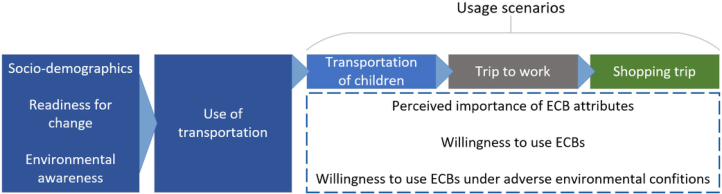
Figure 1 illustrates the structure and the main topics of the questionnaire. First, socio-demographic information of the participants was asked, such as age, gender, education, and income. In addition, the general readiness to change (Szebel, 2015), as well as environmental awareness were measured (ISSP Research Group, 2003). The former as an indicator of openness to changes in mobility behaviour, the latter because environmental awareness was associated with effects on willingness to use in other bicycle contexts (Johnson & Rose, 2013; Becker & Rudolf, 2018).
This first thematic section was followed by questions on mobility beha- viour, in particular on the current use of various means of transport. The remainder of the questionnaire focused on questions about the use of ECBs. For this purpose, a within-subjects design was used to present three different usage scenarios or trip purposes: The transportation of children (kindergar- ten/elementary school), the use of the ECB to travel to work or education, and the use for shopping trips. Participants only had to answer the scena- rios that were relevant to them, i.e., child transport only by participants with
Figure 1: Flowchart of the questionnaire with thematic modules and presented usage scenarios (within-subjects-design).
children and trip to work only by participants who were working or in edu- cation, while the shopping scenario was answered by everyone. All scenarios assumed a private acquisition and not the use of a shared vehicle. For each scenario, user requirements in terms of the perceived importance of some ECB attributes, such as safety, comfort and quality, the general willingness to use, as well as the willingness to use under adverse environmental conditions, such as snow, rain, or darkness, was asked.
Six-point Likert response formats were used for the survey, ranging from full disagreement to full agreement, for example, and were standar- dized to the numerical range from −1 (disagreement/unimportant) to +1 (agreement/important) for the analysis.
Data Acquisition, Preparation and Analysis Participants for the survey were acquired in social media, especially in the- matic forums and groups on mobility and on cargo bike use, as well as in the university environment. The aim was to get novices, as well as peo- ple with previous experience using electric cargo bikes, to participate in the response. Thereby, participation was voluntary, and no financial or other form of compensation was provided. The survey was implemented in German and accordingly the acquisition was limited to German-speaking regions.
Following data collection, the data sets were subjected to quality con- trol. In this process, both early dropouts, speeders, and responses that could not be assumed to be reliable due to contradictory or non-question- related response behaviour (free-text fields) were identified and excluded for subsequent analysis.
Subsequently, the resulting data set was statistically analysed. Scales were calculated by averaging individual items as far as possible after reliability testing (Cronbach’s α > 0.7). Descriptive and inferential statistical analysis was performed, with the level of significance set at α=0.05.
SAMPLE The present sample consisted of N=180 responses. In the following, the socio-demographic and attitudinal characteristics of the sample are presented first, followed by the present mode of transportation use.
I Want to Ride My Bicycle? – User Requirements and Usage Scenarios 125
Socio-Demographics & Attitudes At 72.2% (n = 130), the majority were male, while 26.7% (n = 48) were female. The remainder (1.1%, n = 2) indicated a different gender. Age ran- ged from 18 to 64 years with a mean age of 36.2 years (SD = 11.0 years). Almost all participants reported a high school diploma as their highest level of education (93.9%, n = 169), while the remainder held secondary or lower secondary school diplomas. 80.6% (n = 145) tended to live in urban areas, while 19.4% (n = 35) resided in rural areas. The median household net income was 3,000-5,000€, which was also the most frequent salary mention. Both the readiness for change (M = 3.4, SD = 0.7) and the environmental awareness (M = 3.6, SD = 0.8) were above the scale mean (min = 0, max = 5) and must therefore be regarded as rather distinct.
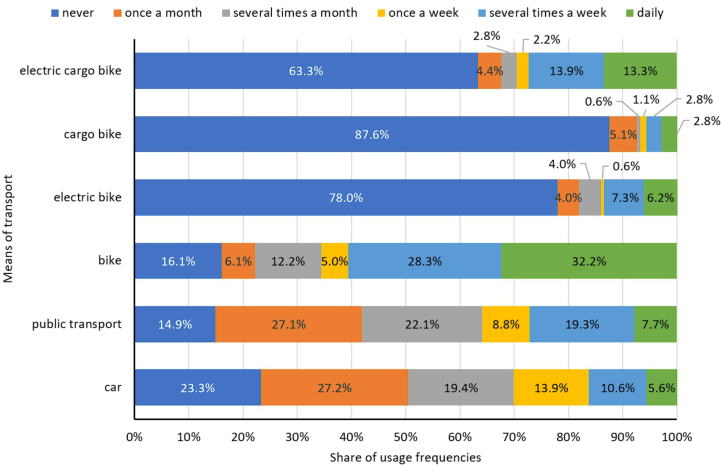
Mobility Behaviour As might be expected, the use of traditional bicycles, public transportation, and passenger cars was more common in the sample than the use of electric or conventional cargo bikes. An overview of the frequency of use of various means of transport can be found in Figure 2. It is noticeable for the sam- ple that electric bicycles, regardless of whether they are standard or cargo bicycles, are used very frequently (several times a week or daily) or not at all, while for other means of transport such as public transport or cars, many par- ticipants also use them infrequently (once a week or several times a month). This suggests that if an electric bicycle is available, it will be used intensively.
The frequency of use of electric cargo bikes was positively correlated with age (ρ = 0.449, p < 0.001), household income (ρ = 0.299, p > 0.001),
Figure 2: Frequency of use of different means of transport.
and environmental awareness (ρ = 0.256, p < 0.001). In contrast, a cor- relation with the educational level or gender of the participants was not found.
In order to further examine the experience of using different types of bicycles, participants are assigned to the ‘electric cargo bike’ group if they use an electric cargo bike at least once a month, to the ‘conventional cargo bike’ group if they do not use an electric cargo bike but use a conventional cargo bike at least once a month, and so on down to the group in which no one uses any type of bicycle. As a result, while it is possible that a member of the cargo bike user group may also use an electric bike, the groups thus represent, in descending order, the greatest available experience in terms of the similarity of the regularly used bicycle type to the object of study, the electric cargo bike.
RESULTS
The results of the study are presented below. To this end, the focus is first placed on the perceived importance of ECB attributes. Subsequently, the willingness to use ECB is analysed, differentiated according to gene- ral willingness to use and willingness to use under adverse environmental conditions.
Importance of ECB Attributes Regarding the perceived importance of the ECB attributes, no significant influence of previous experience with different types of bicycles could be found for any of them, which is why the focus is further on the usage scenarios and trip purposes.
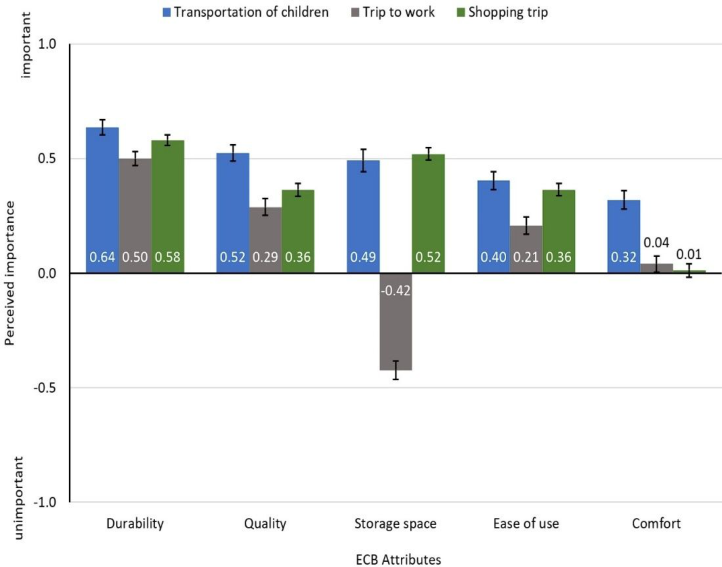
As can be seen in Figure 3, bicycle durability is the most important attri- bute in participants’ perceptions for all trip purposes. In contrast, comfort was considered least important by participants on average in two of the three scenarios (Transportation of children and shopping trips). All five attribu- tes queried tended to be perceived as important. One exception is storage space, which was considered significantly less important for the commute. This is also the only attribute where the trip purpose has a significant impact (p < 0.05 for all pairwise comparisons) on the perception of importance. No significant influence was found for the participants’ readiness for change and their environmental awareness either.
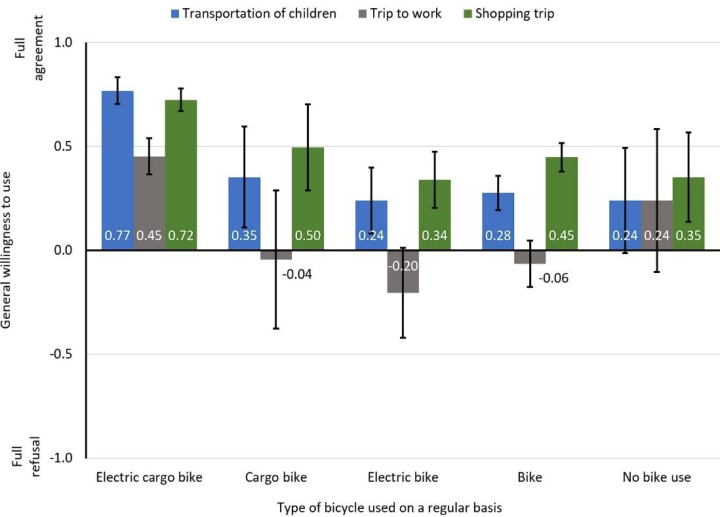
Willingness to Use Regarding the general willingness to use electric cargo bikes, significant diffe- rences were found both in relation to the purpose of the trip and in relation to previous experience in terms of the current use of different types of bicycles. First, all user groups are willing to use ECBs for bringing children as well as for shopping trips (see Figure 4). The lowest willingness to use (or reje- ction) is found for trips to work or education. This difference between the work scenario and the other two is significant (p = 0.014 for the comparison with child transportation, p = 0.002 when compared with shopping trips). However, the main effect of the use scenario is not significant when, as in
I Want to Ride My Bicycle? – User Requirements and Usage Scenarios 127
Figure 3: Perceived importance of different ECB attributes (means and standard errors) differentiated by trip purpose.Figure 4: Willingness to use electric cargo bikes (means and standard errors) differen- tiated by trip purpose and current regular use of different types of bikes.
the present case, readiness for change and environmental awareness are con- trolled as covariates. For the latter, a significant, albeit weak, effect was also found. The higher the environmental awareness, the higher the willingness to use, regardless of the scenario (F(1, 151) = 4.025, p = 0.045, η2
p = 0.077). In terms of the influence of experience, in terms of current use of different types of bicycles, on the other hand, a significant main effect was found (F(4, 151) = 4.025, p = 0.007, η2 p = 0.240). This is reflected in the special status of participants who already use electric cargo bicycles. They show a significantly higher willingness to use them across all trip purposes. Pairwise comparisons between user groups show that users who do not ride bicycles at all, who use standard bicycles, electric bicycles, or conventional non-electric cargo bikes do not differ significantly in terms of willingness to use ECR (p > 0.05 for all pairwise comparisons). In contrast, the group of electric cargo bike users differs significantly from all other groups in terms of willingness to use (p < 0.05 for all pairwise comparisons), except for the group of non-electric cargo bike users (p > 0.05).
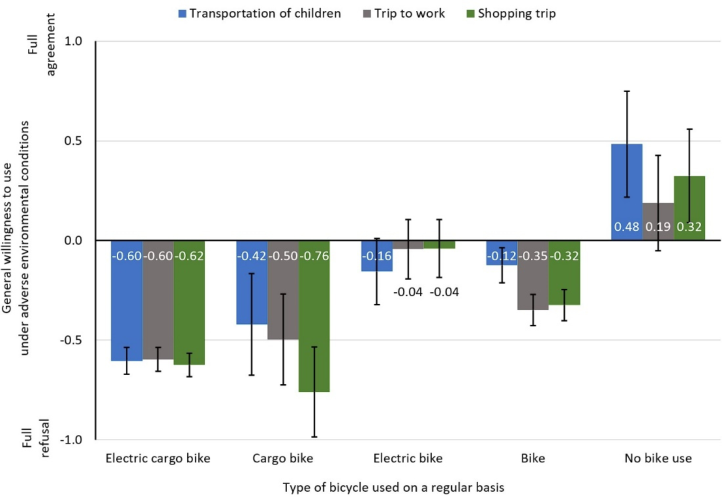
Willingness to Use Under Adverse Environmental Conditions Regarding the willingness to use ECBs even under adverse environmental conditions, such as rain, snow or darkness, a different picture emerges. Although Figure 5 depicts slight mean differences for the different trip pur- poses, these were not significant. There was no main effect of trip purpose, nor did pairwise comparisons of trip purposes yield significant effects.
Figure 5: Willingness to use electric cargo bikes (means and standard errors) under adverse environmental conditions differentiated by trip purpose and current regular use of different types of bikes.
I Want to Ride My Bicycle? – User Requirements and Usage Scenarios 129
In contrast, there are again significant differences between the user groups (F(4, 150) = 5.269, p = 0.001, η2
p = 0.297) and, accordingly, the users of ele- ctric cargo bikes again did not differ significantly from those of non-electric cargo bikes in terms of willingness to use ECB, but they did in comparison to all other groups. While these again did not differ significantly among them- selves. In absolute terms, however, the picture is different. The electric cargo bike users do not show the highest willingness under adverse environmental conditions, as was the case in a general sense, but the lowest one across the trip purposes. Furthermore, it can be seen (compare Figure 5) that almost all user groups reject ECB use, even if only slightly in some cases. Only the group of participants that currently does not use a bicycle at all shows a low agreement to use ECBs even in adverse weather conditions. Neither for the personal readiness for change nor for the environmental awareness a significant effect was found on this occasion.
DISCUSSION & OUTLOOK Regarding the discussion of the results, it can first be stated that previously identified correlations between the use of (electric) cargo bicycles and user factors were also reflected in the present sample, even though these were not the focus of the research. Analogous to Gruber et al. (2014), Gruber & Kihm (2016), and Johnson & Rose (2013), the actual frequency of use correla- ted positively with age, income, and environmental awareness. Interestingly, no significant effects of gender or education were found. While this may be related to the fact that the sample tends to be highly educated, it is also possi- ble that the user characteristics of current ECB users have changed in recent years due to further market penetration and that they no longer correspond to the early adopters in the studies listed. Further research focusing on user characteristics is needed here.
In terms of perceived vehicle attributes, none could be identified as unim- portant, except for storage space for the use of electric cargo bikes on the way to work. However, this must be qualified in two respects. First, the present study examined trip purposes in isolation. In practice, howe- ver, there are often trip chains, such as taking a child to kindergarten on the way to work and perhaps doing some shopping on the way back. In such a case, the vehicle must therefore be able to cover all the trip pur- poses of a mobility chain. Second, attributes have also been queried in isolation. In practice, however, technical factors are rarely independent of each other, so future research should go into more detail here with conjoint analyses to better understand possible drawbacks and tipping points in user evaluation of ECB’s attributes. The extent to which different user profiles perform different evaluations remains an open question. In any case, pre- vious experience does not seem to play a role at this point, which would also be consistent with the uniform semantic evaluation of cargo bicycles at Dorner & Berger (2020). Another remarkable aspect regarding the eva- luation of the vehicle attributes was the perceived importance of comfort. The rather indifferent evaluation seems to contradict the strong influence of adverse environmental conditions on the intention to use the vehicle, which
will be discussed in the following. However, it is possible that the partici- pants did not or only partially associate comfort with weather protection at this point. Future research should further specify vehicle characteristics in detail here.
When looking at the general willingness to use, it was noticeable that the trip to work was significantly different from the other trip purposes and was seen by users as the least suitable for ECBs. Of course, this could be due to the fact that the work context was assessed in isolation and thus the necessity of transporting something was not seen, but it could also be that the willin- gness to use any kind of bicycle for commuting to work is generally lower and strongly dependent on the characteristics of the workplace, such as distance, characteristics of the route, use of work breaks or working hours (Heinen et al., 2011). About previous experience in terms of current use, two things stand out: First, even current users of electric cargo bikes show high but not complete willingness for all trip purposes. This suggests that the assessment of the fit of the vehicle to the trip purpose does not depend on experience alone, but also on other individual user and context factors that were not investiga- ted in the present study. Future research would have to explore, as a holistic survey, what effect experience has in relation to internal user factors in rela- tion to external contextual factors (characteristics of the route, infrastructure, etc.). Second, the results show that prior experience has a positive effect, but only prior experience with cargo bikes. Experience with electric bikes has no added value compared to regular bikes. Thus, the effect of experience stems from the type of construction and not from the type of drive. Therefore, it cannot be assumed that sharing services with regular electric bicycles signifi- cantly increase the willingness to purchase and use electric cargo bicycles. If the political aim is to achieve market penetration of electric cargo bicycles, it can therefore be assumed that only sharing services with ideally electric cargo bicycles could have a significant positive effect.
Last, it is worth looking at the importance of adverse environmental condi- tions and their dependence on other factors. Again, the previously discussed effect of prior experience and its limitation to cargo bikes is evident. It is surprising, however, that the group that does not use bicycles in everyday life is the only one that still shows a willingness to use ECBs under adverse conditions, while the current cargo bike users show the greatest rejection. Here, expertise seems to lead to a more realistic assessment of the practi- cality of the technology, as is also known from other technology contexts (Philipsen et al., 2019), but in this case this does not lead to an underestima- tion of the practicality by laypersons, rather the opposite is the case. Here, future research, possibly using qualitative approaches, would have to work out with current non-users (potential users) the reasons for such assessments. In summary, this paper is only the first step to better understand private ado- ption of electric cargo bikes and possible facilitating factors to integrate the findings into urban planning and service/technology development. It appe- ars that findings from sharing or non-electric contexts are transferable, but further research is needed in a holistic approach, especially considering user diversity and contextual factors, to answer when users really want to ride their bicycles.
I Want to Ride My Bicycle? – User Requirements and Usage Scenarios 131
ACKNOWLEDGMENT
The authors thank all participants for sharing their opinion on electric cargo bikes. Special thanks are given to Nnanna Muoneke for research assista- nce. Our research interest in the perception and evaluation of innovative and sustainable services was inspired by the DAC-Tales project (reference no. 01 LS 2106A). The authors would like to thank the Federal Ministry of Edu- cation and Research for the oppor-tunity to develop further ideas of carbon dioxide free sustainability. Further thanks go to the majestic ones for inspiring the paper title.
REFERENCES
Barbarossa, L. (2020) “The post pandemic city: Challenges and opportunities for a non-motorized urban environment. an overview of Italian cases,” Sustainability, 12(17), p. 7172. Available at: https://doi.org/10.3390/su12177172. Becker, S. and Rudolf, C. (2018) “Exploring the potential of free cargo-bikesharing
for sustainable mobility,” GAIA - Ecological Perspectives for Science and Society, 27(1), pp. 156–164. Available at: https://doi.org/10.14512/gaia.27.1.11. Carracedo, D. and Mostofi, H. (2022) “Electric cargo bikes in urban areas: A new mobility option for private transportation,” Transportation Research Interdisci- plinary Perspectives, 16, p. 100705. Available at: https://doi.org/10.1016/j.trip .2022.100705. Dorner, F. and Berger, M. (2020). “Peer-to-Peer Cargo Bike Sharing: Findings from
LARA Share project,” Proceedings of 8th Transport Research Arena TRA 2020, April 27-30, 2020, Helsinki, Finland. Faxér A. Y., Olausson E., Olsson L., Smith G., Pettersson S. (2018) Electric Cargo Bike with a Twist - A Field Test of Two Innovative Bicycle Concepts. In: 31st Inter- national Electric Vehicle Symposium and Exhibition (EVS 31) and International Electric Vehicle Technology Conference 2018 (EVTeC 2018), Kobe, Japan. Gruber, J. and Kihm, A. (2016) “Reject or embrace? messengers and electric cargo
bikes,” Transportation Research Procedia, 12, pp. 900–910. Available at: https: //doi.org/10.1016/j.trpro.2016.02.042. Gruber, J., Kihm, A. and Lenz, B. (2014) “A new vehicle for urban freight? an ex-ante evaluation of electric cargo bikes in Courier Services,” Research in Transportation Business & Management, 11, pp. 53–62. Available at: https://doi.org/10.1016/j. rtbm.2014.03.004. Heinen, E., Maat, K. and van Wee, B. (2011) “Day-to-day choice to commute or not
by Bicycle,” Transportation Research Record: Journal of the Transportation Rese- arch Board, 2230(1), pp. 9–18. Available at: https://doi.org/10.3141/2230-02. Hess, A.-K. and Schubert, I. (2019) “Functional perceptions, barriers, and demographics concerning E-cargo bike sharing in Switzerland,” Transportation Research Part D: Transport and Environment, 71, pp. 153–168. Available at: https://doi.or g/10.1016/j.trd.2018.12.013. ISSP Research Group (2003) “International Social Survey Programme: Environ-
ment II - ISSP 2000,” GESIS Datenarchiv, Köln. ZA3440 Datenfile Version 1.0.0, Available at: https://doi.org/10.4232/1.3440. Johnson, M. and Rose, G. (2013) ”Electric bikes - cycling in the New World City: an investigation of Australian electric bicycle owners and the decision making process for purchase,” Australasian Transport Research Forum 2013 Proceedings. Austra- lian National Audit Office, Canberra ACT Australia, pp. 1–10, Australasian Transport Research Forum 2013, Brisbane, Queensland, Australia, 2/10/13.
Narayanan, S. et al. (2022) “Purchase intention and actual purchase of cargo cycles: Influencing factors and Policy Insights,” Transportation Research Part A: Policy and Practice, 155, pp. 31–45. Available at: https://doi.org/10.1016/j.tra.2021.10.007. Narayanan, S. and Antoniou, C. (2022) “Electric cargo cycles - A com- prehensive review,” Transport Policy, 116, pp. 278–303. Available at: https://doi.org/10.1016/j.tranpol.2021.12.011. Philipsen, R. et al. (2019) “Under pressure—users’ perception of range stress in the context of charging and traditional refueling,” World Electric Vehicle Journal, 10(3), p. 50. Available at: https://doi.org/10.3390/wevj10030050. Sodiq, A. et al. (2019) “Towards modern sustainable cities: Review of Sustainabi-
lity Principles and trends,” Journal of Cleaner Production, 227, pp. 972–1001. Available at: https://doi.org/10.1016/j.jclepro.2019.04.106. Szebel, A., 2015. Veränderungskompetenz von Mitarbeitern. Eine empirische Untersuchung zur differentiellen Konstrukterschließung der individuellen Veränderung- skompetenz von Mitarbeitern unter besonderer Berücksichtigung des Einflus- ses dispositionaler Persönlichkeitsfaktoren (Doctoral dissertation, Universität zu Köln) Website: https://kups.ub.uni-koeln.de/id/eprint/6183. Vasiutina, H., Szarata, A. and Rybicki, S. (2021) “Evaluating the environmen-
tal impact of using cargo bikes in cities: A comprehensive review of existing approaches,” Energies, 14(20), p. 6462. Available at: https://doi.org/10.3390/en 14206462. Wolf, A. and Seebauer, S. (2014) “Technology adoption of electric bicycles: A survey among early adopters,” Transportation Research Part A: Policy and Practice, 69, pp. 196–211. Available at: https://doi.org/10.1016/j.tra.2014.08.007.
LISTED IN THE AHFE DIGITAL BOOKSTORE CATALOGUE
Explore the complete digital volume
Human Factors in Transportation
Read this individual research paper free through the original publisher, or explore the full digital proceedings book.
ISBN 978-1-958651-71-1
Explore this ISBN in the AHFE Bookstore ↗Listed in the July 2026 bookstore catalogue; search by ISBN to confirm current availability · Digital book purchase optional