Sylvia Kowalewski, Anna Borg, Johanna Kluge, Simon Himmel, Bianka Trevisan, Denise Eraßme, Martina Ziefle, Eva-Maria Jakobs (2018). Modeling the Influence of Human Factors on the Perception of Renewable Energies. Taking Geothermics as Example. In: Advances in Human Factors, Software, and Systems Engineering. AHFE Open Access, vol. 4. https://doi.org/10.54941/ahfe100136
Issues of social acceptance, such as lack of awareness and negative community perceptions, can considerably affect technology development and rollout. For this purposes a deeper understanding of underlying mechanisms that influence acceptance is urgently needed in the context of renewable energies when the goal is to reduce CO2 emission by 20% until the year 2020. The associated project of this study - TIGER - has the aim to develop a communication strategy to implement renewable energy technologies like geothermics. As a first step this research focuses on analyzing factors that determine the perception and thus acceptance of deep geothermal energy technologies. A study was conducted with a sample of 360 participants in the western part of Germany. The TPB (Theory of planned behavior) was expanded with further variables such as environmental attitudes and attitudes towards renewable energies. A structural equation model was used to analyze the correlation between proposed psychological antecedents and further moderating factors on the acceptance of geothermal power plants in the own neighborhood. Results show that underlying motives as well as barriers significantly affect the acceptance of geothermal energy. Behavioral control appeared as an important moderating effect in this model whereas the influence of environmental attitudes is not apparent. Furthermore, results also reveal that especially the scope of information plays an important role in acceptance of geothermal energy, meaning informed people show a significantly higher acceptance and less skepticism than not-informed people. This emphasizes the urgent need for information and communication in the context of relatively unknown technologies like geothermal energy.
Although the urgency to find an alternative to fossil fuels and provide energy in a sustainable way is apparent, more and more action groups protest against the infrastructure of renewable energies. The expansion of renewable energies is one of the major topics in many western countries. Especially in Germany, the government has the ambitious goal to increase the share of renewable energy in the whole energy sector to 60% until 2050 (BMU, 2012). Apart from technical aspects, public acceptance is one of the key factors for a successful implementation of renewable technologies in society. It has been neglected during the last decades when the first policy programs started (Wüstenhagen et al., 2007).
Issues of social acceptance such as lack of awareness and negative community perceptions can considerably affect technology development and rollout. Especially in the context of large-scale technologies, a lack of public acceptance or adequate information can be critical for a whole society as in most cases these large-scale technologies (e.g., electricity grids or mobile phone networks) should give benefit to a broader part of the population. For example, citizens can profit from replacing nuclear power plants with renewable energy technologies. Though the urgency to find an alternative to fossil fuels and provide energy in a sustainable way, more and more action groups protest against the infrastructure of renewable energies. The so-called NIMBY-phenomenon (not-in-my-backyard) means that although most of the population supports the development of renewable energy technologies, many people do not accept a power plant or wind farms in their neighborhood. Although a lot of research has been done on the NIMBY concept, it was criticized in literature for overly simplifying attitudes and intentions towards structures (Vittes, Pollock & Lilie, 1993; Groothuis, Groothuis & Whitehead, 2008). It disregards the complexity of underlying psychological factors influencing the attitude towards large scale technology, for example using motives and barriers and risk perception. Those factors are necessary to understand to develop a proper communication and information strategy for relatively unknown Technologies, e.g. geothermics.
In order to get a better understanding of underlying psychological factors that influence the perception of large-scale technologies, this study took geothermal energy as example and used the TPB as theoretical background. As with other technologies, geothermal technology has its own unique characteristics that should be considered. For the development of geothermal energy technology the acceptance issue is particularly relevant, as problems such as induced earth-movements have led to a negative image of this technology within the public. A lack of understanding underlying cognitions, motives, and barriers regarding this technology was identified when the first public communication programs started.
The objective of this paper is to identify and analyze factors that are important for winning acceptance of deep geothermal energy power plants. Different stakeholders are interested in knowledge about how to manage ‘‘social acceptance’’ at the different stages of planning, realization, and operation. More specifically, the following research aims were aspired:
1. Quantification of acceptance and investigation of influencing factors regarding deep geothermal energy 2. Explanation of acceptance by underlying usage benefits and barriers 3. Contrast of acceptance for knowledge and not knowledge groups 4. Derivation of guidelines for development of communication strategies in the context of renewable energies and geothermics in particular
THEORETICAL BACKGROUND Acceptance of renewable energies and the theory of planned behavior
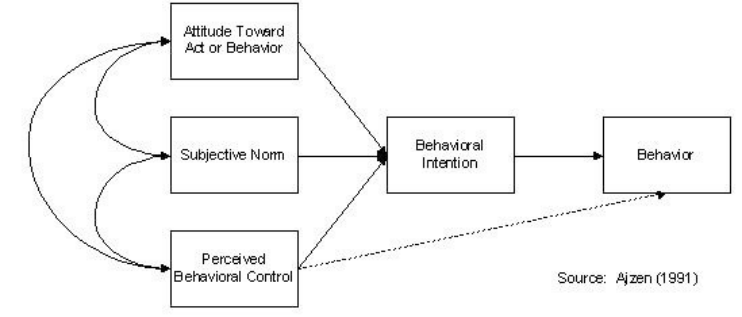
As already mentioned, criticism about the NIMBY concept reveals the requirement for a deeper understanding of how acceptance works in order to develop communication strategies in the context of renewable energies. A better approach to understand and analyze dynamics of public opposition and lack of acceptance would be the theory of planned behavior (TPB) (Ajzen, 1991). As recent literature shows, this theory does not only provide an insightful research base for acceptance of smaller technologies like ICT (e.g., Yang, 2012; Cheon, Lee, Crooks & Song 2012; Zhang & Aikman, 2007) but also for large-scale technologies as used in the context of renewable energies. In addition, the model allows classifying and quantifying single components that underlie human decisions or behavioral patterns. As such, the theory defines psychological antecedents that influence intentions and thus behavior - attitudes, subjective norm as well as perceived behavioral control (PBC) (see Fig. 1). Attitudes refer to a person’s feelings and beliefs about a particular behavior. Subjective norm refers to the extent to which social pressure from significant others may influence a person’s intention to perform a particular behavior. PBC refers to the degree to which a person feels they have control over their decision to engage (or not engage) in a particular behavior (Ajzen & Fishbein, 1980). Thus, according to the theory, a person will intend to perform a certain behavior if they evaluate it positively, believe that important others think they should perform it, and perceive it to be under their own control (Ajzen, 1991).
Figure 1: The theory of planned behavior (Ajzen, 1991)
In the context of renewable energy technologies, a few recent studies used the theory of planned behavior to explain, for example, the acceptance of wind farms (Read et al., 2013) or the acceptance of carbon capture and storage (Kraeusel & Möst; 2012). As every technical context has its own determinants that influence people’s perception and thus acceptance (Arning, Gaul & Ziefle, 2010), the models are usually expanded with further constructs. In the context of renewable energy, risk perception plays a crucial role for acceptance (Huijts, Molin & Steg, 2012; Sovacool & Ratan, 2012). An understanding of perceived risks and thus arguments against a technology is indispensable for developing an adequate communication strategy. Additionally, risk perception is driven by a person’s perceived behavioral control which is in turn influenced by a person’s knowledge. This knowledge can be a general knowledge like a basic technical understanding or a domain specific knowledge.
Regarding deep geothermal energy results from studies in Australia, Japan, and Italy have shown that public knowledge about geothermal technology is low and uncertainty of risks and predictability is high (Dowd et al., 2011; Kubota et al., 2013; Cataldi, 2001). In Germany, the majority of the public reports limited knowledge or understanding of geothermal technology and has various concerns including water usage and seismic activity instigated by geothermal drilling (Brian, 2013). Therefore, a second focus of this study lies on the influence of people’s knowledge in order to study the need for information. Altogether, few other theoretical approaches have been explored in relation to acceptance of geothermal energy. Wüstenhagen et al. (2007) conceptualized (social) acceptance of geothermal energy as a concept that contains three dimensions, namely socio-political acceptance, community acceptance, and market acceptance. This approach might be useful in order to combine different perspectives on a more general level, but it is not suitable for a deeper understanding of how acceptance works. Parallel geothermal acceptance research often follows a more practical approach, for example the project Enerchange (Wallquist & Holenstein, 2013) whose communication concept more or less follows learning by doing by actively engaging in community discussions. The present associated TIGER project bases its communication concept on scientific research data in a holistic and not interfering approach.
METHODOLOGY
Questionnaire The first part of the questionnaire assessed demographic data (age, sex, education, residence) and whether participants had informed themselves about deep geothermal energy before. Perceived behavioral control is conceptualized in a general concept of people’s technical self-efficacy which is operationalized with four items. The following parts assessed the items for our research model. Items containing arguments for and against geothermal energy were developed based on findings of a prior interview study. In order to familiarize participants with deep geothermal energy, a detailed introduction into the topic was given. Furthermore, the questionnaire contained attitudes towards environmental awareness and renewable energies in general. In the end, as a measure for effective behavioral acceptance, participants were asked whether they would accept a geothermal power plant in their own town. Multiple-choice items had to be answered on a six-point Likert scale ranging from 1 (do not agree at all) to 6 (fully agree).
Procedure and Sample A total of n = 360 people between the age of 14 and 79 years (M = 31,11 SD = 13,76, 54,1% male) took part in the study. Regarding their place of residence, a minority of 26% live in rural areas, whereas most of the participants live in small (35%) or bigger (39%) towns. More than half of the sample (57%) reported they live in a rented flat and 31% reside in their own houses. Only a minority lives in rented houses (8%) or condominiums (4%). Asked about their knowledge of geothermal energy, nearly one third reported they had never heard of it before; only 29% had actively informed themselves about the topic. While 98.3% of the participants stated that the expansion of renewable energies must be advanced, only 85% think geothermal energy should be supported. Still, there is a great general support of geothermal energy, which can be seen from 89% of participants who find it reasonable.
Statistical Analysis ANOVAS and Partial Least Squares (PLS), a component-based structural equation modeling (SEM) technique, were employed. In contrast to covariance-based SEM techniques, PLS has less strict requirements on sample size and residual distribution (Weiber & Mühlhaus, 2009), but allows for statistical modeling with formative and reflective constructs (Petter et al., 2007).
RESULTS
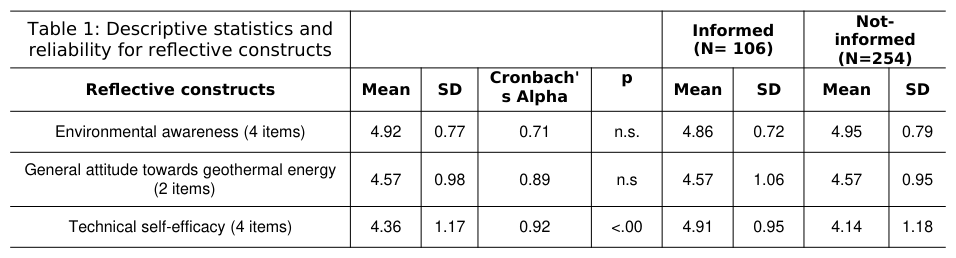
The analysis of the PLS measurement model demonstrated that all items had acceptable measurement properties. For the two formative constructs “arguments for” and “arguments against” geothermal energy, the variance inflation factor (VIF) varied from 1.02 to 2.1; therefore, validity problems due to multicollinearity could be ruled out. All reflective constructs met reliability criteria (Cronbach’s alpha > 0.7, see Table 1) and discriminant validity criteria (Fornell-Larcker-Criterion, Weiber & Mühlhaus, 2009). Thus we can conclude that the measures were valid.
Descriptive statistics for measured constructs are presented in Tables 1 (reflective constructs) and 2 (formative constructs), along with the results of ANOVA analyses to assess differences between informed people and not- informed people.
User factors – the role of information Based on the fact whether people informed themselves about deep geothermal energy before or not, participants were assigned into one of two groups. Informed people and not-informed people did not differ with regard to their environmental awareness and their general attitude towards renewable energies and geothermal energy(see Table 1).
Table 1: Descriptive statistics and reliability for reflective constructsEquation reproduced from the original PDF.
However, they significantly differed regarding their technical self-efficacy (F(1,356)= 35.82; p < .001) and their behavioral acceptance (F(1,356)= 5.24; p < .05), with informed people showing higher scores on both constructs. With a mean of 4.14 (SD = 1.19), informed people are more open for a deep geothermal power plant in their town than not-informed people (M = 3.86; SD = .92). Informed people also show a higher technical self efficacy (M = 4.91; SD = 0.95) than not-informed people (M = 4.14; SD = 1.18; F(1, 357) = 39.2; p<.001).
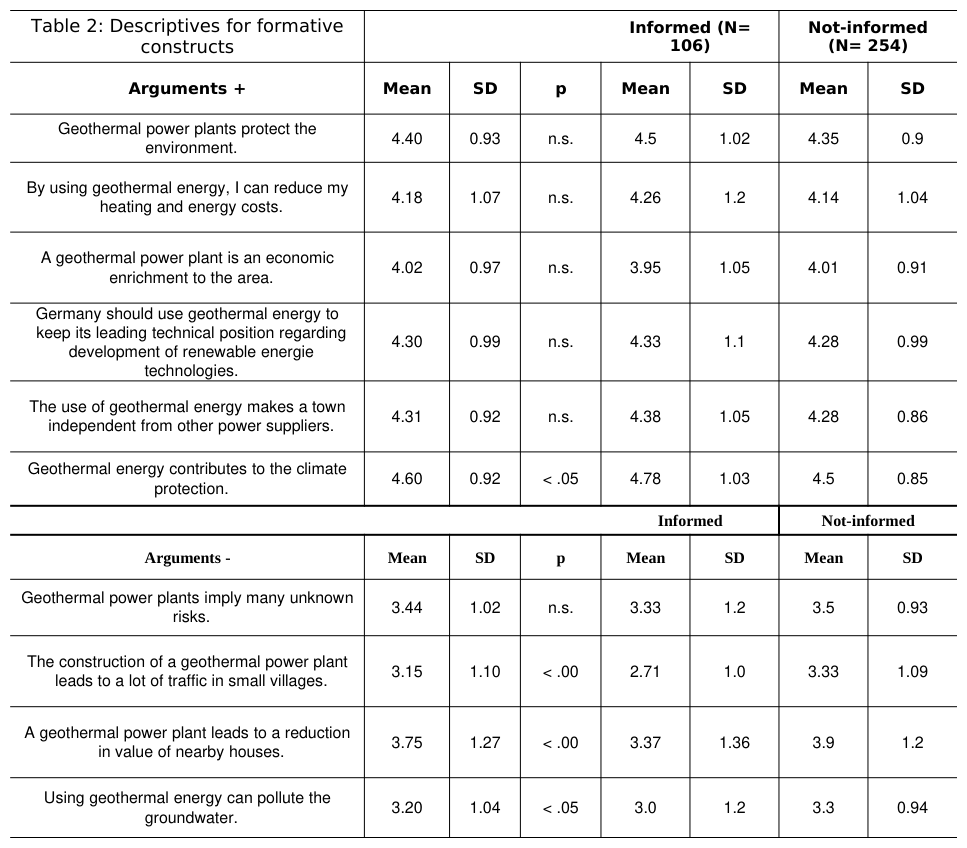
A closer look on the individual arguments for and against deep geothermal energy (formative constructs see Table 2) reveals that informed people differ significantly from not-informed people in their rating of arguments against deep geothermal energy. Although most of the arguments for deep geothermal energy do not reveal significant differences between the groups, the informed group’s higher mean scores on these arguments reveal a slight tendency toward a more positive attitude than not-informed people have.
Table 2: Descriptives for formative
In case of a breakdown, a geothermal power plant carries high risks for the environment. 2.98 1.17 < .05 2.73 1.3 3.08 1.06
In relation to its use, a geothermal power plant is too expensive. 3.43 0.95 n.s. 3.39 1.12 3.44 0.87
Equation reproduced from the original PDF.
The most important argument in both groups for deep geothermal energy is its contribution to climate protection. Economic reasons alone are not sufficient to accept geothermal energy in the group of informed people, as indicated by a slightly lower mean (3.95; SD = 1.05) compared to the not-informed group (M = 4.01; SD = 0.91).
Regarding the arguments against deep geothermal energy, informed people show less consent than not-informed people, which conforms with higher general acceptance values in table 1 (see Table1). The most striking difference between the two groups turns out regarding the contra arguments that the construction of a power plant leads to more traffic in the town (F(1,356)= 38.21;p<.001) and that a power plant will reduce value of the houses nearby (F(1,356) = 31.78; p<.001). The most important argument against deep geothermal energy for the group of the informed people is it being too expensive (M= 3.39; SD = 1.12), whereas the fear of loss in value of the houses is the most striking objection for not-informed people (M= 3.9; SD =1.2).
Research model results – antecedents of acceptance The PLS analysis yielded path coefficients for the structural models of the whole sample. Levels of significance were estimated using t-statistics derived from a bootstrapping procedure with 1000 re-samples. The results of structural equation modeling are presented in Figure 2.
The model explains at least 17.7% of the behavioural acceptance within the whole sample. 22.7% of the general attitude towards geothermal energy are explained by the arguments for and against geothermal energy as well as by the general attitude towards renewable energies a person has. Nevertheless, arguments for geothermal energy (arguments +) have the greatest influence on the attitude, which is indicated by a higher path coefficient ([Equation or mathematical symbol available in the original paper PDF] = .35; p < .001). However, the general attitude is also significantly influenced negatively by arguments against the technology (arguments -; ([Equation or mathematical symbol available in the original paper PDF] = -.16; p< .05)). As expected, the technical self-efficacy significantly influences the attitude for geothermal energy (attitude +) as well as against it (attitude -). Another interesting aspect is the fact that environmental awareness has influence only on the general attitude towards renewable energies ([Equation or mathematical symbol available in the original paper PDF] = .42; p < .001), not on the general attitude towards geothermal energy.
Figure 2: Results of the research model (* p<.05; **p<.001)
Figure available in the original PDF paper.
CONCLUSIONS
The aim of this study was to identify and analyze factors that are important to winning acceptance of deep geothermal energy power plants. More specifically, this study modeled acceptance of deep geothermal energy and its influencing factors. Additionally, the influence of people’s status of information was investigated by contrasting the acceptance of informed and not-informed people. For this purpose, a questionnaire study with 356 participants was conducted. Results give valuable insights for guidelines for the development of communication strategies in the context of renewable energies and geothermics in special.
First of all, results reveal that especially the scope of information plays an important role in the acceptance of geothermal energy and thus information- and communication strategies play a crucial role in creating acceptance. Comparing a group of people that are informed about deep geothermal energy with a group that is not informed reveals significant differences in behavioral acceptance as well as in the attitudes of both groups. Informed people show higher acceptance as well as a more positive attitude towards the technology. This indicates that knowledge induces a more positive perception of geothermal energy and emphasizes the importance of informing the people. A deeper analysis of the individual arguments for and against geothermal energy showed that informed people advocated more the positive arguments whereas negative arguments were more advocated by not-informed people. Interestingly, in the group of informed people the most striking argument against geothermal energy as well as the least supported argument in favor of the technology was the economical risk respectively economical benefit. This indicates that the perception of geothermics within the informed group is positive, but there is a distrust of the economic efficiency. Thus, a communication strategy has to consider that and should make the economical risks and benefits to a subject of discussion.
Results from the structural equation modeling showed that the perception of the benefit is the most influential factor on a positive attitude and thus on acceptance. Although arguments against geothermal energy do have a negative influence on acceptance, path coefficients in the model revealed that their impact is not that significant. For communication strategies the results indicate that the benefits of deep geothermal should be clearly emphasized when informing residents. Also, arguments against the technology should be refuted and possible risks cleared up. However, the main focus of communication has to be on the benefit of the technology. General attitudes towards renewable energies have only a slight positive influence on the attitude towards deep geothermal energy. This means a person’s positive position towards renewable energies does not automatically result in an affirmation of geothermal energy. Additionally, the fact that there is no correlation between environmental awareness and the attitude towards geothermal energy indicates that geothermal energy is not perceived as a stereotypical renewable energy and thus naturally supported by environmentally aware people. The most striking arguments in favor of geothermal energy are those indicating its climate- and eco-friendliness. These results suggest that within the emphasis on the benefits of this technology, the green side of deep geothermal energy should be highlighted.
Limitations and future research Parallel research (Trevisan et al., 2014; in this proceedings) also associated with the TIGER project, analyzed web comments on Facebook and found out that within the context of energy systems gender sensitivity is of most importance. Men are primarily focusing on the overall economic efficiency and the environment protection whereas women pay more attention to costs and benefits that affect themselves. Thus, future studies should consider gender effects and pay attention towards the influence of different acceptance aspects with men and women.
Regarding the identification of relevant user groups, future studies should examine a bigger sample when the aim is to contrast and identify different Types of users. For example the role of opinion leaders could be important to understand. Especially in rural areas opinion leaders could influence the community acceptance of geothermic. Also the detection of local differences in the perception and acceptance of geothermal energy should be included in future works. Therefore a broad regional sample should be examined.
This study showed, that overall the positive arguments and especially the “green side” of geothermal energy is relevant for acceptance. Future works should investigate more detailed which kind of information should be reported and at which stage of a geothermal project. Also the question which communication channel is the appropriate to use should be examined. In this study, the role of scope of information was identified as crucial for creating acceptance. The here presented division into informed and not-informed people is based on a self-assessment. Future works should investigate if the influence of information is based on a perceived or an objective level of information.
Furthermore the fact that geothermic isn't perceived as a stereotype of renewable energy should be examined in more detail for the development of a proper communication guideline for deep geothermal energy.
ACKNOWLEDGEMENTS
This research is funded by the German Federal Ministry for the Environment, Nature Conservation, Building and Nuclear Safety (BMU). The research team owes gratitude to the ministry project coordinator Andrea Ballouk for her diligent supervision and her helpful support in organizational as well as research issues. Thanks also to Julian Halbey and Chantal Lydinia for research support and remarks on earlier versions of this manuscript.
REFERENCES
Ajzen, I. (1991). The Theory of Planned Behavior. Organizational Behavior and Human Decision Processes. 50, 179-211. Ajzen, I., & Fishbein, M. (1980). Understanding attitudes and predicting social behavior. Englewood Cliffs, NJ: Prentice-Hall. Arning, K., Gaul, S., Ziefle, M. (2010). “Same same but different”. How service contexts of mobile technologies shape usage motives and barriers. In G. Leitner, M. Hitz & A. Holzinger (eds). HCI in Work & Learning, Life & Leisure, 6th Symposium of the WG HCI&UE of the Austrian Computer Society (USAB 2010). Lecture Notes in Computer Science 6389 (pp. 34-54). Berlin, Heidelberg: Springer. Brian, M. (2013). Vertrauensbildung durch zielgerichtete Kommunikation. bbr – Sonderheft Geothermie 2013. S. 72-74. Bundesministerium für Umwelt, Naturschutz und Reaktorsicherheit (BMU). Erneuerbare Energien Motor der Energiewende.
Bd. 1. Bundesministerium für Umwelt, Naturschutz und Reaktorsicherheit (BMU), Okt. 2012 Cataldi, R. (2001). Social acceptance of geothermal projects: problems and costs. Proc. European Summer School on Geothermal Energy Applications. Oradea/RO, 343–351.
Cheon, J., Lee, S., Crooks, S. M., Song, J. (2012). An investigation of mobile learning readiness in higher education based on the theory of planned behavior. Computers & Education, 59 (3), 1054-1064. Dowd, A.-M., Boughen, N., Ashworth, P., & Carr-Cornish, S. (2011). Geothermal technology in Australia: Investigating social
acceptance. Energy Policy, 39(10), 6301–6307. Emmann, C. H., Arens, L., & Theuvsen, L. (o. J.). Individual acceptance of the biogas innovation: A structural equation model.
Energy Policy. (in press) Groothuis, P. A., Groothuis, J. D., & Whitehead, J. C. (2008). Green vs. green: Measuring the compensation required to site electrical generation windmills in a viewshed. Energy Policy, 36(4), 1545–1550. Huijts, N. M. A., Molin, E. J. E., & Steg, L. (2012). Psychological factors influencing sustainable energy technology acceptance:
A review-based comprehensive framework. Renewable and Sustainable Energy Reviews, 16(1), 525–531. Kraeusel, J. & Möst, D. (2012). Carbon Capture and Storage on its way to large-scale deployment: Social acceptance and willingness to pay in Germany. Energy Policy, 49, p. 642-651. Kubota, H., Hondo, H., Hienuki, S., & Kaieda, H. (2013). Determining barriers to developing geothermal power generation in
Japan: Societal acceptance by stakeholders involved in hot springs. Energy Policy, 61, 1079–1087. Read, D. L., Brown, R. F., Thorsteinsson, E. B., Morgan, M., & Price, I. (2013). The theory of planned behaviour as a model for predicting public opposition to wind farm developments. Journal of Environmental Psychology, 36, 70–76. Rogers, E. (1995). Diffusion of innovations. Free Press, New York. Petter, S., Straub, D. & Rai, A. (2007). Specifying formative constructs in information systems research. MIS Quarterly, vol. 31,
no. 4, 623-656. Sovacool, B. K., & Lakshmi Ratan, P. (2012). Conceptualizing the acceptance of wind and solar electricity. Renewable and Sustainable Energy Reviews, 16(7), 5268–5279. Trevisan, B., Eraßme, D., Hemig, T., Kowalewski, S., Kluge, J., Himmel, S., Borg, A., Jakobs, E. & Ziefle, M. (2014). Facebook
as a source for human-centered engineering. Web Mining-based reconstruction of stakeholder perspectives on energy systems in: Proceedings of the 1st International IBM Symposium on Human Factors, Software, and Systems Engineering (AHFE 2014). Vittes, M. E., Pollock III, P. H., & Lilie, S. A. (1993). Factors contributing to NIMBY attitudes. Waste Management, 13(2), 125–
129. Wallquist, L., & Holenstein M. (2013). Sustaining the public's trust in geothermal projects. Think Geoenergy (inaugural issue). Weiber, R., Mühlhaus, D. (2009). Strukturgleichungsmodellierung: Eine anwendungsorientierte Einführung in die Kausalanalyse mit Hilfe von AMOS, SmartPLS und SPSS. 1 Auflage. Springer, Berlin/Heidelberg. Wüstenhagen, R., Wolsink, M., & Bürer, M. J. (2007). Social acceptance of renewable energy innovation: An introduction to the
concept. Energy policy, 35(5), 2683–2691. Yang, K. (2012). Consumer technology traits in determining mobile shopping adoption: An application of the extended theory of planned behavior. Journal of Retailing and Consumer Services, 19(5), 484-491. Zhang, Ping, and Shelley Aikman. “Attitudes in ICT Acceptance and Use.” In Human-Computer Interaction. Interaction Design
and Usability, edited by Julie A. Jacko, 1021–1030. Lecture Notes in Computer Science 4550. Springer Berlin Heidelberg, 2007.
LISTED IN THE AHFE DIGITAL BOOKSTORE CATALOGUE
Explore the complete digital volume
Advances in Human Factors, Software, and Systems Engineering
Read this individual research paper free through the original publisher, or explore the full digital proceedings book.
ISBN 978-1-4951-2096-1
Explore this ISBN in the AHFE Bookstore ↗Listed in the July 2026 bookstore catalogue; search by ISBN to confirm current availability · Digital book purchase optional