Ralf Philipsen, Philipp Brauner, Hannah Biermann, Martina Ziefle (2022). I Am What I Am – Roles for Artificial Intelligence from the Users’ Perspective. In: Artificial Intelligence and Social Computing. AHFE Open Access, vol. 28, pp. 108–118. https://doi.org/10.54941/ahfe1001453
With increasing digitization, intelligent software systems are taking over more tasks in everyday human life, both in private and professional contexts. So-called artificial intelligence (AI) ranges from subtle and often unnoticed improvements in daily life, optimizations in data evaluation, assistance systems with which the people interact directly, to perhaps artificial anthropomorphic entities in the future. How-ever, no etiquette yet exists for integrating AI into the human living environment, which has evolved over millennia for human interaction. This paper addresses what roles AI may take, what knowledge AI may have, and how this is influenced by user characteristics. The results show that roles with personal relationships, such as an AI as a friend or partner, are not preferred by users. The higher the confidence in an AI's handling of data, the more likely personal roles are seen as an option for the AI, while the preference for subordinate roles, such as an AI as a servant or a subject, depends on general technology acceptance and belief in a dangerous world. The role attribution is independent from the usage intention and the semantic perception of artificial intelligence, which differs only slightly, e.g., in terms of morality and controllability, from the perception of human intelligence.
Digitization is advancing in various areas of life and is becoming visible and tangible to the public in developments such as autonomous driving in the mobility sector or novel medical assistance in healthcare (Heng- stler et al., 2016). So, the topic of artificial intelligence (AI) is beco- ming important for non-professional end users. From a layman’s point of view, the boundaries between simple decision support systems and actual intelligent, self-learning algorithms are becoming blurred, and much is subsumed under the abstract term “artificial intelligence”. However, this perception is relevant for the users’ acceptance of the technology in dif- ferent areas of life and for the compliance, ignoring, and use of AI recommendations.
So far, user perception of AI has been researched only fragmentarily: for instance, with respect to the public awareness and understanding of AI
I Am What I Am – Roles for Artificial Intelligence from the Users’ Perspective 109
(Selwyn and Cordoba, 2021), conceptions of and emotions about AI (Mays et al., 2021), as well as general perceptions of AI, e.g., in terms of perceived usefulness and risk, in different usage contexts (Araujo et al., 2020, Bier- mann et al. 2021). The aim of this work is to take a closer look at the interaction between humans and AI, especially regarding roles for AI from the users’ perspective, i.e., which areas of life AI may and should enter, in which function AI may and should act, what relationship people would like to have with AI, what knowledge AI may have about the user. Initial research findings suggest that people have more positive attitudes toward functional than social AI (Kim et al., 2021). Discomfort is expressed for AI agents in powerful positions, such as country and company leader or therapist (Mays et al., 2021).
A major threat to the acceptance of AI lies in user concerns and fears (Mays et al., 2021), driven not least by the media’s portrayal of AI and science fiction (Liang and Lee, 2017). Also, increasing system complexity and insufficient knowledge about how AI works may lead to uncertainties on the user side, especially since the algorithms underlying AI are difficult to “touch”. Therefore, individual attitudes as well as subjectively perceived associations and affective attributions regarding the design and use of AI need to be considered in acceptance mapping. Besides, human factors need to be addressed, as user-specific characteristics, personality traits, etc. are related to the perception and evaluation of AI (Araujo et al., 2020; Park and Woo, 2021). For example, there are connections between the perceived anxiety about AI and sociodemographic factors as well as an individual’s sensitivity to other types of fear (Liang and Lee, 2017). Also, AI role perception varies among user groups, e.g., in terms of general perceived technology competence (Mays et al., 2021).
A key to the acceptance and use of AI is user’s trust (Lockey et al., 2021; Thiebes et al., 2021). As in human relations, trust may help to endure and overcome uncertainties in dealing with AI. How trust is established, depends on system-related features (Siau and Wang, 2018). This, of course, inclu- des the large amount of data required for processing and the handling of these data, which presents a particular challenge for users to trust AI, e.g., due to feared data misuse or privacy concerns (Burbach et al. 2019), which, however, can be overcome, e.g., through effective control measures (Rossi, 2018; Lockey et al., 2021). Conceptually, a distinction is made between initial trust, i.e., general perceptions and attitudes, e.g., influenced by an AI’s tran- sparency, and continuous trust which is strengthened during the interaction between humans and AI (Siau and Wang, 2018). For the latter, the sociability of AI plays a crucial role, i.e., the way it reacts, behaves, and communicates (Siau and Wang, 2018).
Like interpersonal interaction, for which a culturally shaped etiquette has evolved over millennia and is still evolving, human interaction with artifi- cial rather than human intelligence requires socially shaped rules, which may depend on role perception and individual differences. An AI that does not violate those rules is considered to have higher user acceptance, trust, and greater chances of success on the market.
QUESTIONS ADDRESSED Based on the current state of research and existing knowledge gaps, the following questions arise for future technology development:
What role may AI take on from the user’s point of view, in which areas of human life is it welcomed, and what knowledge about humans may it have?
How does the perception of AI and its decisions differ in distinction to human intelligence?
How do user characteristics, such as socio-demographics, personality traits, or attitudes influence trust in AI, intent to use, and especially the roles seen for AI?
By initially addressing these questions, the present study thereby aims to be a first step towards a better understanding of how AI fits into everyday human life and towards a holistic culturally shaped AI etiquette.
METHODOLOGY
A two-stage, consecutive empirical approach was used to address the research questions. First, qualitative interviews were conducted (N=38) and content analyzed to identify possible role and trait attributions for AI, as well as requi- rements and concerns. Subsequently, the identified attributions, requirements and roles were incorporated into a large-scale quantitative questionnaire study for assessment (N=538).
Questionaire Design The developed questionnaire instrument consisted of five thematic sections. First, the classic socio-demographics of the participants were surveyed (e.g., age, gender, income, and education). Second, personality traits and attitudes of users were focused. For this purpose, among other things, the participants’ general willingness to use technology was surveyed with the dimensions of technology acceptance, technology competence belief, and technology control belief (Neyer, Felber and Gebhardt, 2012). Furthermore, the threat sensiti- vity (Denefrio and Dennis-Tiwary, 2017) was surveyed to be able to assess the respondents’ general sensitivity to dangers and his or her tendency to anxiety. As a final general attitude characteristic, the participants’ belief in a dangerous world (Duckitt, Wagner, du Plessis and Birum, 2002) was queried as an indicator of whether the respondent already sees life as dangerous or threatening and is pessimistic about the future. After this section of the que- stionnaire, a short definition on artificial intelligence and machine learning was given to bring all respondents to a common minimum knowledge.
The three parts of the questionnaire dealing directly with AI consisted on the one hand of a measurement based on self-formulated items of the inten- tion to use AI (α=.80), the concession of emotions to AI (α=.85), the fear of AI (AI anxiety, α=.76) and, in contrast, the trust in AI, differentiated according to general trust (α=.85) and trust in data handling (α=.80), since the latter was frequently discussed in the qualitative preliminary study. In
I Am What I Am – Roles for Artificial Intelligence from the Users’ Perspective 111
the next step, semantic attributions (Osgood, 1952), such as whether intel- ligence is perceived as controllable or good-natured, were investigated by deciding between opposing conceptual terms, each in distinction to human intelligence. The terms for this method were also derived from the preli- minary qualitative survey. Last, potential knowledge, such as information about demography, routines, or family, as well as potential roles for the AI, such as servant, work colleague, or friend, were presented to respondents for evaluation. This was done exclusively using six-point Likert response formats.
Data Collection, Processing, and Analysis Data collection was conducted online. Participants were recruited both in the university community and in forums on artificial intelligence. Participa- tion was voluntary and there was no form of incentive. Upon completion of data collection, the data set was reviewed for quality by identifying dro- pouts, speeder as well as non-serious responses and excluding them from the analysis.
The resulting data set was then analyzed using descriptive and inferential statistical methods. A significance level of α=.05 was applied. Principal com- ponent analyses and exploratory factor analyses with subsequent reliability testing were used prior to combining individual items into constructs. For a more intuitive understanding, all scales were normalized to a range of values from −1 to +1, so that negative values can be interpreted as rejection and positive values as agreement.
Sample In total, the sample analyzed consisted of N=538 participants. 56.1% of these reported being female (n=302), 43.1% male (n=232), and 0.7% (n=4) being diverse gender. The average age was 33.5 years, with a minimum of 16 and a maximum of 87. The participants were rather educated. Almost half of the participants had a high school diploma (46.1%, n=248), 38.1% in addition held a university degree (n=205). While the rest of the participants reported a secondary school diploma or no degree as their highest educational qualification. The monthly income of the sample was comparatively below average with a median at 1,000–2,000€.
In terms of personality traits and beliefs, participants indicated an average general technology acceptance of M=.17 (SD=0.47), a high technology com- petence belief of M=.61 (SD=0.38), and a lower technology control belief of M=.33 (SD=0.37) - each on a scale from -1 to +1. Regarding threat sen- sitivity (M=-.12, SD=0.33) and the belief in a dangerous world (M=-.23, SD=0.35), there was on average a slight rejection, which is why it can be assumed that these characteristics were only marginally evident in the sample.
RESULTS
The results of the study are presented below. To this end, the focus is first on the differences in perception between artificial and human intelligence, followed by the fundamental trust in AI, the knowledge that an AI may have
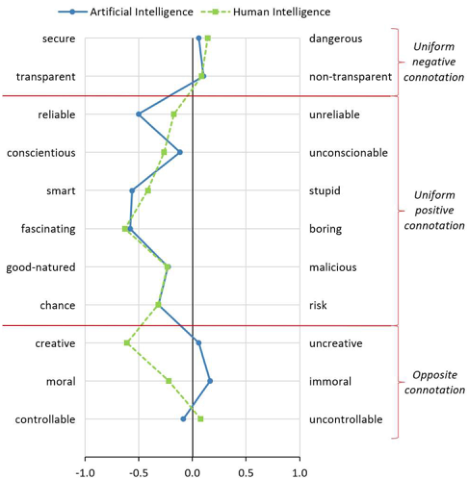
Figure 1: Semantic attributions to intelligence (Mean) differentiated according to Artificial and Human Intelligence.
and the role that is attributed to the AI. Next, an explanatory model for the role attribution is presented.
Is AI perceived differently from human intelligence?
Artificial intelligence and human intelligence were perceived by the respon- dents in a basically similar way (see Figure 1). Both forms of intelligence tended to be perceived as dangerous and non-transparent, although the cor- responding attribution values were close to the indifferent midpoint of the scale. Both forms of intelligence also differed only slightly with respect to the evaluation of whether the intelligence is fascinating, good-natured, or fundamentally an opportunity. Regarding these attributions, both forms of intelligence were perceived rather positively, which also applies to the perception of the intelligences as reliable, conscientious, and clever.
Absolute differences in the sense of a positive connotation for one form of intelligence and a negative connotation for the other form were evident only with respect to three pairs of terms. While human intelligence was perceived as creative and moral, artificial intelligence, in contrast, was perceived as uncreative and immoral. In terms of controllability, this was reversed, so that human intelligence was classified as uncontrollable and artificial intelligence as controllable.
What Trust, Usage Intention and Anxiety is Attributed to AI?
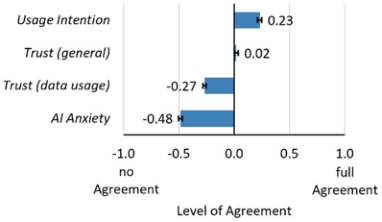
The respondents trust in AI was rather indifferent (see Figure 2). While the measured value for general trust was near the midpoint of the scale, trust
I Am What I Am – Roles for Artificial Intelligence from the Users’ Perspective 113
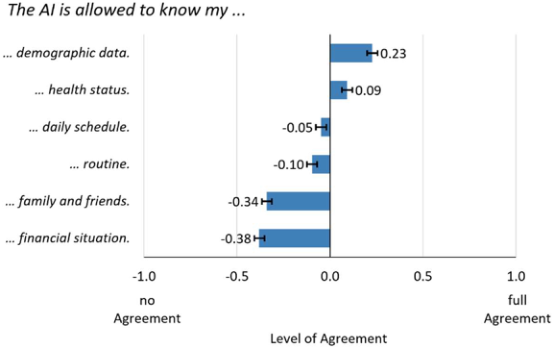
Figure 2: Agreement on trust in AI (Mean and Standard Errors) differentiated according to general trust and trust in the context of data use.Figure 3: Agreement on what an AI is allowed to know (Mean and Standard Errors) differentiated according to information categories.
in AI’s handling of data was even slightly lower. On average, respondents showed disapproval of AI anxiety and positive but low agreement with the intention to use AI technology.
What is AI Allowed to Know?
Analogous to the previously reported low level of trust in AI with regarding the handling of data, a rather negative picture emerged concerning what an AI is allowed to know. Figure 3 illustrates that respondents would only allow AI to know demographic data, such as name, age, or gender, as well as health data. However, agreement with the latter was near the indifferent midpoint of the scale, which is also true for sharing daily schedules and routines. Though, regarding these information categories, there was a slight disagreement. The least willingness to share information with an AI was found for information about third parties, in terms of family and friends, and for information about one’s financial situation.
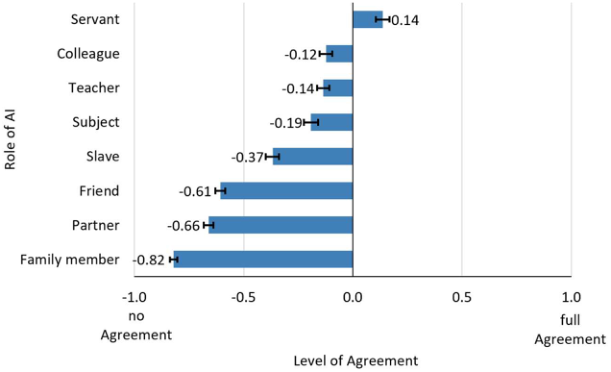
Figure 4: Agreement on potential roles of an AI (Mean and Standard Errors).
What Roles May an AI Take on?
Regarding the possible roles that an AI may take on, it appeared that the highest level of agreement was towards an AI as a servant (see Figure 4), even though the level of agreement was low with an extent just above the midpoint of the scale. All other potential roles were opposed by respondents. The least disapproval was found for an AI as a teacher or colleague at work, followed by an AI as a subject or slave. High rejection could be measured for all AI roles that addressed a personal relationship, such as an AI as a friend or partner. Especially an AI as a family member was rejected by the respondents (value close to the minimum of the agreement scale).
Based on an exploratory factor analysis, three different role categories could be identified analogous to the labels used. A distinction can be made between roles that can potentially be situated on the same level with the respondent and roles that are clearly subordinate (α=.81). The latter cate- gory includes AI as slave, subject, or servant. Roles potentially on the same level can be subdivided into a role with a professional relationship to the respondent (teacher, work colleague, α=.60) and a role with a personal relationship (friend, partner, family, α=.70). The highest agreement sco- res are found for professional (M=-0.14, SD=0.61) and subordinate roles (M=-0.13, SD=0.56), while the lowest agreement was found for a role with a personal relationship (M=-0.70, SD=0.38). In absolute terms, however, none of the role categories can be considered approved, but rather rejected.
What Influences Role Attribution?
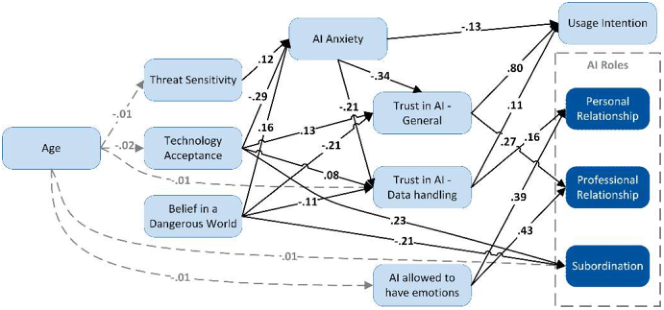
To understand how individual differences and the attributions of AI are rela- ted, a structural equation model (SEM) was calculated. Figure 5 shows the path diagram of the explanatory model for role attribution (X2(34)=249, p<.001, TLI=.86, RMSEA=0.12). First, it can be noted that agreement
I Am What I Am – Roles for Artificial Intelligence from the Users’ Perspective 115
Figure 5: Path diagram of the SEM with path coefficients. For the sake of clarity, the residuals are not visualized. Paths starting from the factor age are indicated by gray dashed lines for the same reason and due to the small path coefficients.
with the three role categories (personal relationship, professional relation- ship, and subordination) is independent of the general intention to use an AI. In the model, the usage intention itself depends only on the trust in AI and the AI Anxiety. The higher the trust and the lower the anxiety, the higher the willingness to use.
To explain user agreement with different AI roles, it is necessary to con- sider them separately. Agreeing to have a personal relationship with an AI, in that the AI is family, friend, or partner, depends positively on how much trust is placed in the AI’s handling of data and how much emotions are also granted to the AI. Consent to a professional AI relationship, on the other hand, is positively related to general trust in AI technology and likewise to the extent to which AI is allowed to have emotions. In turn, general trust in AI technology and confidence in AI’s handling of data depends predominantly on the respondent’s general acceptance of technology, their belief in a dan- gerous world, and their AI anxiety. The latter depends on the respondent’s individual threat sensitivity, technology acceptance, and belief in a dangerous world. Unlike the other two role attributions, preference for a subordinate AI does not depend on trust in the latter. Approval of a subordinate role depends positively on technology acceptance and negatively on belief in a dangerous world. Especially the latter sounds counterintuitive at first, but results from the fact that the belief in a dangerous world has a direct or indirect effect on all role attributions. The more strongly respondents believed in a dangerous world, the less they generally considered AI to have a role, regardless of the type of role.
Regarding socio-demographic factors, only age could be identified as a significant predictor in the model. Age has a negative effect on threat sensi- tivity, technology acceptance, trust in the handling of data by AI, agreement that an AI has a subordinate role, and agreement that an AI should be allo- wed to have emotions. However, despite significance, the correlations were very weak. Other socio-demographic user factors, such as gender, education, or income, as well as personality traits, such as technology competence beliefs
or technology control beliefs, were examined but could not be identified as significant explanatory predictors.
DISCUSSION & OUTLOOK The results clarify two key points. First, artificial intelligence—at least regar- ding the adjectives studied—is barely perceived as different from human intelligence, especially not as more dangerous, risky, or malicious. This could explain why, on average, there was no AI anxiety and a positive intention to use in the present sample. Still, respondents did not want AI for speci- fic roles. First, socially equal roles (such as a role as family member) were clearly rejected, which is in accordance with the existing state of research (Kim et al., 2021). This challenges the development of AI-based assistance systems that could be deeply integrated into people’s everyday lives. On the one hand, AI should not assume a social role in the family or circle of friends, but on the other hand, AI would need knowledge for decisions or decision support that is normally reserved for persons from exactly these role cate- gories. And having this knowledge as AI, e.g., about family members, daily routines, or finances, was rejected by the participants in the present study. To what extent this also excludes future visions of AI firmly integrated into the social fabric of humans, possibly anthropomorphic, remains open, however. Advances in technical development, habituation, and transparent behavior and data use could have a positive effect on the willingness to use immersive systems. Further research is needed accompanying the development of such systems.
Subordinate roles were preferred over socially equal roles, but there is more variance within this role category. For example, AI as a servant received the highest approval ratings, while AI as a slave or subject was more likely to be rejected. This could reflect the current connotation of the surveyed role labels. Today, the terms slaves or subjects have negative connotations, which may make them less acceptable as possible AI roles. Nevertheless, the approval of the AI servant shows that a clear hierarchical subordination is desired, but without oppressive elements and without a complete command by humans. Future research, however, still needs to address to what point human control over AI is required from the user’s point of view, or where the freedom for AI to act autonomously ends.
It must be pointed out that superordinate roles—apart from the role of a teacher, which is not necessarily higher in the hierarchy—were not considered in the present study. A measurement of these roles in analogy to Mays et al. (2021) was therefore not carried out. However, since such roles were not mentioned as a possibility for AI in the qualitative preliminary surveys either, it can be assumed that they would not be agreed upon (cf. Mays et al., 2021).
Of course, this study is not without limitations. Foremost, it must be con- sidered that the fit of the explanatory model was poor. Although significant predictors and relationships were identified, the low fit indicates that other explanatory factors exist that were not examined in the present study. In the future, the model should be expanded to include additional user characteri- stics and personality traits that could possibly elucidate further variance. One
I Am What I Am – Roles for Artificial Intelligence from the Users’ Perspective 117
possibility, for example, would be to consider extraversion and openness as indicators of the extent to which people engage with other human or artificial entities. Another limitation relates to the restriction of participant acquisition to the German-speaking countries and thus to a single cultural region. Howe- ver, the occupation of roles, e.g., in the family or at work, could be culturally shaped, whereby the preferred roles for AI could also differ depending on the culture. Further cross-cultural research is therefore imperative.
On the future path to an AI etiquette, the next step is to focus more on the details. Now that basic role evaluations are available, a better understanding is needed of how this affects concrete actions of the AI, i.e., whether the attribution of a role is generic or whether certain actions associated with roles when humans fulfill them are wanted or not for an AI. With a culturally shaped role-dependent cartography of the expected and desired actions and the permitted knowledge of an AI—in the sense of an etiquette or a set of rules—there would be the basis for an accepted technology that people would trust and be willing to use.
ACKNOWLEDGMENT
This work was partly funded by the Federal Ministry for Digital and Tran- sport (Project LandLeuchten 19F2102E) and by the Deutsche Forschungsge- meinschaft (DFG, German Research Foundation) under Germany’s Excelle- nce Strategy – EXC-2023 Internet of Production – 390621612. The authors would like to thank all participants for their willingness to share their opi- nions on a novel and innovative technology. Thanks are also due to “Jerry” and the cage full of fools for inspiring the paper title.
REFERENCES
Araujo, T., Helberger, N., Kruikemeier, S., de Vreese, C.H. (2020) In AI we trust?
Perceptions about automated decision-making by artificial intelligence. AI and Society, 35(3), pp. 611–623. doi: 10.1007/s00146-019-00931-w Biermann, H., Brauner, P. and Ziefle, M. (2021) ‘How Context and Design Shape Human-Robot Trust and Attributions’, Paladyn Journal of Behavioural Robotics, 12(1), pp. 74–86. doi: 10.1515/pjbr-2021-0008. Burbach, L., Halbach, P., Plettenberg, N., Nakayama, J., Ziefle M. and Calero Valdez
A., (2019) ““Hey, Siri”, “Ok, Google”, “Alexa”. Acceptance-Relevant Factors of Virtual Voice-Assistants”, 2019 IEEE International Professional Communication Conference (ProComm), pp. 101-111, doi: 10.1109/ProComm.2019.00025. Denefrio, S. and Dennis-Tiwary, T. (2017) Threat Sensitivity. Encyclopedia of Personality and Individual Differences, pp. 1–3. doi:10.1007/978-3-319-28099- 8_869-1 Duckitt, J., Wagner, C., du Plessis, I. and Birum, I. (2002) The psychological bases of
ideology and prejudice: Testing a dual process model. Journal of Personality and Social Psychology, 83(1), pp. 75–93. doi:10.1037/0022-3514.83.1.75 Hengstler, M., Enkel, E., & Duelli, S. (2016). Applied artificial intelligence and trust—The case of autonomous vehicles and medical assistance devices. Techno- logical Forecasting and Social Change, 105, PP. 105-120.
Kim, J., Merrill Jr, K., Collins, C. (2021) AI as a friend or assistant: The mediating role of perceived usefulness in social AI vs. functional AI. Telematics and Informatics, 64, 101694. Lockey, S., Gillespie, N., Holm, D., Someh, I.A. (2021) A Review of Trust in Artificial
Intelligence: Challenges, Vulnerabilities and Future Directions. In: Proceedings of the 54th Hawaii International Conference on System Sciences Liang, Y., Lee, S.A. (2017) Fear of Autonomous Robots and Artificial Intelligence: Evidence from National Representative Data with Probability Sampling. International Journal of Social Robotics, 9, pp. 379–384 Mays, K.K., Lei, Y., Giovanetti, R., Katz, J.E. (2021) AI as a boss? A national US
survey of predispositions governing comfort with expanded AI roles in society. AI and Society doi:10.1007/s00146-021-01253-6 Neyer, F., Felber, J. and Gebhardt, C. (2012) Entwicklung und Validierung einer Kurzskala zur Erfassung von Technikbereitschaft (technology commitment). Dia- gnostica, 58(2), pp. 87–99. doi:10.1026/0012-1924/a000067 Osgood, C. (1952) The Nature and Measurement of Meaning. Psychological
Bulletin, 49(3), pp. 197–237. doi:10.1037/h0055737 Park, J., and Woo, S.E. (2021) Who Likes Artificial Intelligence? Personality Predictors of Attitudes toward Artificial Intelligence. The Journal of Psychology, pp. 1–27 Rossi, F. (2018). Building trust in artificial intelligence. Journal of international
affairs, 72(1), pp. 127–134 Selwyn, N. and Cordoba, B.G. (2021) Australian public understandings of artificial intelligence. AI and Society, pp. 1–18. doi: 10.1007/s00146-021-01268-z Siau, K., Wang, W. (2018) Building trust in artificial intelligence, machine learning,
and robotics. Cutter business technology journal, 31(2), pp. 47–5 Thiebes, S., Lins, S., Sunyaev, A. (2021) Trustworthy artificial intelligence. Electronic Markets, 31(2), pp. 447–464
LISTED IN THE AHFE DIGITAL BOOKSTORE CATALOGUE
Explore the complete digital volume
Artificial Intelligence and Social Computing
Read this individual research paper free through the original publisher, or explore the full digital proceedings book.
ISBN 978-1-958651-04-9
Explore this ISBN in the AHFE Bookstore ↗Listed in the July 2026 bookstore catalogue; search by ISBN to confirm current availability · Digital book purchase optional