Remigio Hurtado, Janneth Matute, Juan Boni (2022). An analysis model for Machine Learning using Support Vector Machine for the prediction of Diabetic Retinopathy. In: Artificial Intelligence and Social Computing. AHFE Open Access, vol. 28, pp. 85–91. https://doi.org/10.54941/ahfe1001450
Diabetic Retinopathy is a public health disease worldwide, which shows that around one percent of the population suffers from this disease. Likewise, another one percent of patients in the population suffer from this disease, but it is not diagnosed. It is estimated that, within three years, millions of people will suffer from this disease. This will increase the percentage of vascular, ophthalmological and neurological complications, which will translate into premature deaths and deterioration in the quality of life of patients. That is why we face a great challenge, which is to predict and detect the signs of diabetic retinopathy at an early stage.For this reason, this paper presents a Machine Learning model focused on the optimization of a classification method using support vector machines for the early prediction of Diabetic Retinopathy. The optimization of the support vector machine consists of adjusting parameters such as: separation margin penalty between support vectors, separation kernel, among others. This method has been trained using an image dataset called Messidor. In this way, the extraction and preprocessing of the data is carried out to carry out a descriptive analysis and obtain the most relevant variables through supervised learning. In this sense, we can see that the most outstanding variables for the risk of diabetic retinopathy are type 1 diabetes and type 2 diabetes.For the evaluation of the proposed method we have used quality measures such as: MAE, MSE, RSME, but the most important are Accuracy, Precision, Recall and F1 for the optimization of classification problems. Therefore, to show the efficacy and effectiveness of the proposed method, we have used a public database, which has allowed us to accurately predict the signs of diabetic retinopathy. Our method has been compared with other relevant methods in classification problems, such as neural networks and genetic algorithms. The support vector machine has proven to be the best for its accuracy.In the state of the art, the works related to Diabetic Retinopathy are presented, as well as the outstanding works with respect to Machine Learning and especially the most outstanding works in Support Vector Machines. We have described the main parameters of the method and also the general process of the algorithm with the description of each step of the analysis model. We have included the values of hyper parameters experienced in the compared methods. In this way we present the best values of the parameters that have generated the best results.Finally, the most relevant results and the corresponding analysis are presented, where the results of the comparison made with the methods of Neural Networks, SVM and Genetic Algorithm will be evidenced. This study gives way to future research related to diabetic retinopathy with the aim of conjecturing the information and thus seeking a better solution.
In this section, the fundamentals of Diabetic Retinopathy, of Machine Learning, the Motivation and the proposed Method of this work will be exposed.
Fundamentals of Diabetic Retinopathy Diabetic Retinopathy has become a main ocular problem of systemic path- ology, it is also one of the main reasons that leads to blindness in people
between twenty and sixty four years of age worldwide, for which epidemio- logical studies have been carried out, such as the one carried out in Wisconsin that have shown the presence of aneurysms and hemorrhages, this has been detected in people with type one and two diabetes, with a period of adva- ncement of twenty years of disease, which can be said that between 90% of patients with diabetes have diabetic retinopathy. (Peris-Martínez et al. 2021).
However, the articles focused on diabetic retinopathy seek to assess diffe- rent factors or variables that determine the risk of developing DR. Next, we will talk about the fundamentals of Machine Learning.
Fundamentals of Machine Learning Machine Learning is applied in different fields such as science, engineering, medicine, management, so much so that its development has contributed considerably to image processing, pattern recognition, text mining, to voice recognition, etc. (Bensoussan et al. 2020). In this sense, Machine Learning has a great capacity to approach non-linear systems and extract important characteristics from high-dimensional data; a machine Learning algorithm can replace traditional methods, although the data used in the training of an ML algorithm contains numerical errors of approximation and rounding (Buizza et al. 2021).
Motivation and Proposed Method Diabetic retinopathy presents different levels of severity; the patterns that reveal the existence of the disease are diverse; that is, when the disease pre- sents a low level of severity; it is difficult to find the characteristics that reveal the existence of DR, while a high severity index is identified with the appeara- nce of neovessels in an area of the retina and outside the optic nerve. So, this work seeks to classify the most important patterns among the Messidor ima- ges through a support vector machine that is a supervised learning algorithm for the classification of a dataset.
In short, this paper is made up of seven sections; in section II we have the related work, in section III we will talk about the proposed method, in section IV the design of experiments is presented where the dataset and quality mea- sures are described in a general way to evaluate and compare some methods, same way in section V we will present the pertinent results and analysis, and finally in section VI we have the conclusions and future work of this research.
Next, the state of the art is exposed, where the works related to both the problem and the techniques used for the development of this project will be detailed.
STATE OF THE ART For this section of the essay, the investigation of the works especially related to Diabetic Retinopathy and the most outstanding in both Machine Learning and Support Vector Machine and classification that seek to determine the concern that this disease has generated is proposed.
An Analysis Model Through Machine Learning Using Support Vector Machine 87
Jobs generally related to Diabetic Retinopathy Projects related to diabetic retinopathy focus on datasets with processed ima- ges of an eve (Ocampo, 2018). To classify images, this disease has become the fundamental idea to apply strategies that help collect important information in large amounts of data (Castillo-Otí et al. 2020). For this reason, there are a variety of practices that have been developed by classifying images to identify the level of severity established in a study of retinography (Herrero, 2021).
Featured Machine Learning Works The research work developed is focused on the classification of images, in addition to detecting, segmenting and classifying, first of all, preprocessing must be carried out, extract or select the characteristics and choose the classi- fication method that will be used to evaluate the results. In the same way, for the extraction of characteristics, each image presents a vector with a visual characteristic such as size, shape, color, texture, intensity, etc.; this indicates that various research works are focused on the extraction of characteristics (Lucero et al. 2020).
There are also works that are focused on the recommendation of users, this refers to the suggestions that a user can give regarding products or others, with this we can say that Machine Learning can be reduced to more than health, to systems of marketing recommendation (Moreno et al. 2019).
Outstanding works in Support Vector Machines (SVM) and Classification In article (Rojas et al. 2020) a supervised learning technique is proposed to evaluate four metaheuristics by optimizing the hyperparameters of a support vector machine, the evaluation was carried out on a database concerning Diabetic Retinopathy.
Next, the proposed method is exposed, which through a descriptive analy- sis aims to reveal variables that will help us predict the signs of diabetic retinopathy by means of a supervised learning technique based on the support vector machine (SVM).
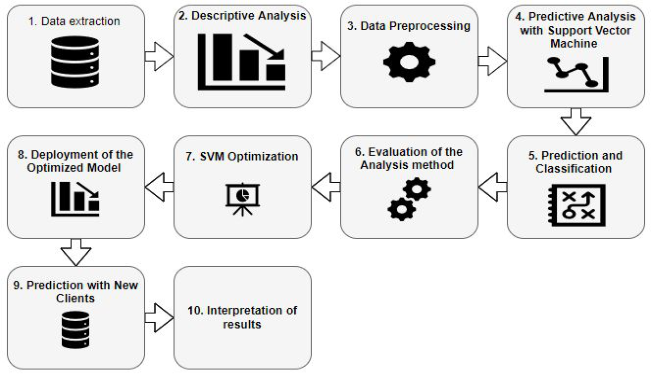
PROPOSED METHOD In this section, the proposed method will be exposed, which contains a table with each of the parameters that was used to develop the work, later the procedure will be described by means of a diagram.
Table with the definition of the parameters The following table explains the parameters that were used in the SVM classification algorithm.
Analysis model process Q1 Data extraction: Collect information to perform data analysis.
Descriptive analysis: It is a phase prior to data processing. Data Preprocessing: Data preparation is a process that involves the
Table 1. Definition of Parameters used in the algorithm.
Table available in the original PDF paper.
Variable Description C Penalty parameter in an SVM. gamma It is the coefficient for the kernels. kernel Kernel function used in an SVM.
Figure 1: Analysis process diagram.
manipulation and transformation of raw data.
Predictive Analysis with Support Vector Machine: A Support Vector Machine is used for classification.
Evaluation of the analysis method: Quality measures such as precision, Recall, F1 are evaluated.
Optimization of the SVM: The values to test for each parameter are defined.
Deployment of the optimized model: add the optimized SVM classifier at the end.
Prediction with new clients: The data of another client is entered. Interpretation of Results: The results of the data analysis are compared with those of the research.
DESIGN OF EXPERIMENTS Section in which a description of the database we use, the methods and parameters used for the comparison will be explained.
Brief Description of the Database (Dataset) The proposed method uses a public database with 1151 observations, con- tains features extracted from a group of Messidor images. The dataset is located in an Machine Learning repository: “ https://archive.ics.uci.edu/
An Analysis Model Through Machine Learning Using Support Vector Machine 89
Table 2. Characteristics of the Diabetic Retinopathy database.
Table available in the original PDF paper.
Data set Diabetic retinopathy Number of variables 20 Number of Observations 1151
Table 3. Define Parameters for the different Methods.
ml/datasets/DiabeticRetinopathyDebrecenDataSet“ (Antal & Hajdu, 2014). Next, a table with the characteristics of the dataset is provided.
Use Parameters for Future Comparison This item will define the parameters for each of the proposed methods.
In following section, the results obtained with the different methods are presented.
RESULTS AND DISCUSSION
This section will deal with the results of the proposed method and the comparison with the method used with the neural network and a genetic algorithm.
Definition of the Final Parameters of each of the Methods This table defines the final parameters that will be used in the evaluation of each of the methods.
With respect to the genetic algorithm, it calculates the most similar K nei- ghbors (the new population) for each user and then by means of the mode function with the K neighbors, the class of the new individual is determined.
Method Precision Neural Network 0.7446 SVM 0.761 GA 0.5086
Final Results of the Comparison of the three Methods The following table shows the final results obtained when comparing the three methods.
That is, in this work we are concerned with the classification model to determine whether or not there is Diabetic Retinopathy, which is why we are interested in classification measures such as Precision, Recall, F1, Accuracy.
CONCLUSION
A classification has been created by means of an SVM, which has car- ried out the tuning of the hyperparameters. It can be seen that without the optimization the accuracy with cross validation is 0.70, if the opti- mization and adjustment of parameters is applied, the result is 0.75 with (kernel=polynomial, C=0.001 and gamma=1). Where the important phase of optimization and tuning is reflected, using parameters of machine learning models.
In addition, we can confirm that the model proposed in this article exceeds the base model in both quality measures with a considerable difference, addi- tionally, train and test values are obtained with a considerable improvement to the base model. For the realization of this article we took the model of a duly published paper, in this sense the proposed model development, the trials and errors, were a great challenge for the authors because we would compete with professionals who have more experience in the field of science of data.
An Analysis Model Through Machine Learning Using Support Vector Machine 91
REFERENCES
Antal, B., & Hajdu, A. (2014). An ensemble-based system for automatic screening of diabetic retinopathy. Knowledge-based systems, 60, 20–27. Bensoussan, A., Li, Y., Nguyen, D. P. C., Tran, M. B., Yam, S. C. P., & Zhou, X.
(2020). Machine learning and control theory. arXiv preprint arXiv:2006.05604. Buizza, C., Casas, C. Q., Nadler, P., Mack, J., Marrone, S., Titus, Z., ... & Arcucci, R. (2022). Data Learning: Integrating Data Assimilation and Machine Learning. Journal of Computational Science, 58, 101525. Castillo-Otí, J. M., Cañal-Villanueva, J., García-Unzueta, M. T., Galván-Manso, A. I.,
Callejas-Herrero, M. R., & Muñoz-Cacho, P. (2020). Prevalencia y factores de rie- sgo asociados a la retinopatía diabética en Santander. Norte de España. Atención Primaria, 52(1), 29-37. Herrero Tudela, M. (2021). Clasificación automática de la severidad de la retinopatía diabética mediante técnicas de Deep Learning. Lucero, M. Á. M., Castolo, E. M. C., Sánchez, D. N. L., González, J. F. U., Solís, O. C.,
Alayola-Sansores, A., & Dolci, G. F. (2020). Modelos de aprendizaje automático para clasificar patologías oculares en imágenes de fondo de ojo como prueba de tamizaje. Res. Comput. Sci., 149(8), 267–279. Moreno, B. D. V., Ortiz, R. I. H., & Rivera, D. A. M. (2019, November). A new approach hybrid recommender system of item bundles for group of users. In 2019 IEEE International Autumn Meeting on Power, Electronics and Computing (ROPEC) (pp. 1–7). IEEE. Ocampo Arbeláez, H. F. (2018). Categorización de retinopatía diabética utilizando
algoritmos de inteligencia artificial. Peris-Martínez, C., Shaha, A., Clarida, W., Amelon, R., Hernáez-Ortega, M. C., Navea, A., ... & van der Heijden, A. A. (2021). Uso en la práctica clínica, de un método de cribado automatizado de retinopatía diabética derivable mediante un sistema de inteligencia artificial de diagnóstico. Archivos de la Sociedad Española de Oftalmología, 96(3), 117–126. Rojas, M. G., Carballido, J. A., Olivera, A. C., & Vidal, P. (2020). Optimización
de Support Vector Machine mediante metaheurísticas para clasificación de reti- nopatia diabética. In XXI Simposio Argentino de Inteligencia Artificial (ASAI 2020)-JAIIO 49 (Modalidad virtual).
LISTED IN THE AHFE DIGITAL BOOKSTORE CATALOGUE
Explore the complete digital volume
Artificial Intelligence and Social Computing
Read this individual research paper free through the original publisher, or explore the full digital proceedings book.
ISBN 978-1-958651-04-9
Explore this ISBN in the AHFE Bookstore ↗Listed in the July 2026 bookstore catalogue; search by ISBN to confirm current availability · Digital book purchase optional