Paulo Eduardo Tonin, Celio Teodorico Dos Santos, Gabriela Mager, Elton Moura Nickel (2022). Sensory-perceptual attributes in the creation of the store’s image: how they act on consumer behavior and improve physical retail experience. In: Human Interaction & Emerging Technologies (IHIET-AI 2022): Artificial Intelligence & Future Applications. AHFE Open Access, vol. 23. https://doi.org/10.54941/ahfe100883
In the last decade, the world has seen the transformation of shopping habits. According to a report prepared in 2017 by Global Data, only 5.8% of customers in 2011 preferred virtual stores. In 2016, the number increased to 9.2% and in 2021 the estimate was 13.3%. However, the estimate did not take into account an important aggravating factor: Covid-19. With the Coronavirus pandemic and the necessary social isolation, purchases made through digital channels gained even more strength over physical retail. Numerous articles have been showing the impact of the event on consumer behavior, needs and preferences. Therefore, the old estimate of 13.3% is expected to increase considerably, as the online channel became for a period of time, for the first time in history, the only possible channel to buy. For security and convenience, users who habitually shopped at physical points of sale seem to have migrated to digital.In this precisely digital moment, user power demands a new level of concern. Being at the center of the development of products and services, the user is the one who defines any design decision. Even though digital interfaces such as e-commerce and internet banking have broken paradigms and changed the way in which everyday tasks are consumed and performed quickly and conveniently, the user is still looking for personalized and sensory experiences that only physical environments are capable of to offer. Currently, the point of sale that does not rethink the experience it offers and revises its engagement strategies ends up becoming obsolete. In an immediate and digitalized reality, the physical store only becomes relevant if it offers a differential and this is the structuring of the experience behind a multi-sensory shopping journey that keeps the user and his interests at the center of everything.The structuring of the experience is based on the construction of the store's image and the attributes that best represent the brand in its physical spaces should be highlighted in it, whether they are concept or pop-up stores. Attributes, by themselves, are acts performed in language and reflect the perceptual, emotional and experiential coordination of a given community and therefore are fundamental to the creation of a cohesive store image that is faithful to the interests of its consumers. Attributes, like adjectives, have as main function to accompany the noun, giving it characteristics or presenting something that particularizes it, just as attributes do with products, services and experiences. When analyzing the concept of Brand Equity, it is clear that it is through the attributes that the identity is created and transformed. It is responsible for bringing awareness to brands and differentiating them from others. Based on this finding, the study intends to answer the question: How do sensory-perceptual attributes, when used in the creation of store's image, influence users' cognitive processes and responses and improve their experience in physical retail?Sensory experience originates in the visual, auditory, tactile and olfactory systems. These systems constantly influence human cognitive responses. Designers commonly consider visual stimulation but end up forgetting the great power of the other four senses and consequently the results that could be achieved if they were used in conjunction with vision. Marketing or sensory branding at the point of sale consists in the use of sensory-perceptual attributes in order to act on the consumer's senses and generate affective, cognitive and behavioral reactions that favor the creation of the store's image, the experience offered in the commercial environment and, consequently, stimulate satisfaction and purchase. The importance of using different activities and actions directed to each on of the senses will depend on the category of products or services offered, the positioning sought by the brand, its target audience and main objectives. Through an exploratory research on the state of the art involving the main topics on the subject, such as cognitive and semiotic ergonomics, this study works with the hypothesis that, when used with clarity and consistency to brand identity, its target audience and products offered, sensory-perceptual language attributes are extremely important in the construction of the store's image and can influence cognitive processes of memory and decision-making, as well as improve experience in physical retail environments.
Human Interaction & Emerging Technologies (IHIET-AI 2022) Artificial Intelligence & Future Applications https://openaccess.cms-conferences.org/#/publications/book/978-1-7923-8989-4 community. Through an exploratory research involving the main topics on the subject, this study works with the hypothesis that, when used with clarity and consistency to brand identity, its target audience and products offered, language attributes are of extreme importance in the construction of the store's image and influence cognitive processes such as memory and decision-making, improving experience design in physical retail. Keywords: Language attributes, Sensoriality, Store’s Image, Cognitive Ergonomics, Experience Design, Consumer behavior, Physical retail
INTRODUCTION
According to a report on shopping habits prepared in 2017 by Global Data, only 5.8% of customers in 2011 preferred virtual stores. In 2016, the number increased to 9.2% and in 2021 the estimate was 13.3%. However, the estimate did not take into account an important aggravating factor: the Covid-19 pandemic. Numerous articles have been showing the impact of the event on consumer behavior, needs and preferences. Therefore, the former estimate of 13.3% is expected to increase considerably, as the online channel became for a period of time and for the first time in history, the only possible channel to buy from. For security and convenience, users who habitually shopped at points of sale seem to have migrated to digital.
In the current scenario, the point of sale that does not rethink the experience it offers and revises its design strategies ends up becoming obsolete. In an immediate and digitized reality, the physical store only becomes relevant if it offers a differential and this is the structuring of the experience behind a sensory and humanized shopping journey. The structuring of the experience is based on the construction of the store's image, and in it, the attributes that best represent a brand in its physical environment should be highlighted (Krippendorf, 2006). Attributes, like adjectives, have as a main function to follow the noun, giving it characteristics or presenting something that particularizes. Through the attributes, identity is created and transformed, being responsible for bringing awareness to brands and differentiating them from others. Based on this finding, the study intends to answer the question: How do sensory- perceptual attributes, when used on building store's image, influence users' responses and cognitive processes, improving experience design in physical retail?
Language and meaning: sensory-perceptual attributes Language is a complex concept. For Krippendorf (2006), it can be conceived as a system of signs and symbols, which seeks references in a non-linguistic, often physical world; but also as a means of individual expression, which looks for meanings in the emotions, ideas and cognitive structures of the human mind. Language is related to people's behavior, with technological, cultural and economic aspects. As a coordination process, language reveals its centralization in the human being. Its use: a) directs attention, distinguishing between what it wants to highlight or hide; b) frames the perception, with metaphors being excellent examples of structuring perceptions; c) creates facts; d) it is relational and narratives are told with the expectation of being retold, suggesting that the meaning resides in a recursive relationship between speakers and listeners; e) it is a built-in phenomenon, since the ability to use language involves the ability to articulate, listen, learn and conceptualize experiences, including feelings. It is inseparably connected to the human body and its senses.
In retail, language directs the construction and improvement of storytelling, the narratives that are told to consumers. Telling stories to convince and inspire people is much more effective when the right language resources are being used. The role of language resources such as analogy and metaphor is to fill some gaps in the stories, expand their meaning and make it possible to understand a concept more quickly, following the “show, don’t tell” model (Sternberg, 2016). For Ferreira (1995), attribute means what is proper to a being, a qualitative or quantitative characteristic, which identifies a member of an observed set, the essential character of a substance, the quality attributed to the subject. Attributes manifest through the senses. Colors are perhaps the most recognized way by users and designers to translate attributes. The use of color can be directly related to the cultural context of users and therefore design solutions can be oriented in a way that reaches the native roots of the individuals for whom the experience is designed (Santos, 2006).
Goldstein (2006) describes the perception process as an interaction between information that stimulates receptors and information from previous experiences. Emotional and cognitive responses are affected by the feelings of seeing, hearing, tasting, touching, and smelling. Attributes, whether adjectives inherent to the qualities of a product or service or to the chromatic accord they present, are important to establish brand value, enabling the creation of an identity to it. The identity definition is an important step as it is the visual representation of what the brand wants to convey to its customers. It encompasses the entire imagery universe that will identify the brand and transmit its culture, values, principles and policies. However, in today’s retail scenario, restricting brand identity to just how it visually represents itself is not enough (Krippendorf, 2006).
Behavioral psychologists estimate nowadays that about 80% of the impressions formed when someone communicates with others are non-verbal, and that is to say, are sensory. The fact is that practically the entire understanding of the world is experienced through the senses. They are the main link to memory, evoking
Human Interaction & Emerging Technologies (IHIET-AI 2022) Artificial Intelligence & Future Applications https://openaccess.cms-conferences.org/#/publications/book/978-1-7923-8989-4 past and present memories and emotions. Memory libraries begin to accumulate material from the second someone is born. Fluid and flexible, this library is constantly open for redefinition and reinterpretation (Lindstrom, 2010). Experience design and the creation of the store’s image
In the experience economy, consumers make shopping decisions based on the moments they experience. Pine II & Gilmore (1999) provide a classic example for understanding economic progression: the coffee. The price escalation moves from unprocessed coffee beans (commodity), to coffee grounds (product), to a generic cup of coffee (service), and finally to a meaningful cup of Starbucks coffee (experience). In essence, people are willing to pay more for the same staple product if it's involved in a desirable experience. Experience design can be defined as the process of intentionally orchestrating experience elements to provide opportunities for participants to co-create and sustain interactions that lead to desired outcomes by users and designers. The image of a store is built through the experience that the brand offers its customers through physical environments (Rossman et al., 2019). According to Oxenfeldt (1974), it is characterized as a complex of attributes that consumers feel about the store.
Martineau (1958) indicates that the store's image consists of layout and architecture, symbols and colors, advertising and salespeople. Bloemer & De Ruyter (1998) suggested a connection between store's image, store selection, customer satisfaction, and store loyalty. This bond determines that satisfaction is the result of a deliberate assessment of the store's image. A favorable evaluation of the store's image results in satisfaction and loyalty. Experience design and store image are closely related to each other and to brand value attributions (Song, 2010). According to Healey (2008), designers and retailers need to consider other meanings when designing each aspect or point of interaction with the user during the brand experience: from the product and packaging, to how the retail environment is advertised and thought.
Figure 1. Sensory slider created by Malnar & Vodvarka. (Adapted from Song, 2010) Malnar and Vodvarka (2004) present a sensory slider model (see Figure 1), a tool to analyze and measure sensory existence and intensity in physical retail. At the extremes of the model, there are the concepts of deprivation and overload, indicating that the sensoriality may be being explored in a very mild, discrete or even non- existent way, as well as indicating that sensory stimuli are being applied with such intensity that end up making perception difficult and even causing some mental confusion due to the accumulation of information. In addition to having a positive impact on users' cognitive processes, the benefits of sensory marketing extend to the brand itself, from generating awareness to better communicating identity through the store's image. As experiences develop on the associations and attributions inherent to what differentiates a brand from others, they certainly affect the value transmitted and the relationship built with consumers (Song, 2010). Consumer behavior: responses and cognitive processes
Figure available in the original PDF paper.
According to Gibson (1966), perception helps the interpretation of different stimuli, giving them meaning. One way to bring order and coherence to the perception is the ability to group similar objects together. In this way, the number of actions that need to be processed is reduced and it is possible to better decide which parts of objects belong to the same object. The Gestalt approach to form perception, developed in Germany in the early 20th century, is especially useful for understanding how groups
Human Interaction & Emerging Technologies (IHIET-AI 2022) Artificial Intelligence & Future Applications https://openaccess.cms-conferences.org/#/publications/book/978-1-7923-8989-4 of objects or even parts of them are perceived to form complete objects (Sternberg, 2016). Attention, which includes conscious and unconscious processes, is the means by which a limited amount of information captured by the senses, stored memories and other cognitive processes is processed. Through limited mental resources, one can focus more on the stimulus that matters and is relevant and less on the internal and external stimuli that do not matter. Psychology today recognizes that attention and awareness are not the same thing and that one can pay attention to some sensory information and memories without actually making use of awareness. The number of targets and distractions as well as the size of a given display affects the difficulty of the task. In other words, it takes longer to search for a certain stimulus if there are a lot of items in the search panel. The similarity theory describes that the more similar the target and the distractions are, the more difficult the search for the target will be. It is noteworthy that searches performed by young adults are more accurate and faster than searches made by older adults, who have lower cortical volume (Manzano et al., 2012). Memory is the means by which individuals retain and use information about their past experiences to use in the present. Three common memory operations can be identified: encoding, storing, and retrieving. In the first one, sensory data is transformed into a form of mental representation. In storage, the encoded information is kept in memory. In retrieval, information stored in memory is accessed. There is a model that conceptualizes memory in terms of three storage systems: sensory, short- term, and long-term. The first one constitutes the initial repository of much information or sensory records that eventually become part of both short-term and long-term storage. Such information is stored in the form of icons or visual images that represent something. The encoding of information in short-term memory appears to be largely acoustic in form. However, there is some visual and semantic encoding, the latter being the main form of encoding information in long-term memory. Some evidence points to the existence of visual coding, as well as acoustic coding in long- term storage (Sternberg, 2016).
The first models of how people make decisions reflect only an economic perspective, however, when dealing with design, the focus must be centered on user satisfaction. The heuristic is the mental shortcut that reduces the cognitive load of decision making, reducing the information to an amount that can be managed. One of the first heuristics formulated is precisely satisfaction. In it, the options are considered individually and then an option is selected as soon as it meets the minimum acceptability level. When there are more alternatives than can be considered in the time available, the process of elimination by aspects is used. Here, alternatives are discarded by focusing on aspects of each. The elimination process may look like this: 1- the user focuses on one aspect or attribute of several options; 2- elaborates a minimum criterion for that aspect, such as price; 3- eliminates all options that do not meet such criteria; 4- for the remaining options, selects a second aspect for which it sets a minimum criteria for eliminating additional options and 5- continues using a sequential elimination process of options by examining a series of aspects until a single option remains (Sternberg, 2016).
Sheena Iyengar (2011), through experiments involving consumer behavior in supermarkets, noticed that when they are faced with few options, people tend not to
Human Interaction & Emerging Technologies (IHIET-AI 2022) Artificial Intelligence & Future Applications https://openaccess.cms-conferences.org/#/publications/book/978-1-7923-8989-4 want to buy anything because they usually have the thought that some other store will possibly have more and better alternatives to consider. However, she also found that in the presence of too many options, individuals feel overwhelmed and therefore have difficulty choosing. Users feel more comfortable evaluating and choosing between approximately three to six options. It is common for users to experience these situations that she calls the “choice overload problem”, especially in retail. Everyone makes bad decisions. However, it is noteworthy that bad decisions made intuitively tend to be less penitent than those made rationally. In other words, intuitive and subconsciously processed decision making still tends to have the best answers. Sensory input is therefore closely related to this type of decision. Certain factors such as intuition, rationality and perception can influence a decision. Intuition is born from experience and feelings about stimuli, these mostly sensory (Sternberg, 2016).
Figure 2. Loyalty impact of each sense. (Adapted from Lindstrom, 2010) Results from the “Brand Sense” study conducted by Lindstrom (2010) revealed that the more sensory touch points consumers are able to access when thinking about buying, the greater are the number of sensory memories activated; and, the greater the number of sensory memories activated, the stronger the bond between the brand and the consumer (see Figure 2). The research also confirmed that the more positive the relationship established between the senses, the stronger the connection between sender and receiver. Branding is all about establishing emotional connections between the brand and the consumer. As with any relationship, emotions are based on data that comes from the five senses. Sensory branding aims to stimulate the relationship with the brand. Arguably, it sparks interest, amplifies impulsive buying behavior, and allows emotional responses to dominate rational thinking (Lindstrom, 2010).
Figure available in the original PDF paper.
CONCLUSION
Feeling is existing. Since the end of the 20th century, and especially during the first decade of the 21st, human rationality has given way to emotion. This emotionality is not only presumed, it is based on theoretical speculation concluded from
Human Interaction & Emerging Technologies (IHIET-AI 2022) Artificial Intelligence & Future Applications https://openaccess.cms-conferences.org/#/publications/book/978-1-7923-8989-4 experimentation, including neurological mapping, where the influence of emotions on mental processes such as perception, attention, memory and decision-making was evidenced; previously addressed in this study. Design acts in the creation and management of meanings. Attributes are the basis of language, responsible for coordinating communication between brands and people. Sensory-perceptual attributes are essential for communicating the brand's identity and value as well as for creating the store's image, directly conditioned to the experience design that involves physical retail.
Once defined, these attributes will lead from the choice of the chromatic chord to the way in which visual arrangements will be explored and how each of the senses will perform in the environment. It is important that stimuli are always linked to attributes and are presented congruently, taking into account the identity of the brand it represents, the product, the audience and its cultural context. The congruence of the messages of the stimuli used translates into positive factors, such as a greater speed of recognition and attribution caused by the stimulus, a greater ease in processing information by the brain and a better evaluation of the transmitted messages. Each brand, through its attributes and identity, must seek its own way to incorporate the senses (see Figure 3).
When applied with the right intensity - so that they do not deprive or overload users - the stimuli arising from the attributions improve the shopping experience and influence cognitive and behavioral processes inherent to retail, such as perception, attention, memory and decision-making, closely related to usability, satisfaction and loyalty with the brand. Evidence points to the existence not only of visual coding but also of acoustics and semantics (meaning) in short and long-term memory stores. The definition of the size of the display that presents the products is extremely important, as well as the awareness that different generations of consumption require different solutions. The number of elements shown on a given display is equally important to the size, since when people see few options they tend not to want to buy anything, while in the presence of many, they feel overwhelmed (Sternberg, 2016).
Figure 3. Relation of senses and actions according to sensory branding at the point of sale. (Adapted from Manzano et al., 2012)
Figure available in the original PDF paper.
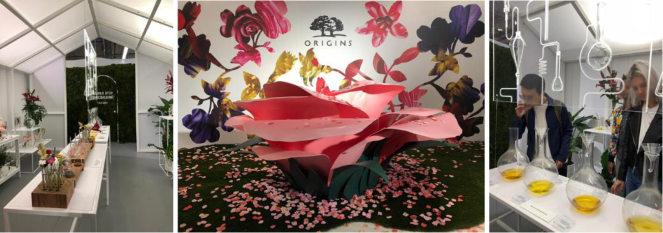
Through perceptual and sensorial attribution, physical retail can determine its advantage over digital. It is undoubtedly important to communicate compatible messages. Studies conducted by Lindstrom (2010) revealed that the more sensory touch points consumers are able to access, the greater the number of sensory memories activated and, the stronger the bond between the brand and the consumer. Although there are many possibilities to incorporate the senses in physical commercial environments, it seems sensible that the actions that involve them follow the proper language attributes inherent to each specific case. For example, in a cosmetics brand where the main attributes are “fresh”, “light” and “natural”, as in the case of Origins (see Figure 4), from the chromatic chord to the visual arrangements, smell and musical programming, each stimulus must follow the attributes that better define the brand image.
Figure 4. In Origins' 2018 ephemeral installation in Soho, New York, an immersive experience
Human Interaction & Emerging Technologies (IHIET-AI 2022) Artificial Intelligence & Future Applications https://openaccess.cms-conferences.org/#/publications/book/978-1-7923-8989-4 was created from the main sensory-perceptual attributes of the brand. (Author, 2018)
REFERENCES
Bloemer, J.; de Ruytier, K. (1998). On the relationship between store image, store satisfaction and store loyalty. Vol. 32. Issue 5/6, 499-513. European Journal of Marketing, United Kingdom. Ferreira, A. B. H. (1995). Dicionario da lingua portuguesa. Nova Fronteira, Rio de
Janeiro. Gibson, J. (1966). The senses considered as perceptual systems. Houghton Mifflin Company, Boston. Goldstein, E. B. (2006). Sensation and perception. Brooks/Cole Publishing Company,
Pacific Grove. Healey, M. (2008). What is branding. RotoVision, Switzerland. Iyengar, S. (2011). The art of choosing. Twelve, New York. Krippendorf, K. (2006). The semantic turn: a new foundation for design. Taylor & Francis, Boca Raton. Lindstrom, M. (2010). Brand sense: sensory secrets behind the stuff we buy. Free
Press, New York. Malnar, J. M.; Vodvarka, F. (2004). Sensory design. University of Minnesota Press, Minneapolis. Manzano, et al. (2012). Marketing sensorial: comunicar con los sentidos en el punto
de venta. Pearson, Madrid. Martineau, P. (1958). The personality of the retail store. Vol. 36. Issue 1, 47-55.
Harvard Business Review, Brighton. Oxenfeldt, A. R. (1974). Pricing for marketing executives. Wadsworth, San Francisco. Pine II, B.J.; Gilmore, J. H. (1999). The experience economy: work is theatre & every
business a stage. Harvard Business School, Boston. Rossman et al. (2019). Designing experiences. Columbia Business School Publishing, New York. Santos, C. T. dos. (2009). Requisitos de linguagem do produto: uma proposta de
estruturação para as fases iniciais de PDP. PhD Thesis. Universidade Federal de Santa Catarina, Brasil. Song, J. (2010). Retail design and sensory experience: design inquiry of complex reality. Iowa State University, USA. Sternberg, R. J. (2016). Psicologia cognitiva. 6th ed. Cengage Learning, Boston.
Read this individual research paper free through the original publisher, or explore the full digital proceedings book.
ISBN 978-1-7923-8989-4
Explore this ISBN in the AHFE Bookstore ↗Listed in the July 2026 bookstore catalogue; search by ISBN to confirm current availability · Digital book purchase optional