Eusébio Conceição, João Gomes, Maria Manuela Lúcio, Rafael Raposo, Xavier Viegas, Maria Teresa Viegas (2022). Design of Three- Dimensional Pine Tree Geometry and the Radiation Heat Exchanges in Fire Environments. In: Human Interaction & Emerging Technologies (IHIET-AI 2022): Artificial Intelligence & Future Applications. AHFE Open Access, vol. 23. https://doi.org/10.54941/ahfe100847
This work presents a design of a three-dimensional pine tree geometry and the ra-diation heat exchanges in forest fire environments. Using Computer Aided De-sign software, the pine tree geometry design is developed in this study. The radia-tion heat exchanges are evaluated between the pine tree and the forest fire plan surface. The geometry, applying mesh generation, is used to evaluate the view factors, which in turn are used to calculate the heat exchanges by radiation. The virtual pine tree geometry has a height of 7.5 m and is constituted by 8863 cylin-drical elements. The pine tree is constituted by trunks, branches and leaves. The fire front has 10 m long and 1 m high, which is located at a distance of 5 m from the virtual pine tree. The numerical results of the geometry, mesh generation, the view factors and Mean Radiant Temperature (MRT) are obtained. In this study, a statistical function was used to randomly place the leaves determined to be includ-ed in the numerical model of the pine tree. The results show that the use of a per-centage of 20% of the total number of leaves makes it possible to guarantee that the distribution of MRT in the various elements of the pine tree remains practical-ly equal to the use of the total number of leaves.
The lethal threshold of the several elements (trunks, branches and leaves) of the tree depends on the temperature (Kelsey and Westlind, 2017). Therefore, it is important to assess the distribution of the temperature along the tree when in a forest fire environment. This temperature distribution is evaluated by a numerical model which simulates the thermal response of the pine tree, considering also the heat exchanges by radiation. Accordingly, we must have the geometry of the tree and calculate the view factors.
The numerical model developed in this work to obtain the geometric design of the pine tree uses cylindrical elements and is founded on a numerical model developed to obtain the human geometry (Conceição, 2000). The view factors numerical model, used to evaluate the radiative heat exchanges, utilizes the mesh generated in the geometric design numerical model. The view factors and the Mean Radiant Temperature (MRT) evaluation is shown in Fanger (1970), where it is presented the tables and equations used in the human body posture and surrounding plan surfaces. For other kind of applications, the evaluation of view factors and MRT is shown in the works of Jiang et al. (2017) and Vorre et al. (2015).
The evaluation of the temperature distribution is done by the pine tree thermal response numerical model, which is based on energy and mass balance integral equations. The fundamentals of the energy balance equations, presented in this work, were developed in the work of Conceição et al. (2000). Examples of other fields where were applied energy and mass balance equations can be seen in the works of Heidarinejad and Esmaili (2015) and Ouldboukhitine et al. (2011).
The solution of the energy and mass balance integral equations system is obtained using the Runge-Kutta-Fehlberg method with error control. In this equation system
Human Interaction & Emerging Technologies (IHIET-AI 2022) Artificial Intelligence & Future Applications https://openaccess.cms-conferences.org/#/publications/book/978-1-7923-8989-4 the following phenomena are considered:
Conduction in the pine tree concentric layers, using cylindrical coordinates. The application of this phenomenon can be seen in the works of Conceição et al. (2010), for buildings, and Ferreira and Yanagihara (2009), for human bodies;
Convection (forced, natural or mixed) between the surface (bark) of the pine tree trunk and the surrounding environment. The application of this phenomenon can be seen in the work of Conceição et al. (2001), for human body;
Radiation between the surface (bark) of the pine tree trunk and the surrounding environment and between the surface (bark) of the pine tree trunk and the fire front. The application of this phenomenon in cold radiant surfaces and in solar radiation can be seen in the work of Conceição et al. (2016). For other examples see the work of Rein et al. (1970).
When calculating the radiation, using heat exchanges and solar radiation, it is important to determine the shading that each element causes in others. Details about this determination, which are applied in this work, are shown in Conceição and Lúcio (2010).
The aim of this study is to develop a numerical model that is used to generate a pine tree geometric design and to calculate radiation heat exchanges, in order to assess the pine tree thermal response when present in a forest fire environment. In order to simplify the calculation of the view factors, used in the calculation of radiative exchanges between the pine tree and the fire front plane, a numerical model was developed to randomly generate leaves distribution, whose number is less than their total, which allows to characterize, likewise, the thermal performance of the pine tree. In this sense, five leaves distributions are evaluated through the distribution of MRT in the various elements of the pine tree.
MODELS AND MATERIALS The software used in this work takes into account the following numerical models: geometric design; view factors; and thermal response. The geometric design numerical model is founded on geometric equations that use cylindrical and spherical coordinates. Cylindrical coordinates are used to define the cylindrical elements. In particular, it is used to generate a mesh around each cylindrical element. Radial, angular and linear (referring to the height of the axis) coordinates are considered. Spherical coordinates are used to locate each cylindrical element in the space. Radial, azimuthal and polar spherical coordinates are considered. The three-dimensional (3D) pine tree model is constituted by cylindrical elements that characterize its trunk, branches and leaves. Each element is divided into several concentric layers
Human Interaction & Emerging Technologies (IHIET-AI 2022) Artificial Intelligence & Future Applications https://openaccess.cms-conferences.org/#/publications/book/978-1-7923-8989-4 dimensioned by its diameter, length and inclination.
The view factors numerical model is used to evaluate the radiative exchanges, in particular in this study the MRT. The view factors are calculated between the elements’ surfaces and the fire front, considering the center of each surface. This model takes into account 3D geometric equations to generate a mesh around the elements and in the fire front. The finite elements theory is used in the mesh generation of the 3D pine tree.
The thermal response numerical model is founded on energy and mass balance integral equations for the various layers of concentric cylindrical elements. The 3D pine tree numerical is based on the human thermal response numerical model (Conceição, 2000; Conceição and Lúcio, 2001), considering layers of concentric cylindrical elements.
The geometry of the 3D virtual pine tree geometry, developed in this study, has a height of 7.5 m, is made up of 133 trunks and branches and a set of leaves making up a maximum of 8863 cylindrical elements. The virtual fire front is 10 m long and 1 m high and has an average flame temperature of 1000 ºC. The distance between the pine tree and the fire front is 5 m.
The pine tree is built is built on four levels. The first level is located near the ground and the fourth level is located at the top of the pine tree. Each pine tree level is characterized by: eight trunks and one vertical trunk section of the main trunk; each inclined trunk has three branches; and each branch has provided by a set of leaves. One branch on the top of the higher level is also provided by a set of leaves.
In this type of studies, it is intended to obtain the temperature distribution along a tree when it is inserted in a forest fire environment. The numerical study of a real pine tree involves a high computational time due to its geometric complexity and the models that simulate its thermal behavior. Thus, in order to reduce this complexity and the computing time associated with it, several simplified real pine tree geometries were generated. The generation of these simplified pine geometries was carried out ensuring that the results obtained for the view factors between the leaves and the fire front remained similar to those of the real pine tree.
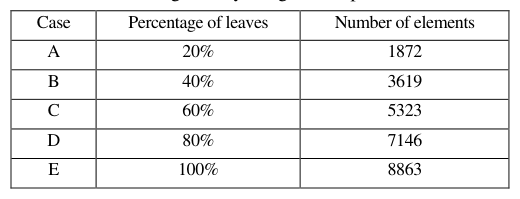
The simplified geometry design was developed using a numerical model that uses a statistical function to randomly distribute its leaves. The number of leaves was previously determined as a percentage of the total leaves existing in the real pine tree geometry design. In this work, five Cases were studied (Table 1). In each Case, percentages of leaves to be attributed to each pine were defined, that is, the number of elements to be used in each pine tree were defined. Cases A to D refer to simplified pine tree geometries in which 20%, 40%, 60% and 80% of randomly distributed leaves were used, respectively. Case E refers to the real geometry of the pine tree in which all the leaves have been placed in their proper positions.
Table 1: Number of pine tree elements in function of the percentage of leaves to be used in each geometry design of the pine tree
RESULTS AND DISCUSSION
This section presents the results obtained from the geometry design of the pine tree, view factors mean values and MRT distribution.
The geometry design of the pine tree with 20% of the leaves randomly distributed, Case A, and with all leaves placed in their proper positions, Case E, are presented, respectively in Figure 1 and Figure 2. Here, we can see the geometries design of the trunk, branches and leaves for both (simplified and real) pine trees.
The results obtained from the mean values of the view factors are presented in Figure 3 for the five studied Cases (Table 1). These results show that the mean values of the view factors are similar. The percentage differences in relation to Case E (real geometry of the pine tree) vary between -0.19% for Case A and +0.52% for Case D. Therefore, the application of a methodology using a reduced percentage of randomly distributed leaves can guarantee the use of acceptable values of view factors in the calculation of radiative exchanges.
Using the results obtained for the distribution of form factors, the distributions of the MRT values for the five Cases under study were calculated. The mean MRT values calculated for each of the five Cases are shown in Table 2. These results show that the mean values of MRT are similar. The percentage variations in relation to Case E of the other four Cases are as follows: A, -0.10%; B, 0.00%; C, 0.16%; D, 0.26%.
Table 2: Mean MRT temperature calculated for each Case.
Table available in the original PDF paper.
A B C D E 192.6 ºC 192.8 ºC 193.1 ºC 193.3 ºC 192.8 ºC Therefore, it can be concluded that the use of the numerical model of a pine tree with a simplified geometry with a random distribution and a reduction in the number of its leaves allows to guarantee a uniform distribution of both the view factors and the MRT. As an example, the MRT distribution for Cases A and E are shown,
Human Interaction & Emerging Technologies (IHIET-AI 2022) Artificial Intelligence & Future Applications https://openaccess.cms-conferences.org/#/publications/book/978-1-7923-8989-4 respectively, in Figure 4 and Figure 5. In this way it is also possible to obtain a reduction in the simulation time keeping a similar distribution of the results obtained in all the five Cases.
Figure 1. Virtual pine tree geometry for Case A (20% of randomly distributed leaves).Figure 2. Virtual pine tree geometry for Case E (all leaves properly positioned).
0 1000 2000 3000 4000 5000 6000 7000 8000 9000 Pine tree elements
Figure 5. Virtual pine tree geometry for Case E (all leaves properly positioned).
Figure available in the original PDF paper.
CONCLUSIONS
In this paper a numerical study was presented on the generation of a geometric design of a pine tree and on the calculation of radiative exchanges in order to evaluate the pine tree thermal response when included in a forest fire environment. The calculation of the view factors, necessary to assess the MRT, was simplified through a random distribution of a smaller number of leaves in the pine tree than the real one. Thus, five Cases of leaves distributions in pine tree were studied. The main conclusions are:
The mean values of view factors obtained in each of the five Cases are very similar (around 0.0165);
The MRT distributions of the five Cases are very similar to each other;
Thus, the use of the simplified model of the pine tree geometry, namely the one referring to Case A, allows obtaining a thermal response of the pine tree similar to that of Case E (real model) with simulation time savings.
ACKNOWLEDGMENTS
The authors are grateful to the support of the project reference PCIF/MPG/0108/2017, funded by the Portuguese Foundation of Science and Technology (FCT).
Conceição, E. (2000). “Evaluation of thermal comfort and local discomfort conditions using the numerical modelling of the human and clothing thermal system”, proceedings of the 7th Conference on Air Distribution in Rooms, Reading, UK. Conceição, E., Silva, M., André, J., Viegas, D. (2000) Thermal behaviour
simulation of the passenger compartment of vehicles. International Journal of Vehicle Design 24(4), 372-387. Conceição, E., Lúcio, M. (2001). “Numerical and subjective responses of human thermal sensation”, proceedings of the 6th Portuguese Conference on Biomedical Engineering, Faro, Portugal. Conceição, E., Lúcio, M (2010). Numerical study of the influence of opaque
external trees with pyramidal shape in the thermal behaviour of a school building in summer conditions. Indoor and Built Environment 19, 657-667. Conceição, E., Nunes, A., Gomes, J., Lúcio, M. (2010). Application of a school building thermal response numerical model in the evolution of the adaptive thermal comfort level in the Mediterranean environment. International Journal of Ventilation 9, 287-304. Conceição, E., Lúcio, M. (2016). Numerical simulation of the application of solar
radiant systems, internal airflow and occupants’ presence in the improvement of comfort in winter conditions. Buildings 6(3), 38. Fanger, P. (1970). Thermal comfort: analysis and applications in environmental engineering. Copenhagen, Denmark: Danish Technical Press. Ferreira, M., Yanagihara, J. (2009). A transient three-dimensional heat transfer
model of the human body. International Communication in Heat and Mass Transfer 36(7), 718-724. Heidarinejad, G., A. Esmaili, A. (2015). Numerical simulation of the dual effect of green roof thermal performance. Energy Conversion and Management 106, 1418-1425. Kelsey, R., Westlind, D. (2017). Physiological stress and ethanol accumulation in
tree stems and woody tissues at sublethal temperatures from fire. BioScience 67(5), 443-451. Jiang, F., Li, Z., Zhao, Q., Tao, Q., Lu, S. (2017). Accuracy analysis and improvement of the Blind Enclosure Model to calculate the longwave radiative heat transfer for a façade with louver blinds. Energy and Buildings 140, 98- 109. Ouldboukhitine, S., Belarbi, R., Jaffal, I., Trabelsi, A. (2015). Assessment of green
roof thermal behavior: A coupled heat and mass transfer model. Building and Environment 46(12), 2624-2631. Rein, R., Sliepcevich, C., Welker, J. (1970). Radiation view factors for tilted cylinders. Journal of Fire and Flammability 1, 140-153. Vorre, M., Jensen, R., Le Dréau, J. (2015). Radiation exchange between persons
and surfaces for building energy simulations. Energy and Buildings 101, 110- 121.
Read this individual research paper free through the original publisher, or explore the full digital proceedings book.
ISBN 978-1-7923-8989-4
Explore this ISBN in the AHFE Bookstore ↗Listed in the July 2026 bookstore catalogue; search by ISBN to confirm current availability · Digital book purchase optional