Catarina Carreto, Rui Carreto (2026). Material Immortality: Designing for Eternity. In: Human Factors and Ergonomics In Design. AHFE Open Access, vol. 210, pp. 309–317. https://doi.org/10.54941/ahfe1007452
In this article, we aim to highlight a complementary analysis within the universe of environmental design projects, taking as a starting point a design methodology based on the concept of reuse. Daily involvement with the field of design compels us to reflect on the issue of the new. Not only for iconic preservation, but also for the creative stimulus that reuse represents as an emerging concept in an exhausted consumer society. The reuse of an existing building, product, or raw material not only promotes a cultural connection of memory, but also a sustainable action. The designer must consider how it is designed and its relationship to the function it will perform. In short, with this research, we intend to highlight the need for a design approach that extends the useful life of spaces.
In order to take advantage of what once had a function, the designer can intervene, creating or assigning a new use, extending its useful life. Reusing discarded products or spaces can postpone the consequences of waste caused by humans, contributing to the function of refining society.
This function of reuse should certainly not involve a domineering attitude on the part of the designer, imposing their aesthetic notion on what already exists, “gutting down” spaces or products previously conceived. These spaces cannot be treated carelessly by designers, who must be aware of their relationship to the historical and technological context to which these works belong.
Derelict buildings do not justify being stripped of their identity, leaving only their decaying facades as if they were mere memories or simply part of the urban landscape. A careful analysis of these buildings is required, considering as an essential premise the ability to adapt the building to current legislation and to immortalize the identifying aspects of the building’s origins, be they: floor plans, wainscoting, baseboards, wall coverings, cornices, ceilings, openings, construction or decorative methods, and even the equipment itself. The building must be understood as a whole, interior and exterior. Often, spaces are permanently altered, where the past disappears completely, making it impossible to restore the pre-existing structure for a future and potentially better adaptation.
310 Carreto and Carreto We could try to define the following projects as product design, due to their prefabrication aspect, or as interior design, primarily for creating the interior environment; however, they could also be considered architecture, but it is certain that they are spaces with a hybrid definition in terms of their intervention.
DESIGN AND REUSE: OVERCOMING DEATH In order to make use of what once had a function, the designer can intervene, creating or assigning a new use to a particular object, extending its useful life. In this context of Ecodesign, making use of every part can delay the consequences of waste caused by humans. “We must examine what contribution each of us can make based on our activity in society” (Papanek, 1995, p. 17). It would be important for designers, “(...) tried to reformulate their values and their work, so that all design was based on humility, combined the objective aspects of climate and the ecological use of materials with subjective intuitive processes, and was based on cultural and bio-regional factors” (Papanek, 1995, p. 14–15).
According to Manzini (2015), design plays a fundamental role in fostering more sustainable practices by supporting the emergence of new ways of living, producing, and consuming. From this perspective, ecodesign extends beyond the development of individual products to the transformation of sociotechnical systems that promote resource reuse, waste reduction, and locally embedded solutions. This systemic understanding of design resonates with Papanek’s earlier critique of industrial production models, which emphasized the ethical responsibility of designers in addressing environmental degradation and social needs (Papanek, 1995). By encouraging collaborative, low-impact, and context-sensitive practices, design becomes a strategic agent in the transition toward circular and regenerative models of production and consumption.
Expanding on these principles, Baker-Brown and Brooker (2024) illustrate how pedagogical and practical approaches to material reuse and adaptive design can transform both educational and professional practices, demonstrating the role of design as a strategic agent in advancing circular economies and sustainable lifestyles.
Thackara (2015) argues that the core idea of sustainable design extends beyond the creation of products to encompass practices and ways of living that contribute to the regeneration of ecosystems and social relations. The author emphasizes the role of design as a means of shaping not only material artifacts, but also social relations, environments, and ecological systems.
This fact leads us to reflect on the basis of the raw material, a material that is not accidental, in the consolidation of the design of any space or object. Reuse is a preponderant factor in the current context, as it is relevant to reuse materials and objects or structures already built to give economic viability to the world, namely to the world of Design. Following what has been mentioned above, with the use of reusable material or object for another form or function, the act of creating can be more than just designing an object from scratch.
Material Immortality: Designing for Eternity 311 In this context, we highlight Carlo Scarpa’s Castellvechio project. This project immortalizes history by adapting the pre-existing structure, leaving historical fragments as a finished product, in contrast to the modern materials applied in its contemporary interpretation. The presence of the fragment was not merely in the finishing aspect, but also in the selection of demolitions and in the search for remnants of the various construction periods to display them.
The Loft in Barcelona project by Enric Miralles and Benedetta Tagliabue follows the same conceptual line of reuse. These architects encountered a building where the old is perceptible through the existing flooring. Considering that they chose to maintain the pre-existing floors, reusing the material for a new floor stereotomy, complemented with pieces of new flooring. After demolitions, they found gothic windows that remained uncovered. In this project, previously constructed elements are maintained and contextualized within the current structure.
We can also highlight, on a more intimate scale, the Casa do Arco designed by Maria José Salavisa, in the city of Óbidos, Portugal. The designer discusses her design approach: “Should the project adapt to the environment, live and coexist with it? Cultural experience also in the choice of materials and objects? In this case I would say yes. To bring the lyricism of the exterior into the interior, the interior and exterior in dialogue. To submit the former to the history of the place or to the fascination of the exterior, making it its audience. In this case, the interior is not only an audience for the exterior, it also seeks to integrate itself into it” (Neves, 2001, p. 37).
In this project, the identity conferred by maintenance and discovery details was preserved. Thus, traditional lines were maintained in the doorways, stonework, and some of the finishes. The discovery of two Gothic windows with window sills also reinforced the idea of continuity and contemplation in relation to the exterior. In these openings, we encounter a lesson from history where the construction method of the wall transforms into a feature, highlighting an intrinsic harmony of functionality and the plasticity of the raw material.
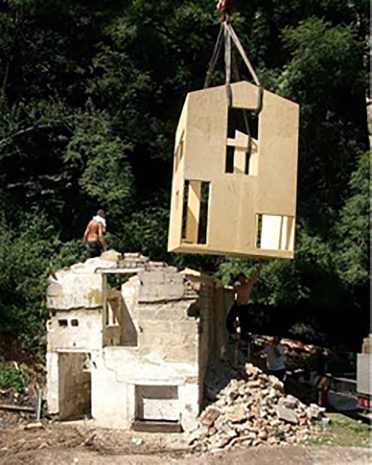
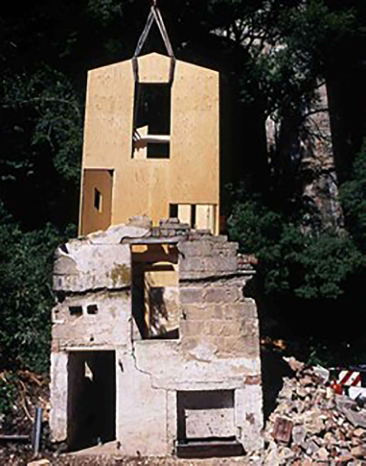
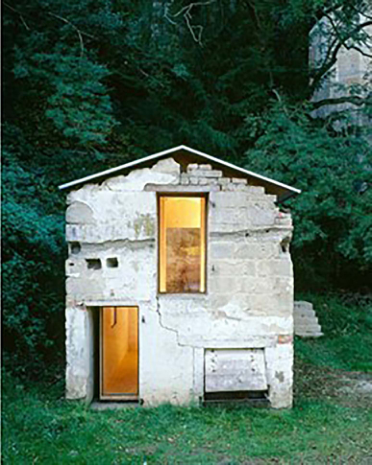
In another concept of reusing an existing ruin, we can analyse the intervention in the interior space. In the S(ch)austall project (Fig.1, 2 & 3), the existing structure endures and is all that remains. A new prefabricated core is then applied within the pre-existing structure, adapted to the demands of our time. Respecting the ruin, it interacts with and uses it as an external cladding without altering it.
According to Moxon (2012, p.29), “(…) interiors are often designed to have a short lifespan, while buildings are usually designed to last for many years. The duration of the project influences the decisions a sustainable designer makes, in part determining whether a particular material or construction method is a sustainable choice”.
In the Arts and Crafts movement, designers were inspired by vernacular construction. In this context, Sir Edwin Lutyens, “(…) used different natural materials to adapt what was traditionally found on the construction site (…)” (Moxon, 2012, p. 21).
This fact leads us to reflect on the basis of raw materials, materials that are not accidental in the consolidation of the design of any object or work. Reuse is a preponderant factor in the current situation, as it is relevant to reuse materials, objects or structures already built to give economic viability to the world, namely to the world of projects. The design attitude of reinterpreting and readapting raw materials can be seen in the use of chance works authored by nature itself.
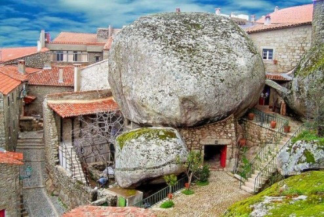
We can analyse this empirical design approach of reuse in the caves of Prehistory transformed into shelters or even in the Casa dos Barrocos in Monsanto, in Beira Baixa, Portugal. Figure 4 demonstrates how it is possible, after analysing the material in its surrounding context, to adapt it to a construction.
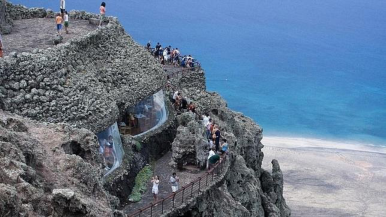
Also, in the 1970s, César Manrique reused the natural volcanic holes formed in the rock to create an interior viewpoint restaurant. In both cases, the buildings blend almost imperceptibly into the landscape, reusing nature’s construction as a structural element (Figure 5).
Figure 4: Casa dos Barrocos, Monsanto, Portugal. Source: https://descobrirportugal. pt/aldeia-mais-portuguesa-de-portugal/ (Access: November 27, 2025).Figure 5: Mirador del Rio Restaurant, Lanzarote, Spain. Source: https://www. tripadvisor.pt/Attraction_Review-g187477-d1007046-Reviews-Mirador_del_Rio- Lanzarote_Canary_Islands.html (Access: November 27, 2025).
We can also highlight the transfiguration of pre-designed products for other purposes, readapted in the construction of an installation for an art gallery.
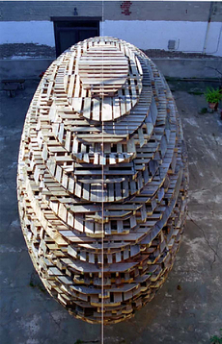
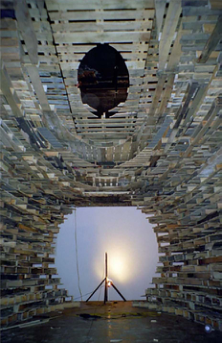
The authors, Mehrdad Hadighi and Frank Fantauzzi, based the project’s design on the name given to the gallery, Big Orbit (Figure 6 &7). Upon discovering that the implementation site was a warehouse of ice blocks that had once been filled to the top, the idea arose to fill it again with something. They went around the city and discovered several wooden pallets stacked everywhere, as it was an industrial city. All these factors led to the construction of an installation based on emptiness and solidity, causing a total filling of the warehouse with pallets, with the central core being removed, creating an “orbital void”. The corresponding void became solid on the outside, constituting a “solid orbital”. The concept of orbit is based on the idea of pallets rotating in orbit around the city (Richardson, 2007).
Figure 6: Big Orbit Project. Source: Richardson, 2007, p.89.Figure 7: Big Orbit Project. Source: Richardson, 2007, p.89.
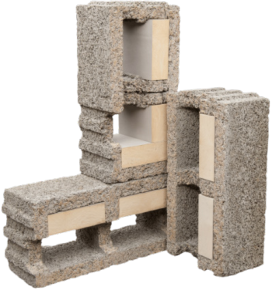
In an attitude of metamorphosis through reuse, we highlight the conception of new materials. The North American company K-X Industries created a wall structure called Faswall (Figure 8). Using waste resulting from the manufacture of raw materials, and combining these surpluses with Portland cement and ash, they create a new material and a new construction method.
Whenever a designer creates something, in one of the phases of the design methodology, they have to consider the choice of materials in which the project will be produced.
Taking into account the various design methodologies consulted, such as Lobach, Munari, Archer, Bonsiepe, Maldonado, Sidal, among many others, we detected common points in the different phases of a methodological process, in an attempt to respond to a specific need, with all of them having in common the definition of the owner or target client, a problem/objective and its delimitation, a framing of the idea or solution, a design application and a validation.
Based on this analysis, we highlight a methodology that we can define, within the limits of the macrostructure, in two phases: the genesis phase and the design phase.
316 Carreto and Carreto In a more detailed description of the macrostructure, we approach the microstructure. In this sense, the first “macro phase” (genesis) concerns the foundation, giving rise to the project. In this phase, information will be collected, whether from the client or the target market. It is essential to define, through analysis, the entire framework of the problem – commercial analysis, social analysis, cultural analysis, technical and economic analysis, and finally, the creative analysis that culminates in the compilation of all analyses.
We emphasize that during the technical analysis period, the definition of materials, whether new or reused, and the inherent costs should take place. Because here we will have the notion of sustainability and duration of the project, so that the process is more objective and well-defined in the second phase.
In the second “macro phase”, the project is implemented. Within this phase, the first is based on the exploration of ideas, followed by a preliminary representation phase, interspersed with a validation analysis, and subsequently a final representation.
After this methodological synthesis, we can assume that the analysis of the material is a factor in the genesis of any reuse project.
The reuse of materials has transformed the world of Design, because the goal is not just usability, but to go further with design methodologies that consider the demise of the product or space. In the proposed methodology, we assume these analyses as initial techniques. For some time, it was thought that Sustainable Design was about reducing means of subsistence, but reality indicates the growing need for goods and services that must be properly adapted ecologically throughout their useful life and, at the end of it, be decomposed or reusable.
As holistic designers, designers must have increasingly responsible concerns, as the scope of their interventions should not be merely formal, functional or aesthetic, but must stem from an agglutinative and convergent attitude to meet the needs of the user belonging to a plural and free society.
According to Maria José Salavisa, “The professional interior designer has obligations: to use ethics inseparable from aesthetics, psychology in defending the project, and sufficient humility to fulfil the dream of those who seek their services” (Neves, 2001, p. 17).
CONCLUSION
The designer bases their work on a design methodology capable of solving a wide variety of problems. Knowledge of this methodology will allow the designer to work more effectively in various areas of the field, with the aim of exploring new disciplinary fields. In the relationship between Design and Reuse, it is necessary to justify concepts that enable the application and insertion of new creative methods to implement new Design processes that can be analysed as a new paradigm. The use of materials for a Design solution is becoming increasingly relevant not only in our society, but also in industry and the world. The concept of Ecodesign through Recycling/ Reuse of materials considered waste is often portrayed as a new trend in
Material Immortality: Designing for Eternity 317 Contemporary Design. What is useless or meaningless to some, can be considered invaluable raw materials for the creations of others. In short, with this research, we highlighted the need for a design approach with examples that extended the useful life of the projected product.
ACKNOWLEDGMENT
This scientific article was funded by national funds through the Portuguese National Funding Agency for Science, Research and Technology (FCT) under the project UID/05488/2025 https://doi.org/10.54499/UID/05488/2025.
REFERENCES
Baker-Brown, D., & Brooker, G. (Eds.) (2024). The Pedagogies of Re-Use: The International School of Re-Construction. Routledge. Manzini, E. (2015). Design, when everybody designs: An introduction to design for
social innovation. MIT Press. Moxon, S. (2012). Sustentabilidade no Design de Interiores. Editorial Gustavo Gili. Neves, J. M. (2001). Maria José Salavisa: 1965-2001. Estar Editora. Papanek, V. (1995). Arquitectura e Design: Ecologia e Ética. Edições 70. Richardson, P. (2007). XS Ecológico: grandes ideias para pequenos edifícios. Editorial Gustavo Gili. Thackara, J. (2015). How to thrive in the next economy: Designing tomorrow’s
world today. Thames & Hudson.
LISTED IN THE AHFE DIGITAL BOOKSTORE CATALOGUE
Explore the complete digital volume
Human Factors and Ergonomics In Design
Read this individual research paper free through the original publisher, or explore the full digital proceedings book.
ISBN 978-1-964867-86-1
Explore this ISBN in the AHFE Bookstore ↗Listed in the July 2026 bookstore catalogue; search by ISBN to confirm current availability · Digital book purchase optional