Huajie Wang, Rong Chen, Jinwu Xiang, Zhang Jin (2026). Product Design with Human-Machine Collaboration and AI Integration into Design Process. In: Artificial Intelligence and Social Computing. AHFE Open Access, vol. 203, pp. 51–57. https://doi.org/10.54941/ahfe1007317
In order to enhance product design efficiency, this paper integrates AI technology into the design process by combining AI software with traditional workflows. Three design methodologies—text-to-image generation, image-to-image generation, and sketch-to-process generation—were explored, along with human-machine collaborative design approaches. Practical implementation demonstrated that this collaborative workflow significantly improves the effectiveness of creative solution generation, providing valuable insights for design professionals.
The fashion industry is one of the most dynamic sectors, driven by continuous innovation and creativity. As a vital component of fashion products, jewelry design serves not only as a decorative element but also as a medium for cultural expression, emotional communication, and individuality. Traditional jewelry design processes heavily rely on designers’ personal experience, artistic intuition, and manual skills. From inspiration gathering and sketching to 3D modeling and prototyping, these processes are time-consuming, costly, and often lag behind market trends. In recent years, artificial intelligence (AI) technologies—particularly deep learning, computer vision, and natural language processing—have achieved groundbreaking advancements, demonstrating exceptional capabilities in image generation, style transfer, and data mining. AI-powered tools like Midjourney and Jimo are revolutionizing traditional creative industries in unprecedented ways. This study focuses on jewelry design as a specific domain, systematically analyzing how AI integrates throughout the design process. It provides a theoretical framework and practical guidance for professionals, educators, and researchers in fashion design to understand and apply AI technologies, driving the industry’s transformation toward digitalization, intelligence, and sustainability.
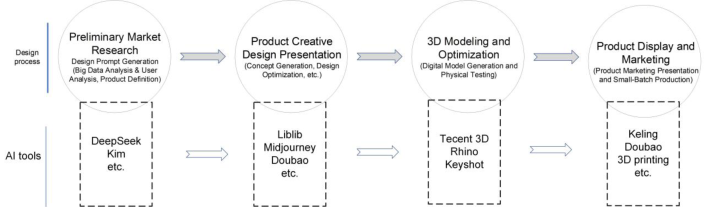
THE TRADITIONAL WORKFLOW FOR FAHION PRODUCT DESIGN As illustrated in Figure 1, represents a comprehensive process that systematically integrates aesthetic trends, creative expression, and craftsmanship. This process follows a clear phased progression, encompassing four key stages: market research, creative design, 3D design, and mass marketing. Together, these stages ensure the seamless integration of artistic inspiration and commercial viability throughout the product lifecycle.
Preliminary Market
Product Display and
Product Creative Design Presentation Research Design Prompt Generation
Design process
(Concept Generation, Design
3D Modeling and Optimization (Digital Model Generation and Marketing (Product Marketing Presentation Optimization, etc.)
Physical Testing)
(Big Data Analysis & User Analysis, Product Definition)
and Small-Batch Production)
Figure 1: Normal product design process.
Figure available in the original PDF paper.
The first phase of the process primarily involves market research and positioning analysis, serving as the strategic foundation for design development. Key tasks include: 1) Trend analysis to identify emerging trends in jewelry colors, materials, styles, and wearing methods; 2) User persona research to understand target customers ‘situational needs, value preferences, and consumption psychology; 3) Competitive analysis and channel evaluation to study strategies of similar products in design, craftsmanship, pricing, and sales channels; 4) Brand identity alignment to ensure the new collection maintains the brand’s aesthetic craftsmanship and cultural narrative. This phase produces a clear design direction document defining the collection’s theme, price range, featured materials, and core emotional values.
The second phase focuses on creative design and visual transformation, the core creative process of converting market positioning and artistic inspiration into concrete visual solutions. Guided by research findings, designers draw inspiration from natural forms, architectural structures, historical patterns, or contemporary art to create mood boards that solidify the collection’s visual atmosphere, texture combinations, and color palette. The creative sketch stage then explores infinite design possibilities through extensive hand-drawing, emphasizing contours, proportions, negative space, and dynamic effects during wear. After refinement, the final proposal is presented with precise three-view diagrams and detailed close-ups, accompanied by preliminary material and process planning, forming a “design blueprint” to guide subsequent production.
The third phase focuses on 3D design and prototype development, serving as the core process for verifying design feasibility and finalizing product specifications. Traditionally, this stage heavily relies on physical prototypes. Craftsmen or pattern makers create initial prototypes by hand, using techniques like wax carving or metal roughing. Through iterative trials, visual feedback, and adjustments, they optimize the design in terms of spatial dimensions, comfort, structural strength, weight distribution, and detail presentation. Once the form and structure are finalized, the final product is fabricated using designated materials. Simultaneously, the production mold,
Product Design With Human-Machine Collaboration and AI Integration 53 inlay techniques, and surface treatment plan are determined, generating precise technical guidelines for manufacturing. This process achieves the seamless transformation from “blueprints” to “wearable art pieces.”
The fourth phase of the workflow focuses on mass production design and pre-market marketing. This stage emphasizes the industrial implementation of precision manufacturing and market value creation. Production teams execute standardized processes—including pattern confirmation, mold setup, insert assembly, polishing, and electroplating—based on verified technical specifications, with rigorous quality control. Concurrently, marketing and sales teams conduct in-depth engagement: capturing professional still-life and wear scenarios using final prototypes, developing product storytelling materials, maintenance guides, and display strategies. These products are showcased at jewelry exhibitions, trade shows, or brand launches to gather direct feedback from buyers and customers, which informs adjustments to product portfolios and production plans. The core objective is to transform designs into high-quality products through meticulous process control, while building compelling value narratives and consumer desire through strategic content marketing, ultimately achieving successful market penetration.
Figure 2: Schematic diagram of AI-integrated design process.
AI INTEGRATION IN JEWELRY DESIGN PROCESS ARCHITECTURE COMPARED TO TRADITIONAL JEWELRY DESIGN AI tools can significantly enhance design efficiency. The integration of AI into the design process may involve the use of one or multiple AI tools at specific stages. As illustrated in the figure, this paper establishes an AI-driven jewelry design process model comprising four core stages, analyzing the practical applications and advantages of combining AI with conventional design methodologies.
Phase 1: AI-Enabled Early Market Research During the initial stage of jewelry production—market research and inspiration gathering—AI tools like DeepSeek and Kimi empower designers to swiftly obtain precise market insights, providing a scientific foundation for design direction.
AI tools can also perform visual style deconstruction and trend forecasting. By leveraging computer vision technology, AI can identify, classify, and analyze the visual style characteristics of works from different historical periods, cultural movements, and designers—such as lines, colors, materials,
and compositions. Through analyzing the evolution of these features over time, AI can predict future trends in colors, shapes, and materials, generating visual trend reports to provide designers with scientific data support.
Phase 2: Rapid Emergence of Design Solutions. AI tools provide boundless inspiration and conceptual exploration, generating high-quality visual concept diagrams with remarkable precision from text descriptions. By inputting core keywords, designers receive dozens or even hundreds of visual design proposals within minutes, dramatically expanding creative boundaries and transcending traditional brainstorming limitations. In early- stage design, AI-generated prompt generation proves crucial for enhancing design quality. Furthermore, AI accelerates iteration and solution refinement. Unlike traditional processes requiring designers to invest significant time in modifying designs, AI enables real-time generation of new variants through prompt fine-tuning. This empowers teams to efficiently explore diverse directions while rapidly refining selected preliminary solutions with meticulous attention to detail.
This streamlines early-stage design communication, allowing the team to discuss and make decisions based on concrete visual concepts at an earlier phase. This enables them to focus more on creative development and user experience optimization, rather than tedious repetitive drawing tasks.
As a powerful ‘super collaborator,’ AI liberates designers from repetitive tasks, empowering them to explore broader horizons and innovate more deeply, dramatically shortening the time from ‘idea’ to ‘solution.’
Phase 3: Design Implementation and Prototype Optimization. By integrating parametric design platforms with AI algorithms, designers can define objectives such as minimum weight, maximum structural strength, or specific lighting effects. The intelligent software then performs topology optimization to generate structures that meet both aesthetic requirements and mechanical logic. For jewelry crafted from precious materials, this approach effectively conserves resources while ensuring product durability. In manufacturing processes like simulated casting and 3D printing, AI can predict and alert potential defects—such as uneven wall thickness, structural support issues, or missing details—allowing for optimization during the digital phase and reducing the failure rate of physical prototyping.
Phase 4: Product Showcase & Marketing Experience. AI can generate tailored product narratives, social media visuals, and even short videos based on each piece’s design features, enabling automated and personalized marketing content. AI seamlessly bridges the creative process from inspiration capture to rendering, significantly boosting efficiency. By learning designers’ style preferences, it generates content that aligns with their creative vision. It also optimizes material usage and manufacturing processes, supporting sustainable design practices. AI is ushering creative design into a new era where efficiency and creativity go hand in hand.
DESIGN PRACTICES OF AI INTEGRATION IN TRADITIONAL JEWELRY DESIGN AI-Assisted Preliminary Research and Trend Forecasting Initial user research identified target demographics and needs. AI software was then employed to predict design trends, specifically analyzing “the color, form,
Product Design With Human-Machine Collaboration and AI Integration 55 and material evolution of butterfly-inspired brooches in future jewelry designs.” This analysis provided actionable trend insights and inspiration sources.
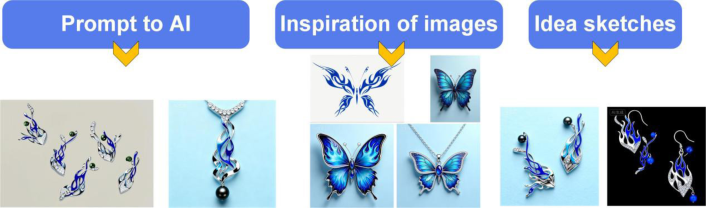
The design concept integrates prompt words with creative sketches, combining the jewelry’s features through a prompt phrase: “Style + imagery + color + material + size.” Specifically, the prompt is: “Design a brooch with a modern, butterfly-inspired shape, predominantly blue-toned, and primarily silver metal,” optimized using DeepSeek. The design theme, “Butterfly Dance in Azure,” requires creating a high-end, contemporary brooch inspired by butterflies while avoiding realistic depictions.
Meanwhile, during this design phase, designers can gather conceptual sketches to guide AI in generating creative designs. Alternatively, traditional hand-drawing methods can be employed to develop innovative solutions. Figure 3 demonstrates the corresponding design proposals produced through three distinct approaches at this stage.
Figure 3: Schematic diagram of design proposals generated by multiple methods.
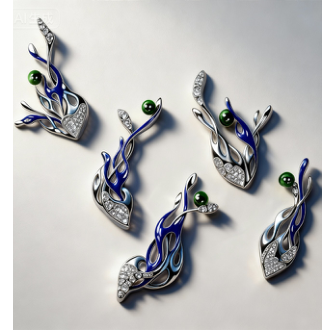
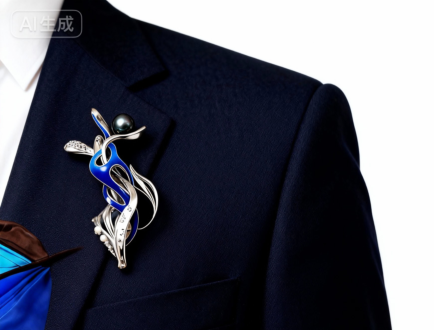
Based on the proposed design, users were invited to provide feedback, and the optimal solution was selected after considering practical manufacturing processes and cost factors (Figure 4). Subsequently, the prototype was fabricated (Figures 5 and 6).
The final design received high praise from the client, with its fluid geometric lines seamlessly blending into the gradient enamel colors, capturing the butterfly’s fleeting, dynamic motion in flight.
CONCLUSION
This study systematically explores the pathways, value, and challenges of integrating AI technology into the fashion jewelry design process. By constructing a four-phase model encompassing “inspiration-creation- realization-display”, it demonstrates how AI empowers design practices through data intelligence, intelligent creativity, and presentation, effectively addressing pain points such as inefficiency and creative stagnation in traditional workflows. The collaborative co-creation approach combining human wisdom with artificial intelligence represents a promising pathway for future successful fashion product design. Integrating AI technology into jewelry design does not aim to replace designers but rather to establish a more efficient, intelligent, and insightful new design ecosystem. This integration partially liberates designers from repetitive and fundamental tasks, enabling
Product Design With Human-Machine Collaboration and AI Integration 57 them to focus on higher-level creative endeavors such as strategic decision- making, emotional infusion, and artistic elevation.
Practical experience has demonstrated that in the AI era, while technology enhances efficiency, designers’ unique value will become even more prominent—namely their irreplaceable aesthetic judgment, profound cultural understanding, rich emotional experiences, and boundless original imagination. The future design process will be a fusion of human-machine collaboration. With continuous advancements in AI technology, the paradigm shift from “design assistance” to “collaborative creation” is inevitable.
ACKNOWLEDGMENT
We would like to acknowledge the support from the Shanghai Oriental Talent Program and the Shanghai Artificial Intelligence for Research Paradigm Transformation Program.
REFERENCES
Hong Wudi, Luo Jing. The Transformation of Designer Identity and Design Education Reform in the Generative AI Era [J]. Art and Design Research (Chinese and English), 2025, (06):92-98+141–142. Li W, Zhang W, Wu W, et al. Exploring human-machine collaboration paths in the
context of AI-generated content creation: A case study in product styling design. Journal of Engineering Design, 2025, 36(2):298–324. Li W, Zhang W, Wu W, Li W, Zhang W, Wu W, et al. Exploring human-machine collaboration paths in the context of AI- generation content creation: a case study in product styling design[J].Journal of Engineering Design, 2025, 36(2):298–324. Wang HJ, Zhang J. Research on the Design of Off-road Vehicle Appearance with
User Emotional Evaluation and Dual Diamond Model [J]. Decoration, 2024, (09):139–141. Wang Huajie, Cang Ping, Wang Binbei. Research on the Design of Precision Craft Cultural and Creative Products Based on Sino-French Cultural Integration [J]. Packaging Engineering, 2020,41(20):240–245. Wang Jianhua, Cui Xinlong, Chen Yu, et al. Research Review and Prospects of
Generative AI Empowering the Field of Art Design [J]. Packaging Engineering, 2025,46(16):387–400. Wang Xiaohui, Tian Tianhong, Li Jinyu. A Study on the Model of Creative Inspiration Assisted by Artificial Intelligence Generated Content (AIGC) [J]. Packaging Engineering, 2025,46(10):22–32+75.s
LISTED IN THE AHFE DIGITAL BOOKSTORE CATALOGUE
Explore the complete digital volume
Artificial Intelligence and Social Computing
Read this individual research paper free through the original publisher, or explore the full digital proceedings book.
ISBN 978-1-964867-79-3
Explore this ISBN in the AHFE Bookstore ↗Listed in the July 2026 bookstore catalogue; search by ISBN to confirm current availability · Digital book purchase optional