Huajie Wang, Jian Xu (2023). Design index system based on user preferences: The case of Chinese medical products. In: Affective and Pleasurable Design. AHFE Open Access, vol. 71, pp. 214–221. https://doi.org/10.54941/ahfe1003261
In order to improve the design quality of Chinese medical products, this paper constructs a design index system based on the Hierarchical analysis method for aesthetics, functionality, usability and user experience, combines the Kano model to locate the importance of the relevant indexes in the design expectations of users' psychology, and forms a clear design direction. The design of the "Look and Feel" Chinese traditional medical product was completed under the guidance of the methodology, and the product was well received by users. The design of the product was approved by the users. This project shows that the design method is a good guide to improve the design of Chinese traditional medical products, and also has some significance for the development of similar medical products.
New product development is a key task for enterprises and one of the strategic cores for their survival and development. The product design process involves different design activities and requires the application of various knowledge, involving both socio-cultural knowledge and technical scientific knowledge. In the preliminary stage of design, designers produce design solutions through intuitive innovation, and the generation of design solutions is too dependent on designers’ experience. If design directions including user needs can be obtained through reasonable methods, it will provide designers with better design instructions and more easily produce more reasonable design results (Wang, 2021).
Based on the above problems, it is especially important to choose the appropriate method to avoid mistakes in related work at each stage of design innovation.
It has been shown that incorporating various quantitative methods into the process of product design will help to better complete the innovative design work of the product (Lin, 2015). The user’s preference is an important indi- cator to determine the direction of product design, and the Kano model can be used to organize the user’s needs and do more in-depth and detailed rese- arch on the user’s needs, which can make up for the lack of the traditional
Design Index System Based on User Preferences: The Case of Chinese Medical Products 215
Kano model demand classification processing ability. It has been applied in the fields of cell phone development, electric car design, school bus design, etc. Through this method, user needs can be quantified and the design can be guided to achieve a satisfactory result for users.
Combined with the development project of Chinese traditional medical products, the design was guided in the creative stage of the project design, and the product design and production were completed.
METHODS
Analytic Hierarchy Process The Analytic Hierarchy Process (AHP), proposed by Professor Saaty (Saaty, 2004) is mainly used in complex situations, multi-objective and multi- dimensional problem decision-making. It has the feature of deconstructing multi-objective decision problems into a hierarchical model, decomposing the complex objectives from high to low levels. Each level is made up of dif- ferent evaluation criteria. The entire decision-making process is based on a hierarchical relationship between the criteria and the alternatives, in order to derive the priority of each criterion. The priority of an item in a tautological hierarchy depends on its weight.
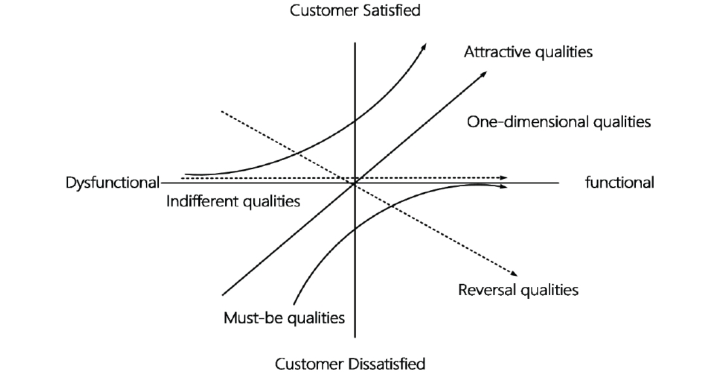
Kano’s Model How to achieve the division of product quality attributes, Sauerwein pro- posed a Kano model-based questionnaire-Kano questionnaire. The Kano questionnaire asks questions in both positive and negative directions to determine different types of user needs (see Figure 1).
In order to better identify user needs, Kurt Matzler proposed a more detailed and practical Kano questionnaire survey analysis table based on the Kano questionnaire (see Table 1). Among them, ‘M’ indicates necessary qua- lity, ‘O’ indicates desired quality, ‘A’ indicates attractive quality, ‘I’ indicates
Figure 1: Kano’s model, showing the five quality attributes.
216 Huajie and Jian
Table 1. The analysis of questionnaire results about Kano model.
Table available in the original PDF paper.
Customer requirements Dysfunctional (negative) question like Must be neutral Live with dislike
Functional (positive) question like Q A A A O Must be R I I I M neutral R I I I M Live with R I I I M dislike R R R R Q
non-differential quality, ‘R’ indicates reverse quality, and ‘Q’ indicates suspi- cious quality. Necessary quality, expected quality and charm quality are the quality of user needs, which need to be paid attention to in the design process.
The Kano model is an evaluation model based on the consumer’s prefe- rence for products. The traditional Kano model classification is too general. The Fuzzy Kano model is good at handling consumer ambiguity and uncer- tainty. When the evaluator has doubts about the existence or absence of functions, Fuzzy Kano model guides consumers in choosing attributes such as positive joy and negative aversion.
Combined with the Kano questionnaire, the 5-element matrix was used to record the evaluator’s feelings about the presence and absence of function. The Kano model describes the pleasing clear scale by F = [1 0 0 0 0], and describes the disgusting clear scale by D = [0 0 0 1 0]. For fuzzy Kano, F = [0.75 0.25 0 0 0] and D = [0 0 0.1 0.8 0.1]. According to the matrix algebra, the fuzzy relation matrix R is obtained by FT × D:
[Equation or mathematical symbol available in the original paper PDF]
Equations and mathematical formulas are available in the original paper PDF.
When the relation matrix R is obtained, the two-dimensional Kano classification can be expressed as a matrix:
[Equation or mathematical symbol available in the original paper PDF]
[Equation or mathematical symbol available in the original paper PDF]
Equations and mathematical formulas are available in the original paper PDF.
R I I I M R I I I M R I I I M R R R R Q
The attractive, required, expected, undifferentiated, reversed, and suspici- ous membership degrees P in the Kano category are:
M , 0.075
O , 0.225
I , 0
R, 0
Q
Design Index System Based on User Preferences: The Case of Chinese Medical Products 217
Since the Kano model is difficult to quantify consumer perceptions, the positive (D+
i ) and negative (D−
i ) needs to be corrected and quantitatively derived:
D+
D−
In the formula: Ai, Oi, Mi, Ri, Ii represent the corresponding percentages of different Kano categories.
Empirical Study The development of the farm tractor from the 1960s to today has undergone great changes. Due to the complex use environment of medical products, coupled with the lack of attention to the needs of users, resulting in the dull appearance of products, lack of aesthetic value, operation does not conform to the laws of man and machine, and even some medical products in the use of safety hazards. It is necessary to make design improvements in terms of form, function and user experience.
From the perspective of styling design, the process of medical product design is concerned with both the shape of the product and the user’s demand experience. In this paper, more than 80 indicators have been identified in con- junction with the components of medical product design. Through extensive review of data and extensive consultation with experts, a multi-factor and multi-level comprehensive evaluation system containing 19 indicators was determined from five aspects, including aesthetics, user needs, functionality, and process economy (see Table 2).
Combined with the product design indicators of medical products sum- marized by the analytic hierarchy process, Kano questionnaire method was used to recruit 22 users with experience in the use of this type of pro- duct. Using electronic questionnaires and user interviews, the identified user demand indicators were investigated. 22 questionnaires were distributed and 16 valid questionnaires were collected. The answers to the positive and negative questions of the quality of each user’s needs were entered into the Kano questionnaire result analysis table, and the number of types of needs was counted. The largest number is the main demand. Categories to cla- rify what type of user needs are, and divide them into corresponding Kano requirements categories.
Calculated in combination with formula 1-5, the better and worst values of the various indicators after statistics are shown in Table 2, and the product’s better-worse matrix diagram is completed according to Table 3.
Combined with the survey, it can be seen that must-be factors include the proportion of total form that can meet the needs of design aesthetics (U11), styling and color harmony (U24). In the one-dimensional quadrant, custo- mers expect the details of the product to be more beautiful (U14), the overall
218 Huajie and Jian
Table 2. Evaluation index system of medical product design.
Table available in the original PDF paper.
Primary index Secondary index Evaluation criteria U1 aesthetics U11 product ratio’s beauty The aesthetics of the individual component form and the overall coordination U12 The styling is consistent with the brand style U13 uniform front, back and side styles U14 accessories’ beauty
U2 User perspective design evaluation
U21 product is friendly The plan conforms to the aesthetic trends of the times, and the plan conforms to the company’s brand style
U22 universal design U23 has a good interactive experience U24 styling and color consistency U25 shape conforms to aerodynamic principles U3 Rationality of Manufacturing process U31 has good production process performance Reasonable design process and controllable mold cost U32 mold parts cost controllable U33 styling components are reasonably assembled U34 easy processing and post-processing
U4 Styling maintenance costs
U41 Easy maintenance Low replacement cost of molding parts and easy maintenance U42 shape parts are environmentally friendly U43 Replacement cost is low U44 shape parts are not easily damaged U51 key components can be replaced on different models The mold can be universal, Reduced production costs U52 key components can be applied iteratively U5 Modeling versatility and economy
style of the model is consistent with the brand style (U12), and the product must have affinity (U21), which shows that the user’s expectations for the product are reflected in higher Level of requirements.
Design Index System Based on User Preferences: The Case of Chinese Medical Products 219
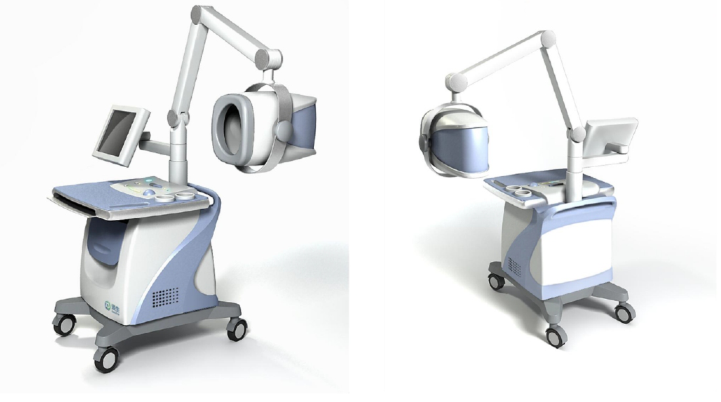
Figure 2: Final design proposal of medical product.
Among them, the product has a barrier-free design (U22), the environmen- tal protection material of the external parts (U42), the replacement cost of external parts (U43), the external parts are not easily damaged (U44), and key parts can be replaced on different models (U51) The above are the user’s surprise indicators. If you improve these indicators, you can improve the product design charm.
By analyzing the Kano model and user demands, the user’s quality needs are tapped to find a design direction to improve user satisfaction: (1) Product design can reflect the brand’s style, pay attention to details, and have affinity on the whole; therefore, in-depth research on the brand value and product design style of the company’s products is needed, and elements can be fully applied to the new design scheme.
(2) Make careful preparations on the product’s barrier-free design, product environmental protection, maintenance costs, and common use of key com- ponents. In the process of design creativity, be fully prepared. It can be seen that the appearance design of the product is not Pure aesthetic issues require designers to creatively design products from a systemic perspective.
By analyzing the user needs of the Fuzzy Kano model, based on a well- defined design direction, the product is creatively designed, and ideas such as brainstorming and bionic design are used to develop the idea. Use the 3D software to complete the exterior design of the new product (see Figure 2).
DISCUSSION
Through the research, it is found that customer demand analysis based on fuzzy kano model unearths the design requirements of customer expectations and surprises, and discovers the potential room for product improvement, which can effectively guide the direction of design (Wang, 2020). Rotar (Rotar, 2017), Lee (Lee, 2009) and other scholars have introduced Kano
220 Huajie and Jian
model or Fuzzy Kano model into product design for enhance the satisfa- ction of the product for users. The process of product development has unearthed several design innovation points, for example, the introduction of information technology can enhance user experience, which is beneficial for the product to take the lead in the competition and win good reputation. In terms of universal design, for example, the design of retractable pedals provides convenience for division users. The user needs found through the Fuzzy Kano model are better to improve the comfort and livability of the product.
CONCLUSION
Product design is a complex practical activity. It is a creative activity that has plans, steps, goals, and directions. It is not the same as engineering design, nor is it pure art creation; it is the fusion of technology and art, the fusion of rationality and sensibility. Can’t simply decide the direction of design from quantification In addition to a deep understanding of the job, designers need to study the characteristics of the discipline and the design process. Able to perceive the deficiencies in the design process, constantly summarize the design experience, and comprehensively consider the meaning of design from the perspective of enterprises, users and social culture. The perfect combination of sensible creativity and rational evaluation to design excellent design works.
In the next stage of research, I hope to further enrich the design system of Medical products and other products, continuously improve the relevant design indicators, and establish a more comprehensive and scientific research system (Homburg, 2015). This article emphasizes the importance of quanti- tative evaluation, but the actual project involves The factors may be more. It is also recommended that companies can effectively combine qualitative and quantitative research in the process of product design to improve the design process.
ACKNOWLEDGMENT
This paper is supported by Shanghai Philosophy and Social Science Planning Project (No. 2021ZWY006) and Ministry of Education Humanities and Social Sciences General Project (No. 21YJA880043).
REFERENCES
Homburg C, Schwemmle M, Kuehnl C. (2015). New Product Design: Concept, Measurement, and Consequences. Journal of Marketing, 79(3): 41–56. Lee, Y., & Huang, S. (2009). A new fuzzy concept approach for Kano’s model. Expert
Syst. Appl., 36, 4479–4484. Lin, Ching-Torng, Yang, Yuan-Shan. (2015). A Linguistic Approach to Measuring the Attractiveness of New Products in Portfolio Selection. Group Decision & Negotiation, 24(1): 145–169. Rotar, L. J., & Kozar, M. (2017). The Use of the Kano Model to Enhance Customer
Satisfaction. Organizacija, 50, 339–351.
Design Index System Based on User Preferences: The Case of Chinese Medical Products 221
Saaty T L. (2004). Decision making — the Analytic Hierarchy and Network Processes (AHP/ANP). Systems Science and Systems Engineering. Wang Huajie, Cheng Jianxin. (2021). Sustainable Design Method for E-cigarette
Products from the International Perspective. Tobacco Regulatory Science, 7(5): 1329–134. Wang, T. and M. Zhou. (2020). “A method for product form design of integrating interactive genetic algorithm with the interval hesitation time and user satisfaction.” International Journal of Industrial Ergonomics 76: 102901.
LISTED IN THE AHFE DIGITAL BOOKSTORE CATALOGUE
Explore the complete digital volume
Affective and Pleasurable Design
Read this individual research paper free through the original publisher, or explore the full digital proceedings book.
ISBN 978-1-958651-47-6
Explore this ISBN in the AHFE Bookstore ↗Listed in the July 2026 bookstore catalogue; search by ISBN to confirm current availability · Digital book purchase optional