Huajie Wang, Zhang Jin, Xikai Tan (2024). Study on the shape design of off-road vehicle combined with double diamond model. In: Kansei Engineering. AHFE Open Access, vol. 145, pp. 57–66. https://doi.org/10.54941/ahfe1005141
In order to improve the design quality of car form and guide the designers to grasp the direction of car form design more accurately, this paper researches the process of car form design. Taking the double diamond model design process as the research carrier, firstly, the user's perceptual imagination is studied, and the correlation matrix between the user's perceptual imagination and the product form characteristics is established by combining the evaluation construction theory. Secondly, the correlation matrix was integrated into the double diamond model design process, forming an effective combination of user perceptual needs and the designer's design process. In order to prove the effectiveness of the method, it was implemented in the Sport Utility Vehicle form design project led by the author. We find that the method can effectively combine the user's perceptual needs with the designer's creative process and the evaluation process of the program, providing more scientific guidance for the creativity and evaluation of Sport Utility Vehicle, which is of great significance for improving the quality of vehicle form design. In addition, the Sport Utility Vehicle designed under the guidance of the optimized design process, as the main models of the enterprise, have gained high evaluation from users and also brought the enterprise rich profit returns.
Automobile is the representative of the national industrial level, but also the core of China to participate in the global industrial product competition. In recent years, Chinese automobile brands based on traditional culture, pay more and more attention to the appearance design of cars, and constantly cre- ate their own design language, gradually walk in the forefront of the world. The appearance design of automobile is accompanied by the progress of sci- ence and technology and the growing spiritual needs of consumers, with a wide range of styles and forms, diverse aesthetic appreciation and functions, and the innovation of materials and processes. In the era of experience econ- omy, “people-oriented” design concept is deeply rooted in the hearts of the people, the appearance of the car design also pay more attention to the user’s perceptual needs, improve the user for the product appearance of perceptual experience has become one of the important measures to improve the quality of products, but the traditional designer-led car design process, rely too much on the designer intuition ideas, output design quality and designer’s experi- ence and design ability. How to better integrate the perceptual evaluation
of users into the design process is of great significance for tracing the origin of design problems and scientifically improving the quality of automobile appearance design.
STUDY ON THE INFLUENCING FACTORS AND PROCESS OF AUTOMOBILE SHAPE DESIGN Factors of Automobile Shape Design
The relevant national standards and regulations and policies of automo- bile design have corresponding restrictions on the appearance design of automobiles.
In terms of policy. In order to promote the scientific development of new energy vehicles, in recent years, China has issued more than 100 national standards of new energy vehicles in China, which provides a basis for the standardized development of new energy vehicle design. This example illustrates the impact of policy on design.
In terms of science and technology, automobile shape design is influenced by technologies such as automobile structure, material technology, aerody- namics, ergonomics and Internet. For example, traditional energy vehicles need the flow of external air to cool the engine, so the front of the vehi- cle needs to design the air intake grille to meet this function. However, new energy vehicles no longer need this functional component, the whole is more concise, but also provides a greater space for the appearance design of the car. In addition, economic conditions determine the demand level of cars, and eco- nomic conditions are used to divide social consumer groups. The purchasing power of different groups has certain differences, which also determines the level and grade of vehicles.
With the maturity of the technology, the needs of users have gradually become one of the most important factors to determine the shape design of cars. For user factors, users’ needs are manifested in three aspects: function, aesthetics and sensibility. The functional layer of the user can be understood as the functional definition of the car in The Terminology and Definitions of Automobile, Trailer and Automobile Train Part I: Type (GB / T 3730.1- 2022). If the shape of the car body is deconstructed, it can be decomposed into 18 large parts, which form the external functional form of the car. This is the first level of the user’s vehicle, which determines the user’s impression of the vehicle.
The aesthetic layer of the automobile shape is mainly to meet the aes- thetic needs of the users, Contains the beauty of the overall form of the car and the beauty of the local detail form, It is mainly manifested as attention-attracting graphics (attention drawing), the basis of type identifi- cation (categorization), practical external information communication form (the communication of practical), ergfriendliness (ergonomic), pleasant visual beauty (hedonic aesthetics) and symbolic value (symbolic product value) And so on content.
Study on the Shape Design of Off-Road Vehicle Combined With Double Diamond Model 59
The expression of the perceptual layer of automobile shape includes the visual and unified perceptual cognition, which is embodied as follows: users have corresponding perceptual image description for different automobile appearance characteristics. The perceptual layer is also described as an implicit clue to the shape of the car. User’s perceptual evaluation generally starts from the local characteristics of the shape, and then these forms are used as visual symbols to express the visual unified perception. This visual unity of perceptual symbols is often interpreted by users as a reflection of a certain value of the product. For example, BYD’s front grille uses the image of a dragon as a design reference to create a unified product feature and combines it with the slogan “Build your dream” to enhance user perception, reflecting the brand’s commitment to meeting consumer needs.
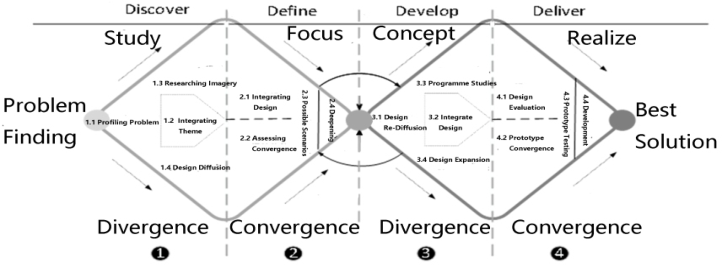
RESEARCH ON THE PROCESS OF AUTOMOBILE SHAPE DESIGN About the process of product shape design, the design process of different types of products will have certain differences.Van Boeijen A summarizes the product shape design process into several stages, such as market research (user analysis), product shape design, product 3 D data processing and sample verification. This process is generally understood as a linear pro- cess. Another design process framework is the widely used “design thinking (Design Thinking)” process, which is not the step-by-step execution process, but the designer’s way of thinking. Design thinking is non-linear, and the four stages of “empathy ∼define problem ∼test ∼prototype” form the frame- work of design thinking, when each stage cannot obtain the expected results, the process will go back to the previous stage or to a more advanced stage until the best design results are found. In addition, the double drilling model design process (Double Diamond) is also a design process that is often used in product shape design. As a typical product design process (Figure 1), it has been applied in the fields of pet products and home appliances. This paper mainly studies the double drilling model process of automobile shape design.
The modern automobile design process is based on the automobile design process initiated by Harry Earl. After long-term practice and improvement, it can be divided into four stages: research ∼design ∼prototype ∼testing, each of which plays an important role in the automobile design process. As shown in Figure 2, the double drilling model process of the automobile shape design is decomposed, and the process can be refined into the divergence and convergence process of finding the correct question and the correct answer. Divergence is the process of exploring various possibilities and increasing options; convergence is the process of evaluating and selecting and reduc- ing options. Specifically, it can be summarized as: the first divergence and convergence process, focusing on the design problem based on the current design situation; the second divergence and convergence process, according to the discovered problems, propose multiple solutions in the divergence pro- cess, and fully consider the limiting factors in the design in the convergence process to determine the best design scheme.
Figure 1: Flow chart of the double-drill model for the automobile shape design.
THE DESIGN PROCESS RECONSTRUCTION OF DOUBLE DRILL MODEL Research on the Relationship Between Product Shape and User Perception Image Space
The process of general users’ understanding of a product is a relatively complex process. Through visual observation, they can establish the first impression of the product, perceive the product from the local character- istics of the product, and then evaluate the product on the whole. As the interaction of users and the product increases, users can further understand the performance of the product and form an emotional (thread) response. In the aspect of emotional expression of the product appearance, on the whole, users can generate emotions on the appearance of the product through the four stages of cognition, decomposition, evaluation and integration. The local and overall appearance of the product can cause the corresponding emotional reaction of the user. This is the basis of forming the correlation between the user’s perceptual image space and the design element space. According to the corresponding space of product design elements, the overall shape of the product can be decomposed into 1∼R local elements. In the perceptual image space of the user’s emotions, including 1∼M perceptual words. The design element space forms a corresponding correlation with the user’s perceptual word space.
Research on the Correlation Between Product Shape and User Perception Image (1) Semantic difference method constructs the user’s perceptual image
In the middle of the 20th century, the semantic difference method (Method of Semantic Differential, SD) proposed by American psychologist Charles Egerton Osgood is a method of emotion and attitude measurement. After continuous verification, it has become an important method of emotion quantification research. The semantic difference method quantitatively eval- uates the relevant perceptual vocabulary, and during the evaluation process, 5,7 or 9 evaluation points are set between the corresponding phrases.
Study on the Shape Design of Off-Road Vehicle Combined With Double Diamond Model 61
Take the “innovative and conservative” phrase as an example, if 7 evalu- ation points are set between the corresponding phrases, the user will score according to the agreement between the perceived object and the phrase when answering the questionnaire. The score is based on “very innovative” -3, “relatively innovative” -2, “innovative” -1, neutral 0, “conservative” 1, “conservative” 2, and “very conservative” 3.
(2) The evaluation and construction theory forms the correlation model of users’ perceptual image and product form The evaluation construction theory (Evaluation Grid Method, EGM) was developed by Japanese scholars Junichiro (Junichiro Sanui) and Gan (Masao Inui) referring to Kelly square (Kelly Repertory Geid Technique). The theory can be used as an important method of product appearance design research, mainly used to understand different subjects for the cognition of a thing, using the depth of interview, let the subject to compare things A and B, clearly discuss the relationship between the two, combined with the test cognitive arrangement, summarizes the unique personality of the target object.
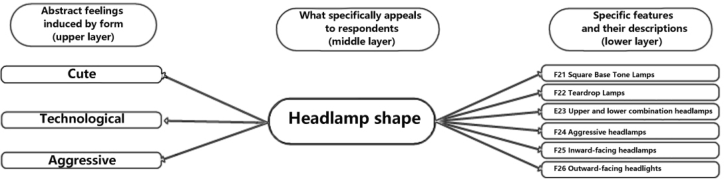
To complete the evaluation structure of the product, select the subject and the related products, describe the first impression of the subject, select the understanding of the reason for the impression of the subject, specific to the local characteristics of the product or overall characteristics, make the cor- responding records to form three levels of evaluation construction diagram, which is the evaluation construction structure of the headlight shape of a certain model as shown in Fig. 2.
Figure 2: The relation structure of user perceptual image and product appearance established by evaluation construction method.
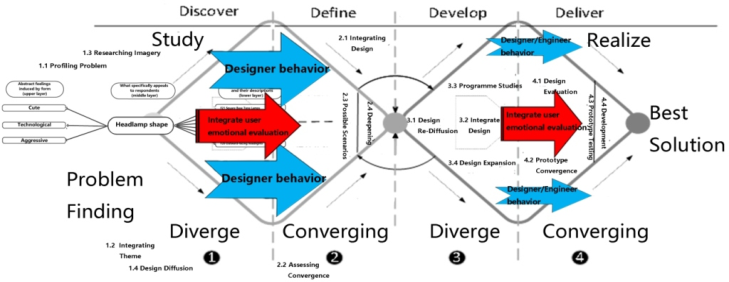
User Perceptual Evaluation Integrates the Design Process of Double-Drill Model In the design process of the double drill model, the user’s emotional eval- uation of the product appearance is considered, which reflects the user’s emotional needs, and better solves the problems caused by the original design process only considering the designer’s behavior.
Reconstruction design process as shown in Figure 3, in the first divergent phase of the double diamond model design process, the user’s emotional image, reflects the emotional demand for the product, combined with the continuation of the product appearance characteristics, deformation and combination process, the stage from the import image vocabulary, according
to the user’s visual image, the corresponding product shape features, design- ers combined with their own experience and design skills to complete creative activities, the design idea visual expression, in the form of design rendering. At this stage, the relevant appearance features and the user’s perceptual image to establish a correlation model, to help the designer to improve the accuracy of the design scheme.
“Definition period” is the process of focusing on the design scheme, which evaluates the creative scheme, eliminates the scheme that does not meet the design expectation, reduces the scope of the design, and at the same time, deeply studies the design details, and selects the design expectation that meets the relevant design scheme through the feasibility of the design standards.
Figure 3: The design process of the user’s perceptual evaluation after integrating it into the double-drill model.
The “development period”of the design is the second divergent stage. After the first scheme screening, the selected design scheme is innovated twice, which is generally manifested in the multi-angle innovation of the design details under the premise of the unchanged overall style, such as material selection or component replacement, to form a series of new design schemes.
With the deepening of the design, the design process has entered the “real- ization period”, and the integration of users’ perceptual evaluation can better confirm the accuracy of the design scheme. At the same time, the design scheme needs to consider the feasibility of economy, materials, function and other aspects, and external factors are also reflected in the continuation of design culture. Combined with virtual or physical model, the design scheme is evaluated, find the best result of design, and realize the engineering of products.
DESIGN PRACTICE: TAKE THE SHAPE DESIGN OF OFF-ROAD VEHICLE AS AN EXAMPLE The Dongfeng Honda M-NV shape project is designed to verify the effective- ness of this method. Before the implementation of the project, the customer positioning of the product is determined through interviews, and the standard
Study on the Shape Design of Off-Road Vehicle Combined With Double Diamond Model 63
model of the off-road vehicle and related user groups are determined com- bined with the positioning. These information provides basic information for the following design work. Next, it is necessary to build the correla- tion model of user perceptual image and shape characteristics of the SUV, and integrate the double-drill model design process to complete the design task.
Image Vocabulary Extraction of SUV Appearance Consumers express their opinions about SUVs using simple adjectives that represent their abstract emotional responses to the product’s appearance. Initially, about 150 Chinese adjectives related to SUVs were collected from websites, magazines, and other media, which were narrowed down to 31 groups after screening by six product designers. Subsequently, two test groups were involved in evaluating these adjectives, and statistical anal- yses confirmed that they did not differ significantly in describing typical vehicle suitability, ensuring the validity of the data. Principal component analysis simplified the 31 adjectives into three main factors, which together explained 92 percent of the cumulative variance. Factor 1 included the adjec- tives “individuality”, “masculine”, “young”, “novelty” and “innovative”. “innovative”, reflecting the uniqueness and personality of the car. Factor 2 is characterised by ‘elegance’ and ‘simplicity’, representing aesthetic fea- tures. Factor 3 is associated with “technical” and reflects the attributes of future trends in the shape of the product. Thus, the vocabulary of the user perceptual image conforming to the shape of the off-road vehicle con- tains five words: “personality”, “innovative”, “elegant”, “concise” and “technological”.
Cluster Analysis of Shape Characteristics of SUVs (Take the Front of the Vehicle as an Example) In the process of clustering the appearance features of off-road vehicles, 166 standard models were selected and classified by feature proximity. For exam- ple, the shape (grille) is mainly manifested in three forms: the first form is a relatively independent Chinese network structure; the second form is integrated design between the headlights and headlights; the third form is to arrange the headlights and the central transition parts, with hierarchical beauty. Each features of the front view of the SUV are classified in turn. As shown in Table 1, after different features are classified, a set of features is formed according to coding.
For example, according to cluster analysis, it are classified into six typical types: F21 square tone lights, F22 tear drop shaped headlights, F23 combi- nation lights, F24 aggressive lights, F25 inclining lights and F26 lateral lights, and so on to complete the classification of the morphological characteristics of the front of the SUV.
Table 1. Classification of each morphological features in the anterior SUV view.
Table available in the original PDF paper.
Classification Form
Classification Instructions
Headlight form Coding and characteris- tics
F21 square tone headlights
F24 aggressive headlights
F25 reclined lamp
The F22 teardrop- shaped car lamp
F23 up and down com- bination lamp
F26 outward- facing lamp The relationship between the bumper and the fog lamps Coding and characteris- tics
F93 attachment, fog lamp spacing
F91 attachment shape, the fog lamp is not obvious
F92 attachment with small fog lamp spacing
F94 interspersed shape, fog lamp spacing is large
F95 separation form with large fog lamp spacing
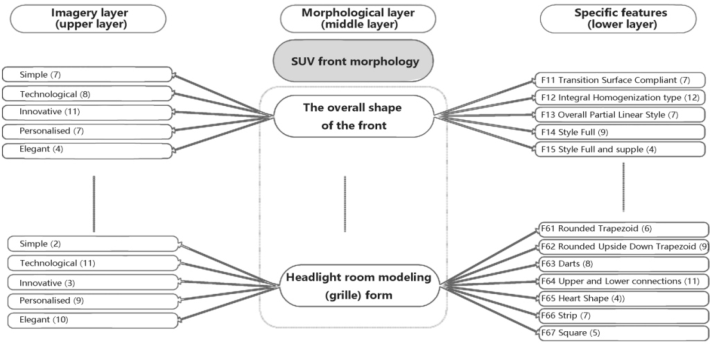
Establish a Model Between Off-Road Vehicle Shape and Perceptual Image Using evaluation construction method to build suv shape and perceptual image associated mapping model, as shown in Figure 4, suv front shape including front overall shape, before face overall shape, headlight shape, between headlights (grille) shape, front bumper shape and front fog lamp (combination) shape appearance elements, different, appearance elements after clustering 4∼6 kinds of specific appearance type, the composition of the lower specific elements. Through the connection between the upper, middle and lower layers, the relationship between the shape of the off-road vehicle and the perceptual image vocabulary is sorted out.
Figure 4: Mapping model of SUV shape and perceptual image.
Study on the Shape Design of Off-Road Vehicle Combined With Double Diamond Model 65
Complete the SUV Shape Design Project Based on the Reconstruction Design Process In the design process of dual drilling model, the off-road vehicle appearance evaluation model is integrated to form an off-road vehicle appearance design and optimization process based on user perception evaluation and integra- tion of dual drilling model. In the “discovery stage”, the designer adds a new scheme according to the user’s perceived image, and obtains the shape features of the product according to the image vocabulary to complete the creative activities. Compared with previous designs, the solutions generated by the design team are closer to the perceived needs of users. In the “defini- tion stage”, the creative scheme is comprehensively evaluated based on the user’s perceived needs, the relevant scheme that meets the design expectation is determined, and the scheme is selected through in-depth study of the design details and evaluation of the design feasibility.
CONCLUSION
The study of the method of automobile design is of practical significance to further improve the level of automobile design in China. In the exploration of “user perceptual evaluation into design process”, the method is used to improve the agreement between designers ‘creative solutions and user’s emo- tional needs, and verify the method in real cases. The practice shows that this method can bring more process control for the automobile shape design, and improve the quality and scientificity of the design scheme. In the next step, we plan to study the combination of this method and information tech- nology, establish user participatory design creativity and design evaluation design process, and explore more scientific design methods.
ACKNOWLEDGMENT
Fund Project: Shanghai Philosophy and Social Science Project, Project No.: 2021ZWY006; General Project of Humanities and Social Sciences of Min- istry of Education; Project Approval No.: 21YJA880043.
About the author: Wang Huajie, male, doctor, associate professor, research direction: user visual perception, vehicle design and engineering realization; Zhang Jin (corresponding author), female, master, lecturer, research direction: Product creative design.
Tan XIkai,male,master candidate,research direction: Integrated product design.
Brunel University London, London, Middlesex UB8 3PH, U.K.
REFERENCES
Chang H C, Chen H Y. Exploration of action Fig.appeals using evaluation grid method and quantification theory type I[J]. Eurasia Journal of Mathematics, Science and Technology Education, 2016, 13(5): 1445–1459. Chyung, Seung Youn Yonnie, et al. Evidence-based survey design: the use of a mid-
point on the likert scale[J]. Performance Improvement, vol. 56, no. 10, 2017, 56(10): 15–23.
Creusen M. Product appearance and consumer choice[J]. Industrial Design Engineering, 1998, 32(11): 91–102. Donnelly B. The emergence of Chinese-influenced design as an international auto-
motive design language[J]. Design Issues, 2020, 36(1): 77–87. Hao Ruimin, Li Yong, Liu Fuyong. Study on the dimension of vehicle innovation design from a system perspective [J]. Decoration, Issue 11, 2020, pages 126–127. Karjalainen, T.-M. It looks like a Toyota: Educational approaches to designing for
visual brand recognition[J]. International Journal of Design, 2007, 1(1): 67–81. Kong Deyang, Huang Sirui, Ma Shujie. Emotional evaluation method of automobile modeling design based on emotion analysis [J]. Journal of Tongji University (Natural Science Edition), Issue 12, 2022, pp. 1817–1824. Osgood, Charles E. Semantic differential technique in the comparative study of
cultures[J]. American Anthropologist, 2009, 66(3): 171–200. Research on Wang Huajie’s SUV morphology design method based on visual user perception [D]. Shanghai, East China University of Science and Technology, 2022. Van Boeijen A, Daalhuizen J, van der Schoor R, et al. Delft design guide: Design
strategies and methods[M]. Amsterdam, BIS Publishers, 2014. Wang Tianxiong. Research on the design method of product shape evolution driven by online user evaluation [D]. Shanghai, East China University of Science and Technology, 2021. Zhu Wei, Zhao Lei, Wang Xiaolong. SUV modeling design method based on brand
image [J]. Mechanical Design, Issue 1, 2017, pp. 118–121.
LISTED IN THE AHFE DIGITAL BOOKSTORE CATALOGUE
Explore the complete digital volume
Kansei Engineering
Read this individual research paper free through the original publisher, or explore the full digital proceedings book.
ISBN 978-1-964867-21-2
Explore this ISBN in the AHFE Bookstore ↗Listed in the July 2026 bookstore catalogue; search by ISBN to confirm current availability · Digital book purchase optional