The professional landscape of industrial design is evolving in response to increasingly complex societal challenges. This raises pressing questions about how designers engage in practice within globally distributed production systems and how they articulate design intent so it carries from concept through development to use. While design intent is often discussed implicitly in industrial design, adjacent fields—including product engineering, architecture, civil engineering, and CAD—employ more explicit strategies for defining and employing it.This chapter first examines how these fields think about design intent within professional practice. It then presents reflections from a group of experienced industrial design practitioners who are also educators, who analyze how they identify, communicate, and embed design intent in their own work. The findings suggest ways in which industrial design practice can move towards articulating and developing design intent as a clear pathway for novice practitioners to move from concept to production in systematic, efficient, and meaningful ways. This chapter forms part one of a two-chapter exploration positioning design intent as a catalyst for the transformational potential of industrial design (see Educating Industrial Designers: Design Intent Part Two).
The professional landscape of design is changing due to the multifaceted and complex challenges facing society. This presents many questions including how industrial designers: engage in professional practice; work in an interconnected world where continents divide design, production and consumption; and articulate their design intent in ways to carry it through the product development process and into the hands of users. Within industrial design practice, people implicitly talk around design intent yet other design practices, such as product engineering, architecture, civil engineering, and CAD have developed specific strategies linked to clearly identifying, characterizing and highlighting how a design intent is part of the design process to carry through a concept into production.
This chapter begins by synthesizing how design intent is characterized in the literature, contrasting industrial design’s largely implicit treatment with Received March 7, 2026; Revised April 13, 2026; Accepted April 30, 2026; Available online July 20, 2026
the more explicit formulations found in product engineering, architecture, civil engineering, and CAD development. This background is followed with the authors’ collective reflections about design intent within the industrial design profession. Five seasoned design professionals—with 15-40+ years each working within industrial design practice on various continents and teaching industrial design (currently teaching in three different design programs)—identify the nature and characteristics of design intent within professional practice (this chapter) and industrial design education (see Educating Industrial Designers: Design Intent Part Two in this volume).
Methodologically, the reflections presented in Design Intent: Holding the Invisible Through the Visible were developed through problematization (Sandberg & Alvesson, 2011) prior to conducting the literature review presented in Design Intent in Practice. This sequencing was intentional, allowing us to surface and examine our assumptions before engaging the literature. Our research begins with problematization followed by gap spotting (Sandberg & Alvesson, 2011), a common approach when research is grounded in expert perception.
DESIGN INTENT IN PRACTICE In this section we examine how design intent is explicitly and implicitly articulated within industrial design and beyond. We conducted literature searches using keywords and phrases including ‘design intent’, ‘intended designs’, and ‘design intentions’ combined with ‘design’, ‘industrial design’, ‘design education’, ‘engineering’ and ‘architecture’ with the aim to identify ways that design intent is being defined and discussed.
Industrial Design Explicit references to design intent within industrial design are limited; the literature most often references design intention (e.g., Lawson et al., 2003; Crilly et al., 2008). See Strickfaden et al., (2026) in this volume for more detail on design intent terminology. Laursen & Mřller (2016) suggest industrial designers create ‘product frames’ linking deep user insights with solution principles, positioning design intent to human centered designing. Similarly, Mengoni, Germani, & Mandorli (2007) describe design intent as bridging mental images and physical forms through conceptualization and representation. It is the communication of semantics–meanings and emotions designers wish to evoke (Cheutet et al., 2008).
Across these accounts, design intent functions as a communicative bridge in product development, helping interdisciplinary teams align underlying reasoning, e.g. between industrial designers (who might be focusing on form and meaning) and design engineers (who might be focusing on functionality and cost), so changes do not weaken core aims (Laursen & Mřller, 2016). Yet as projects move from sketch to production, intent risks dilution under engineering and manufacturing constraints (Trimis, 2025). Sustaining design intent may therefore require continued designer involvement during later development stages (Trimis, 2025).
Practicing Industrial Design: Design Intent Part One 209 Because design involves negotiations between disparate groups—including clients, engineers, and marketers—diagrammatic and linguistic models are used to render complex design information intelligible to non-designers (Crilly, Maier, and Clarkson, 2008). Within industrial design, illustrating design intent requires different forms of communication tailored to specific audiences, as various stakeholders have different perspectives, mindsets, and professional ‘languages’ (Cheutet et al., 2008).
Product Engineering Although product engineering is a similar profession to industrial design and there’s often confusion between the two, there are core differences around the roles and responsibilities of each. While industrial designers are often considered to be more ambidextrous in their creative thinking and focused on form, product engineers lean more towards designing products that assemble well and are functional. As such, product engineering has documented systematic, and often quite prescriptive, ways to engage in the design process (e.g., Pugh, 1991). Even so, Sim and Duffy (1994) tell us that traditionally decisions made within the industrial design process and the rationale behind the components and the overall system designs (aka products with various components) are not generally recorded. In cases where the design process has been documented, it has been the sequence of actions taken by the designer, not the design intent for that action, which remains known only to the designer and is hidden to others who may wish to use the design information. As such, defining design intent in product engineering seems to be more like a prescription or description of expected behaviors that a design must fulfill to complete their required function (Sim and Duffy, 1994). This also ensures that beyond simply working, the designed object meets quality and performance expectations intended by the developer. Interestingly, design intent in product engineering seems to be implicitly linked to specified criteria that helps engineers define and choose specific configurations over competing alternatives during the selection process. The logical proof for acceptance of the design solution is considered the design rationale, a concept that is further explored in our companion chapter in this volume Educating Industrial Designers: Design Intent Part Two.
This research distinction between intent (behavior) and rationale (reasoning) has informed models like the ‘Core Product Model’ used in collaborative 3D CAD systems (Cheng et al., 2019). More recently, AI-driven ‘Semantic Direct Modeling’ tools (Zou & Liu, 2025) aim to translate natural language into geometric modifications, helping bridge the gap between designer intent and low-level CAD operations.
Architecture & Civil Engineering Differently from industrial design and product engineering, architecture and civil engineering have taken a more explicit approach to developing design intent frameworks and even indicate that: “…design intent represents the soul of the project - your vision for spatial relationships, textures, materials, and atmosphere. But as that vision moves from sketches to site, the risk of
dilution grows” (Trimis, 2025). Within the fields of architecture and civil engineering practitioners are responsible for large projects that have long lifespans. The duration of the building process itself is often measured in years where many decisions are made, affecting many parts of the design. Historically, motivations for these decisions have been recorded informally if they are recorded at all. When changes to the design must be made, it has been difficult to reconstruct why certain decisions were made and to predict the consequences of proposed changes. According to literature, capturing the design intent is critical to maintaining the ‘why’ behind design decisions (Ganeshan, Garrett, & Finger, 1994). The written design intent becomes a hierarchy of objectives (e.g., functionality, financial requirements, and maintainability) and tracks how high-level specifications are transformed into a final design (Ganeshan, Finger, and Garrett, 1992). Most notable is that a Design Intent Document (DID), created by the Lawrence Berkeley National Laboratory (Mills et al., 2002), helps to document the vision and functional goals of construction projects. This verification system is said to ensure continuity from design and documentation through construction and ultimately provides future building owners means to make sure the resulting systems perform as designed. Further, the DID is also a record of how sub- systems function (Mills et al., 2002). “The DID Review Guide was rolled out in 2016 to provide a coordinated drawing review tool and a means for less experienced/non-technical folks to approve them with confidence” and is utilized by the United States General Services Administration (GSA) (Client Enrichment Series, 2018).
Computer Aided Design (CAD) Following on explicit ways that design intent is defined within fields of design, according to Reynolds (2014) CAD uses design intent to refer to how a 3D model behaves when dimensions are modified. It is primarily implemented in parametric modeling, where meaningful relationships (constraints) are defined between features so that changes to one part of the model propagate automatically to others (Reynolds, 2014). Designers must plan to build a robust model; e.g., if a hole is intended to always be centered on a part, it must be constrained to the mid-plane so that it remains centered even if the part’s width changes (Reynolds, 2014). Although the specific term design intent has become a hallmark of parametric modeling, its technical foundation–feature-based modeling–has played a role in qualitative knowledge specification in CAD since the 1970s (Cheng et al., 2019). It is important to note that all these design-related professions, including industrial design, are accustomed to using CAD as a central tool for communicating various characteristics of a design that can include form, parts, interfaces, and more. Much of our discussion here was inspired through understandings, and misunderstandings of how CAD platforms use design intent.
To further examine how design intent is characterized—both explicitly and implicitly—across design-related fields, we compare industrial design, product engineering, architecture, civil engineering, and CAD in Table 1.
Table 1: Comparing four design-related fields’ implicit and explicit use of design intent.
Table available in the original PDF paper.
Design Intent Illustrations of Usage Why Communication Tools Industrial Design
Connect deep user- insights with solution principles.
Conceptualization + representation of meaning, user needs, + emotion.
While design intent is implicitly and explicitly present in the four design- related fields we reviewed, it is clear when comparing these to industrial design that it plays out in very different ways. This begs the question: what are industrial designers’ perceptions of design intent and how does this affect their professional practice?
DESIGN INTENT: HOLDING THE INVISIBLE THROUGH THE VISIBLE Design intent is often discussed through tools, processes, and outcomes, yet it is equally shaped by how designers see the world. Throughout these discussions it is apparent that thinking and communicating about design intent grows from lived experience, curiosity, observation, and practice.
Suresh Sethi, designer of consumer products and furniture My understanding of design intent has been shaped over time, through practice—by working across cultures, disciplines, and scales of production. I do not see intent as something fixed or declarative. It is something fragile, something that must be held. It exists in the space between imagination and constraint, between intuition and responsibility. Design intent reveals itself through making, through the tension between what is imagined and what
is possible, and through the relationships formed with materials, processes, collaborators, and users. It cannot be imposed. It must be carried—carefully— if it is to survive the long journey from concept into production and finally into use. This understanding informs how I work, encouraging a practice grounded not only in problem-solving, but as a way of interpreting the world with curiosity, empathy, and awareness.
In this sense, design intent is not a technical instruction embedded in a drawing or defined by software constraints. It is a way of seeing. It is shaped by memory, by experience, and by curiosity. It is what holds an idea together as it travels from the mind’s eye into everyday life.
Design may be understood as a visual language, but it does not follow the rules of written language. It has no fixed grammar. It speaks through form, proportion, material, light, and interaction. Above all, it speaks through feeling. The ultimate aim of design is not simply to function, but to create an emotional form—one that communicates without explanation. Form becomes the visible content of intent.
Design is a continuous dialogue—between form and function, need and desire, logic and intuition. It requires balance. It also requires play. A childlike curiosity allows designers to question the obvious and see the familiar anew. Design intent does not emerge from certainty, but from exploration—by asking questions and letting go of excess.
Design intent must also survive collaboration. Industrial design is shaped by many hands, often across continents. Engineers, manufacturers, marketers, and business realities all influence the outcome. The responsibility of the designer is to make intent clear enough that it does not get lost. When intent is embedded in form, users understand intuitively. The object speaks. The success of a product lies in how well relationships are balanced—between product and user, material and process, design and production, design and profit.
Today, design is no longer only about aesthetics or problem-solving. It is a way to humanize technology and imagine futures that empower people. Yet imagining the future is also an act of memory. We predict what lies ahead using what we already know—our experiences, cultures, and personal histories. These inner landscapes become the material of design. Design intent is ultimately shaped by how deeply we learn to see.
Shea Tillman, design research and designer of consumer products In practice, the scope of design intent might be best viewed as a crucial concept or component for which a particular discipline involved in design is distinctly and uniquely responsible. This intent might be a particular embodiment or detail of a design or potentially the conceptual idea behind it. Whatever the degree of the intent, within the context of a product development project there is the notion of the “if it accomplishes nothing else, it must do…”. Because product development involves a diverse group of contributors, each stakeholder must understand and command their expertise for its essential contributions. In a patent application, intent might be viewed a novel claim; in business, a core value proposition; and for industrial design, it covers the creative and human-centered considerations that distinguish and advance the
Practicing Industrial Design: Design Intent Part One 213 design, the omission of which might risk its failure. This means identifying, creating, and communicating what matters most from the human-centered perspective. John Edson’s description of Apple’s ‘Design Voice’ is drawn from a designer’s ‘conviction’ that can justify small, nearly invisible details— such the centerline alignment for an iMac’s rear cable connectors (Edson, 2012). Despite the costly implications for internal component engineering to accommodating a feature as this, it was judged to be a crucial element in the overall success of the design. It is with this voice of conviction that design intent must be communicated in the product development process.
Design intent is also most effectively communicated through visual embodiment. Verbal and written communication can document ideas, but employing illustrations, models, and demonstrations can expand the understanding of others and serve as an industrial designer’s superpower in decision-making persuasion.
The long-standing critique—How many beautiful designs never left the drawing board?—reminds us that an industrial designer’s effectiveness, particularly in the corporate office, is measured not only by creativity but by the ability to navigate design intent through the circular paths of development into production.
To do this, designers must balance three approaches towards managing design intent. First, they must anticipate collaborator counter arguments (cost, manufacturability, adoption, etc.) and prepare strong justifications for their intent, drawing enough knowledge from adjacent fields to defend critical aspects of the design. Second, they should remain receptive to the evolving intentions of other disciplines (engineering, business, etc.), adapting and strengthening the design intent as the development matures. Finally, designers should work to transform individual design intent into shared intent—a collective vision embraced by the entire team rather than a singular vision. When combined with persuasive communication and holistic project understanding, this shared design intent can become a powerful catalyst for innovation.
Megan Strickfaden, designer of products, furniture, fixtures, and systems Because I work on complicated societal issues that require a lot of ‘unpacking’, there is a great deal of research that happens before embarking on physically designing the object or space. This means that I need to communicate about how I will engage in design research and how this relates to the project. Typically, I will have meetings with the client where we talk about the project and get to know the team. The first phase of a project always involves relationship and team building, where sometimes we create a logo or visual identity as part of this process. The creation of the logo involves deep collaboration about the focus of the project and where we as a team might go forward. Future meetings involve unpacking the issues and establishing recommendations. The direction forward is often mapped out on a timeline and then reported one stage at a time through mini-reports that culminate in a final report. With each of these there are visuals that include diagrams, tables, sketches and photos. Depending on the length of the project, if for example, it’s a multi-year project, we will have year-end reports that are
written for the team and then public facing reports that can be provided to the community. In some cases, I’ve created a film that highlights some of our findings. The visualization of the design intent changes depending on the audience.
Although I haven’t used the term design intent very often, I see it as a means to work with clients to establish expectations and determine the nature of the project at hand by co-creating a guiding design document. We work together to ensure that I’m asking the right questions and considering the ‘right problems’ for the clients or community. Having a guiding document is a way to focus on the work to discover what design thinking, design methods and design approaches can do for the project. This document changes over time depending on the project and is more like a set of working intentions that help the team and clients to see the scope of the work, what’s already been accomplished, and what stage we’re at with the project.
I have used many different tools to illustrate the design intent like engaging in deep discussions, sketches, photographs, models, rapid prototyping to illustrate early phases or specific details of a design, and even rough cuts of films before they’re finalized. These can also be basic presentation tools including PowerPoint. The range of tools is broad.
The idea of establishing a design intent is something that is inherent to the design process. I believe that as designers we all implicitly engage in creating design intents, whether we call it that or not.
Joyce Thomas, designer of consumer, pet, and industrial products Fresh out of college in the mid 1970s working in a corporate design office I often started my design process by creating my own list of design criteria that were important to guide my brainstorming and development process. This benchmark sometimes grew and changed as new customer needs were uncovered, engineering and manufacturing constraints were encountered, or changes in the market occurred. At this start of my career product development was very siloed, beginning in industrial design and then ‘throwing it over the wall’ to engineering after which it moved to industrial engineering and production. In the late 1980s we began to practice concurrent engineering (Wognum et al., 2003) through collaborative multi-discipline teams in our organization which resulted in more conceptual projects moving to production.
Although human-centered design has engineering roots back to the 1950s, it did not become formalized until the 1980s. The design methods that I utilized in my professional practice intuitively reflected this kind of thinking by employing the user and empathy in my designing process – creating design criteria that would allow the customer to have a better experience with the product, helping to solve problems that they encountered in their everyday experiences. Working within an engineering division of an international corporation, it was critical to develop a shared language (Thomas and McDonagh, 2013) between design, engineering, and product management so that the intent of my design criteria (and theirs - which were sometimes in conflict) was carried through into production. Throughout my 30+ years as a professional industrial designer, I didn’t formally use the phrase design
Practicing Industrial Design: Design Intent Part One 215 intent, although it was evident in every project that I worked on. Pre-CAD the exterior shape of a product was first illustrated by designers through clay and wood models, then described in sectioned drawings created by skilled draftsmen, built as Keller models by seasoned modelmakers that were utilized in a tracer-controlled, horizontal milling machine, to duplicate the form to molds and dies (NYU.edu. 2024). It would be easy to lose the designer’s intent at any moment in this process as there was no formal documentation for the design intent, especially when the practice was for the designer to move onto new projects once the exterior form was determined. The designer needed to stay in touch as the project moved through the organization to ensure that intent was maintained.
As we progressed into the digital era, getting the design/shape intent into CAD became a tough nut to crack as everyone learned how to navigate the software tools and develop sensitivity to form as well as the engineering requirements. Initially, this development was done by CAD technicians who generally had no design training. Eventually industrial designers began to develop 3D models as well. Sometimes the designers work in a different software than engineering and this practice leaves opportunities for the design intent to go sideways as a new parametric model is built from a ‘rock’ (non-parametric solid models that allow movement from one software to another).
But design intent was and is more than simply the shape or the functional requirements. It is about the why/purpose/need and suggests a plan towards a result that will affect the consumer of the product as well. Understanding and communicating that reason to others in the development process is critical so that what we see in our head and the shared vision between design, engineering, and product management gets into production and into the consumer’s hands.
Jerrod Windham, designer of consumer products Design intent can be thought of as the malleable sum of a project’s performance criteria and contextual constraints, shaped by brand values, technological capabilities, and production realities. Some criteria are concrete and measurable. For example, design must achieve a defined metric or meet a specific cost target. Other criteria may be more abstract, such as quality, beauty, or ease of use. Criteria may even compete– high quality versus low cost, durability versus weight. Design intent, therefore, is not simply a checklist of metrics but a prioritization among competing demands. The more abstract the criteria, the more malleable the intent.
Action is directed by intent. Intent frames decisions, causes values to be prioritized and gives meaning to outcomes. Constraints do not merely serve to restrain; they focus divergence, preventing exploration from drifting into randomness. Convergence reconnects that exploration to stated priorities. Importantly, intent is not fixed at the outset and executed mechanically. As projects progress through exploration, new discoveries and opportunities emerge. Divergent exploration often reveals previously unseen possibilities that prompt refinement. In this way, design intent evolves, molded through iteration in an ongoing negotiation between criteria and constraint.
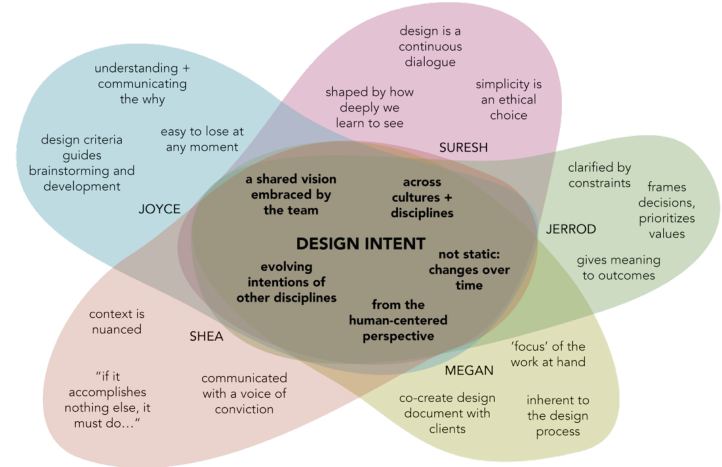
ELABORATING DESIGN INTENT IN INDUSTRIAL DESIGN The summary shown in Figure 1 are words and phrases that draw from the professional journeys of the authors, offering situated perspectives on how design intent is formed, carried forward, and ultimately translated into objects that enter everyday life. It reflects how making, collaboration, and cultural exchange inform professional practice and have the potential to enter into teaching and learning design.
Figure 1: Summary of the authors reflections on design intent in industrial design.
When connecting back with how design intent is identified, illustrated and highlighted within industrial design we can elaborate upon: (1) how design intent is characterized; (2) what further illustrations of usage are present; (3) additional details of why design intent is used; and (4) which additional communication tools are used. First, in this investigation, design intent can be characterized as being dynamic, continuous and sometimes elusive, which is further linked to how industrial designers see and imagine products/ systems. The dynamic nature of design intent is naturally linked to the various contexts and interfaces related to products and the various design outcomes that industrial designers engage in. Second, although literature indicates that design intent is a conceptualization and representation of meaning, user needs and emotion, it was discovered that considering and engaging with design intent is inherently part of the design process and part of taking a human- centered approach. This finding illustrates that design intent is variable and not fixed, but not simply about function and use. Third, design intent is used to clarify, frame, focus, and establish project expectations with the intention of creating a shared vision with team members. Professionals engage in design intent to give meaning and move forward with concepts, to maintain context, and even to give a ‘voice of conviction’ when engaged in designing.
Practicing Industrial Design: Design Intent Part One 217 Fourth, although literature shows that there are many communication tools used to advance and maintain design intent there are also textual materials used such as documents and oral descriptions. The various communication tools are identified as being highly significant towards connecting team members, people from different disciplines/fields, and cultures.
CONCLUSION
This chapter examines how design intent is understood in industrial design practice through the perspectives of five expert designers and a review of literature across five design-related fields. Our findings begin to nuance prevailing understandings, yet they also reveal need for deeper scrutiny. Although some design scholars have investigated the relationship between design intent and consumers (e.g., Crilly et al., 2008) and others have examined the links between product appearance and designer intentions (Jagtap, 2017) the elusive and dynamic nature of design intent needs further attention. This chapter initiates that inquiry, advancing a more explicit understanding of design intent as a central force in the design process.
REFERENCES
Cheng, Y., He, F., Lv, X. and Cai, W. (2019). On the role of generating textual description for design intent communication in feature-based 3D collaborative design. Advanced Engineering Informatics, 39, pp. 331–346. Cheutet, V., Léon, J.C., Catalano, C.E., Giannini, F., Monti, M. and Falcidieno, B.
(2008). Preserving car stylists’ design intent through an ontology. International Journal on Interactive Design and Manufacturing (IJIDeM), 2(1), pp. 9–16. Client Enrichment Series Welcome to today’s presentation on: Demystifying Design Intent Drawings. (2018). Available at: https://www.gsa.gov/system/files/Client_ Enrichment_Series__-_Demystifying_Design_Intent_Drawings_6-21-18.pdf [Accessed 17 Feb. 2026]. Crilly, N., Good, D., Matravers, D. and Clarkson, P.J. (2008). Design as communication:
exploring the validity and utility of relating intention to interpretation. Design Studies, 29(5), pp. 425–457. Crilly, N., Maier, A.M. and Clarkson, P.J. (2008). Representing artefacts as media: Modelling the relationship between designer intent and consumer experience. International Journal of Design, 2(3), pp. 15–27. Dresselhaus, B. and Dresselhaus, W.F. (2000). Return on Innovation. Dresselhaus
Design Group Incorporated. Edson, J. (2012). Design like Apple: Seven principles for creating insanely great products, services, and experiences. John Wiley & Sons. Ganeshan, R., Garrett, J. and Finger, S. (1994). A framework for representing design
intent. Design Studies, 15(1), pp. 59–84. Ganeshan, R., Finger, S. and Garrett, J.H. (1992). Representing and recording design intent: A progress report. Jagtap, S., 2018. Intentions and inspiration in shaping visual appearance of products:
The practice of professional industrial designers in India. The Design Journal, 21(1), pp. 85–107. Laursen, E.S. and Mřller, L. (2016). Sharing the design intent between industrial designers and engineering designers. In DS 84: Proceedings of the DESIGN 2016 14th International Design Conference (pp. 1741–1750).
Mengoni, M., Germani, M. and Mandorli, F. (2007). Reverse engineering of aesthetic products: use of hand-made sketches for the design intent formalization. Journal of Engineering Design, 18(5), pp. 413–435. Mills, E., Abell, D., Bell, G., Faludi, J., Greenberg, S., Hitchcock, R., Piette, M.A.,
Sartor, D. and Stum, K. (2002). Design intent tool: User guide. NYU.edu. (2024). Keller Mechanical Engineering Corporation Collection: NYU Special Collections Finding Aids. [Online] Available at: https://findingaids.library. nyu.edu/poly/poly_rg_001/ [Accessed 12 Feb. 2026]. Pugh, S. (1991). Total design: integrated methods for successful product engineering.
(No Title). Reynolds, R.A. (2014). Design Intent is not a buzz phrase like ‘ideation funnel’ or ‘value streaming’ it is a real term, with a real purpose. Ok, so those other buzz phrases are real too, but I’m just not talking about them at the moment. [online] Linkedin.com. Available at: https://www.linkedin.com/pulse/20140424180856- 18102574-what-is-this-design-intent-i-keep-hearing-about/ [Accessed 10 Feb. 2026]. Sandberg, J. and Alvesson, M. (2011). Ways of Constructing Research Questions:
Gap-spotting or Problematization, Organization, 18(1), pp. 23–44. Sim, S. and Duffy, A. (1994, August). A new perspective to design intent and design rationale. In Artificial Intelligence in Design Workshop Notes for Representing and Using Design Rationale (Vol. 1518, pp. 4–12). Strickfaden, M., Windham, J., Sethi, S., Tzeng, S., Tillman, S., Thomas, J. (2026).
Educating Industrial Designers: Design Intent Part Two. In: Yong-Gyun Ghim and Cliff (Sungsoo) Shin (eds) Interdisciplinary Practice in Industrial Design. AHFE (2026) International Conference. AHFE Open Access. AHFE International, USA. Thomas, J. and McDonagh, D. (2013). Shared language: towards more effective communication. Australasian Medical Journal, 06(01). doi: https://doi. org/10.21767/amj.2013.1596. Trimis, G. (2025). Preserving Design Intent: How Collaborative Design Makes It Real.
[online] Medium. Available at: https://medium.com/@GeorgeTrimisEliteHydra/ preserving-design-intent-how-collaborative-design-makes-it-real-b3720d4f2e56. Wognum, P.M., Jardim-Gonçalves, R., de Graaf, R., Lettice, F. and Roy, R. (2003).
Analysis on 10 years of ISPE/CEconf community. In 10th ISPE International Conference on Concurrent Engineering: Research and Applications, ISPE-CE 2003: Enhanced Interoperable Systems (pp. 1–7). Swets & Zeitlinger. Zou, Q. and Liu, S. (2025). Semantic Direct Modeling. arXiv preprint arXiv:2504.13893.
LISTED IN THE AHFE DIGITAL BOOKSTORE CATALOGUE
Explore the complete digital volume
Interdisciplinary Practice in Industrial Design
Read this individual research paper free through the original publisher, or explore the full digital proceedings book.
ISBN 978-1-964867-98-4
Explore this ISBN in the AHFE Bookstore ↗Listed in the July 2026 bookstore catalogue; search by ISBN to confirm current availability · Digital book purchase optional