How can design transform crime? Can criminal actions be transformed into purposeful future products? How can designers understand users and/or abusers to design for sustainable products that promote personal safety and well-being regardless of the product category? These are questions we asked our students in the project theme focus ‘design out crime’.So, how do we teach our students to engage in problem discovery when asked to respond to a multifaceted issue that can be solved by design? The obvious response to this question is first to take a human-centred approach to bring humanity to the forefront, and second to use a design process framework to guide students through a methodical way of thinking. In our 3rd year industrial design studio, we presented four different project themes with varying degrees of complexity across five years. In the process of teaching this design studio, we constructed an alternative way to engage in the design process that we now call Define, Design, Repeat, Refine that involves three dynamic design sprints. We zoom in on one of our projects called ‘design out crime’ that industrial design students (n=12) completed within one semester to illustrate this. Students were provoked to move creatively through the design process by engaging in deep problem discovery, design, repetition, two unique concepts worthy of refinement, and a final design that embodied the entire process.Define, Design, Repeat, Refine is presented as a design process framework through ‘design out crime’ to exemplify and tease out how students engaged in this process to enhance their more traditional industrial design tools. Within this paper, we situate Define, Design, Repeat, Refine within the context of other design process frameworks, and we elaborate on the value of and critique its use. As an alternative design process that uses repetition as the primary means of engaging, Define, Design, Repeat, Refine has the potential to advance ways of knowing, and teaching and learning industrial design education for an increasingly complicated and multifaceted world.
Traditional industrial design practice often begins with a clearly defined problem, as seen in projects where companies provide specific briefs—such as designing housewares, automotive, and other consumer products. These projects allow for iteration but do not necessarily require extensive problem discovery. However, in cases like the ‘design out crime’ project used here as an example, the design process can begin with an area of focus rather than a predetermined problem. This shift from problem-solving to problem
discovery is a key distinction in designing for multifaceted issues that are more complicated design challenges.
Define, Design, Repeat, Refine is a design process framework that was employed in single semesters for 5 years with different groups of 3rd year industrial design students. Define, Design, Repeat, Refine was advanced to emphasize iterative learning through repetition, back tracking, deepening and integration of design thinking and research in a building process that continually develops and redevelops previous information and knowing. Table 1 showcases the various projects over 5 years that inform our descriptions and analysis herein.
Table 1: Projects using the Design, Define, Repeat, Refine design process framework.
Table available in the original PDF paper.
Year/Students Project Theme Stakeholders/Experts Sponsor – HP Global Print SP2020 Print as a portal between the Experience n = 19
Senior Manager and Creative Director Advanced Design and Strategy
digital and physical worlds. How will the print experience ecosystem evolve to fit in the Gen Z’s and other people’s lives?
Senior Manager Global Experience Design
Systems Design Manager Sponsor – Perlick
FA2021
Equation reproduced from the original PDF.
VP Marketing
Product Manager
Senior Industrial Designer
dispensing ecosystem evolve to fit into venues of the future where owners have a growing concern for sustainability and return on investment and where customers expect great experiences?
Winsell Granites for Plastics
SP2023
Equation reproduced from the original PDF.
Rotational Molding Student Design Competition
Winner First Place Rising Star
design encourage wholesome and sustainable activities in personal backyards that keep people moving and promote health and well-being?
Sponsors and supporters:
SP2024
Equation reproduced from the original PDF.
ADT User Experience Design, Sr Director and 2 member design team
Design + Empathy Specialist
design be used to transform crime? How might designers transform criminal actions into purposeful future experiences?
City of Auburn Police Captain
Criminal Justice Conflict Mediator Continued
Define, Design, Repeat, Refine 79
Table 1: Continued Year/Students Project Theme Stakeholders/Experts
Table available in the original PDF paper.
Winsell Granites for Plastics
SP2025
Equation reproduced from the original PDF.
Rotational Molding Student Design Competition
design encourage wholesome and sustainable activities in personal backyards that keep people moving and promote health and well-being?
Global engineering and procurement leader, rotational molding specialist
This chapter considers alternative ways to teach industrial design within our increasingly complicated and multifaceted world. We believe that present day students need to be provoked to be more creative, and that engaging in deep problem discovery and repetition are effective strategies. We use the ‘design out crime’ project to exemplify and tease out how students can engage in learning a skillset that enhances the traditional industrial design tools. This chapter briefly summarizes design process frameworks; continues by describing Define, Design, Repeat, Refine as a design process framework; presents ‘design out crime’ to illustrate the framework; and closes by highlighting the value of and critiquing Define, Design, Repeat, Refine.
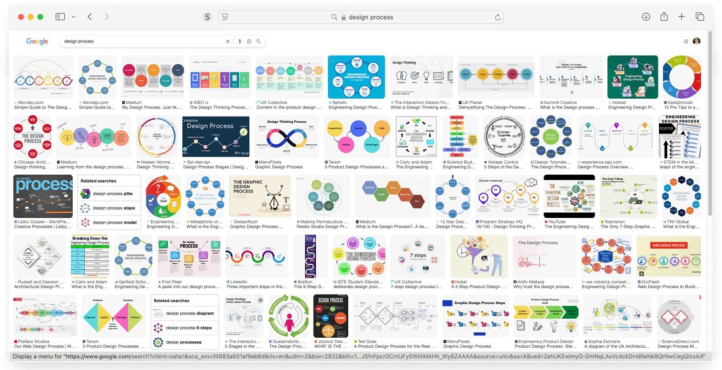
DESIGN PROCESS FRAMEWORKS To engage in troublesome, complicated, and wicked design problems, designers have turned to using various design process frameworks for guidance. The earliest frameworks emerged in the 1960s (e.g., Jones, 1963; Archer, 1965) and were created as prescriptive models that industrial designers were encouraged to use. Later, design process frameworks became known as being more descriptive of the creative process (Dorst & Cross, 2001). Design frameworks are excellent for enculturing design students into how to engage in designing. The double diamond (UK Design Council, 2005), as an example, is one of the most used design process frameworks. Nowadays, there are literally thousands of illustrations of design process (see Figure 1) that are categorized into three types: those that are “iterative”, those that address “novelty”, and those that address “complexity” (Wynn & Clarkson, 2018, p. 193).
Even though there a vast number of existing design process frameworks only the ones that are geared towards engineering have extensive detail providing specific guidance (e.g., Pugh, 1991), while the others tend to be vague and leave the details of how to engage in designing up to designers. This chapter dares to advance yet another design process framework. Our rationale is that despite there being frameworks that involve iteration by going back and forth in the design process and that address multifaceted issues (Wynn & Clarkson, 2018), there do not seem to be any design process frameworks that advance the repetition of an entire project as described in this chapter. Therefore, we present here the framework of Define, Design, Repeat, Refine as an alternative way to engage in industrial design education.
80 Thomas and Strickfaden
Figure 1: The first page of many in a Google search for ‘design process’ images.
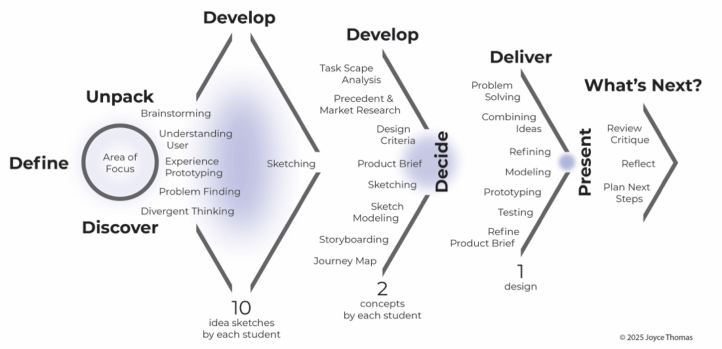
THE DEFINE | DESIGN | REPEAT | REFINE FRAMEWORK The Define, Design, Repeat, Refine framework involves four phases. It is called a framework because it acknowledges complexity, whereas a model is considered to be reductive (Sterman, 2002). The Define phase involves an in-depth process where a design problem or issue is unpacked and opportunities are explored through a variety of design thinking and design research methods. During this phase students are provided with inputs that help to focus their projects. The Design phase involves creating a concept in response to Define to develop ideas using a design sprint–a rapid development process to get past the obstacles of getting stuck, decision- making, and falling in love with one’s own idea that simulates real-world design and decision-making processes (Thomas & Shin, 2016; Thomas & Strickfaden, 2018; Thomas et al., 2021). The Design phase culminates with a presentation and a detailed ‘what’s next’ list. This is immediately followed with shifting back to begin a second design sprint with additional definition relating to the same issue, using different inputs that provide alternative and complementary information to support students. This shift backwards is called Repeat, because the students double back and create another viable project in response to the issues identified in the design brief. On completion of Repeat, the students have two unique concepts, both with ‘what’s next’ lists, to choose from to enter into the Refine phase. Finally, in a shorter third sprint to the finish, students advance one these concepts into a higher level of refinement. This unique four phase process results in two concepts and one more refined project relating to a single multifaceted issue.
We articulate Define, Design, Repeat, Refine as being three separate design sprints: sprint one focuses on problem discovery and then conceiving an idea and moving to a concept; sprint two focuses on further problem discovery and moving through developing a second idea into a concept; and sprint three focuses on refining one of the concepts further.
Define, Design, Repeat, Refine 81
Define This phase is about problematizing the issue at hand, starting with the unknown. It involves considering different user groups specific to the design challenge (e.g., adults, children, people who are aging or have disability, or even criminals or lawmakers/enforcers), events that are linked to a social phenomena (e.g., theft, domestic disputes), and engaging in problem discovery towards an area of focus (e.g., safety, security, rehabilitation). The Define phase also deeply connects with students’ understanding (or lack of understanding) of society. This phase is best characterized as the ‘fuzzy front end’ where small teams of 3–4 students engage in problem discovery. The focus here is to begin to unpack and identify a myriad of problems, objectives, and constraints. This phase requires research from various perspectives to ensure a well-rounded understanding of players, events, and how design might support or shift the issue. It includes engaging in various design thinking and research methods through interviewing, consulting with experts, consulting media, empathic modeling and experience prototyping, precedent and market research generally related to the project, and more to deepen knowledge about the issue and to anticipate potential challenges.
Design Once the problem is unpacked and students begin to come up with ideas that might address multifaceted issues through design, they work individually to brainstorm and conceptualize possible solutions. Students engage in this first design sprint where they follow approximately what is illustrated in Figure 2. They gather further insights from precedent and market research directly related to their target concepts, establish a clearer product canvas brief to align stakeholder expectations by defining the why and who, and create a value proposition/big picture statement (see Strickfaden & Thomas, 2025 for additional detail). The Design phase requires students to visualize at least ten unique ideas over the course of several days using a fast paced technique, which are then evaluated based on their value proposition statement and design criteria. These ideas spark collaborative discussions across the classroom and encourage discovering new opportunities through the wide variety of concepts developed among their colleagues in the studio. They are guided on how to advance their ideas into concepts through sketching and creating interactive prototypes; and considering usability, accessibility, and scalability in their design choices. Throughout the Design phase students are encouraged to foster collaboration with stakeholders that include experts (e.g., law enforcement officers, lawyers, safety and security experts). By the end of Design, one cultivated idea is finalized and presented to fellow students, instructors and the stakeholders. This is followed by a formal reflection where students consider ‘what’s next’ which includes what they hope to refine in the future including aesthetics, interfaces, human factors, usability, manufacturing, and more.
Repeat Following Define and Design, students repeat the process through a second design sprint, potentially with a new area of focus or user group. New information is added beyond the original Define stage and they work through new ideas and research to discover and develop new concepts. By engaging in Repeat, students begin to understand that design is an evolving process that requires continuous feedback and iteration. Design elements and functionalities are refined to enhance user experience. Information from their previous iterations and those of their colleagues are integrated into this Repeat phase. Encouragement is given to maintain a flexible approach and to adjust strategies as needed. Frequently this second iteration is more refined than the initial design due to increased familiarity with design issues connected to the theme and to the students’ advancing skills.
Refine Once the students complete their two concepts, they collaborate to evaluate and analyze what has been already created and they incorporate feedback from their colleagues, instructors, and stakeholders. Students also peruse their ‘what’s next’ materials to determine which concept they would like to advance. Following this intensive period, they begin to Refine one of their concepts through a third sprint into a more completed, though still not production-ready, proposition. The Refine phase ensures final designs are addressing the central issues, meeting the expectations of stakeholders, considering materials and manufacture, and optimizing users’ needs.
DESIGN OUT CRIME PROJECT EXAMPLE ‘Design out crime’ is a theme framed by the authors who developed a design brief that laid the foundation for problem discovery around how design might help prevent crime. Approaching this project, we asked the
Define, Design, Repeat, Refine 83
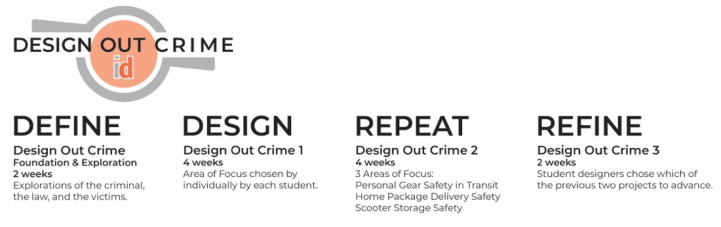
students to consider how can we develop complete understanding of the design’s use, misuse, and abuse that will help to design out crime. What types of sustainable product solutions can promote personal safety? Figure 3 illustrates the project framework.
Figure 3: ‘Design out crime’ within the design process framework.
Starting with Define, students began to deep dive into research about what crime means and is within the USA and their own state. They researched existing products that help prevent crimes, or discourage theft (e.g., a cell phone that be totally disabled by the user from another device). They found representations (videos, articles, images, audios) of people who have committed crimes to help understand the criminal persona. A workshop using a variety of empathy exercises helped the students explore the voices of criminals, victims, and the law. Invited guest speakers—including a local police captain, a criminal justice mediator, and a design team from a leading home security company—provided key insights from their unique perspective and made themselves available for questions and feedback. Students put themselves in the shoes of a criminal, a victim, or law enforcement to help them embody their experiences through creating and filming an empathic modelling exercise. This helped them to understand their user’s mindset and needs, and provoked thoughtful design opportunities. Students chose their own area of focus based on their research including things such as: preventing drug overdoses, preventing pet or child abduction, protecting the bodies of police officers, protecting vulnerable adults in nursing homes.
The Design phase began with several rounds of rapid ideation through sketching. Precedent research helped to refine the students’ concept direction and value propositions. Students advanced one idea by colliding it with something they saw or heard from other students during the ideation round presentations and began to develop and refine their own concept. This was demonstrated in low-fidelity prototypes that became the foundation for rapid concept development over the course of a week. Some of the concepts developed in this Design phase include: a bulletproof backpack to protect children, senior living center shield monitors, a police officer’s weight distribution system, fentanyl detection for party drugs, multi-dose Narcan dispenser, and safe firearm storage at home. Students showcased their designs in a formal presentation that included two requirements in their storytelling:
84 Thomas and Strickfaden
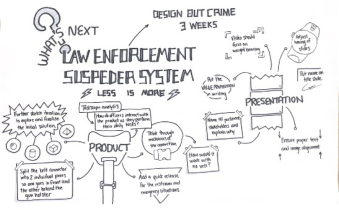
1) describe why their design is compelling (their value proposition) and who benefits from it; and 2) describe the ‘what’s next’ in the development of this specific concept. Stakeholders, instructors, and students gave written critique of each concept during presentations. A ‘what’s next’ reflection poster (see Figure 4) was created based on this feedback that included a detailed and comprehensive list of required refinements should they choose to move forward with this concept at a later time.
Figure 4: ‘What’s next’ reflection posters.
For the Repeat phase of the process, three new design parameters were introduced: 1) mobility–related to short distance travel and securing a personal transportation device such as a scooter at home and/or out in public; 2) travel–related to securing personal belongings when out and about at a movie set, at an airport, train station, in a hotel; 3) home–related to securing packages and deliveries that arrive when no one is at home. Students created interview guides that were the beginning to problem discovery once again and were prompted to use sketchnoting (Paepcke-Hjeltness et al., 2017) to collect user responses.
A critical design thinking tool, Taskscape Analysis, was introduced to encourage students to seek depth within their project definition and in their concept development. Taskscape provokes students to think critically about multiple aspects related to a product, related tasks, other related objects, use-context, and environments (Strickfaden & Thomas, 2025). A series of preconception sketches helped to draw out the first ideas that novice designers have the tendency to fall in love with and get stuck on. Further ideation through experience prototyping, developing a design criteria, refining a project brief, and conducting more precedent research moved things along within this designing phase. Students further developed their concept through journey mapping user experiences and low fidelity prototyping. Some of the concepts developed through Repeat included: an e-scooter lock-mate, a motorcycle multifunctional anti-theft awning, a luggage tracking network for travel, a valet for travel, a security porch planter, and a home security system. As in their previous concept development, students showcased their designs in a formal presentation where feedback through critique was given, followed up by ‘what’s up’ reflections on this second concept.
Define, Design, Repeat, Refine 85
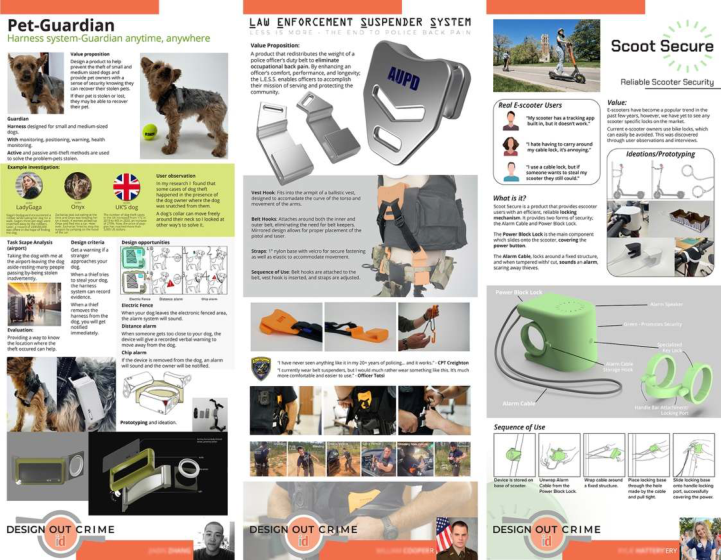
In Refine, the final phase of our design process framework, students began with their ‘what’s next’ reflection posters from the Design and Repeat phases and the feedback from stakeholders, instructors, and colleagues to evaluate their two concepts. Once they chose the concept with the most potential, they embarked refining, adding detail and generally working out and enhancing the concept to transform it into a product with multiple features and nuanced detail. This final, more developed product, was presented in their third pitch through posters (see Figure 5) and an exhibition to the broader community, stakeholders, instructors and colleagues.
Figure 5: Posters showing the results of the final Refine phase of ‘design out crime’. Products are: a pet guardian dog tracker, camera and recorder (left); law enforcement suspender system to bear weight of tools and equipment (middle); an e-scooter secure and lock system (right).
DISCUSSION
In our 3rd year industrial design studio, we presented four different design problems with varying degrees of complexity across five years. In the process of teaching this design studio, we developed an alternative way to engage in the design process that we now call the Define, Design, Repeat, Refine framework. The first two years of employing the framework predominantly involved engaging in two dynamic design sprints. These were sponsored projects that were driven by the stakeholders’ parameters. These two projects
86 Thomas and Strickfaden
focused on Define, Design, Repeat and only engaged in Refine on a somewhat superficial level. A major shift occurred when we recognized that the students didn’t have enough refinement in their concepts. This prompted us to enhance the Repeat phase, and then have the students choose which concept to refine, rather than refining both concepts. As such, the third year of engaging in Define, Design, Repeat, Refine was very close to what we’ve described herein with it evolving only slightly since then. We acknowledge that various kinds of design thinking and research methods can be used during the four phases, in a pick-and-mix style of teaching based on educator preference or project needs.
A fundamental aspect of the Define, Design, Repeat, Refine framework is its emphasis on repetition as the primary means of working that involves advanced iteration and doubling back to develop and redevelop previous information and knowledge to advance an idea to a concept, and a concept to a product. Upon reviewing many design process frameworks we note that Define, Design, Repeat, Refine has characteristics not found in others. These characteristics are:
Repetition of the same general design problem with different inputs resulting in two viable concepts;
Focus on problem discovery;
Opportunity to dig deeply into a single multifaceted problem;
Engaging in three dynamic design sprints;
Potential for engaging with multiple stakeholders;
Potential for incorporating various kinds of design thinking and research methods;
Use of alternative and/or complementary information for the two phases of concept development;
Built-in opportunities to reflect on personal designing processes;
Participating in collaboration and learning from colleagues;
Mastery of concept development before refinement;
Synthesis of skills and information into a comprehensive understanding of a design problem;
Integration of everything learned through two cycles of innovation into a potential project solution.
When critiquing the Define, Design, Repeat, Refine framework we can see that it can be further refined. One thing we have refined over time, and wish to continue working on, is the pace of the three design sprints because we recognize that different student cohorts work at different paces due to the prior knowledge, design acumen, and motivation they bring to the project. Another potential refinement is for Define, Design, Repeat, Refine to incorporate concrete ways the students can document their process. We noted that with the barrage of information provided during the delivery of the project students often got lost or lost information they had previously gathered. The students often failed to realize the value of some of the fundamental hands-on skills (i.e., sketching, prototyping) they had previously learned and this was amplified by the emphasis of this project on critical
Define, Design, Repeat, Refine 87
thinking rather than learning through making. In other words, the students require more support to balance thinking, researching, and doing/making in their process.
CONCLUSION
Historically, industrial design has focused on mass-produced products, responding directly to client briefs. However, as consumer behavior shifts— favoring experiences over material goods—designers must adapt. Companies such as Lululemon have embraced this shift by incorporating service- based value into their product offerings (Sheth & Uslay, 2022). Today’s consumers, particularly younger generations, seem to prioritize experience- driven consumption, reinforcing the need for a more dynamic and complex design approach. Furthermore, designers nowadays are being charged with working on increasingly more troublesome, complicated, and wicked problems. Define, Design, Repeat, Refine is a design process framework that uses advanced iteration through repetition and doubling back, while also considers the complexity of society by supporting students to engage in a multitude of design thinking and research methods. Students exercise adaptability and flexibility as they discover that a willingness to iterate and refine is crucial to the project success. They are encouraged to make decisions based on user needs and feedback, ensuring a human-centered approach. In this way student designers are encouraged to develop more innovative and contextually relevant solutions. Moving forward, we invite other design educators to play with Define, Design, Repeat, Refine, because we believe that the resulting student outcomes will provide surprising results that meet societal challenges into the future.
REFERENCES
Archer, B. (1965). Systematic Method for Designers. Council of Industrial Design, London. Design Council (2015). “The Double Diamond.” www.designcouncil.org.uk/news-
opinion/design-process-what-double-diamond. Dorst, K. & Cross, N. (2001). Creativity in the Design Process: Coevolution of Problem-solutions. Design Studies. 22(5), 425–437. Jones, J. C. (1963). A Method of Systematic Design. In Jones, J. C., Thornley,
D. (eds) Conference on design methods: Papers presented at the conference on systematic and intuitive methods in engineering, industrial design, architecture and communications. London, England. Sept 1962. Pergamon, Oxford. 53–73. Paepcke-Hjeltness, V., Mina, M. and Cyamani, A., (2017). October. Sketchnoting: A new approach to developing visual communication ability, improving critical thinking and creative confidence for engineering and design students. In 2017 IEEE frontiers in education conference (FIE) (pp. 1–5). IEEE. Pugh, S. (1991). Total Design: Integrated Methods for Successful Product Engineering. Addison-/Wesley, Boston, MA. Sheth, J. N. and Uslay, C., (2022). Creating enduring customer value. Journal of
Creating Value, 8(2), pp. 241–252. Sterman, J. D. (2002). All Models are Wrong: Reflections on Becoming a Systems Scientist. System Dynamic Review, 18(4), 501–531.
88 Thomas and Strickfaden
Strickfaden, M. and Thomas, J. (2025). Taskscape Analysis: Provoking Depth in Product Development. Advances in Interdisciplinary Practice in Industrial Design, In this volume, AHFE (2025) International Conference. Thomas, J. and Shin, C. (2016). Implementing design sprints in the education of
industrial designers. Design Principles and Practices: An International Journal — Annual Review, Volume 10, pp. 59–73. Thomas, J and Strickfaden, M (2018). From Industrial Design Education to Practice: Creating Discipline Through Design Sprints. In M., W. Chung and C. S. Shin (Eds.): Advances in Interdisciplinary Practice in Industrial Design, AHFE 2018, AISC 790, pp. 111–121, 2019. https://doi.org/10.1007/978-3-319-94601-6_13 Thomas, J., Yang, Y., Lee, I., Chen, X., Strickfaden, M. (2021). Learning Design
Thinking Through a Collaborative Focus on Social Justice. In: Shin, C. S., Di Bucchianico, G., Fukuda, S., Ghim, YG., Montagna, G., Carvalho, C. (eds) Advances in Industrial Design. AHFE 2021. Lecture Notes in Networks and Systems, vol. 260, pp. 192–200. Springer, Cham. https://doi.org/10.1007/ 978-3-030-80829-7_24 Wynn, D. and Clarkson, J. (2018). Process Models in design and development. Res Eng Design (2018) 29:161–202. https://doi.org/10.1007/s00163-017-0262-7
LISTED IN THE AHFE DIGITAL BOOKSTORE CATALOGUE
Explore the complete digital volume
Interdisciplinary Practice in Industrial Design
Read this individual research paper free through the original publisher, or explore the full digital proceedings book.
ISBN 978-1-964867-59-5
Explore this ISBN in the AHFE Bookstore ↗Listed in the July 2026 bookstore catalogue; search by ISBN to confirm current availability · Digital book purchase optional