Educating future industrial designers presents many challenges. Students must learn to be comfortable identifying problems, work within global systems, and articulate their ‘design intent’ within the product development process. As educators, we ask: how does what exists in a student’s mind’s eye makes its way through the circuitous development process and into potential production–and remain clear to the people who use it? The degree to which a student considers the full scope of product development influences whether their ‘design intent’ is sustained or diluted along the way. Building on our companion chapter, ‘Practicing Industrial Design: Design Intent Part One’, we elaborate from the perspective of seasoned design educators on: (1) terminology related to design intent; and (2) pedagogical strategies and tools that cultivate and transfer design intent within the design process. This chapter begins to describe, illustrate, and define design intent as it’s embedded into teaching and learning industrial design.
In our companion chapter, ‘Practicing Industrial Design: Design Intent Part One’, we explore how ‘design intent’ is characterized and defined by comparing it to four related fields: product engineering, architecture, civil engineering, and CAD (Computer Aided Design). In that chapter we sought to advance understandings about design intent in industrial design practice through a dialogue with five seasoned professionals. Here we continue our inquiry by focusing on industrial education through observations by six experienced design educators.
Educators face persistent challenges in preparing future industrial designers. Students are encouraged to identify problems by asking questions; given knowledge about working in teams (sometimes even including people who are remote and living somewhere else); are taught about design methods and processes; and are guided to articulate their design intent with the goal of creating products of value and relevance. Along the way, educators must choose different ways to engage in teaching and to encourage learning that exposes students to design practice, advancing their physical, emotional and intellectual capacities.
Here we approach design intent from the perspective of industrial design education. We begin by summarizing various terminology used in design studies literature related to ‘design intent’, followed by a brief background situating it within design process and design thinking. This sets the stage for excerpts from six industrial design educators–each with 20–35+ years teaching experience in the U.S., Canada, Europe, Asia, U.K., and Australia, and currently teaching in three design programs–who are also seasoned design professionals. As in our previous chapter, we employ problematization followed by gap spotting (Sandberg and Alvesson, 2011), writing independently prior to doing literature searches. Thus, this chapter begins from lived perceptions rather than literature.
TEACHING INDUSTRIAL DESIGN There are various ways that industrial design is taught in the Western world. This includes advancing ‘designerly ways of knowing’ (Cross, 1982) through “…a process of discovery…” that involves learning about design processes and design thinking (Lawson et al., 2003 p327). Clarifying design intent is inherently linked to design process and design thinking when they are taught explicitly by walking students through various stages, e.g., ‘discover, define, develop, deliver’ (Design Council, 2024), ‘empathize, define, ideate, prototype, test’ (Plattner, 2010), and other iterative processes (e.g. Thomas and Strickfaden, 2025); or more implicitly by asking students to ‘define’ their project through provided design briefs or problem statements. We acknowledge that the definition stage is rarely straightforward and often does not use design intent as specific terminology, but we also believe that design intent is always present in each project.
Playing with and creating design intent, whether it’s called ‘define’ (Design Council, 2024, Plattner, 2010), ‘design intention’ (e.g., Lawson et al., 2003; Crilly et al., 2008; da Silva et al., 2015; Jagtap, 2018), ‘design aspirations’ (Lawson et al. 2003), or ‘design intent’ (e.g., Sim & Duffy, 1994) is a core part of industrial design education. It often begins by having students interpret a design brief or a project statement and is followed with some sort of ideation such as sketching, or model making. The relationship between design intent and sketching has been explored in various ways by design scholars illustrating that intentions and visualization are intrinsically conjoined (e.g., Mendoza- Collazos & van de Weijer, 2024, Do & Gross, 1997). Further, Lawson et al. (2003) explore and propose a model where ‘intentions’ (what the design team is supposed to do), ‘practices’ (what the design team is actually doing) and ‘aspirations’ (what the design team would like to do) are illustrated as a more explicit procedure or protocol that moves away from improvising the design process (p332). Finally, the distinction between ‘design intent’ and ‘design rationale’ is articulated by Sim and Duffy (1994) who say design intent is the expected effect or behavior that a designer intended (p2) and design rationale is a reasoning or argument that led to how the intent was achieved (p2).
Some specific understanding about design intent is provided by da Silva et al. (2015) where designers’ ‘intention knowledge’ is linked to products. They
Educating Industrial Designers: Design Intent Part Two 243 explain, for example, a spoon is intended to bring food to the mouth, a watch is intended to check the time of the day, and a basin is intended for washing the hands (p21). Furthermore, eight general design intentions are detailed by Jagtap (2018) as: comprehension, attraction, identification, attention, attribution, emotions, action, and recognition (p88). These design scholars begin to map out the nature of design intent within professional practice, however, there is an absence of explanation on how to teach students how to identify, embody or consider design intent in their projects.
TEASING OUT TERMINOLOGY Terminology defines fields and culture, and how these are used can set one field apart from another. For example, the emergence of computers into everyday lives has changed the way designers use and subsequently think about the term ‘interfaces’. In the past, interfaces were predominantly about how two or more parts fit together, whereas in the present interfaces can be object-to-object, human-to-object, object-to-environment, and more.
Because industrial design scholars have used different terminology to explore design intent, we begin by interrogating some of the most used terms that relate to design intent.
Table 1: Summary definitions of key terms related to design intent.
Table available in the original PDF paper.
Term Definition Design Intention Linked to a specific design action. Movement forward. Often more than one intention that might be in conflict.
Design Intent Forward-facing. The why, purpose or need. What is done in the design. Defined by goals, aims, objectives, values and constraints. Provides focus, direction and/or plan. Mission critical design elements. Linked to the memories of designers. Implicitly ever-present. Aspirational. Linked to design process.
Design Aspiration Linked to individual values and biases. Subjective. Linked to the memories of designers.
Design Rationale Rear-facing. Justifies actions and decisions. The reason why. Analyzes changes in process. Reflects on different project phases. Evaluates completed work.
Table 1 summarizes how these authors and industrial design scholars have used the terms ‘design exploration’, ‘design intent’, ‘design aspiration’, and ‘design rationale’ in this chapter exploring design intent in industrial design education.
Suresh Sethi, design studio, design research, consumer product design, design process ‘Design intent’ is not written in lines; it gathers quietly in the way light rests on a surface, in the pause before a hand reaches out. It is the memory we carry into form, the silence that shapes proportion, the feeling that guides what remains and what is let go. Before the object exists, intent is already there—a quiet knowing, waiting to become visible.
Shea Tillman, design foundations + studio, design history, photography, industrial design in modern society The term ‘design intent’ may initially seem straightforward enough to define and describe, but its context and potential for fulfillment seem to be more nuanced. The term ‘design rationale’ seems more commonly used in justifying decisions, while design intent seems more specific and tangible perhaps due to its inclusion into parametric modeling vocabulary. Associations of the term design intent also tend to surround the formulation of mission critical design elements and the art of managing the steady stream of often conflicting intentions towards the ‘finish line’ of production.
In sum, design intent communicates a focused, visible direction, whereas ‘design intentions’ suggest a combination of multiple—often unseen— motivations. ‘Design rationale’, by contrast, provides an explanatory justification for a direction. Put another way, design intent and design intentions lean towards the what (at micro and macro levels), while a design rationale explains the why.
Joyce Thomas, design foundations + studio, design thinking, CAD, human factors, professional practice In my viewpoint, ‘design intent’ is most related to the why/purpose/need and suggests a plan towards a result that will affect the consumer of the product. ‘Design aspirations’ often relate to the students’ personal ‘why’ melded with their user research and observations. ‘Design criteria’ focus on specific needs for the user and engineering and manufacturing constraints/ requirements. ‘Design rationale’ refers to the documentation of the decisions that may require changes to the design intent during the designing process.
Shu-Wen Tzeng, design foundations + studio, interaction design, materials and technology ‘Design intent’ is the appropriate term to describe the goals a designer seeks to achieve success through the design process. In my definition, design intent refers to the purposeful objectives that guide a designer’s decisions and actions throughout design activities.
Megan Strickfaden, design foundations + studio, design history, design research, design thinking ‘Design intent’ is similar to ‘design rationale’ since they both zoom in on the focus or expectations of a given project. A design intent is about the aims and objectives of the project, which then drives the direction that the project
Educating Industrial Designers: Design Intent Part Two 245 takes and keeps it on course as the intent may shift and evolve. A ‘design aspiration’ might be something that a student desires to include in their work that is often very subjective and attached to their memories and/or personal values and goals. Design aspirations may be more biased. A design rationale can be used to analyze changes in the process or evaluate completed work, perhaps made up of reflections on each phase of the project. I have used the phrase design rationale more often than design intent with my students but have asked students to be ‘intentional’ when they are engaging in the design process.
Jerrod Windham, design foundations + studio, sustainable design, design drawing Intent, within the context of design, is forward-facing. It is often aspirational and defined by goals, values, and constraints. It helps guide action and decisions. Intent can evolve as new insights emerge. Rationale, on the other hand, is rear-facing. It serves to justify actions and decisions. Successful designs align rationale with intent.
IMPLICITLY TEACHING DESIGN INTENT WITHIN PROCESS ‘Design intent’ is frequently articulated through tools, processes, and outcomes; however, it is also shaped by how designers learn to see and make sense of the world around them. While education emphasizes methods and deliverables, design intent forms through less visible dimensions of practice.
It grows from lived experience, curiosity, observation, and iterative engagement with materials, people, and context. Design intent is therefore both explicit and implicit—explicit in briefs and specifications, implicit in positionality, habits of noticing, and accumulated experience.
To teach design intent is not only to teach process, but to cultivate the reflective ways of seeing that give process meaning.
Suresh Sethi, design studio, design research, consumer product design, design process My teaching begins with a simple faith: that sensitivity is not a gift reserved for a few, but a muscle that grows when we dare to look inward. Before a designer shapes the world, they must gently excavate themselves. Form has meaning only when it carries a lived feeling. So, I ask students to treat their memories, their longings, their quiet daydreams, not as indulgence, but as material—as intelligence.
Then comes another practice: to listen to the emotional life already present in things. To stand between the outer world and the inner one, between culture and self, and hold both without forcing them to agree. Sensitivity matures in that space. And always, there is the reminder—design begins within, but it does not end there. It moves outward toward others. Empathy is not softness; it is the discipline of imagining another’s need and giving it form. In the end, emotional sensitivity is not separate from design intent. It is design intent—made human.
The language of intent is ever present in design foundation education for a simple reason: intent directs action. It frames decisions, prioritizes values, and gives meaning to outcomes. For beginning design students, few lessons are more foundational than understanding the relationship between constraints, goals, and intent. In studio, critiques often begin with a simple question: What was the goal of the assignment? This question creates a reflective pause. It invites students to measure their work not merely by appearance, but by alignment between the stated objectives, the provided constraints, and the individual student’s intent they brought to the project.
Early in a foundations sequence, constraints are deliberately acute. Students may be limited to a defined format, color harmony, or tightly prescribed compositional elements. These limitations are not meant to hinder creativity. They sharpen focus and perception. By narrowing possibility, constraints force attention on specific ‘design principles’ including visual tension, proportion, contrast, rhythm, hierarchy, and balance. In these early exercises, personal agency is intentionally restrained. The aim, with respect to intent, is clarity. Students learn how to make decisions within boundaries, and how clearly defined goals focus effort.
The balancing act in crafting these exercises and their sequence is to promote creative exploration without overwhelming students with wide- open opportunity. Creativity within this structure is neither accidental nor purely rational. As discussed in Discovering the Design Process, creative work oscillates between conscious and unconscious modes of thinking (Windham & Fletcher, 2025). ‘Divergent’ phases encourage iterative exploration and experimentation. Unexpected associations are recognized, unintended solutions surface, and new possibilities emerge. ‘Convergent’ phases require judgment, sensitivity, refinement, and alignment with articulated goals. Foundations projects are carefully sequenced to move students through this rhythm. Constraints provide direction for divergence, preventing the exploration from drifting too far into randomness, while convergence reconnects exploration to stated design intent. Students begin to understand that ‘happy accidents’ are not in opposition to intentionality; they are recognized, curated, and developed through intentional reflection.
As students progress through the foundations sequence, constraints gradually loosen. Material options are expanded and the parameters of assignments widen. With this loosening comes increased agency with respect to intent. Students are encouraged to identify where their own values, interests, and perspectives can contribute to a project. Having experienced tightly framed problems, students both develop an appreciation for constraints and the heightened responsibility that accompanies freedom from constraint. Equally important is the realization that intent is not static. It is not concretely defined at the outset and executed robotically. As projects unfold, intent shifts and matures. Divergent exploration may reveal unforeseen opportunities which leads to thoughtful refinement of intent.
This understanding of the malleable nature of design intent becomes increasingly critical as students move beyond foundation studios into more
Educating Industrial Designers: Design Intent Part Two 247 robust design challenges. In advanced projects, constraints extend beyond formal exercises to encompass sustainability, manufacturability, accessibility, and economic realities.
The integration of artificial intelligence into the design process further points to the importance of human intent. AI systems can dramatically accelerate divergence, generating a volume of conceptual possibilities in response to prompts. But these outputs do not possess intent. They are statistical predictions that result from provided parameters. The framing of the prompt, the definition of constraints, the selection and refinement of outputs, and the ultimate judgment of alignment remain human acts, directed by intent. In this emerging landscape, AI may expand the divergent field, but convergence remains rooted in human agency.
Design intent, therefore, is not diminished by constraints or AI collaboration. It is clarified by them. Foundations education, through its careful calibration of constraint and agency, prepares students to navigate this complexity. By learning to define, evolve, and evaluate intent within structured conditions, students develop the capacity to guide increasingly sophisticated design processes where creativity flourishes, tools evolve, and intent remains distinctly human.
Joyce Thomas, design foundations + studio, design thinking, CAD, human factors, professional practice I started using the term ‘design intent’ in my 2nd career as a design educator. I came upon it when I was teaching SolidWorks to design students and the phrase really stuck with me. While CAD utilizes design intent drawings to help identify how a part is made and functions as things might change, I felt the idea of design intent was a powerful tool for the student designer to help them clarify to themselves and multiple audiences (teacher, sponsor/ client) why this product was needed by people, how it could help resolve their problems, and what was needed to create a better human experience. For novice designers, asking them to clarify their design intent helps to create an understanding of their need to communicate to others not only through drawings and models, but also through callouts, descriptors, and non-verbal communication to create shared understanding.
Students are encouraged to use drawings and 3D sketch models to develop and communicate design ideas more clearly to themself first. Later, these illustrations are used to communicate the brief from the teacher, sponsor/ client and refined by the student designer to others over the course of a product’s development.
Industrial design intent drawings show the focus of the proposed design, where everything is supposed to go and how it will look, often including overall dimensions. They also show the location of all functional elements but do not include engineering calculations or construction details. These drawings must provide a complete, faithful and accurate graphic depiction of the project design concept in a way to allow the product to be made to scale (perhaps starting in the model shop, then through CAD, and ultimately into production).
As we encourage students to be intentional with their design work, design intent provides a goal for that intentionality.
Shea Tillman, design foundations + studio, design history, photography, industrial design in modern society In teaching industrial design, the raising of a student’s awareness and growth of their design intent is often facilitated through one-on-one and group critique discussions in the studio within a project’s ideation phase. While researching and generating ideas, students are prompted to recognize and embrace what their design intent really is. All too often, students approach a project as simply tasks to complete or a means of self-differentiation rather than establishing thoughtful design intent. Providing students with discrete phases and tasks through a process is aimed at exposing them to tools and techniques as well as a means of systematically enabling them to formulate their design intent.
Following this recognition, students are then often challenged to elevate the magnitude of their design intent beyond the obvious, superficial, or banal. This exercise of creative criticism can be particularly arduous for students since teaching faculty have as their reference an extensive inventory of many past ideas and concepts with which to draw comparisons. Due to the demands of the project, students tend to confuse the aim of this activity as decoding what a faculty member likes or wants rather than an expansion of their thinking. For this reason, a question that must be asked during the educational design process and evaluation of a design project is…Has the student effectively defined and advanced their design intent or is it an attempt to decipher the design intent of the faculty? It is imperative that faculty teaching creative problem solving and design continually foster a student’s self-reflection on their design intent rather than emulating the perceived intentions of others. Only then will students be able to cultivate the confidence that will be required of them as professionals to communicate and navigate design intent through the development process.
Shu-Wen Tzeng, design foundations + studio, interaction design, materials and technology As a designer and design educator, I strongly believe in the value of ‘design principles’ in all their forms. Design principles represent the accumulated knowledge of researchers and practitioners in design and related fields, providing guidance that helps designers improve usability, influence perception, enhance appeal, educate users, and make informed decisions throughout a project. For this reason, I begin my teaching by introducing the design principles most relevant to the topic at hand. Design principles can be divided into different categories, e.g., two-dimensional principles, UX/ UI principles, and product principles. Although principles are commonly known in design, the ones I often teach with are (1) two-dimensional category–alignment, contrast, visual harmony, rhythm, visual tension; (2) UI/UX category–feedback, state visualization, safety; and (3) product category–simplicity, form transition, unity, semantics. I then ask students to study exemplary products by analyzing which principles are applied and examining the relationship between those principles and the perceived
Educating Industrial Designers: Design Intent Part Two 249 quality of the design. Once students develop a foundational understanding of design principles, they are better equipped to make intentional decisions about which principles to apply in their own work. They can then evaluate how these principles support their design goals—what I define as their design intent—and help them achieve more coherent, purposeful outcomes.
Megan Strickfaden, design foundations + studio, design history, design research, design thinking In teaching design, intent begins with self-knowing exercises (e.g., Strickfaden, Ruiz and Thomas, 2023) to support students to better understand their biases, values and behaviors; analysis of existing objects/spaces; and through a design brief. A simple or complicated design brief that outlines the focus of the project, the clients, the stakeholders, material constraints, and more. The design brief is likened to topographical maps, where there may not be any paths and these are not in a straight line, and require on-the- ground work to determine the best direction to go.
Each project is not taught by considering the end product per se, but by taking the student through the design process in structured yet unexpected ways. For example, students are asked to see the world differently in order to design better for others by exploring design thinking techniques; engaging in precedent and market research; and examining the ‘taskscape’ of prior designs or their own design to determine what might be missing from their interpretation of the design brief. Each phase of the design process involves collectively sharing and critiquing to learn from each other. As students advance through their education, a design brief becomes increasingly vague and there might be more than one stakeholder and client to complicate the problem and force students to consider and reconsider their design intent.
Further into a project, students are asked to produce a ‘design criteria’ (Tullio-Pow and Strickfaden, 2022) that is based on design research (human or object-based). A design criteria that includes 20-60 points, is developed through a process of unpacking the project brief and determining all the constraints and issues related to the project. A design criteria will have a range of criteria (small or large) depending on the complexity of the project.
Finally, as the project begins to come to a close, students are prompted to rationalize their designs during critiques and to write design rationales to explain why they made specific choices in creating their designs. Students seem to respond best when asking them to reflect on their work, doing self- critiques, and providing details on what they would do should they have more time. Sometimes these reflections are considering their design process rather than the product they completed.
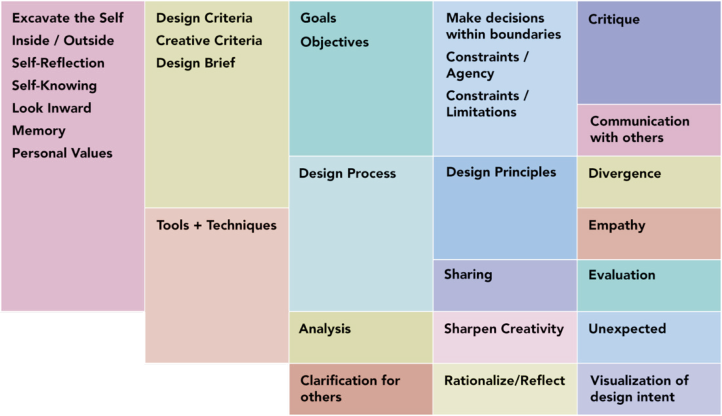
Figure 1 shows key concepts articulated by this group on how design intent is used and defined in education. Concepts are grouped by focus areas with frequency of use relative to rectangle height (higher use on left, lower on right).
Figure 1: Keywords from the authors grouped by area of focus and frequency of usage.
ADVANCING DESIGN INTENT THROUGH TEACHING & LEARNING Although the term design intent doesn’t always show up in the language of teaching and learning design, it is ever present through the various tangible skills (e.g., drawing and visualizations, manipulating materials); design thinking tools and techniques (e.g., communicating, critiquing, empathy, self-knowing); and design theories (e.g., design principles, memory, design processes). Interestingly, through our individual written excerpts about educating while considering design intent within the design process we independently came up with similar thoughts.
Table 1 identifies that our characterization of concepts varies depending on when and how we need to engage with design intent, often in relation to the stages of the design process that we are teaching. For example, when engaging in problem identification there is an interplay between the overarching design intent presented through a design brief and the intentions, values, and goals of the individual student. This means that both terms might be used, even in the same sentence to help guide students to interpret the design brief (which is often purposefully ambiguous) and then define the specific direction they wish to take. Terms like design intent and design rationale hold very different temporal meanings in respect to the design process, where design intent is forward-facing (looking forward towards what will be designed) and design rationale is rear-facing (reflecting back on what has been designed). This is similar to how Sim and Duffy (1994) characterize design intent as “expected behavior” (p2), but different in that Sim and Duffy indicate that design rationale is “the reasoning and argument that leads to the final decision of
Educating Industrial Designers: Design Intent Part Two 251 how that design intent is achieved” (p2). According to Sim and Duffy, design rationale is imbedded and part of design intent, whereas based on our findings design rationale is distinguishable from design intent and part of a different phase of the design process where design students are asked to look back. This distinction might be due to the nature of design education contrasted with design practice. Student projects often end with the ‘final model’ and do not extend beyond in-class development. However, sometimes students are asked to consider ‘what’s next’–reflecting forward on what still needs to be done if there was further development (Thomas and Strickfaden, 2025).
Figure 1 highlights the differences and commonalities among our statements about teaching design intent within the design process. The differences in our excerpts provide details around the diverse ways that design can be taught, but also how we each situate design intent within various stages of the design process. For instance, talking about design in a variety of ways, and specifically discussing the project at hand, is a way of teasing out design intent and supporting students to think about, interpret, and clarify what they are working on.
The striking commonalities among how we think about design intent within the design process are that, first and foremost, design intent is linked to goals and objectives. This is in line with how each of us defined design intent, as well. Second, several of us believe that design intent is linked to tools and techniques, and to critiquing. Third, others of us determined that design intent is connected to design theories such as self-knowing, engaging in emotional design, and exploring design principles. These commonalities point to ways that design intent is and might be taught more explicitly to industrial design students.
A series of tensions also emerged through our study. The first tension is between the self-and-others. While design is inherently oriented toward creating for others, teaching students to critically understand the relationship between their own positionality and the people they design for remains complex. Developing this awareness requires more than user research techniques; it calls for reflection on how one’s assumptions, values, and experiences shape decision-making.
The second tension lies between constraints and agency. Constraints tend to be tighter at more junior levels and gradually lighten up as students gain confidence in deep inquiry and problem framing. Negotiating balance between structural limitations and meaningful autonomy is fundamental towards training industrial designers.
The third tension is about project boundaries. Boundaries are about clarifying objectives and goals, determining when and how to teach about the self-other relationship, knowing which tools and techniques to offer in a given project, and helping students establish design criteria that helps propel the project towards viable outcomes. Notably, design intent as an educational term remains more individualized and informally invoked rather than embedded in curricula of industrial design studio or articulated as a component of design process.
CONCLUSION
The findings from this study connect directly to our companion chapter in this volume ‘Practicing Industrial Design: Design Intent Part One’, where we identified that ‘design intent’ has not commonly or formally been defined as part industrial design practice as it is within other professional fields such as product engineering, civil engineering, architecture, and CAD.
Within industrial design education–where tangible skills, design thinking tools and theoretical frameworks are taught–there are both shared assumptions and notable differences in the ways design intent is used. Our findings begin to nuance understandings; however, design intent within industrial design education and practice warrants deeper examination.
Further research is needed to more clearly articulate design intent and to support a more comprehensive understanding of how it can be taught and positioned as a central component of the industrial design process. The use of the term ‘design intent’ is just as ambiguous as design ‘intent’.
REFERENCES
Crilly, N., Good, D., Matravers, D. and Clarkson, P.J. (2008). Design as communication: exploring the validity and utility of relating intention to interpretation. Design Studies, 29(5), pp. 425–457. Cross, N. (1982). Designerly ways of knowing. Design studies, 3(4), pp. 221–227. da Silva, O., Crilly, N. and Hekkert, P. (2015). How people’s appreciation of products
is affected by their knowledge of the designers’ intentions. Do, E. and Gross, M.D., (1997). Inferring design intentions from sketches. Proc.
Comput. Aided Des. Res. Asia CAADRIA, 97, pp. 217–227. Design Council (2024). History of the Double Diamond - Design Council. [online] www.designcouncil.org.uk. Available at: https://www.designcouncil.org.uk/our- resources/the-double-diamond/history-of-the-double-diamond/. Jagtap, S., 2018. Intentions and inspiration in shaping visual appearance of products:
The practice of professional industrial designers in India. The Design Journal, 21(1), pp. 85–107. Lawson, B., Bassanino, M., Phiri, M. and Worthington, J. (2003). Intentions, practices and aspirations: Understanding learning in design. Design Studies, 24(4), pp. 327–339. Mendoza-Collazos, J. and van de Weijer, J. (2024). “Sketching With My Mind”:
The Role of Prior Intentions and Intentions in Action for the Creative Process of Design. Design Issues, 40(1), pp. 61–76. Plattner, H. (2010). An Introduction to Design Thinking Process Guide. [online] Stanford University. Available at: https://web.stanford.edu/~mshanks/ MichaelShanks/files/509554.pdf. Sandberg, J. and Alvesson, M. (2011). Ways of Constructing Research Questions:
Gap-spotting or Problematization, Organization, 18(1), pp. 23–44. Sim, S. and Duffy, A. (1994, August). A new perspective to design intent and design rationale. In Artificial Intelligence in Design Workshop Notes for Representing and Using Design Rationale (Vol. 1518, pp. 4–12). Strickfaden, M., Ruiz, A. and Thomas, J. (2023). (Re) storying empathy in design
thinking.
Educating Industrial Designers: Design Intent Part Two 253 Thomas, J., Strickfaden, M. (2025). Define, Design, Repeat, Refine. In: Yong-Gyun
Ghim and Cliff (Sungsoo) Shin (eds) Interdisciplinary Practice in Industrial Design. AHFE (2025) International Conference. AHFE Open Access, vol 183. AHFE International, USA. http://doi.org/10.54941/ahfe1006429 Tullio-Pow, S. and Strickfaden, M. (2022). Clothing taskscape as an approach toward assessment of user needs. Clothing and Textiles Research Journal, 40(1), pp. 19–36. Windham, C. & Fletcher, M. (2025). Discovering the Design Process: Into the
Beautiful Mess. 1st ed. London: Routledge.
LISTED IN THE AHFE DIGITAL BOOKSTORE CATALOGUE
Explore the complete digital volume
Interdisciplinary Practice in Industrial Design
Read this individual research paper free through the original publisher, or explore the full digital proceedings book.
ISBN 978-1-964867-98-4
Explore this ISBN in the AHFE Bookstore ↗Listed in the July 2026 bookstore catalogue; search by ISBN to confirm current availability · Digital book purchase optional