Megan Strickfaden, Joyce Thomas (2024). Transitional Learning through Unexpected Objects. In: Interdisciplinary Practice in Industrial Design. AHFE Open Access, vol. 144, pp. 21–29. https://doi.org/10.54941/ahfe1005114
Design teaching and learning occurs in many forms using a variety of objects including ones that are expected and others that are unexpected. Furthermore, there is a variety of different approaches to teaching and learning design including transitional learning that is about immersing learners into topics and themes that enhance involvement and responsibility. First, this paper highlights the characteristics of transitional learning. Second, we tease out what we mean by expected objects and unexpected objects, and how an object-based approach to teaching and learning is ubiquitous within design education. Additionally, we describe some of the roles that object (in general) play in design learning including, for example: as communication strategies; to create visualizations to describe design ideas and design solutions; to conduct research; and to understand materials, production and/or mechanics of objects. Third, we zoom in on four project explorations to examine how unexpected objects serve a transformative purpose in design education. These unexpected objects include a coffee creamer container, ambiguous objects, an older complicated manufactured object, and insects from nature. These unexpected objects support learning through activation, challenges, (re)design, and (re)construction resulting in learners engaging in object-based hands-on learning, and aid learners towards being more responsible when designing for others. Finally, this paper sums up how transitional learning through unexpected objects plays an increasingly important role in the design process in our current era that has moved away from using actual objects and prioritizes high-tech object learning.
Design learning1 occurs in many forms using a variety of objects includ- ing ones that are expected and ones that are unexpected. Object-based approaches to learning are and always have been ubiquitous in design educa- tion (e.g., for communicating ideas, conducting research, to understand mate- rials, manufacture, and/or mechanics of objects). In fact, much of what is now considered design thinking (Brown, 2008) involves object-based teaching 1We believe that teaching and learning are inseparable within education. For brevity, we often use the phrases design learning, design teaching, object-based learning, object-based teaching and transitional learning throughout this paper.
that pushes learners to engage in deep reflection, collaborative discussions, and critical thinking through products. This paper explores object-based learning in design education through a well-known mode of teaching called transitional learning (James, 2020) through four project explorations where unexpected objects are used in teaching design foundations, design thinking and industrial design.
The first aim of this paper is to amplify the value of using unexpected objects in design learning rather than to identify every possible learning opportunity. As such, we zoom in on four project explorations as exam- ples of how unexpected objects can be used and the resulting pedagogical value. The second aim is to illustrate how object-based learning involves strategies related to “activation, challenges, (re)design, and (re)construction” (Stroobants et al., 2001, pp. 119–120). We believe that transitional learning and using unexpected objects in projects can aid learners towards bet- ter understanding the design process and being more responsible towards designing for others.
TRANSITIONAL LEARNING IN A NUTSHELL Transitional learning is exactly what is implied through its name: an approach that embraces a “permanent learning process” (Stroobants et al., 2001, p. 119) that uses teaching and learning styles that capitalize on vari- ous kinds of transitions. In general, transitions can be described as shifts in ones’ life: from being in school to being in a work environment; from one job to another; and engaging in personal development that expands capabilities and skills. Two key features of transitional learning are “change and time” (Colley, 2007), which are naturally linked to dynamic shifts leading towards something different. When looking to literature the central characteristics are that transitional learning: honours life experiences; is often taught in infor- mal environments; and is rooted in exploration and discovering questions that lead to various results (James, 2020). Furthermore, transitional learning can include informal and tacit learning that are socially and spatially located (Colley, 2007), and intentionally support building meaningful connections among teachers and learners that are advanced through supporting “adapta- tion, growth, distinction and resistance” (Stroobants et al., 2001, p. 117).
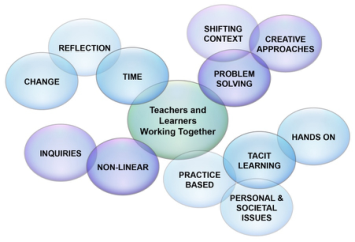
Figure 1: Similar characteristics of transitional and design learning.
Transitional Learning Through Unexpected Objects 23
Interestingly, the ways that transitional learning is described similarly to how design learning or design thinking is described is that they both empha- size capability building. According to Beligatamulla et al. (2019) design thinking pedagogy is about “developing a participatory approach towards world issues… an open, explorative attitude…creative ability…[and] an eth- ical mindset” (p. 98). In sum, both transitional learning and design learning are collaborative, reflective, often non-linear, and: handle time and change, involve teachers and learners working together to make enquiries and prob- lem solve; focus on practice-based (and often hands-on) explorations; shift from one context to another; use creative approaches and sometimes tacit learning; and focus on an interplay between personal and societal issues (see Figure 1).
EXPECTED AND UNEXPECTED OBJECTS IN DESIGN LEARNING Design has always involved using objects for teaching and learning. This is naturally because designers are tasked to create two- and three-dimensional objects and spaces; but also because designers work within exploring and creating visual/tactile/physical languages that involves objects. Even when designers go beyond the design of objects and spaces (e.g., systems design or service design) design learning is and always will be object-based. This focus in design learning traditionally was about using and making actual objects, but more recently has shifted towards looking at and making virtually repre- sented objects. As such, representations of objects are a huge part of design learning. For the purpose of this paper we zoom in on object-based learning through actual, tangible, physical objects that can be touched, held and used.
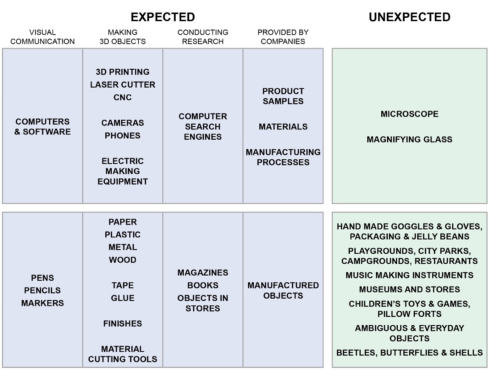
Objects used for design learning can be divided into two categories: expected and unexpected ones. See Figure 2 for an overview of various expected and unexpected objects.
Figure 2: Examples of expected and unexpected objects.
24 Strickfaden and Thomas
There are four basic types of expected objects used in design teaching and learning. First, those things that aid in advancing communicating and visualizing the objects being designed during various phases of the design pro- cess. These expected objects include mark-making instruments (pens, pencils, markers), computers and software, raw materials (wood, metals, plastics, paper products), photographic equipment (cameras, phones) that result in two-dimensional representations of objects. Second, are tools, materials (e.g., card, wood, plastic), adhesives (e.g., tapes, glues) and finishes (e.g., paint) to make three-dimensional objects such as models, mock-ups and proto- types. These include personal material cutting and manipulation tools (e.g., x-acto knives, scissors), electrical wood, metal and plastic making equipment (hand held, and stationary equipment), and computerized making equipment (e.g., 3D printing, laser cutting, CNC). Third, those things that aid in doing research including computers, search engines, magazines, books, and objects in shops/stores. Fourth, those things that aid in teaching about materials and manufacture. This fourth type of object are often provided by companies to promote the use of specific materials (e.g., plastics, recycled materials) or manufacturing processes (e.g., injection moulding, rotational moulding, extruding aluminium); but they could also be objects collected by instructors that demonstrate what objects are made from and how objects are made.
Unexpected objects used in design teaching are defined through this paper and explored more in-depth in the next section. They are those things used to teach specialized information that helps learners to: (1) see like a designer, (2) think critically and analytically about and through designed things, (3) understand existing or historical products, and (4) be creative and innovative.
FOUR PROJECT EXPLORATIONS OF UNEXPECTED OBJECT-USE Unexpected object-use is ubiquitous and often taken-for-granted in design learning. For instance, design educators often seek out unique ways to pro- vide learning opportunities including using: everyday objects to make other stuff (e.g., Stielow & Strickfaden’s, 2023 paper on pillow forts); fun or playful items to spark imagination (e.g., children’s toys and games, Kinder Surprise toys); empathic modelling materials and objects includes hand-made gog- gles, gloves, packaging, jellybeans (e.g., Thomas & Strickfaden, 2023); field trips to museums and stores that house objects; and travel to spaces with unique features (e.g., playgrounds, campgrounds, restaurants). Four project explorations are highlighted here in order to inspire design educators to acknowledge the importance of and use unexpected objects more often.
Seeing Like a Designer: Modelling a Real Object to Produce Realistic Renderings Learning CAD programs like SolidWorks is physical and intellectual skill- based learning that requires understanding how computer software works; but more importantly, how the illusion of form and weight can be achieved through rendering. In addition to developing visualization skills the 3D CAD models can result in two-dimensional renderings and can also be used to produce three-dimensional models, mock-ups and prototypes. In this project,
Transitional Learning Through Unexpected Objects 25
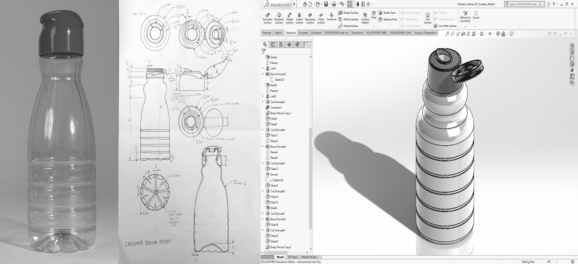
learners are given an actual object, a coffee creamer container (see Figure 3), and asked to reproduce it as accurately as possible.
Figure 3: CAD modelling of a coffee creamer container (original bottle, design intent sketch, CAD model).
Creating a CAD model of an actual object requires deep analysis of the visual elements and form characteristics of the creamer container, which is augmented by “sustained and respectful dialogue” (Strickfaden et al., 2023) about the nature of the object. Detailed observations of this seemingly simple object becomes a transformational process where learners are activated and challenged to consider how the object came to be, how the overall form and individual parts flow to make a cohesive singular object, and how learning to see like a designer is crucial to being a designer.
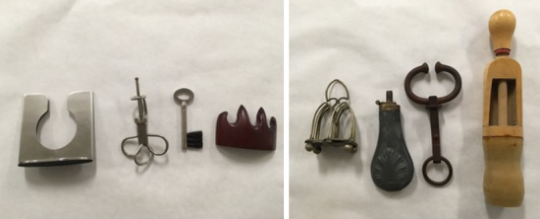
Critical Object Analysis: Two Kinds of Objects, Two Levels of Analysis Seeing like a designer is further supported and enhanced through critical object analysis. Two different approaches are highlighted here to illustrate how learners are asked to encounter different objects in ways completely for- eign to them. Approach one is for learners to analyse an ambiguous object previously unknown to them (see Figure 4).
Figure 4: Eight ambiguous objects.
Learners are given the option to choose from over fifty different ambigu- ous objects that are from different time periods, materials, cultures, and are
26 Strickfaden and Thomas
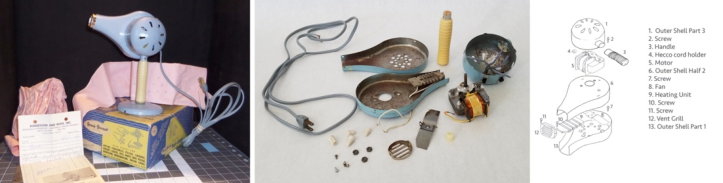
completely out of context. Analysing an ambiguous object requires learners to use their wits to decode the object-to-object interfaces, human-to-object interfaces, use, usability, use-scenarios, materiality, and manufacture. Learn- ers become very attentive to wear marks, stamps and markings on the object; form, volume and weight; how the object feels in the hand and how it feels sitting on a surface; and other aspects that are often taken- for-granted. Approach two is for learners to do a forensic analysis of a complicated manufactured object at least 20 years old (see Thomas et al., 2021 for more details forensic product investigations) that they’ve found in a charity/second-hand/thrift shop (see Figure 5).
Figure 5: Forensic analysis of a 1950s hairdryer.
The forensic analysis of an object requires learners to completely decon- struct the object, create a parts list, research its componentry and how it was made, find any documented information about the object, create drawings of the deconstructed object, determine the original target customer and market, look for other products in the brand, and determine products trends of the date of manufacture related to aesthetics and culture. By completing critical object analyses of these products learners are activated, challenged and pro- vided with opportunities to (re)design and (re)construct the ways they see, analyse, and subsequently create objects.
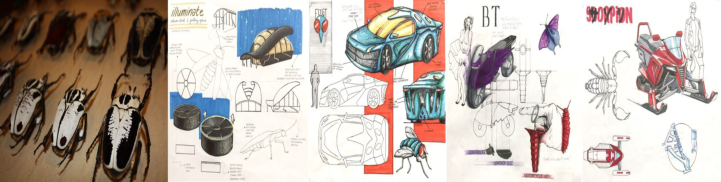
Innovating From Nature: Objects to Inspire and Influence Future Designs Using objects from nature towards biomimicry in newly designed products have been used for decades (e.g., Papanek, 1971; Benyus, 1998; Fiorentino & Strickfaden, 2022; Thomas & Strickfaden, 2022) and using objects for inspiration and influence (Eckert & Stacey, 2000; Strickfaden et al., 2015) are central to designing. One approach to engaging learners to innovate from nature is to bring actual beetle, butterfly and shell specimens into the design process. Learners were provided with specimens, microscopes, and magni- fying glasses throughout their design process with the aim to advance their future designs. In this project exploration, learners do an in-depth analysis of actual objects, to activate new ways of seeing and thinking towards new opportunities; challenge known objects towards alternative future designs; (re)design how they engage in innovation; and (re)construct their personal design processes in ways that shift their present perceptions (see Figure 6).
Transitional Learning Through Unexpected Objects 27
Figure 6: Beetle specimens and two designed concepts.
HIGHLIGHTING TRANSITIONAL LEARNING THROUGH UNEXPECTED OBJECTS Using unexpected objects that are actually present in design teaching is a way to engage learners in making meaningful connections through their personal embodied sensorial experiences in the moment while designing. According to Stroobant et al. (2001, p. 117) a key component of transitional learning is “…meaningful connections are its varying and concrete stakes and possible outcomes at a specific moment”. Unexpected objects aid learners to move into the immediate, to be present with the task at hand, and to make connec- tions within the context of their own lives. Further to this, we identify four specific connections between transitional learning and the use of unexpected objects in design education.
First, unexpected objects bring a level of activation to the learning experi- ence. Activation is about providing learners with opportunities to attune to individual and societal needs (ibid, p. 119). When learners engage in looking at the details of a coffee creamer container, analyse an ambiguous object or do a forensic investigation of a complicated manufactured object they are attuning themselves to their own needs and biases within the context of objects created for other people within a specific time period. Equally, when learners look to specimens from nature for inspiration they become familiar with details that aid them to make connections they otherwise wouldn’t have seen, and they also build up their experiences and knowledge-bases that can influence future designs.
Second, learners are challenged through bringing unexpected objects into learning spaces. Creating and using challenge as a strategy creates “…tension between societal and personal demands…” (ibid, p. 120) that leads to inno- vation. With the four project explorations described in this paper, learners are challenged through objects they do not expect to see in educational spaces. The challenge of object-based learning is pushed by providing opportunities to touch, hold, use and manipulate objects that support moving through the design process.
Third, by pushing learners to engage with actual, tangible, physical unex- pected objects they are forced to consider how to design and redesign other objects. This supports learners to consider their present and to move “beyond existing opportunity structures” (ibid) and engage in personal development. This strategy pushes learners to shift ‘within’ because they better understand their individual perspectives and capabilities. The individual perspectives of
28 Strickfaden and Thomas
learners are linked to their prior experiences with objects that relate to the ones they encounter through the project explorations that use unexpected objects.
Fourth, unexpected objects support a type of (re)construction that pushes beyond personal needs and moves learners to shift towards considering soci- etal needs. (Re)construction is about establishing practices and perceptions that support learners to reposition moral structures related to society (ibid). One of the key things about unexpected objects is that they are not personal objects chosen by learners. They are objects that push learners to consider themselves within the context of society. For instance, by using a well- known everyday object like the coffee creamer container, learners construct an alternative view on similar everyday objects that may be ordinarily be dis- missed as uninteresting. When unknown ambiguous objects are presented to learners, they are pushed to consider their own cultural and temporal conditions, which enables them to consider how to design into the future. (Re)construction has the potential to illuminate hidden values, and to shift these in meaningful ways.
CONCLUSION
Transitional learning through unexpected objects plays an increasingly important role in the design process in our current era that has moved away from using actual, tangible, physical objects. Design education seems to prioritize high-tech object learning that uses expected objects that empha- size building skills focused on computers (e.g., CAD 3D modeling, CAD renderings, rapid prototyping). When expected objects are the emphasis of object-based learning it may steer away from divergent and creative think- ing, which are considered to be core design values. We believe that with the rise in computerization and a focus on human-centred designing, object- focused learning using unexpected objects has fallen to the side. Yet, when transitional and object-based learning are brought together there are many benefits. In sum, using unexpected objects in design education: brings out individual differences of students (capabilities, cultural backgrounds); helps to build intellectual and emotional capital; and supports behaviours linked to designing (e.g., play, problem identification, problem-solving).
ACKNOWLEDGMENT
The authors would like to acknowledge the anonymous makers of the CAD models of the coffee creamer container and the forensic product analysis. We would like to thank Dr. Tomislav Terzin, University of Alberta for providing ongoing access to his exceptional specimen collection of beetles, butterflies and shells. We would also like to thank Professor Emeritus William Bullock, University of Illinois at Urbana-Champaign for conceptualizing the insect assignment.
Transitional Learning Through Unexpected Objects 29
Making Pedagogic sense of design thinking in the higher education context. Open Education Studies, Volume 1, pp. 91–105. Benyus, Janine M. (1998). Biomimicry: Innovation Inspired by Nature. Perennial Harper Collins. Brown, Tim (2008). Design thinking. Harvard business review, 86(6), 84, pp. 1–9. Colley, Helen (2007). Understanding time in learning transitions through the life-
course. International Studies in Sociology of Education, Volume 17, Issue 4, pp. 427–443. Eckert, Claudia & Stacey, Martin (2000). Sources of inspiration: A Language of design. Design Studies, Volume 21, 523–538. Fiorentino, Carlos, & Strickfaden, Megan (2022). Material Culture, design stud-
ies, and human ecology: A biocentered perspective. In Biomimicry for materials, design and habitats: Innovations and Applications. Ed. Eggermont, Marjan, Shyam, Vikram & Hepp, Aloysius F. Elsevier Publishers, pp. 107–122. James, Ross (2020). The Transitional Learning Model is at the Heart of Our Training Philopsophy, Design and Delivery, Health Communication Resources (HCR), Website: https://www.h-c-r.org/transitional-learning-model. Papanek, Victor (1971). Design for the Real World: Human Ecology and Social
Change. New York, NY. Stielow, Malcolm, & Strickfaden, Megan (2023). Pillow Forts: Teaching through Play and Making. AHFE. Strickfaden, Megan, Stafiniak, Lesley & Terzin, Tomislav (2015). Inspired and
Inspiring Textile Designers: Understanding Creativity through Influence and Inspiration. Clothing and Textiles Research Journal. 1–16. Strickfaden, Megan, Ruiz, Adolfo & Thomas, Joyce (2023). (Re) storying Empathy in Design Thinking. Interdisciplinary Practice in Industrial Design, Vol. 100, 2023, 57–67. Published by AHFE Open Access. Stroobants, Veerle, Jans, Marc, & Wildemeersch, Danny (2001). Making sense of
learning for work: Towards a framework of transitional learning, International Journal of Lifelong Education, Volume 20, Issue 1–2, pp. 114–126. Thomas, Joyce, & Strickfaden, Megan (2022). Design for the Real World: A look back at Papanek from the 21st Century. In: Yong-Gyun Ghim and Cliff (Sung- soo) Shin (Eds) Interdisciplinary Practice in Industrial Design. AHFE (2022) International Conference. AHFE Open Access, 48, pp. 9–17. Thomas, Joyce, Chen, X., Lee, I., Wang, J., Yang, Y. and Strickfaden, Megan
(2021). Learning Design Thinking Through a Collaborative Focus on Social Jus- tice. In Advances in Industrial Design: Proceedings of the AHFE 2021 Virtual Conferences on Design for Inclusion, Affective and Pleasurable Design, Interdisci- plinary Practice in Industrial Design, Kansei Engineering, and Human Factors for Apparel and Textile Engineering, July 25–29, 2021, USA (pp. 192–200). Springer International Publishing.
LISTED IN THE AHFE DIGITAL BOOKSTORE CATALOGUE
Explore the complete digital volume
Interdisciplinary Practice in Industrial Design
Read this individual research paper free through the original publisher, or explore the full digital proceedings book.
ISBN 978-1-964867-20-5
Explore this ISBN in the AHFE Bookstore ↗Listed in the July 2026 bookstore catalogue; search by ISBN to confirm current availability · Digital book purchase optional