Jun Iio (2024). What Are Your Impressions? Proposal for Emotional Assessment Platform. In: Kansei Engineering. AHFE Open Access, vol. 145, pp. 22–27. https://doi.org/10.54941/ahfe1005137
Compelling visuals, spanning photographs, drawings, paintings, and illustrations, significantly enhance our daily encounters, conveying a wealth of information and eliciting emotions. Recognizing the impact of specific images and distinguishing them from less impactful ones proves valuable for various applications, including marketing and academic evaluations. However, evaluating these creative expressions presents inherent challenges. In our pursuit of understanding emotional responses to movie posters, we employed Russell's valence-arousal emotion model, incorporating measures of arousal and valence. Our investigation revealed that distinctive movie posters often received assessments marked by low arousal and positive valence. Expanding on these findings, we have enhanced the system to accommodate any image, incorporating administrative features tailored for experimental projects. This paper provides a concise overview of the system, emphasizing its capabilities, and explores a planned experiment use case.An overview of the system: Upon the successful login of a registered user into the system, the portal page is displayed, allowing the user to create a project. A project includes a title, description, and two measure titles, such as arousal and valence. Additionally, the project encompasses a collection of URLs corresponding to the images that need to be evaluated.Access to the evaluation pages is open to the public; therefore, there is no need to register an account to access them. The evaluation process consists of three steps: 1. Introduction, 2. Evaluation, and 3. Displaying the Evaluation Result. The introduction screen provides the project title and description to elucidate the purpose of image evaluation, accompanied by a 'Start Evaluation' button. Clicking this button directs users to the next page for the actual evaluation. On this page, six images, randomly selected from the database, are presented along with two evaluation scales ranging from -1.0 (negative value) to 1.0 (positive value). Users can assess their impressions of each image using two slider interfaces. Upon submitting the evaluation, the result page is generated, featuring a scatter plot graph that illustrates the user's decisions alongside the average scores calculated from other users for each image.Planned experiences: Conducting sensitivity evaluations for paintings involves examining people's ability to distinguish between human-created and AI-generated artworks, along with determining their preferences. The experiment utilized a set of images, comprising half human-drawn and half AI-generated, prompting participants to evaluate them based on two criteria: humanness and preference. The evaluators were unaware of the image authors. By plotting the results on two axes, we can analyze the preferred images by humans and AI and explore the discernibility of AI-created art.Similarly, a sensitivity evaluation for fashion is underway, utilizing two indices: fashionability and likability. Participants are asked to rate fashion items based on these criteria, shedding light on the styles deemed fashionable and preferred by individuals and providing insights into the variations in personal sensibilities. Additionally, collecting data on participants' age groups allows for an analysis of preferences across generations, thereby broadening the scope of the research.
Compelling visuals, spanning photographs, drawings, paintings, and illustra- tions significantly enhance daily encounters, convey information, and elicit emotions. Recognizing the impact of specific images and distinguishing them from less impactful ones is valuable for various applications, including mar- keting investigations, product design, and academic research. However, the evaluation of creative expression presents inherent challenges.
Inspired by the outstanding emotional assessment of emojis (Kutsuzawa et al., 2022), we began studying the emotional evaluation of several images. To understand user responses to movie posters (Hanagaki and Iio, 2023), we employed Russell’s valence–arousal emotion model (Russell, 1980; Kuppens et al., 2013), incorporating measures of arousal and valence. Our investiga- tion revealed that distinctive movie posters often receive assessments marked by low arousal and positive valence.
Based on these findings, we enhanced the system titled General and Uni- versal Image Data Evaluation System (GUIDES) to accommodate images by incorporating administrative features tailored for experimental projects. This study provides a concise overview of the system, emphasizes its capabilities, and explores a planned experimental use case.
What Are Your Impressions? Proposal for Emotional Assessment Platform 23
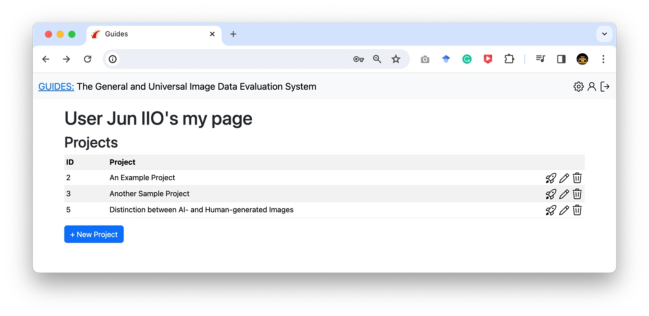
OVERVIEW OF THE SYSTEM When the participants accessed the GUIDES server, a list of projects appeared on the screen (Figure 1). Registered users can create and design these projects.
Figure 1: Index page of the GUIDES server shows the projects hosted on the server.
Assessment Process Although the system uses user management to create a project, access to the evaluation pages is open to the public; therefore, there is no need to register an account to access them.
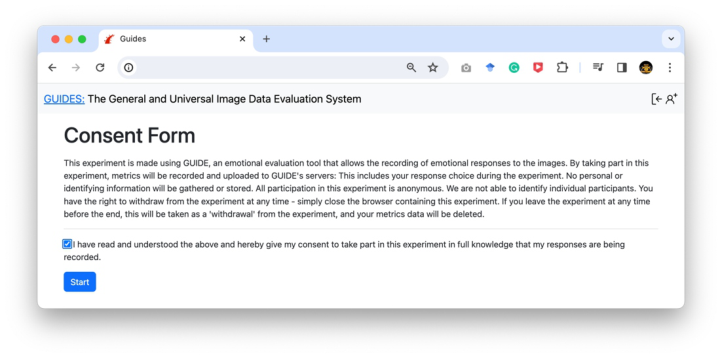
The evaluation process comprised four steps: 1. Information Consent; 2. Introduction; 3. Evaluation; and 4. Display of Evaluation Results. Before starting the assessment, the system provided information consent from the participants to provide permission to participate in the evaluation. Figure 2 shows the start page summarizing information consent.
Figure 2: Start page shows the information consent. Clicking the checkbox at the bottom of the page makes the button for starting the assessment to appear.
24 Iio
The next step is the introduction. The introduction screen provides the project title and description to elucidate the purpose of the image evaluation, accompanied by a ‘Start Evaluation’ button. Clicking this button directs users to the next page for an evaluation (see Figure 3).
Figure 3: Introduction page can be designed using markdown notation.
On the evaluation page, six images, randomly selected from the database, are presented along with two evaluation scales ranging from −1.0 (negative value) to 1.0 (positive value). Users can assess their impressions of each image using a two-slider interface (Figure 4).
Figure 4: Evaluation page contains six images with evaluation sliders.
What Are Your Impressions? Proposal for Emotional Assessment Platform 25
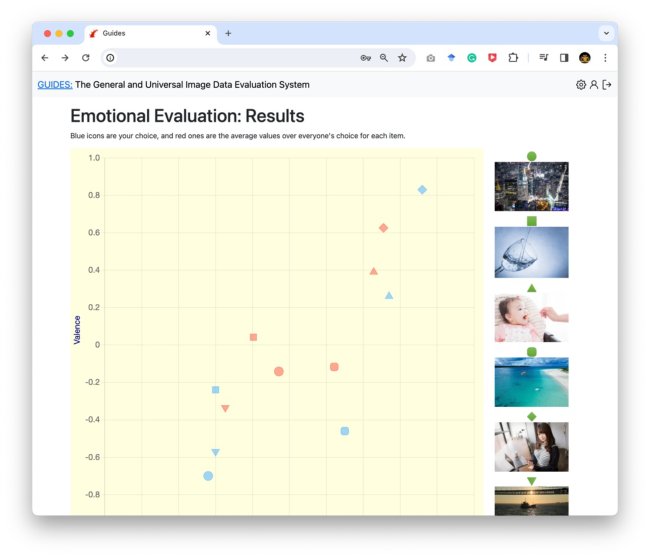
Figure 5: Evaluation results are displayed using a scatter-plot graph. In the graph, blue icons denote the choice of the user, and red ones are the average values over everyone’s choice for each item.
Upon submitting the evaluation, the resulting page was generated, featur- ing a scatter plot graph that illustrates the decisions of the user alongside the average scores calculated from other users for each image. Figure 5 shows an example of the emotional evaluation results. The results of the evaluations are shown as blue icons, and the average values are depicted as red icons in the scatterplot.
Administration Functions As previously mentioned, GUIDES is a versatile platform for emotionally assessing user responses to image viewing. Consequently, registered users can conduct experiments, that include preparing target images, descriptions (including informed consent messages), and two-dimensional metrics. Indi- viduals interested in designing projects must register an account to initiate this process.
After user registration, the portal page (see Figure 6) is displayed upon the successful login of a registered user into the system, allowing the user to create a project. A project includes a title, description, description of the information consent, and two measure titles, such as arousal and valence. In addition, the project encompasses a collection of resource addresses written in the uniform resource locators (URLs) format, corresponding to the images that need to be evaluated.
26 Iio
Figure 6: Registered user’s portal page, where the list of projects appears.
Figure 7 shows the project information editor. The project designer can provide descriptions, metrics, and lists of the image URLs. The GUIDES can- not host the image data; therefore, the project designer must prepare the image data to be investigated elsewhere. The description and the informed consent message can be formatted using the markdown notation.
In addition to putting an image URL one by one, the image URLs can be configured collectively using a Microsoft Excel file.
Figure 7: Project information editor.
What Are Your Impressions? Proposal for Emotional Assessment Platform 27
CONCLUSION AND FUTURE WORK This study introduced an enhanced system for the emotional assessment of images, originating from research focusing on user responses to movie posters that employed Russell’s arousal-valence model. This novel system allows reg- istered users to create and design projects for image evaluation using an open evaluation process comprising information consent, introduction, evaluation, and result display.
The system was implemented using Ruby 3.2.2, Rails 7.0.8, and SQLite3 database version 3.39.5. Its source code is freely available and hosted on GitHub1.
As GUIDES is designed as a general-purpose emotional assessment plat- form, several experiences similar to those of the previously performed assess- ment of movie posters are currently planned by the laboratory members.
Performing emotional evaluations of paintings involves examining the ability of people to distinguish between human-created and artificial intel- ligence (AI)-generated artworks and determining their preferences. The experiment utilized a set of images comprising half human-drawn and half AI-generated images, prompting participants to evaluate them based on their humanness and preference. By plotting the results on two axes, we can ana- lyze the images preferred by humans and AI and explore the discernibility of AI-created art (Bellaiche et al., 2023).
Similarly, a sensitivity evaluation of fashion is underway, utilizing two indices: fashion ability and likability. Participants will be asked to rate fashion items based on these criteria, elucidating the the styles deemed fashionable and preferred by individuals and providing insights into the variations in per- sonal sensibilities. Additionally, collecting data on the age of the participants allows for the analysis of preferences across generations, thereby broadening the scope of the study.
ACKNOWLEDGMENT
The author would like to thank Mr. Takashi Hanagaki and the laboratory members who participated in the discussions on this research.
REFERENCES
Bellaiche, L., Shahi, R., Turpin, M. H., Ragnhildstveit, A., Sprockett, S., Barr, N., Christensen, A. and Seli, P. (2023). Humans versus AI: whether and why we prefer human-created compared to AI-created artwork. Cognitive Research: Principles and Implications, 8(1), 42. Hanagaki, T. and Iio, J. (2023). Emotional Evaluation of Movie Posters, The 21st
International Conference on e-Society (ES2023), pp. 428–431, Lisbon, Portugal. Kuppens, P., Tuerlinckx, F., Russell, J. A., and Barrett, L. F. (2013). The relation between valence and arousal in subjective experience. Psychological bulletin, 139(4), 917. Kutsuzawa, G., Umemura, H., Eto, K., and Kobayashi, Y. (2022). Classification of
74 facial emoji’s emotional states on the valence-arousal axes. Scientific Reports, 12(1), 398. Russell J. A. (1980). A Circumplex Model of Affect; J. of Person. and Soc. Psychol.
39(6), pp. 1161–1178.
1https://github.com/iiojun/guides
LISTED IN THE AHFE DIGITAL BOOKSTORE CATALOGUE
Explore the complete digital volume
Kansei Engineering
Read this individual research paper free through the original publisher, or explore the full digital proceedings book.
ISBN 978-1-964867-21-2
Explore this ISBN in the AHFE Bookstore ↗Listed in the July 2026 bookstore catalogue; search by ISBN to confirm current availability · Digital book purchase optional