Jun Iio, Kenta Kawamoto, Tatsuya Sashizawa, Kumiko Nakai (2023). Determination of Most Effective Medium for E-Learning by Analyzing the Differences in Various Types of Media. In: Human Factors and Systems Interaction. AHFE Open Access, vol. 84, pp. 293–299. https://doi.org/10.54941/ahfe1003615
The COVID-19 pandemic has increased the demand for e-learning and video-on-demand services in education. Several methods of imparting education through on-demand videos exist based on the content and method of delivery. However, the most effective medium has not been identified conclusively. In this study, we explored the effectiveness of six different presentation patterns: the simple display of materials, materials-and-narration, use of animated avatars, use of realistic-humanoid avatars, and presentation in the metaverse (using standard computer monitors and head-mounted displays). Sixty subjects, ten males and ten females, from each of the young, middle-aged, and senior age groups participated in the experiment conducted in Dec. 2022. Each subject performed three different tasks, and subjective evaluations were conducted using questionnaires.
From 2020 to 2021, a significant proportion of the global population had restricted work-related commutes due to the COVID-19 pandemic. During this period, teachers in universities offered their lectures online (Marinoni, et al., 2020; Tarker, 2020). Despite the negative aspects of the pandemic, a positive outcome is the increased use of online communication tools such as Zoom, Webex, Google Meet, and Microsoft Teams (Singh and Awasthi, 2020). Two effective modalities for online communication are: 1. real-time online meetings using the previously mentioned software; and 2. viewing on-demand online materials, slide shows, movies, and interactive learning courses. In the case of universities, a mixture of such on-demand materials was used to provide e-learning courses during the pandemic.
Although face-to-face interaction in the real world is better than online virtual interaction in terms of effectiveness of communication, face-to-face communication requires participants to meet several conditions, such as sharing the same time and space. Such conditions occasionally hinder the participation of, e.g., busy businesspeople, especially in the case of global
communication. Moreover, time-zone differences are a problem when actual globe-wide communication is conducted.
Metaverse, which utilizes virtual reality (VR) technology to create vir- tual community spaces, has recently attracted attention in several areas. Although communication in the VR space has been studied for more than 20 years, recent technologies have leveraged the metaverse more effectively.
Objectives of Our Study Because real-time online communication may not be feasible at times, the optimal online content and mode of interaction must be selected for a given task. Our study aims to evaluate the effectiveness of the on-demand infor- mation provided under such conditions. We hypothesize that on-demand information provided via the Internet is the best method.
Several methods for delivering on-demand content are in use. The simplest method is to upload slides on the Internet and ask information receivers to download them. As mentioned in the previous section, the most successful method is the use of VR in the metaverse. However, an inherent problem in this approach is that the more detailed the representation of the materials, the more complicated the preparation. Therefore, we must seek the best balance between the richness of such material representations and their preparation costs, which is a tradeoff problem. In this study, we explored the effectiveness of six different presentation patterns.
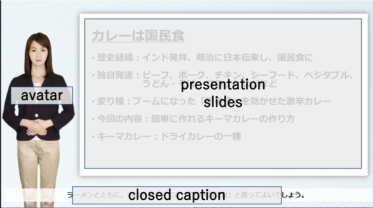
Toppan-Forms Co., Ltd. offers solution proposals using the PIP-Maker presentation tool, which is the service provided by 4COLORS®, Co. Ltd. (see Figure 1). It is a tool used to create a presentation movie from slides and talk scripts. In this study, we used PIP-Maker® to create presentation movies explained by avatars.
The remainder of this paper is organized as follows: The next section describes the research methods used in this study, followed by a discussion on related research. Finally, the last section concludes the paper and presents directions for future research.
Figure 1: A screenshot of PIP-Maker®. The tool comprises presentation slides, a closed caption, and an avatar that explains with an artificial human voice.
Determination of Most Effective Medium for E-Learning 295
RESEARCH METHODS This section provides an overview of the research methods and details of the experiments conducted from 12th Dec. to 22nd Dec. 2022.
An Overview of the Research The research team prepared several messages that could be explained within three to four minutes. Each message included presentation slides and scripts.
In the experiment, a simple presentation movie with only narrations and slide transitions was presented to the subjects as a benchmark. Subsequently, similar presentation movies were shown to the subjects in different ways: 1. material shown as a short movie explaining the message with an avatar explaining the content; 2. material represented in the virtual world (on two- dimensional screens); and 3. material shown as a movie in the metaverse using head-mounted displays (HMDs).
We measured the subjects’ understanding level from a short examination given after each trial and evaluated the presentation methods compreh- ensively using a questionnaire. Sixty participants from three age groups participated in this experiment: university students as the younger group; Toppan-Forms staff as the middle-aged group; and senior members from the silver human-resource center (see Table 1).
Details of the Experiments To evaluate the differences between the six types of media and to identify the most effective one for the presentation, the research team prepared three presentations for the experiment: how to cook a curry dish; an introduction to the ecology of stag beetles; and an introduction to the ecology of the clione (naked sea butterfly).
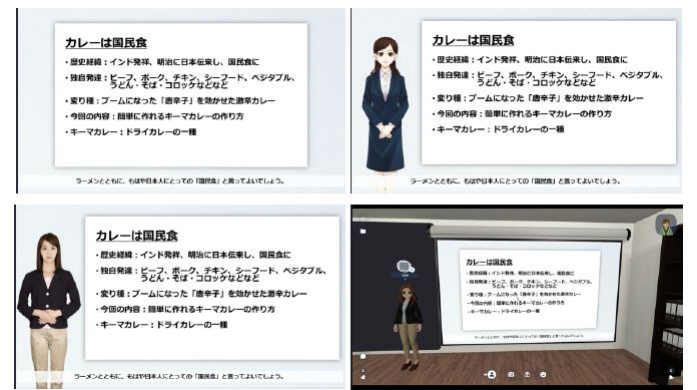
These three presentations are shown in the six different media in Figure 2. Note that each subject tested only three of the six media due to the time restriction.
At the end of the experiment, we showed a video that provided instructions to the participants for answering the questionnaire to evaluate the six types of media showing the same presentation.
Table 2 lists the questions posed to the participants of the experiment. During the one-hour investigation, the research team asked the participants to answer nine questions. Q1 is a simple demography question; Q2 is about the participants’ experiences of similar activities, and Q3 is the tendency of the participants regarding their recognition abilities.
Table 1. Participant details.
Table available in the original PDF paper.
Age group Participants Young Ten male and ten female students at Chuo university Middle-aged Ten male and ten female staff of Toppan-Forms office Senior Ten males and ten females from the silver human resource center
Figure 2: 1. Only presentation, 2. presentation and narration (upper left), and 3. pre- sentation, narration, and animated character-like avatars (upper right); 4. presentation, narration, and human-like avatars (bottom left), and 5. (and 6.) presentation on the metaverse side (bottom right; 5. in PC screens and 6. in HMDs). All figures are clipped from our movie.
As described previously, the subjects were asked to view presentations on three types of materials—the benchmark, task A, and task B—via different media. After viewing the presentation, the subjects were asked to answer questions. Q4 to Q6 are the main questions. Q4, Q5, and Q6 are questions regarding the benchmarks and tasks A and B, respectively.
Q7 includes comprehension questions about the three tasks. After viewing the brief introductory video, the subjects were asked to answer questions Q8 and Q9. The questions in Q8 were subjective comparisons of the six different media, and Q9 asked about the impression of VR.
Currently, we are processing the data obtained from the experiments and have yet to analyze it. Thus, we will omit the discussion of our results.
RELATED WORK
Several studies have compared the effectiveness of different representations of presentation modalities. Aseeri and Interrante (2021) compared three types of avatars for virtual communication: no avatar, scanned avatar, and real avatar (video see-through). They reported that participants indicated higher levels of trustworthiness in the real avatar than in the scanned and no-avatar condi- tions. Their survey also revealed that two-thirds of the participants preferred the real avatar over the scanned or no avatar.
However, another study reported the opposite results (Salehi et al., 2022), where realistic animated avatars for children were compared. The animated avatars were created using the Unity game engine, and state-of-the-art tech- nologies and generative adversarial networks. However, most participants in their experiment preferred to talk with animated avatars.
Determination of Most Effective Medium for E-Learning 297
Table 2. Media evaluation questionnaire given to the participants.
Table available in the original PDF paper.
Question Options or sub-questions
Yes (job) / Yes (hobby) / Yes (job and hobby) / No
Q1a. Gender Male / Female / Do not wish to answer Q1b. Age Number Q2a. Movie creation experience
A: the sound of crying / B: the face or some image
Q2b. Type of experience Still image / Video / None Q3a. Recognition tendency (1) A: visual priority / B: hearing priority Q3b. Recognition tendency (2) Imagine a baby crying Each question has seven multiple-choice (1 of 4 options) sub-questions based on the content shown in the movies Q4a. ∼Q6a. Questions regarding the content provided in the movies
Yes / No (each for the seven questions)
Q4b. ∼Q6b. Prior knowledge: Did you know the answers to any of the seven questions beforehand?
Q4c. ∼Q6c.Interest in the theme
Open question
Highly interested / Interested / Neutral / Not interested / Not interested at all Q4d. ∼Q6d. Concentration Concentrated fully / Concentrated a little / Neither / Did not concentrate / Did not concentrate at all Q4e. ∼Q6e. The reason for the previous question
Open question
Q4f. ∼Q6f. Comments Open question Q7a. Reference Presentation / Voice / Closed caption Q7b. Difficulties Benchmark / Task A / Task B Q7c. The reason for the previous question
Open question
Q7d. Comments on the presentation
Open question
Q7e. Comments on the interests
Presentation only / Presentation and voice / Presentation and avatar (animation) / Presentation and avatar (human) / Presentation in the metaverse (viewed in PC monitor) / Presentation in the metaverse (viewed in HMD)
Q7f. Other comments Open question Q8a. Readability, Q8b. Understandability, Q8c. The ability to concentrate, Q8d. memorability, Q8e. Preference
Attractive / Preferable / Enthusiastic / Easy to Understand / Easy to operate / Caused discomfort, such as feeling ill
Q9a. Knowledge of the VR Yes / Yes but no experience / No Q9b. and Q9c. Evaluation of the VR (before the investigation / after the investigation)
Hepperle et al. (2022) investigated the visual aspects of avatar appearances in social virtual reality applications. They concluded that the investigated platforms varied significantly in their representation of avatars, and that the lack of an unmistakable resemblance was common to all. Their important finding is that the uncanny valley effect is also present in HMDs, and it is more pronounced than in two-dimensional monitors.
In addition to the friendliness of the avatars, other avatar parameters were compared. Wirth et al. (2021) analyzed the influence of avatar appeara- nce, environmental awareness, and camera perspective on gait parameters relevant to clinical applications. They compared the following conditions: baseline, no avatars, point cloud, silhouette, humanoid, exocentric, and envi- ronment (combination of humanoid and environment). Their results showed that VR exposure significantly affected gait stability.
The size and dynamics of the avatar were also compared (Brown and Prilla, 2020). They considered how the appearance of an avatar and its dynamics for online consultations affect the following important factors: social prese- nce, customers’ trust, and satisfaction. Although their experiments could not show the differences in customers’ trust and satisfaction, they could reveal a significant difference in social presence.
CONCLUSION
This study reports on an experiment conducted to determine whether diffe- rent media offer different levels of comprehension regarding the presentation of on-demand materials and the appropriate presentation method. The experiment was conducted in Dec. 2022 with 60 subjects: 20 young, 20 middle-aged, and 20 seniors, with 10 males and 10 females in each group.
For each subject, three types of presentations—benchmark, task A, and task B—were displayed via different media. A questionnaire was used to obtain subjective evaluations of media types.
When this manuscript was prepared, the data obtained from the expe- riment had not been analyzed. Therefore, data cleansing and analysis are urgent tasks that must be addressed in future studies.
ACKNOWLEDGMENT
The authors would like to thank all participants and support members of our research team.
REFERENCES
Aseeri, S., and Interrante, V. (2021). The Influence of Avatar Representation on Interpersonal Communication in Virtual Social Environments, IEEE Transactions on Visualization and Computer Graphics, 27(5), 2608–2617. Brown, G., and Prilla, M. (2020). The effects of consultant avatar size and dynamics
on customer trust in online consultations. In Proceedings of the Conference on Mensch und Computer, pp. 239–249. Hepperle, D., Purps, C. F., Deuchler, J., and Wölfel, M. (2022). Aspects of visual avatar appearance: self-representation, display type, and uncanny valley. The Visual Computer, 38(4), 1227–1244. Marinoni, G., Van’t Land, H., and Jensen, T. (2020). The impact of Covid-19 on
higher education around the world. IAU global survey report, 23. Salehi, P., Hassan, S. Z., Shafiee Sabet, S., Astrid Baugerud, G., Sinkerud Johnson, M., Halvorsen, P., and Riegler, M. A. (2022). Is More Realistic Better? A Comparison of Game Engine and GAN-based Avatars for Investigative Interviews of Children,
Determination of Most Effective Medium for E-Learning 299
In Proceedings of the 3rd ACM Workshop on Intelligent Cross-Data Analysis and Retrieval pp. 41–49. Singh, R. and Awasthi, S. (2020). Updated Comparative Analysis on Video Conferencing-Platforms-Zoom, Google Meet, Microsoft Teams, WebEx Teams and GoToMeetings. EasyChair: The World for Scientists, pp. 1–9. Tarkar, P. (2020). Impact of COVID-19 pandemic on education system. International
Journal of Advanced Science and Technology, 29(9), 3812-3814. Wirth, M., Gradl, S., Prosinger, G., Kluge, F., Roth, D., and Eskofier, B. M. (2021).
The impact of avatar appearance, perspective and context on gait variability and user experience in virtual reality. In 2021 IEEE Virtual Reality and 3D User Interfaces (VR) pp. 326–335.
LISTED IN THE AHFE DIGITAL BOOKSTORE CATALOGUE
Explore the complete digital volume
Human Factors and Systems Interaction
Read this individual research paper free through the original publisher, or explore the full digital proceedings book.
ISBN 978-1-958651-60-5
Explore this ISBN in the AHFE Bookstore ↗Listed in the July 2026 bookstore catalogue; search by ISBN to confirm current availability · Digital book purchase optional