Jun Iio (2026). Gamified, Learner-Built Applications for Language Study: Effectiveness, Limitations, and Implications. In: Human Factors and Systems Interaction. AHFE Open Access, vol. 230, pp. 82–87. https://doi.org/10.54941/ahfe1007979
This paper explores how foreign-language learners can enhance learning efficiency by designing and using personalized digital applications rather than relying solely on commercial language-learning tools. While platforms such as Duolingo dominate the market, their course offerings do not always meet specific learner needs, exemplified by the lack of Thai courses for Japanese speakers. To address such gaps, the study presents two case studies in which learners created their own applications tailored to their goals, proficiency levels, and learning preferences. The first case examines a Japanese learner of Thai who developed a simple Python-based app to master Thai consonant characters. By incorporating randomization and active recall, the app transformed rote memorization into an engaging task and significantly improved retention. The second case focuses on an advanced Japanese learner of English who built a JavaScript-based vocabulary app targeting high-difficulty lexical items often neglected by mainstream apps, resulting in measurable vocabulary growth. The discussion highlights that these apps were intentionally designed for single users—the developers themselves—allowing extreme personalization without concern for general usability. Although such specificity limits generalizability, recent generative AI tools lower technical barriers, enabling more learners to create similar tools. Importantly, both applications are open-source, allowing others to adapt them to their own needs. The study concludes that learner-built apps hold great promise for personalized language learning, while also posing challenges for scalability and broader applicability.
Recent advances in information and communication technologies (ICT) have increasingly supported self-directed learning, including foreign language acquisition. Among these technologies, mobile and web-based language- learning applications have gained widespread popularity. Duolingo, one of the most prominent platforms, has been extensively studied (Vesselinov & Grego, 2012). By the latter half of 2025, its monthly active user base reportedly exceeded 100 million, giving it a dominant share of the global language-learning app market. Despite offering a wide range of language courses, its course lineup does not always meet learners’ specific needs.
Gamified, Learner-Built Applications for Language Study 83 For example, the author, a native speaker of Japanese, aims to learn Thai. While Duolingo provides several courses designed for Thai native speakers learning foreign languages, it does not offer a Thai-language course for non-Thai speakers. This gap illustrates a broader limitation of commercial language-learning platforms: they are optimized for large user bases and thus may overlook smaller or more specialized learner populations.
One potential solution is for learners to develop their own digital tools tailored to their individual learning goals. This study examines how foreign- language learners can enhance learning efficiency by designing and using personalized applications rather than relying exclusively on conventional materials or commercially available tools. The paper presents two case studies in which learners developed customized applications aligned with their specific needs, learning styles, and linguistic objectives. Through these cases, the study analyzes the effectiveness of learner-built applications while also addressing their inherent limitations and challenges.
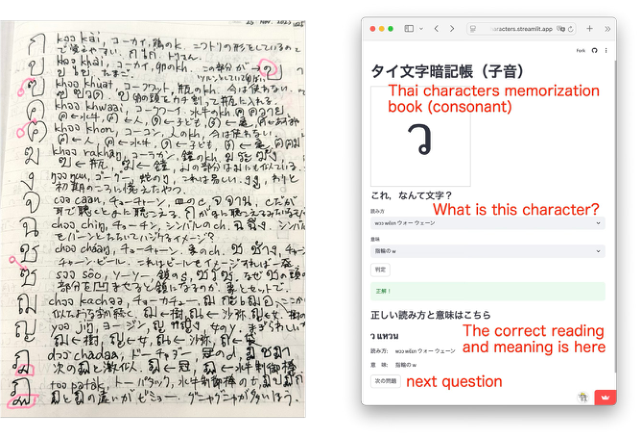
CASE 1: AN APPLICATION FOR LEARNING THAI CONSONANT CHARACTERS The first case focuses on a Japanese learner of Thai who sought to master the 44 consonant characters that form the foundation of the Thai writing system. Traditional analogue learning methods—such as repeatedly copying characters in a notebook (see Fig. 1, left)—often fail to support long- term retention. To address this issue, the learner designed a simple digital application that randomly presents Thai consonants and prompts the user to recall their meanings or phonetic values (see Fig. 1, right). The interface of the application is written in Japanese, reflecting the fact that the developer and primary user is Japanese. English translations were added to the screenshots in Figure 1 for clarity.
Figure 1: Learning Thai consonant characters: an analogous method (left) and a digital application (right).
84 Iio The application is technically simple: it is written in Python, built using Streamlit (Khorasani, et al., 2022), and hosted on the Streamlit Community Cloud1. Despite its simplicity, the app incorporates elements of gamification, such as randomness and active recall, which significantly enhanced memorization and retention. This case demonstrates how a learner-developed digital tool can transform a monotonous memorization task into an engaging and effective learning experience.
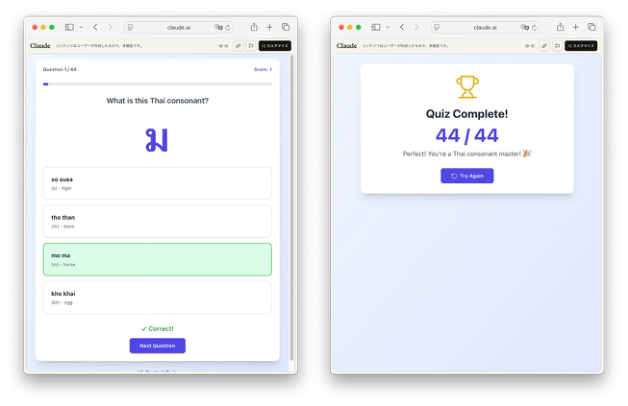
Figure 2 shows a version of the application generated using a generative artificial intelligence (GAI) tool2. Notably, the GAI was able to produce a functional application almost instantly from a relatively simple prompt. However, the automatically generated implementation was not entirely appropriate for the learning goal. For instance, the app initially included multiple-choice options written in Thai, which made the correct answer obvious and reduced the effectiveness of recall practice. The learner subsequently modified the code to correct this issue, illustrating the importance of human judgment even when using AI-assisted development.
Figure 2: Learning Thai consonant characters app created using Claude AI with quite simple prompt, “Could you make an app that provides a quiz asking the Thai 44 consonants to learn the Thai language?”
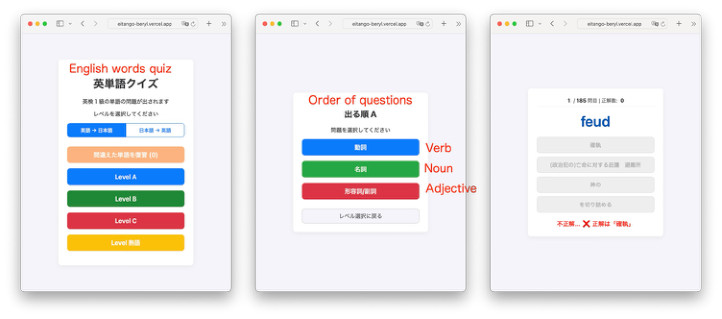
CASE 2: AN APPLICATION FOR LEARNING ENGLISH VOCABULARY The second case examines a Japanese learner of English who aimed to expand advanced vocabulary knowledge. Similar to the first case, the learner developed a digital application that randomly displays English words and prompts the user to recall their meanings or usage. Figure 3 presents
Gamified, Learner-Built Applications for Language Study 85 screenshots of the application with English translations added by the author. The app was implemented using JavaScript and deployed on Vercel3.
Figure 3: Learning english words app created by a Japanese english learner.
This application was designed to target high-difficulty and relatively niche vocabulary items, reflecting the learner’s above-average English proficiency and preference for challenging content. Unlike many commercial English- learning apps, which primarily focus on beginners or intermediate learners, this app addressed a perceived lack of suitable tools for advanced learners. As a result, the application facilitated exposure to a broader lexical range and promoted active engagement with complex vocabulary, leading to measurable improvements in vocabulary knowledge.
However, a key limitation of this application is its lack of adaptability for other users. The difficulty level and number of questions are fixed according to the developer’s preferences; for example, a single session currently includes 185 questions, which would be excessive for most general English learners. This limitation highlights the highly individualized nature of learner- developed applications.
DISCUSSION
An important characteristic shared by both cases is the dual role of the developers as both creators and primary users of the applications. Neither developer intended the applications to be used by a broader audience. Consequently, the apps were designed without consideration for general usability factors such as error handling, visual design, or scalability. However, this was not problematic for the developers, as the sole purpose of the applications was to support their own language learning—and in this respect, the apps functioned effectively.
3Available at https://eitango-beryl.vercel.app/
86 Iio Both developers experienced frustration with existing commercial language-learning tools and possessed a basic level of ICT knowledge through their academic backgrounds in ICT-related fields. These factors motivated them to design applications that directly addressed their unmet learning needs. Importantly, recent developments in GAI have further lowered the technical barriers to app development, enabling even learners with limited programming experience to create functional learning tools. In this sense, GAI expands opportunities for deeply personalized language learning.
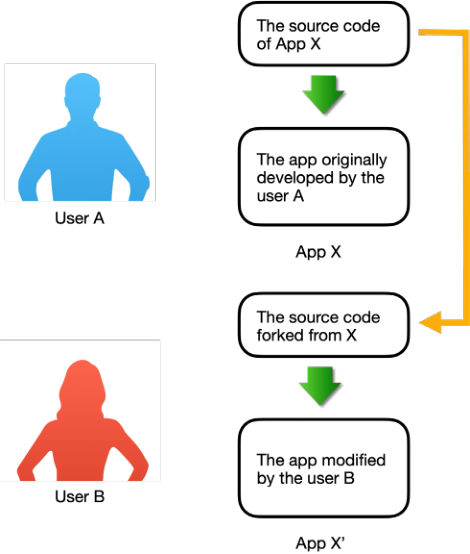
Figure 4: Publishing open-source code partially addresses the limitation of learner- built applications.
A notable point is that both applications and their source code are publicly available online. The code is hosted on GitHub4 and can be accessed by anyone. Because the source code is open, some of the limitations of highly individualized applications can be mitigated. Other learners or developers can fork the code, modify it to suit their own needs, and redeploy it for personal use. In the latter case examined in this paper, a sufficiently large number of questions can be readily reduced through appropriate modifications to the code. Figure 4 illustrates this process. Application X is initially developed by User A for personal use and is therefore highly specialized. If User B finds the application useful but not fully aligned with their needs, they can fork the source code, adapt it, and deploy a modified version tailored to their own learning context.
4Available at https://github.com/iiojun/thai_characters and https://github.com/ syusyusyumaimai/Eitango, respectively.
CONCLUSIONS
This paper examined two case studies of learner-developed language- learning applications, identifying the users’ personas, analysing their learning contexts, and evaluating the effectiveness of their approaches. The findings demonstrate several strengths of learner-driven application design, including high levels of personalization, adaptability, and learner motivation. At the same time, the study highlights important limitations, particularly with regard to generalizability.
In the Thai-language case, the learner represents a very small and specific demographic: a Japanese learner of Thai grappling with a unique writing system that has a relatively limited global learner base. In the English vocabulary case, the learner’s proficiency exceeds that of typical Japanese English learners, resulting in an application focused on highly advanced or specialized lexical items. Consequently, neither application aligns well with the needs of most general language learners.
Building on these observations, this paper discusses the broader potential for learner-built language-learning applications and considers how such tools might be expanded or redesigned to reach wider audiences. Possible directions include adjustable difficulty levels, support for diverse learner profiles, and the integration of adaptive algorithms. Overall, the study underscores both the promise and the challenges of personalized, application-based language learning and offers insights for the future development of more flexible and inclusive language-learning technologies.
REFERENCES
Khorasani, M., Abdou, M., & Fernández, J. H. (2022). Web application development with streamlit. Software Development, 498, 507. Vesselinov, R., & Grego, J. (2012). Duolingo effectiveness study. City University of
New York, USA, 28(1–25).
LISTED IN THE AHFE DIGITAL BOOKSTORE CATALOGUE
Explore the complete digital volume
Human Factors and Systems Interaction
Read this individual research paper free through the original publisher, or explore the full digital proceedings book.
ISBN 979-8-950676-06-2
Explore this ISBN in the AHFE Bookstore ↗Listed in the July 2026 bookstore catalogue; search by ISBN to confirm current availability · Digital book purchase optional