Kurt Englmeier (2024). Insights Gained from Integrating Self-Paced Learning into Digital Learning Environments. In: Human Systems Engineering and Design (IHSED2024): Future Trends and Applications. AHFE Open Access, vol. 158, pp. 268–276. https://doi.org/10.54941/ahfe1005550
Self-paced learning has emerged as a cornerstone of modern education, offering learners unprecedented flexibility and autonomy in their learner journeys. This paper focuses on the design paradigms and support mechanisms necessary to facilitate effective and sustainable learning experiences.The success of self-paced learning lies in its ability to empower learners to engage with course materials at their own pace, anytime and anywhere. This flexibility not only accommodates diverse learning styles and workplace and living circumstances but also fosters a sense of ownership and responsibility in learners. However, while self-paced learning holds immense promise, it also poses significant challenges, particularly in terms of managing learners' study efforts and ensuring the retention of knowledge over a long period of time.One of the first key considerations in designing self-paced learning environments is the structuring of course content. By breaking down complex topics into manageable chunks and leveraging tools such as large language models (LLMs) for dynamic text summarisation (and comparison), digital learning platforms strive to provide learners with clear and comprehensive overviews of the subject matter. These structured environments not only guide learners through their educational journeys but also facilitate the integration of new information with existing knowledge, fostering deeper understanding and retention.This paper presents a digital learning platform for self-paced learning that is already applied in the academic education. The main focus is on self-paced learning in structured learning environments that support the acquisition of comprehensive knowledge to learners that are usually new to the subject matter addressed in the course. Digital courses that allow learners to study autonomously need to take for the learners' metacognition, or their ability to monitor and regulate their learning processes. Metacognitive self-regulation strategies empower learners to monitor their progress and employ effective learning techniques. However, empirical evidence suggests that learners often struggle to accurately assess their own abilities (such as cramming for an exam), leading to suboptimal learning strategies. Managing learners' study efforts is another critical aspect of self-paced learning. Our digital learning platform employs strategies to measure and optimise study efforts, including setting minimum reading times, recommending study breaks, and assigning individual Learning Complexity Indices (LCIs) to course materials. A further challenge of digital courses is the learners’ development of an abstract representation of the knowledge provided by the course. The system must be in the position to allow learners the adoption of knowledge following the semantic wave. Learners continuously switch between from abstract to detailed representation of concepts. Deeper understanding of a concept emerges from recognising which and how many details connect to one particular abstract. The system presented in this paper supports the learners in adopting the semantic wave by enabling them to navigate the content by using their own words as search terms. This active use of the (conceptual) language helps the learners to build up their own mental representation of knowledge structure.The paper presents still work-in-progress, but manifest a strong proof-of-concept that considering semantic wave in the interaction design is an essential ingredient of digital learning environments.
Self-paced learning offers an excellent approach for learners who appreciate flexibility, autonomy, and individuality in acquiring new knowledge. It allows them to learn whenever and wherever they want. However, without a tutor, learners must take full responsibility for their learner journey. Success in self- paced learning depends on their ability to manage this journey effectively. While learning from a book can serve as an initial metaphor for self- paced learning, digital environments can—and should—support knowledge acquisition in far more diverse and powerful ways.
Digital learning environments that support self-paced learning can provide excellent learning materials. However, if they fail to address the inherent challenges of digital spaces, such as distractions and the task-oriented design of human-computer interactions, they will not effectively support learners in managing their efforts and developing sustainable knowledge representations.
Well-structured digital learning environments can clarify the scope and structure of the knowledge to be acquired. Nevertheless, they also require the
Insights Gained From Integrating Self-Paced Learning Into Digital Learning Environments 269
thoughtful implementation of support structures to help learners effectively manage their educational journey and achieve mastery of the subject matter.
This paper presents the design of a digital format for self-paced learning with well-structured guidance. The main focus is on engaging learners with the course content and effectively managing their learning efforts. Additionally, the paper explores how large language models (LLMs) can foster the development of an abstract and consistent semantic representation of the learning content. This representation can provide personalized assistance and enriched interactive experiences, thereby enhancing the learning process.
The paper shares practical experiences from a research project aimed at designing new digital learning formats for both academic and vocational education. The project’s objectives include developing effective digital learning solutions and establishing best practices for their implementation. By integrating advanced technological tools such as LLMs, the project seeks to offer scalable, adaptable, and learner-cantered educational environments.
MANAGING THE COGNITIVE LOAD IN AN ENVIRONMENT OF DISTRACTIONS Beside the support of the learners’ effort management, a central focus of digital courses is the learners’ development of an abstract representation of the knowledge provided by the course. The system must be in the position to allow learners the adoption of knowledge following the semantic wave. Learners continuously switch between abstract and detailed representation of concepts. Deeper understanding of a concept emerges from recognising which and how many details connect to one particular abstract.
Digital courses are always embedded in an environment that offers many distractions. It is marked by the ubiquity of digital services, channels, games, and the constant barrage of notifications. The ability of the learners to maintain focused attention has become increasingly challenging (Hafez et al., 2023). The digital world has brought unparalleled access to information and connectivity, but it has also introduced a plethora of distractions that impedes our ability to concentrate on a particular task at hand. The design of digital learning environments must thus include strategies for cultivating focused attention amidst the distractions from our digital surroundings.
The concept of attention has long been studied by psychologists and philosophers alike. The psychologist William James (Wu, 2011) described attention as “taking possession by the mind, in clear and vivid form, of one out of what seem several simultaneously possible objects or trains of thought.” In essence, attention involves the ability to select and focus on relevant information while filtering out distractions.
However, in today’s digital environments, our attention is constantly being pulled in multiple directions. Our phones, social media, and other services provide an endless stream of stimuli vying for our attention. As a result, many people find it increasingly difficult to concentrate on a task for the period required to thoroughly complete it.
270 Englmeier
Digital distractions have detrimental effects on attention. The mere presence of communication channels, even if not actively being used, can significantly impair cognitive function and attention (Ward et al., 2017) Constant multitasking is a common and even increasing behaviour in the digital age. However, it reduces productivity and cognitive performance.
So how can learners reclaim their attention in a world full of digital distractions? How can we design digital courses that enable learners to sufficiently concentrate on their learning tasks? There are certainly many ways to attract the learners’ attention. One strategy, for instance, is to practice mindfulness (Slattery et al., 2022). Mindfulness involves paying attention to the present moment without judgment. By cultivating mindfulness individuals can train their minds to focus on the task at hand and become less susceptible to distractions.
Our design strategy favours the development of a conducive environment for focused work. It involve minimal distractions by creating a learning environment free from clutter. By eliminating internal distractions, that is distractions within the learning environment, learners experience a space where they can fully immerse themselves in their work.
Additionally, incorporating regular breaks into one’s routine can help maintain attention and prevent burnout. Research has shown that taking short breaks during prolonged periods of focused work can improve productivity and cognitive function. Activities such as going for a walk or simply taking a few minutes to relax and recharge can help replenish mental energy and enhance concentration (Albulescu et al., 2022). Including breaks when calculating the recommended time effort for individual learning tasks is thus part of the time management feature of our system.
Furthermore, developing a sense of purpose and intrinsic motivation can greatly enhance attention and focus (Zhang and Liu, 2022). When individuals are engaged in activities that align with their values and goals, they are more likely to remain focused and motivated. By cultivating a sense of purpose in their work and daily activities, individuals can overcome distractions and stay committed to their objectives.
Paying attention in the digital age requires conscious effort and deliberate strategies (Ferscha et al., 2014). By practicing mindfulness, creating a conducive work environment, taking regular breaks, and cultivating intrinsic motivation, individuals can reclaim their attention in an distracting environment. In doing so, they can develop their full learning potential and achieve greater learning success. As technology continues to evolve, it is imperative for our development to foster skills and habits necessary to navigate the digital learning environment while maintaining focus and attention.
DESIGNING FOR MINDFULNESS IN DIGITAL ENVIRONMENTS Effectively implementing strategies to support mindfulness in learning demands attention to several key elements. These include instructional design, interaction design, and further support mechanisms for time management and the development of a mental abstraction of the learning content (Reinhold et al., 2024). Crucial features such as collaborative
Insights Gained From Integrating Self-Paced Learning Into Digital Learning Environments 271
opportunities with peers, and immediate feedback from tutors or chatbots, must be integrated to facilitate effective learning experiences.
In this paper, we concentrate on the implementation of the instructional design for our digital courses. Our main focus here is on courses providing factual and conceptual knowledge including principles, methods and theories that govern a fundamental and wide-spread knowledge in the topic addressed. Examples of such topics are foundations of (agile) project management, blockchain technology, data security and privacy, and import regulations.
Supporting the Learners’ Time Management Measuring the effort required to learn a certain material can be complex, as it often involves multiple factors. Effort in learning is not solely determined by a single parameter but is influenced by various components. The most basic elements are the time spent on a text or quiz query and the results achieved in learn controls. By recording these values for every learner of the course we can obtain a series of important parameters indicating the performance of the learners and the (intrinsic) cognitive load of the different sections of the course:
Average studying time of a page, subchapter, chapter, or quiz (all learners)
Average studying time of each individual learner
Average points achieved in the learn controls (quizzes)
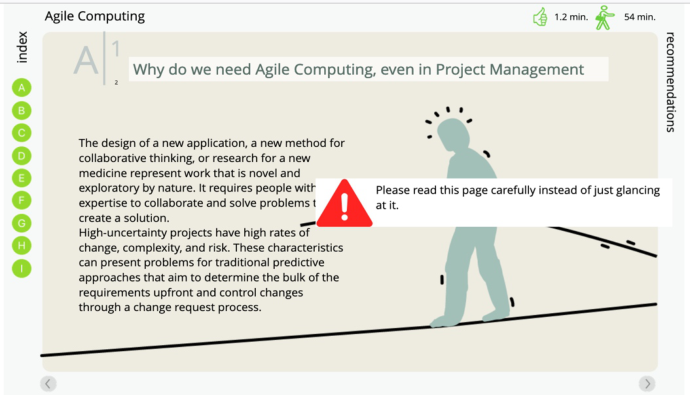
Figure 1: When accessing a page for the first time, learners are required to spend a minimum amount of time reading the text before they can proceed to the next page. While navigating through a chapter, the system displays the total time spent and the remaining time required for the chapter in the upper right corner.
272 Englmeier
Initial study duration benchmarks are established by the course instructor. For instance, we assume that the average reading speed for academic texts defaults to 100 words per minute. This value serves as the minimum reading duration indicated to learners. Upon initial engagement with a page, the system ensures comprehensive study by restricting navigation until the minimum reading duration elapses (see Figure 1). Subsequently, learners enjoy unrestricted navigation access to previously studied pages. The recommended reading time also accounts for breaks between study sessions, as optimal learning occurs when new knowledge is allowed to settle over brief intervals (Dempster, 1988). The minimum break time in our course aligns with the duration required to study the respective subchapter (or nugget).
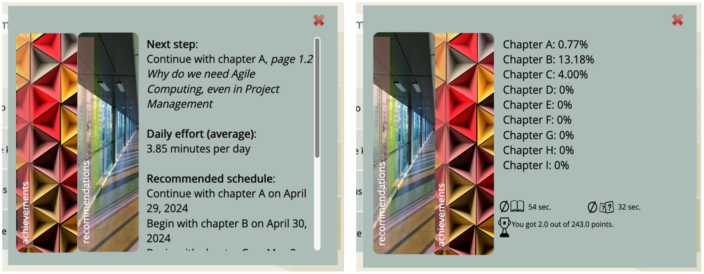
Additionally, there’s a recommended maximum study time per day or week. At the start of each session, the system informs the learners of the recommended learning time and alerts them if the minimum study time required exceeds the maximum study time (Figure 2). Alongside this notification, the system informs the learners about their achievements (Figure 3b) and recommends the learner’s next steps on their learning journey, typically suggesting a return to the point where they previously left off (Figure 3a). However, the system also considers the natural process of forgetting and may recommend revisiting text sections based on elapsed time since initial study. For quizzes, recommendations are tailored based on performance levels. If quiz results indicate lower than average performance, the system may suggest retaking the quiz after a shorter interval than for better results.
Figure 2: At the beginning of each session the learners are informed on the effort they should dedicate to studying the course material.
Course sections vary in the effort required for study, with complexity and difficulty influencing learner effort significantly. To reflect this, we assign an individual Learning Complexity Index (LCI) to each course section (Sweller, 2019). Initially, it’s the tutor’s responsibility to assess the depth, technicality, and conceptual difficulty of each section, with an index of 1.0 representing average complexity. Observing learner study behavior allows us to refine the LCI, adjusting it to accurately reflect the effort required by learners.
Recognizing that each learner’s journey is unique, the indicator model must be sensitive to individual learner characteristics. By calculating the individual learning effort index (LEI) for each learner, we can personalize the remaining time required to study new chapters or complete remaining sections. The individual LEI also applied when individualized learning calendars (see Figure 3a) are generated.
Insights Gained From Integrating Self-Paced Learning Into Digital Learning Environments 273
Figure 3: (a) The learners get recommendations for the next steps in their learner journey and for their time management. (b) They get an overview on their achievements indicating the learning material completed, their average time for reading texts and answering questions, and their results in the learn controls.
Mental Abstraction of the Course Content The design paradigm of our structured learning environments first addresses simplicity in order to avoid internal distraction. It is important to reduce the extraneous cognitive load (Brown et al., 2024). Navigating the course content and handling the learn controls must be as simple as possible. The courses are structured in a traditional way along chapters and subchapters (or nuggets). Learn controls usually conclude subchapters and consist of three to twelve questions depending on the scope of the subchapter. The amount of information provided on each page is kept low. This design principle helps to raise the attention of the learners and to keep the intrinsic cognitive load low. This load emerges from putting pieces or chunks of information together to form the knowledge of a higher-level topic (Brown et al., 2024).
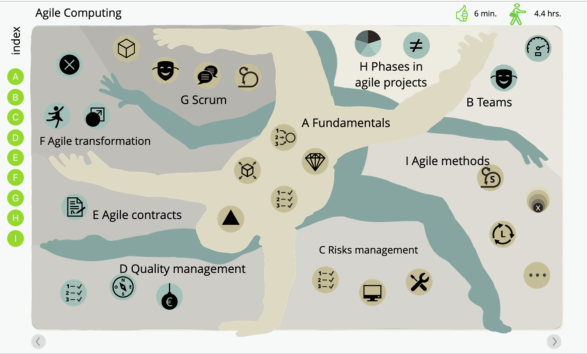
Within our learning environment, each page and subchapter get unique titles, with content organized into manageable chunks. These titles are generated through sophisticated text summarization techniques enabled by LLMs. This semantic representation allows learners to easily retrieve specific course content at any stage of their learning journey (as shown in Figure 4). Our platform features an AI-driven search function that enables learners to state free-text queries and swiftly locate the most relevant pages or content chunks within the course.
The initial structuring of the course content, reflected in the titles, serves as a guiding framework for learners, providing them with an overview of the topic and its intricacies. For novice learners, focusing on these titles provides a good starting point to grasp the surface details of the content. However, as learners delve deeper into the course and begin to navigate the content using their own terminology, they gradually develop a more nuanced understanding (Figure 5). This iterative process helps learners construct individual mental abstractions of the content, mirroring the perspective of subject matter experts. The formation of an individual abstract representation of the course content is essential for the learners’ sustainable adoption and organization of the course knowledge.
274 Englmeier
The learning assessments explicitly include free-text queries to encourage students to formulate comprehensive responses. This skill, essential for effectively communicating knowledge to peers, is often not addressed by multiple-choice questions. Large Language Models (LLMs) evaluate students’ responses by comparing them to ideal answers. The degree of similarity between the student’s response and the ideal answer determines the points awarded.
Figure 4: Overview of the course “Agile Project Management” and its structuring into chapters. In the upper right corner, the system indicates the learning effort (time) already completed by the learner and the remaining studying time.Figure 5: The learners have the possibility to retrieve selected sections from the course at any point along their learner journey. Without leaving the actual page, they can ask the system to provide them with the course content most suitable to their search query. The matching algorithm in the background uses large language models to identify the content sections that match the user query.
Insights Gained From Integrating Self-Paced Learning Into Digital Learning Environments 275
CONCLUSION
Digital learning platforms are increasingly emphasizing self-paced and self-directed learning, often with the support of chatbots. However, in environments where chatbots serve as tutoring assistants, it is crucial for learners to have a foundational understanding of the course material. Without this baseline knowledge, learners may miss important information if the chatbot dialogue does not cover all necessary content. Consequently, individual learning paths might overlook critical aspects, leading to gaps in understanding and knowledge acquisition.
This paper has focused on instructional design for self-paced learning, ensuring that learners maintain a clear and comprehensive focus on the content throughout their learning journey. For learners unfamiliar with the course topic, close guidance is provided, indicating both scope and the expected effort commitment to successfully complete the digital learning material.
Efforts to measure the required study effort for a particular material typically rely on parameters such as reading time and performance in learning controls. By leveraging these observations, our digital learning environments can develop tailored recommendations to guide learners effectively. Furthermore, benchmarks for study effort vary individually, necessitating the adaptation of recommendations to suit each learner’s unique needs.
Currently, our university offers three self-paced learning courses with approximately 250 participants in total. The data collected during each course play a crucial role in evaluating the learners’ performance, providing insights for, among other things, refining the recommendation systems to better align with individual learner profiles. This responsiveness to individual strengths, weaknesses, and constraints ensures sustained learner engagement and motivation, as the learning journey is tailored to their specific requirements.
Looking ahead, the next challenge in our project is to deepen our understanding of learner performance, in particular in the learning controls, and integrate more tailored recommendation features into the system’s interaction, further enhancing the personalized learning experience.
ACKNOWLEDGMENT
Research as outlined here is part of the eduplex_api project under the research framework INVITE of the Federal Institute for Vocational Education and Training (BIBB) funded by the German Federal Ministry of Education and Research.
REFERENCES
Albulescu, Patricia. Macsinga, Irina. Rusu, Andrei. Sulea, Coralia. Bodnaru, Alexandra. Tulbure, Bogdan T. (2022) “Give me a break!” A systematic review and meta-analysis on the efficacy of micro-breaks for increasing well-being and performance. PLoS One. Volume 17, No. 8.
276 Englmeier
Brown, Neil C. C. Hermans, Felienne F. J. Margulieux, Lauren E. (2024). 10 Things Software Developers Should Learn about Learning, Communication of the ACM, Volume 67, No. 1. Dempster, Frank N., (1988). The spacing effect: A case study in the failure to apply
the results of psychological research. American Psychologist Volume 43, No. 8. Ferscha, Alois. Paradiso, Joseph. Whitaker, Roger. (2014). “Attention Management in Pervasive Computing” Pervasive Computing, IEEE. Volume 13, No. 1. Hafez, Omar Fahmy. Nosseir, Ann. McKee, Gerard T. El-Seoud, Samir Abou (2023)
“The Features of Students Paying and Not Paying Attention in Online Classes”. International Conference on Computer and Applications (ICCA), Cairo, Egypt. Reinhold, Frank. Leuders, Timo., Loibl, Katharine. Nückles, Matthias. Beege, Maik.
Boalmann, Jan. M. (2024). Learning Mechanisms Explaining Learning With Digital Tools in Educational Settings: A Cognitive Process Framework. Educational Psychology Review Volume 36, No. 14. Slattery, Eadaoin J. O’Callaghan, Eoin. Ryan, Patrick. Fortune, Donal G. McAvinue, Laura P. (2022). Popular interventions to enhance sustained attention in children and adolescents: A critical systematic review. Neuroscience & Biobehavioral Reviews Volume 137. Sweller, John. van Merriënboer, Jeroen J. G. Paas, Fred. (2019). Cognitive
architecture and instructional design: 20 years later, Educational Psychology Review Volume 31, No. 2. Ward, Adrian F. Duke, Kristen. Gneezy, Ayelet. Bos, Maarten W. (2017). Brain Drain: The Mere Presence of One’s Own Smartphone Reduces Available Cognitive Capacity. Journal of the Association for Consumer Research Volume 2, No. 2. Wu, Wayne. (2011). What is Conscious Attention? Philosophy and Phenomenological Research Volume 82, No. 1. Zhang, Yan. Liu, Sheng-Ming. (2022). Balancing employees’ extrinsic requirements
and intrinsic motivation: A paradoxical leader behaviour perspective. European Management Journal Volume 40, No. 1.
LISTED IN THE AHFE DIGITAL BOOKSTORE CATALOGUE
Explore the complete digital volume
Human Systems Engineering and Design (IHSED2024): Future Trends and Applications
Read this individual research paper free through the original publisher, or explore the full digital proceedings book.
ISBN 978-1-964867-34-2
Explore this ISBN in the AHFE Bookstore ↗Listed in the July 2026 bookstore catalogue; search by ISBN to confirm current availability · Digital book purchase optional