Kurt Englmeier (2025). Scaffolding Autonomy: AI-Augmented Self-Paced Learning Environments for Sustainable Learning Outcomes. In: Human Systems Engineering and Design (IHSED2025): Future Trends and Applications. AHFE Open Access, vol. 198, pp. 181–188. https://doi.org/10.54941/ahfe1006774
This paper presents the design and implementation of a digital self-paced learning format that scaffolds both knowledge acquisition and time management. While self-paced environments offer flexibility and learner autonomy, they also pose challenges in sustaining motivation, managing cognitive load, and regulating study behaviour. The learning environment supports learners through two key scaffolding layers: content-level guidance and temporal regulation.Knowledge scaffolding is achieved through structured content design, semantic navigation tools, and Retrieval-Augmented Generation (RAG) that provides personalized summaries based on learner performance. These features help learners build conceptual understanding and reinforce key concepts. Temporal scaffolding includes time-aware notifications, visual progress dashboards, and learning caps to encourage regular engagement and reduce last-minute cramming.Empirical data from over 600 learners demonstrate improved study behaviour and performance with structured guidance. While artificial intelligence plays a vital role in personalization and feedback, it must maintain transparency and trust. The system is designed to act as a supportive companion, not a controlling presence—preserving learner autonomy and ownership.This work highlights the potential of AI-augmented scaffolding to create human-centred, effective self-paced learning environments.
Self-paced learning environments offer learners the flexibility to engage with their learning content at their own pace. While this autonomy increases access and individuality, it also shifts significant responsibility to the learner. Without structured guidance, many struggle to sustain motivation, manage cognitive load, or maintain consistent progress—especially when facing complex or unfamiliar topics.
These challenges are not only technical but fundamentally human. Learners differ in self-regulation skills, prior knowledge, and emotional resilience. Self-Regulated Learning (SRL) theory (Zimmerman, 1989) highlights competencies such as goal-setting, planning, and self-monitoring, while the Zone of Proximal Development (ZPD) (Roland G. Tharp, 1989) (Cole, Jolm-Steiner, Scribner, & Souberman, 1978) emphasizes tailored
support just beyond a learner’s independent capabilities (Jie, Sunze, & Puteh, 2020). Digital learning formats must therefore do more than deliver content— they must scaffold learning processes. One layer of scaffolding involves progress support, such as personalized feedback, dashboards, and adaptive recommendations that help learners manage their time and attention (Heyman et al., 2024). Another layer addresses knowledge scaffolding, supporting the development of mental models that structure and connect new information meaningfully with the learners’ preexisting knowledge.
This paper introduces a digital learning format that integrates both layers of scaffolding into a structured, self-paced environment. More than 600 learners at the Schmalkalden University of Applied Sciences have used the system across various courses. Observational data highlight large differences in learners’ ability to regulate their study behaviour, with many struggling to maintain focus, pace their study time, or identify key content areas— underscoring the importance of scaffolding both knowledge and time.
Chapter 3 explores the design of knowledge scaffolding, which supports the learner’s evolving conceptual model. The system uses Retrieval- Augmented Generation (RAG) to create personalized summaries based on learners’ performance, targeting knowledge gaps and reinforcing core concepts.
Chapter 4 addresses the temporal dimension of learning, often overlooked but crucial. Developed along SRL theory, the learning format provides features like time-aware notifications and visualizations that promote steady engagement and reduce procrastination.
The conclusion reflects on the potential and risks of AI in educational design. While generative AI offers powerful personalization, it must reinforce autonomy, transparency, and trust. Intelligent features should scaffold learning while maintaining a human-centred experience—where the learner feels supported by a companion, not monitored by a control system.
DESIGN FOR KNOWLEDGE SCAFFOLDING Effective self-paced learning requires more than access to digital content—it demands environments that support learners in building coherent, durable mental models. Drawing on Cognitive Load Theory (CLT) (Paas, Renkl, & Sweller, 2003), our platform implements a design paradigm of knowledge scaffolding. This approach structures both content and interaction to reduce cognitive overload and promote deeper understanding.
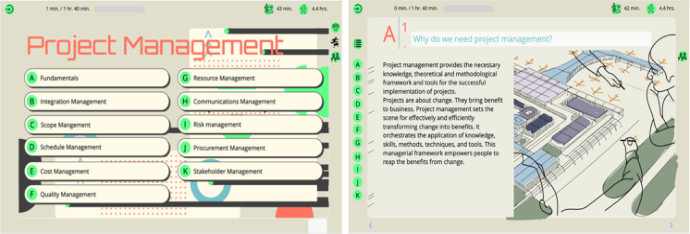
STRUCTURING CONTENT TO SUPPORT MENTAL MODEL FORMATION Course content is organized into clearly defined chapters and subchapters, each concluding with a short set of learning controls (3–12 questions). This consistent structure helps learners navigate independently and supports the individual development of their conceptual content structure. A uniform
layout across all pages minimizes disorientation and preserves attention for core learning tasks (Figure 1).
Figure 1: Overview of the course structure (left). It provides a first cluster of key concepts that supports the learner’s development of an overall view on the subject matter. Reducing the cognitive load is an important overall goal in the design of pages displaying content (right).
To manage cognitive load, each page presents only essential information, organized into semantically coherent chunks. This minimalist design reduces extraneous load and supports integration into the learner’s existing knowledge structures. Titles and headings serve as cognitive anchors, facilitating both navigation and recall.
This structured format helps novices orient themselves with surface- level cues and enables gradual development of personal terminology and conceptual abstraction. Over time, learners internalize content in ways that reflect expert-like thinking—an essential goal for sustainable learning.
AI-Enhanced Cognitive and Metacognitive Support To extend this scaffolding, the platform includes AI-driven features powered by large language models (LLMs). A semantic query system allows learners to search the course content in their own words, retrieving relevant sections from verified material. This bridges learner vocabulary with expert terminology and enhances exploration without cognitive overload.
Importantly, responses are drawn from curated course content rather than generated freely, maintaining consistency in terminology and reducing processing effort. Additional AI tools semantically evaluate free-text quiz answers, enabling personalized feedback and adaptive support (Figure 2). This structured representation forms the initial scaffold for learners’ conceptual development. For novices, chapter and subchapter titles offer a surface-level, indexed understanding. As engagement deepens, learners begin to form their own conceptual vocabulary—an indicator of meaningful internalization. This progression—from exposure to articulation to abstraction—mirrors the trajectory from novice schema formation to expert mental modelling.
184 Englmeier
Figure 2: AI features support checking learner answers against correct answers in free- text questions (left). Example of AI generated response (right).
Reinforcement Through Generative AI: Personalized Summaries To support knowledge reinforcement, we implemented a GenAI-based summarization feature that provides targeted review materials based on learners’ performance in the learn controls. When learners underperform in specific subchapters, the system generates short, focused summaries to clarify misunderstood content (Figure 3).
Instead of repeating questions, learners receive brief explanations that reframe the material, helping them build alternative mental connections. This process promotes elaborative rehearsal, contributing to long-term retention.
Figure 3: Text sections summarizing content the learner should review to reinforce their knowledge. The selection is based on results from the learning assessments, that is, on deficiencies identified in the learner’s performance in the learning controls.
We use transformer-based summarization models (e.g., Ollama-Mistral) to produce concise, coherent summaries that focus attention on key concepts while avoiding information overload. This feedback loop—assessment, personalized summary, and reattempt—supports incremental knowledge consolidation and strengthens learners’ conceptual models.
While full adaptivity remains a challenge, our system uses pragmatic signals—like quiz performance—to guide content personalization. Open- ended dialogue systems often require a high degree of learner autonomy and may lack orientation cues. In contrast, our approach delivers guided personalization, grounding AI-generated support in validated course material aligned with the learner’s actual needs.
SCAFFOLDING THE TEMPORAL DIMENSION OF LEARNING While self-paced formats offer flexibility and autonomy, they also shift the burden of time management onto learners. Our experience with fully asynchronous digital courses revealed wide disparities in students’ metacognitive skills, especially in planning and sustaining effort over time. Many learners postponed their engagement until shortly before the final assessment, leading to poor outcomes and superficial knowledge acquisition.
Empirical studies confirm that learners in self-paced settings are prone to procrastination and discontinuous engagement. Without explicit pacing mechanisms or feedback, even motivated learners may delay meaningful learning actions (Chiu, Moss, & Richards, 2024). To address these challenges, our digital courses introduced several design strategies to scaffold time management and foster consistent effort. The system encourages learners to study around 20 minutes per day, with a weekly cap of 100 minutes. This constraint aims to prevent cramming, promote regular study habits, and allow for cognitive consolidation. Each Monday, a new weekly time allowance is activated.
A key mechanism involves controlling minimum reading time per page, ensuring focused engagement before learners can proceed. The learner dashboard provides real-time visualizations of weekly and total study time, as well as projections of time needed for course completion. If the remaining time becomes insufficient for meaningful participation, the system deactivates access, preventing unproductive last-minute attempts.
To support long-term retention, we introduced a model based on the Ebbinghaus forgetting curve. This model—currently applied with a fixed forgetting rate—analyses learners’ study intervals and performance to generate personalized review prompts. Learners receive recommendations to revisit specific chapters based on detected risks of forgetting, helping them space their learning more effectively.
To reinforce metacognitive awareness, learners also receive gamified progress summaries that visualize their assessment results and course coverage. These feedback elements encourage self-monitoring and help correct overconfidence—often observed when learners misjudge their mastery or neglect essential content.
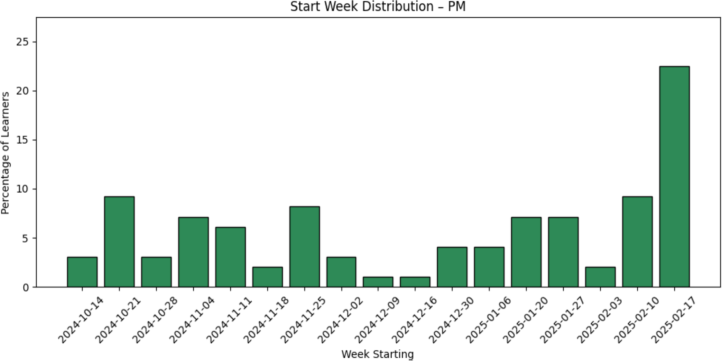
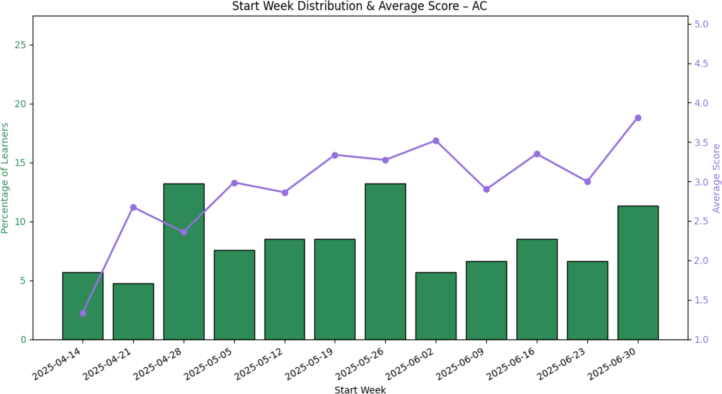
Data from university-level courses demonstrate the importance of temporal scaffolding. In the absence of structured pacing, nearly 25% of learners began studying only in the final week, of whom 95% failed (Figure 4). After introducing stricter time-related guidance, most learners engaged earlier and more consistently (Figure 5), resulting in improved exam outcomes and deeper interaction with both reading materials and assessments.
186 Englmeier
Figure 4: Data from the winter term 2024/25 of the Project Management (PM) course indicate that a significant proportion of students began studying the learning material relatively late in the term.Figure 5: In the summer term 2025, after implementing time management support, data from the Agile Computing course show a more evenly distributed engagement pattern. The chart also suggests a notable correlation between the timing of course engagement and the final scores (ranging from 1.0 = excellent to 5.0 = failed).
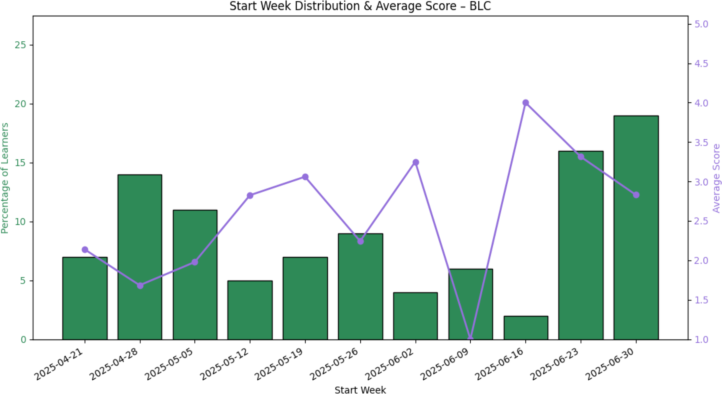
Across all three courses, the data point to a consistent association between timely, evenly distributed engagement and higher exam scores. Although the trends are suggestive, these findings remain preliminary, and further research is necessary to confirm the observed relationship.
These findings underscore the value of structured temporal guidance in digital learning environments. By constraining and visualizing time affordances, learners are nudged toward healthier study rhythms, with breaks for consolidation and less reliance on cramming. In future iterations, we plan
to personalize pacing further by integrating adaptive forgetting models to refine review intervals.
Figure 6: Data from the Blockchain course during the same summer term further support the observed correlation between the timing of course engagement and the final scores. Note: Not all students who took the digital course participated in the final exam.
CONCLUSION
Self-paced learning opens new educational possibilities by offering flexibility tailored to individual capabilities, life contexts, and learning preferences. However, this flexibility also demands more from learners—particularly in self-regulation and metacognitive control. The digital learning format presented in this paper addresses this challenge through a carefully designed integration of artificial intelligence and human-computer interaction.
AI plays a vital role in supporting self-paced learners, but its effectiveness hinges on more than technological capability. Sustainable learning requires thoughtful system design that scaffolds both the content structure and the temporal rhythms of attention, motivation, and cognitive processing. Features such as semantic content navigation, adaptive pacing tools, and personalized knowledge reinforcement help learners build coherent mental models while maintaining steady progress.
As AI becomes more present in educational environments, trust and transparency must be actively cultivated. Many learners express discomfort when they feel overly monitored or algorithmically steered. Concerns about privacy and the loss of control over their learning path, that is, the “transparent learner”dilemma, highlight the need for more participatory and collaborative system features.
AI-supported learning formats should adhere to the conviction that learners must feel guided but not controlled. Learners should perceive these formats as supportive companions, helping them to focus, reflect, and
188 Englmeier
adapt—without undermining their autonomy. Structured guidance, emerging from a seamless fusion of AI features and interaction design, strengthens learners’ motivation, concentration, and comprehension.
The future of self-paced learning will depend not only on technical innovations, but on how well these systems are designed to respect and empower the learner. Intelligent features must serve as scaffolds, not surveillance—offering structured support while encouraging ownership, curiosity, and confidence. When learners feel accompanied, not evaluated, self-paced education can become both more effective and more human.
REFERENCES
Chiu, M.-C., Moss, E., & Richards, T. (2024). Effect of Deadlines on Student Submission Timelines and Success in a Fully-Online Self-Paced Course. SIGCSE 2024: Proceedings of the 55th ACM Technical Symposium on Computer Science Education (pp. 207–213). Portland, USA: Association for Computing Machinery. Cole, M., Jolm-Steiner, V., Scribner, S., & Souberman, E. (1978). L. S. VYGOTSKY.
Mind in Society: Development of Higher Psychological Processes. Harvard University Press. Heyman, J. L., Rick, S. R., Giacomelli, G., Wen, H., Laubacher, R. J., Taubenslag, N.,... Malone., T. W. (2024). Supermind Ideator: How Scaffolding Human-AI Collaboration Can Increase Creativity. CI ’24: Proceedings of the ACM Collective Intelligence Conference (pp. 18–28). Boston: Association for Computing Machinery. Jie, Z., Sunze, Y., & Puteh, M. (2020). Research on Teacher’s Role of Mobile Pedagogy Guided by the Zone of Proximal Development. ICEIT 2020: Proceedings of the 2020 9th International Conference on Educational and Information Technolog (pp. 219–222). New York: Association for Computing Machinery, USA. Paas, F., Renkl, A., & Sweller, J. (2003). Cognitive load theory and instructional design: Recent developments. Educational Psychologist, 38(1), 1–4. Roland G. Tharp, R. G. (1989). Rousing Minds to Life: Teaching, Learning, and
Schooling in Social Context. Cambridge University Press. Zimmerman, B. J. (1989). A Social Cognitive View of Self-Regulated Academic Learning. 81(3).
LISTED IN THE AHFE DIGITAL BOOKSTORE CATALOGUE
Explore the complete digital volume
Human Systems Engineering and Design (IHSED2025): Future Trends and Applications
Read this individual research paper free through the original publisher, or explore the full digital proceedings book.
ISBN 978-1-964867-74-8
Explore this ISBN in the AHFE Bookstore ↗Listed in the July 2026 bookstore catalogue; search by ISBN to confirm current availability · Digital book purchase optional