Mohammad Jahed Murad Sunny, Jan Springer, Aryabrata Basu (2025). Combined Effects of VR and Gaming Expertise on Precision Performance. In: Human Factors in Design, Engineering, and Computing. AHFE Open Access, vol. 199, pp. 946–958. https://doi.org/10.54941/ahfe1006907
The rapid integration of VR in various application domains necessitates a deeper understanding of how levels of user experience impact user performance and task efficiency. We investigate the relationship between experience with VR, 3d computer games, and physical skills across multiple performance metrics. In a comprehensive analysis of multiple levels of VR experience and 3d computer-game expertise, we identified key trends indicating that increased experience in both domains significantly enhances task efficiency while reducing perceived workload and improving task accuracy. Notably, more experience in VR and expertise in controlling 3d computer games consistently correlate with lower task-load scores and more stable performance metrics. Interestingly, we found that physical space requirements remain consistently low across all experience levels, highlighting the accessibility of existing VR technology.
Virtual Reality (VR) has become a critical tool in areas like healthcare, training, and industrial design, particularly for precision-based tasks such as surgery and robotics (Munawar et al., 2024; Vaz et al., 2024; Close et al., 2024). Success in these task domains often depends on prior experience with VR and related technologies like 3d video gaming, which enhances motor control, spatial awareness, and decision making (Vaz et al., 2024; Sunny and Basu, 2024).
In our study we use a VR version of the buzz-wire game to evaluate how VR experience, gaming expertise, and their combination affect performance in a precision task. The task requires fine motor skills, hand- eye coordination, and spatial navigation, tracked through a head-mounted display (HMD) and 3d game controller. Our hypothesis proposes no significant performance difference between users with experience in only VR and only 3d gaming. However, we expect significantly better performance for users with experience in both domains.
By examining task load, accuracy, and spatial efficiency, we explore how expertise in multiple domains influences VR task performance, filling a gap in existing literature by assessing the combined impact of VR and 3d gaming
Combined Effects of VR and Gaming Expertise on Precision Performance 947
expertise, thus offering insights to guide future VR training and design for precision-based applications.
RELATED WORK
VR enables training of crucial tasks in a controlled low-risk environment, supporting the development of spatial awareness and motor skills (Gonz’alez, 2018; Uz-Bilgin and Thompson, 2022). Virtual training enhances real- world performance in many fields requiring precision such as surgery and robotics (Pan 2024; Sanaei et al., 2024). Complex VR tasks demand cognitive, motor, and spatial coordination, mirroring real-world challenges like surgical simulations and remote-controlled robotics, making VR an effective platform for high-stakes skill development (Munawar et al., 2024; Vaz et al., 2024).
Notwithstanding the numerous advantages of VR technologies, its users still face challenges such as motion sickness (Noh et al., 2024), cognitive overload (Alazmi and Alemtairy, 2024), and lack of physical feedback (Peng et al., 2020). These issues can be mitigated through integrated haptic and visual feedback systems, which enhance precision and reduce user stress (Pacchierotti et al., 2024; Lento et al., 2024). However, technology adaptation varies by individual. Prior VR or 3d gaming experience helps to more efficiently overcome task-related challenges (Sagnier et al., 2020; Hufnal et al., 2019; Bellei et al., 2018). Research also shows factors like technology background, age, gender, and athleticism significantly affect VR performance (Pallavicini et al., 2018; Maneuvrier, 2024).
3D video-game experiences enhance cognitive and motor skills such as hand-eye coordination, spatial awareness, and decision making (Vaz et al., 2024; Sunny and Basu, 2024). Studies show 3d gaming experience improves virtual navigation and task execution (Garg et al., 2024; Georgiev et al., 2021; Zioga et al., 2024) which leads us to expect these skills transfer well to the VR domain.
Prior research already highlights the importance of combining 3d gaming experience and VR expertise in virtual environments. Pan (2024) notes that tasks in VR require coordination between real-world motor skills and virtual interaction while studies such as (GomezRomero-Borquez et al., 2024) and (Cecotti et al., 2024) explore how 3d gaming proficiency complements VR usage. Users with limited 3d gaming backgrounds often struggle with hardware controls and navigation, which can be seen in immersive learning studies, emphasizing the need for inclusive VR design (Creed et al., 2024).
The combined effect of VR experience and 3d gaming expertise on performance in complex VR tasks remains underexplored. Our study addresses this gap by evaluating how the combined expertise influences accuracy, task load, and spatial efficiency in a virtual buzz-wire game. Our approach offers insights into the interaction of multi-dimensional skills in precision demanding virtual tasks.
EXPERIMENT Null Hypothesis (H0): Neither VR experience nor 3d gaming expertise, individually or in combination, exhibits statistically significant differences in performance of precision-based VR tasks such as the buzz-wire game.
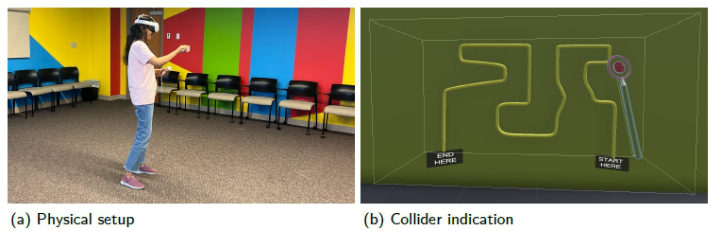
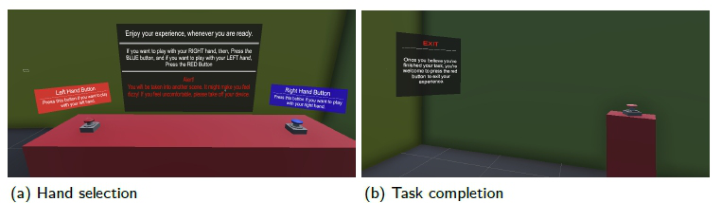
Figure 1: Experimental VR buzz-wire task setup using Meta Quest 3 and Unity environment. (a) Participant’s physical engagement with HMD and controllers. (b) Participant view in the HMD shows guiding a virtual loop along the wire using the chosen hand.Figure 2: User interface elements. (a) Participants approach a table for selecting handedness preferences. (b) After finishing the wire-buzz game, participants hover over a button to conclude the task.
Alternative Hypothesis (HA): Combined proficiency in both VR experience and gaming expertise exhibits statistically significant differences on performance in this precision-based VR task than proficiency in either domain alone.
Task Design Our experiment is designed as an immersive adaptation of the traditional buzz-wire game where participants guide a loop along a wire without making contact. Upon selecting preferred handedness via a virtual-button interface (cf. Fig. 2a), a loop appears at the chosen hand and the task timer begins. The wire’s start and end points are visually indicated to guide navigation (cf. Fig. 1b).
Combined Effects of VR and Gaming Expertise on Precision Performance 949
The virtual loop is controlled using a tracked wand device synchronized with an HMD, enabling precise tracking of hand motion and loop positioning. This setup allows for high-resolution measurement of task performance metrics. Independent of a subject’s hand configuration (cf. Fig. 2a) the core task objective is to traverse the wire’s path without making contact.
Visual feedback is provided in real time. If the loop touches the wire, both the wire and a red circle inside the loop turn black, helping participants to identify and to promptly correct misalignment. After completing the task, participants proceed to an end button (cf. Fig. 2b) to terminate the session.
Participants and Simulation Setup To ensure a diverse as well as representative study sample specific criteria were established to classify participants by their self-reported levels of 3d gaming expertise and VR experience. The selection included frequent VR users and individuals with advanced 3d gaming proficiency, enabling a balanced participant distribution across experience levels and enhancing our study’s validity and reliability by capturing a broad spectrum of motor and cognitive skills.
The study involved 35 participants (n = 35) from diverse demographic backgrounds, varying in age (18–46 years, M = 28.32, SD = 5.48), gender (71.4% male, 28.6% female), handedness (88.6% right handed), height (1.50–1.91 m, M = 1.69 m, SD = 0.11), and technology experience. Participants reported average weekly 3d video-game usage of µgaming = 3.20 hours (σ = 3.07). Participants also self-reported 3d gaming expertise µgame expertise = 5.43 (σ = 3.01) and VR experience µVR experience = 4.03 (σ = 2.68).
Prior to an experiment session, participants completed a pre-experience questionnaire to document baseline data on 3d gaming history and VR exposure. Following the VR task, subjects completed a post-experience survey along with a simulator-sickness questionnaire (SSQ) (Bimberg et al., 2020). These instruments provided insights into both prior experience and physiological or perceptual responses to the VR environment.
Experiment sessions used a Meta Quest 3 headset (Lee et al., 2024) featuring dual LCDs (2064 × 2208 pixels / eye) at 120 Hz powered by a Qualcomm Snapdragon XR2 Gen 2 processor (Aros et al., 2024). The HMD supports advanced inside-out tracking within a 9.29 m2 (∼100 ft2) area, enabling accurate assessment of head and hand movements.
Our VR application was developed using the Unity game engine (Jerald et al., 2014) with integrated OpenXR support (Khronos Group, 2024). Custom scripts controlled scene transitions and interactions, including activation of virtual objects in response to hand-hover gestures. The system captured key metrics such as task completion time, number of collisions as well as positional and rotational data of the loop ring, head, and hand movements. All data was anonymously stored to ensure participant confidentiality.
Spatial data were recorded via Unity APIs at 10 ms intervals (Basu, 2022), enabling precise tracking of head position, i.e. virtual camera, hand and loop, i.e. wand controller, and body movement, i.e capsule collider (Huang, 2024). Colliders (Mendeleev et al., 2022) were placed on key objects (e.g., wire, loop) to detect contact and maintain spatial integrity. Boolean flags such as in-wire zone and in-play zone were used to monitor precision and engagement in real-time (cf. Fig. 1b).
PERFORMANCE AND WORKLOAD PARAMETERS We quantify accuracy as the proportion of time the loop remained off the wire while within the wire zone, PN
Equation reproduced from the original PDF.
Hand speed is derived from the magnitude of three-dimensional velocity vectors across time steps capturing the dynamics of movement and the consistency of control during task execution.
Spatial efficiency is calculated using the volume of the 3d convex hull encompassing head and hand positions (Wang et al., 2024), representing the physical workspace. Smaller volumes indicate more controlled and precise movements while larger volumes suggest broader and exploratory navigation patterns.
Subjective workload is assessed using NASA Task Load Index (NASA- TLX), incorporating six weighted dimensions: mental demand (20%), physical demand (25%), temporal demand (10%), performance (25%), effort (10%), and frustration (10%). These weights were informed by both participant feedback and task-specific characteristics based on (Moharana et al., 2024).
To examine the influence of prior expertise and hand preference, analysis of variance (ANOVA) (Cavus, 2024) was performed on key metrics such as accuracy, task load, and spatial usage. The resulting F-scores measured inter- group variance relative to intra-group variance. Statistical significance was determined using a threshold of p < 0.05 (Habibzadeh, 2024).
RESULTS
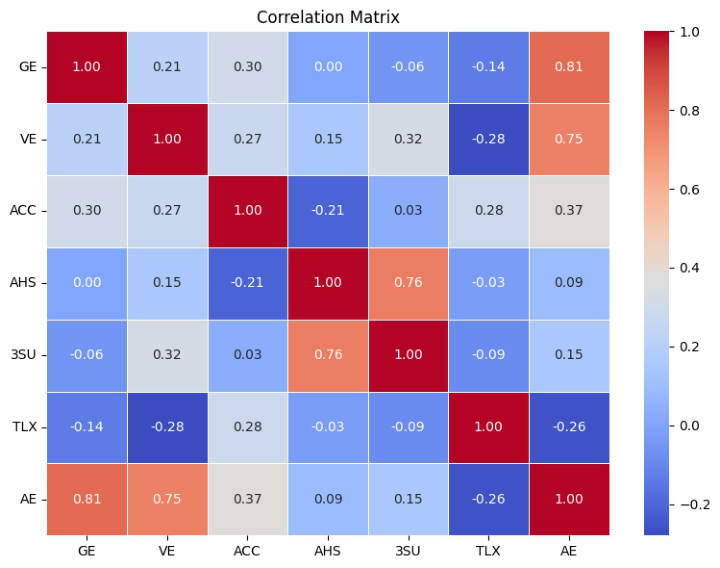
We present our analysis of task performance metrics across participants with varying levels of VR experience, 3D gaming expertise, and their composite. Pearson’s correlation analysis (Zacca et al., 2024) revealed that participants with combined VR and 3D gaming expertise consistently outperformed other groups (cf. fig. 3), motivating subsequent ANOVA-based group comparisons.
Average expertise (the composite of VR and 3D gaming proficiency) was more strongly associated with performance than either dimension alone. Accuracy correlated most with average expertise (r = 0.366), followed by gaming (r = 0.297) and VR experience (r = 0.270). Workload (NASA- TLX) showed a negative correlation with average expertise (r = –0.26), indicating reduced perceived task load among more proficient participants. Spatial usage and hand speed showed weaker associations (r = 0.151 and
Combined Effects of VR and Gaming Expertise on Precision Performance 951
r = 0.095, respectively), suggesting that spatial efficiency and motor speed remain broadly stable across expertise levels.
Increasing F-scores and decreasing p-values—approaching the conventional threshold of 0.05 indicate growing likelihood of rejecting the null hypothesis (cf. Table 1). Higher F-scores reflect greater variance between group means relative to within-group variance, while lower p-values suggest stronger evidence that observed differences are not due to chance. A p-value approaching 0.05 from above implies a more substantial impact than other results (Habibzadeh, 2024).
Figure 3: Pearson’s r-values for gaming experience, VR experience, and average expertise with key performance metrics. Average expertise shows stronger correlations with Accuracy (0.366), 3d space usage (0.151), and hand speed (0.095) compared to Gaming and VR expertise individually. The axis labels are gaming expertise (GE), VR experience (VE), accuracy (ACC), average hand speed (AHS), 3d space usage (3SU), NASA TLX score (TLX), and average experience (AE).
Effect sizes were interpreted using conventional thresholds (Goulet- Pelletier and Cousineau 2018): negligible < 0.01, small 0.01 – 0.059, medium 0.06 – 0.139, and large ≥0.14. Partial η2 and ω2 were estimated assuming one-way ANOVA with three groups. Negative ω2-values were truncated to zero.
These trends are consistent with ANOVA and effect size results in Table 1. Accuracy showed the strongest group-level effects with average expertise yielding a large effect (η2
p = 0.158, ω2 = 0.103). NASA-TLX and volume covered showed medium effects (η2
p ≈0.07 – 0.08) while hand speed yielded
only a negligible effect (η2
p=0.009). These findings suggest that combined proficiency primarily enhances precision and reduces workload rather than altering motor speed.
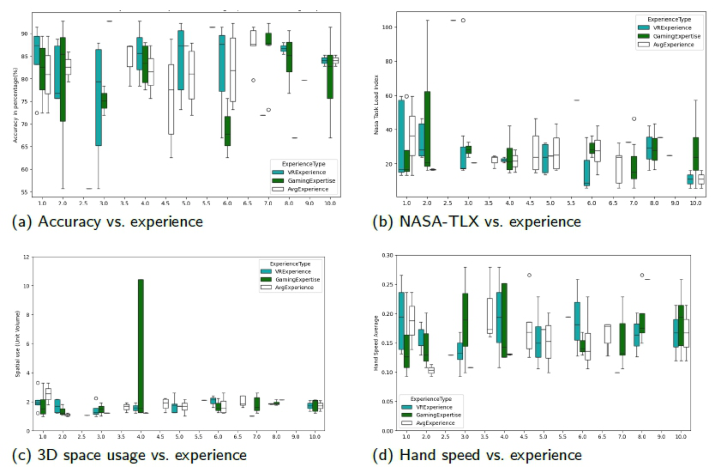
Accuracy ANOVA results showed VR experience had only a minimal effect on task accuracy (F = 1.532, p = 0.231), with a small effect size (η2 = 0.087, ω2 = 0.034). While not statistically significant, fig. 4a suggests accuracy improves and variability decreases at higher experience levels (8–10), indicating possible nonlinear gains.
Table 1: Combined ANOVA and effect size results for (a) Accuracy, (b) NASA-TLX scores, (c) volume covered, and (d) hand speed across VR experience, 3d gaming expertise, and average expertise. Effect sizes include partial η2p and ω2 estimated for one-way ANOVA with three categories (Cat.): low (< 30%), medium (30%–80%), and high (> 80%). Negative ω2-values truncated to zero. Magnitude thresholds (Mag.) are: negligible < 0.01, small 0.01–0.059, medium 0.06–0.139, and large ≥0.14.
Table available in the original PDF paper.
(a) Metric F p Cat. η2 p ω2 Mag.
VR 1.532 0.231 High 0.087 0.030 med Gaming 1.896 0.167 High 0.106 0.049 med Average 3.012 0.063 Med 0.158 0.103 large
(b) Metric F p Cat. η2 p ω2 Mag.
VR 2.016 0.150 High 0.112 0.055 med Gaming 0.160 0.853 — 0.010 0.000 neg Average 1.252 0.300 Med 0.073 0.014 med
(c) Metric F p Cat. η2 p ω2 Mag.
VR 0.410 0.667 Med 0.025 0.000 small Gaming 1.230 0.306 Med 0.071 0.013 med Average 1.317 0.282 Med 0.076 0.018 med
(d) Metric F p Cat. η2 p ω2 Mag.
VR 1.352 0.273 Low 0.078 0.020 med Gaming 1.943 0.160 Med 0.108 0.051 med Average 0.151 0.861 High 0.009 0.000 neg
Combined Effects of VR and Gaming Expertise on Precision Performance 953
3D gaming expertise also showed no significant impact (F = 1.896, p = 0.167), though the effect size was slightly larger (η2
p = 0.106, ω2 = 0.052). Participants with greater gaming proficiency improved accuracy and consistency, suggesting improved reliability despite similar mean performance.
The strongest pattern emerged for average combined expertise in VR and 3d gaming, which is a suggestive trend (F = 3.012, p = 0.063) and showed a large effect size (η2
p = 0.158, ω2 = 0.103). Participants with higher combined proficiency performed more accurately and more consistently (cf. fig. 4a), supporting our hypothesis that synergy across domains enhances precision in VR tasks.
NASA-TLX SCORE ANOVA revealed no significant effect of VR experience on NASA-TLX scores (F = 2.016, p = 0.150), with a small effect size (η2 p = 0.112, ω2 = 0.059). While not conclusive, Fig. 4b shows a slight downward trend at higher experience levels, suggesting a possible reduction in perceived workload among more experienced users.
Equation reproduced from the original PDF.Equation reproduced from the original PDF.
p = 0.072, ω2 = 0.019), though fig. 4b suggests a modest trend toward reduced workload. This points to a potential cumulative benefit, warranting further investigation with larger samples and confidence intervals.
Volume Covered in 3D Space ANOVA showed no significant effect of VR experience on volume covered (F = 0.410, p = 0.667), with negligible effect size (η2 p = 0.025, ω2 = 0.000). VR familiarity did not substantially influence spatial extent, though fig. 4c suggests moderate experience may support more efficient spatial awareness.
Equation reproduced from the original PDF.
p = 0.071, ω2 = 0.018). Spatial requirements remained consistently low across proficiency levels, indicating limited influence on movement strategies.
Equation reproduced from the original PDF.
p = 0.076, ω2 = 0.023). Nonetheless, fig. 4c suggests participants with dual proficiency may exhibit more refined spatial usage, pointing to a potential synergy in movement control worth exploring in future studies with larger samples and finer spatial metrics.
Hand Speed VR experience showed no significant effect on hand speed (F = 1.352, p = 0.273), with a small effect size (η2 p = 0.078, ω2 = 0.025). Hand speed remained stable across experience levels (medians ≈0.15 – 0.2), though greater variability among less experienced participants suggests differences in early motor adaptation (Fig. 4d).
Figure 4: Performance metrics across expertise levels. (a) Accuracy improves with VR experience; 3d gaming expertise alone is not significant though combined expertise trends higher. (b) NASA-TLX shows no significant effects with a mild downward trend for combined expertise. (c) Spatial usage has no significant effects though combined expertise shows a tighter use of space. (d) Hand speed differences are non-significant with a small trend toward 3d gaming expertise. See text for actual F-scores and p-values.
3D gaming expertise also had no significant impact (F = 1.943, p = 0.160), with a slightly larger effect size (η2
p = 0.108, ω2 = 0.054). While higher expertise may be linked to marginally faster movements, inconsistent trends across levels imply that individual strategies may play a larger role.
Equation reproduced from the original PDF.
p = 0.009, ω2 = 0.000). Although none of the factors significantly influenced hand speed, a modest trend associated with 3d gaming proficiency suggests a potential role in motor control warranting further investigation with larger samples and finer metrics.
DISCUSSION
Our findings indicate that performance in precision VR tasks depends less on standalone VR or 3d gaming experience than on their combination. Participants with balanced proficiency across both domains consistently outperformed participants with experiences in only one of these domains, showing higher accuracy, lower workload, better spatial efficiency, and steadier hand movements. This supports our view that synergistic cross- domain skills, not isolated expertise, drive optimal outcomes.
While VR experience builds device familiarity and sensorimotor comfort, transferable skills from traditional video games, especially mission-based and
Combined Effects of VR and Gaming Expertise on Precision Performance 955
arcade-style titles, often confer a sharper performance edge. Such games cultivate fast visuomotor coupling, spatial updating, target selection under time pressure, and a challenge orientated mindset (e.g., iterative strategy shifting, error tolerance, persistence). When combined with familiarity in VR, these competencies translate to tighter movement control, more efficient problem solving, and steadier performance under task load. In contrast, VR- only exposure rarely provides the dense, feedback-rich micro-challenges that hone adaptive control and heuristic switching.
The practical takeaway is clear: blending a gaming-derived challenge approach with VR experience produces more capable and resilient VR users, which is precisely the profile needed for precision-demanding tasks. That said, our findings may be constrained by the sample size available to us, which limits statistical power and generalizability. Larger cohorts are needed to improve statistical reliability. Moreover, our study only relied on visual cues. Adding haptic and auditory feedback could both enhance performance as well as increase ecological validity. Future work should test the bidirectional transfer of skills between physical and VR analogs, broaden task types beyond a single precision task, and model demographic moderators (e.g., age, gender) to better characterize who benefits most from blending gaming-derived challenges and VR experience.
Limitations and Future Work The modest sample size (n = 35) constrains the statistical power of our analyses and limits the generalizability of our study’s results. Larger and more diverse cohorts will be necessary to validate these trends and to better capture demographic moderators such as age, gender, and prior technical background. Second, expertise levels, measured through self- reported scales, may introduce subjectivity or recall bias. Future work should incorporate more objective skill set measures such as logged gameplay history or standardized VR training assessments. Third, our experimental setup primarily relied on visual feedback but without haptic or auditory cues. Although our study design provided a controlled environment, it also reduced ecological validity. Adding multimodal feedback in future studies may reveal stronger effects and different interaction patterns. Finally, our study examined a single precision task, a VR version of the buzz-wire game, which may not fully represent the diversity of real-world precision tasks. Expanding the task set to include surgical simulations, robotic teleoperation, or assembly tasks will provide broader insights into how cross-domain expertise influences VR performance.
CONCLUSION
We presented our study comparing task performance between VR-only, 3d gaming-only, and combined domain expertise. We found that individuals with combined expertise in both VR and 3d gaming outperformed those with experience in only one domain by demonstrating higher accuracy, greater consistency, and modest reductions in workload as well as in use of available interaction space. In contrast, isolated expertise in VR or
3d gaming only provided limited benefits with statistically non-significant effects. Our findings suggest that cultivating multi-domain skills enhances user adaptability and precision in complex VR tasks, which may provide guidance in the design of future VR applications.
REFERENCES
A. Basu (2022) “STAG: A Tool for realtime Replay and Analysis of Spatial Trajectory and Gaze Information captured in Immersive Environments”. In: 2022 IEEE Conference on Virtual Reality and 3D User Interfaces Abstracts and Workshops (VRW) pp. 43–45. A. Close, S. Field, and R. Teather (2024) “Visual thinking in virtual environments:
Evaluating multidisciplinary interaction through drawing ideation in real-time remote co-design”. In: Frontiers in Virtual Reality 4, p. 1304795. A. Maneuvrier (2024) “Experimenter Bias: Exploring the Interaction between Participant’s and Investigator’s Gender/Sex in VR” in: Virtual Reality 28.2, p. 96. A. Munawar, Z. Li, N. Nagururu, D. Trakimas, P. Kazanzides, R. H. Taylor, and F. X.
Creighton (2024) “Fully immersive virtual reality for skull-base surgery: surgical training and beyond”. In: International journal of computer assisted radiology and surgery 19.1, pp. 51–59. B. Moharana, C. Keighrey, and N. Murray (2024) “Voices Unveiled: Quality of Experience in Collaborative VR via AssemblyAI and NASA-TLX Analysis”. In: 16th International Conference on Quality of Multimedia Experience (QoMEX) pp. 15–21. C. Creed, M. Al-Kalbani, A. Theil, S. Sarcar, and I. Williams (2024) “Inclusive AR/
VR: accessibility barriers for immersive technologies”. In: Universal Access in the Information Society 23.1, pp. 59–73. C. Pacchierotti, F. Chinello, K. Koumaditis, M. Di Luca, E. Ofek, and O. Georgiou (2024) “Haptics in the Metaverse: Haptic feedback for Virtual, Augmented, Mixed, and eXtended Realities”. In: IEEE Transactions on Haptics (ToH). C. Sagnier, E. Loup-Escande, and G. Vall’ery (2020) “Effects of gender and prior
experience in immersive user experience with virtual reality”. In: Advances in Usability and User Experience: Proceedings of the AHFE 2019 International Conferences on Usability & User Experience, and Human Factors and Assistive Technology, pp. 305–314. C. Uz-Bilgin and M. Thompson (2022) “Processing presence: how users develop spatial presence through an immersive virtual reality game”. In: Virtual Reality 26.2, pp. 649–658. D. D. Georgiev, I. Georgieva, Z. Gong, V. Nanjappan, and G. V. Georgiev (2021)
“Virtual Reality for Neurorehabilitation and Cognitive Enhancement”. In: Brain Sciences 11.2, p. 221. D. Hufnal, E. Osborne, T. Johnson, and C. Yildirim (2019) “The impact of controller type on video game user experience in virtual reality”. In: 2019 IEEE Games, Entertainment, Media Conference (GEM) pp. 1–9. E. A. Bellei, D. Biduski, L. Andressa Brock, D. I. Patr’ıcio, J. L. de Souza, A. C. B. De
Marchi, and R. Rieder (2018) “Prior experience as an influencer in the momentary user experience: An assessment in immersive virtual reality game context”. In: 2018 20th Symposium on Virtual and Augmented Reality (SVR) pp. 1–9. E. Mendeleev, D. Burtseva, Y. Kiliba, R. Petrov, S. Bozhkov, I. Milenov, and P. Bozhkov (2022) “Virtual Design of Physical Processes”. In: 2022 22nd International Symposium on Electrical Apparatus and Technologies (SIELA) pp. 1–4.
Combined Effects of VR and Gaming Expertise on Precision Performance 957
F. Habibzadeh (2024) “On the use of receiver operating characteristic curve analysis to determine the most appropriate p value significance threshold”. In: Journal of Translational Medicine 22.1, p. 16. F. Pallavicini, A. Ferrari, A. Zini, G. Garcea, A. Zanacchi, G. Barone, and
F. Mantovani (2018) “What distinguishes a traditional gaming experience from one in virtual reality? An exploratory study”. In: Advances in Human Factors in Wearable Technologies and Game Design: Proceedings of the AHFE 2017 International Conference on Advances in Human Factors and Wearable Technologies, pp. 225–231. H. Cecotti, M. Leray, and M. Callaghan (2024) “Countdown VR: a Serious Game in Virtual Reality to Develop Mental Computation Skills”. In: IEEE Transactions on Games. H. S. Alazmi and G. M. Alemtairy (2024) “The effects of immersive virtual reality
field trips upon student academic achievement, cognitive load, and multimodal presence in a social studies educational context”. In: Education and Information Technologies, pp. 1–23. J. C. Goulet-Pelletier and D. Cousineau (2018) “A review of effect sizes and their confidence intervals, Part I: The Cohen’s d family”. In: The Quantitative Methods for Psychology 14.4, pp. 242–265. J. C. Vaz, N. Kosanovic, and P. Oh (2024) “ART: Avatar Robotics Telepresence—the
future of humanoid material handling loco-manipulation”. In: Intelligent Service Robotics 17.2, pp. 237–250. J. GomezRomero-Borquez, C. Del-Valle-Soto, J. A. Del-Puerto-Flores, R. A. Briseno and J. Varela-Ald’as (2024) “Neurogaming in Virtual Reality: A Review of Video Game Genres and Cognitive Impact”. In: Electronics 13.9, p. 1683. J. Huang (2024) “Modeling and Mesh Processing for Games”. In: Encyclopedia of
Computer Graphics and Games, pp. 1175–1178. J. J. Zacca, C. P. S. J’auregui, F. M. V. Bardales, J. R. Yabar, J. E. E. Soria, and V. D. A. Caro (2024) “Correlation coefficient distribution and its application in the comparison of chemical data sets”. In: Chemometrics and Intelligent Laboratory Systems 248, p. 105091. J. Jerald, P. Giokaris, D. Woodall, A. Hartholt, A. Chandak, and S. Kuntz (2014)
“Developing virtual reality applications with Unity”. In: 2014 IEEE Virtual Reality (VR) pp. 1–3. Khronos Group (2024) OpenXR - A Royalty-Free Standard for Virtual Reality and Augmented Reality. https://www.khronos.org/openxr/. Accessed: 2024–09-15. Lee, H. Chiu, J. Xiang, A. Klement, Y. Park, C. Varel, W. Lin, F. Sulem, B. Huh,
N. Malecki, et al. (2024) “90–1: Invited Paper: Quest 3 Immersive Display with High PPI and Hybrid Backplane Technology”. In: SID Symposium Digest of Technical Papers. Vol. 55, pp. 1258–1261. Lento, E. Segas, V. Leconte, E. Doat, F. Danion, R. P’eteri, J. Benois-Pineau, and A. de Rugy (2024) “3D-ARM-Gaze: A Public Dataset of 3D Arm Reaching Movements with Gaze Information in Virtual Reality”. In: Scientific Data 11.1, p. 951. M. Aros, C. L. Tyger, and B. S. Chaparro (2024) “Unraveling the Meta Quest 3:
An Out-of-Box Experience of the Future of Mixed Reality Headsets”. In: International Conference on Human-Computer Interaction, pp. 3–8. M. Cavus (2024) “Comparison of one-way ANOVA tests under unequal variances in terms of median p-values”. In: Communications in Statistics-Simulation and Computation 53.4, pp. 1619–1632. M. J. M. Sunny and A. Basu (2024) “Non-linear parameterization of spatial decision
making in immersive virtual environment”. In: 2024 IEEE Conference on Virtual Reality and 3D User Interfaces Abstracts and Workshops (VRW) pp. 389–395. doi: 10.1109/VRW62533.2024.00076.
M. Sanaei, S. B. Gilbert, N. Javadpour, H. Sabouni, M. C. Dorneich, and J. W.
Kelly (2024) “The Correlations of Scene Complexity, Workload, Presence, and Cybersickness in a Task-Based VR Game”. In: International Conference on Human-Computer Interaction, pp. 277–289. N. A. A. Gonzàlez (2018) “Development of spatial skills with virtual reality and augmented reality”. In: International Journal on Interactive Design and Manufacturing (IJIDeM) 12, pp. 133–144. P. Bimberg, T. Weissker, and A. Kulik (2020) “On the Usage of the Simulator
Sickness Questionnaire for Virtual Reality Research”. In: 2020 IEEE Conference on Virtual Reality and 3D User Interfaces Abstracts and Workshops (VRW) pp. 464–467. doi: 10.1109/VRW50115.2020.00098. P. Wang, M. R. Miller, E. Han, C. DeVeaux, and J. N. Bailenson (2024) “Understanding virtual design behaviors: A large-scale analysis of the design process in Virtual Reality”. In: Design Studies 90, p. 101237. S. Noh, S. Park, and G. J. Kim (2024) “OnVehicleVR: Mitigating Sickness in On-
Vehicle Virtual Reality by Mixing in Synchronized Vehicle Motion Information”. In: IEEE Access. T. Garg, P. F. Velasco, E. Z. Patai, C. P. Malcolm, V. Kovalets, V. D. Bohbot, A.
Coutrot, M. Hegarty, M. Hornberger, and H. J. Spiers (2024) “The relationship between object-based spatial ability and virtual navigation performance”. In: PLoS One 19.5, e0298116. T. Zioga, A. Ferentinos, E. Konsolaki, C. Nega, and P. Kourtesis (2024) “The Effects of Videogame Skills Across Diverse Genres on Verbal and Visuospatial Short- Term and Working Memory, Hand-Eye Coordination, and Empathy in Early Adulthood”. In: Behav. Sci. 14, p. 874. Y. Pan (2024) “Sports game teaching and high precision sports training system based
on virtual reality technology”. In: Entertainment Computing 50, p. 100662. Y. Peng, C. Yu, S. Liu, C. Wang, P. Taele, N. Yu, and M. Y. Chen (2020) “Walkingvibe: Reducing virtual reality sickness and improving realism while walking in vr using unobtrusive head-mounted vibrotactile feedback”. In: Proceedings of the 2020 CHI conference on human factors in computing systems, pp. 1–12.
LISTED IN THE AHFE DIGITAL BOOKSTORE CATALOGUE
Explore the complete digital volume
Human Factors in Design, Engineering, and Computing
Read this individual research paper free through the original publisher, or explore the full digital proceedings book.
ISBN 978-1-964867-75-5
Explore this ISBN in the AHFE Bookstore ↗Listed in the July 2026 bookstore catalogue; search by ISBN to confirm current availability · Digital book purchase optional