Faezeh Salehi, Manish Dixit (2025). Exploring the Influence of Environmental Context on Visual Attention and Spatial Perception in Virtual Reality. In: Intelligent Human Systems Integration (IHSI 2025): Integrating People and Intelligent Systems. AHFE Open Access, vol. 160, pp. 816–827. https://doi.org/10.54941/ahfe1005888
Spatial perception plays a fundamental role in how individuals navigate and interact with their environments, and visual attention, particularly fixation patterns and durations, is a key component of this process. This study examines how fixation behaviors vary across different environmental contexts using Distance Perception (DP) and Size Perception (SP) tests conducted in virtual reality (VR). Participants were placed in three distinct environments: a cityscape with familiar landmarks (Control Group), a simulated Martian surface with limited spatial cues (Experiment Group 1), and an outer space simulation devoid of recognizable reference points (Experiment Group 2). Eye-tracking data captured variations in fixation counts and durations to explore how these factors are influenced by environmental familiarity and complexity. In the DP test, participants demonstrated the highest fixation counts in the Control Group, with an average of 24.59 fixations, compared to 21.25 in EG1 and 22.19 in EG2. The analysis suggested significant shifts in visual attention strategies when participants moved from the familiar cityscape setting (CG) to EG2, where fixation counts dropped notably. Between the CG and EG2, patterns were more comparable, with similar fixation counts suggesting overlapping visual engagement demands. Additionally, fixation durations were longest in the CG, averaging 4.80 seconds, indicating sustained engagement with the stimuli. In contrast, durations in the EG1 (4.17 seconds) and EG2 (4.23 seconds) environments were shorter, reflecting a reduced level of sustained focus in unfamiliar or visually sparse conditions. The SP test provided further insights into how participants directed their attention across objects within each environment. Participants in the Control Group exhibited the highest fixation frequencies, with an average of 28.34 fixations per trials, compared to 22.67 fixations in Experiment Group 1 and 23.12 fixations in Experiment Group 2. Alongside the increased fixation frequency, the Control Group also demonstrated longer average fixation durations when interacting with objects, indicating stronger engagement and familiarity with the environment. A clear relationship emerged between fixation counts and durations, suggesting that objects attracting more frequent gazes also held participants’ attention for longer periods. Changes in fixation behaviors were most pronounced when comparing the Control Group to the Martian environment (EG1), highlighting the cognitive adjustments required when transitioning to less familiar settings. These findings illustrate how environmental context influences visual attention patterns and, by extension, spatial perception. Environments with familiar visual landmarks, such as the cityscape, supported greater fixation counts and longer durations, reflecting enhanced cognitive engagement and processing efficiency. In contrast, the Martian and space environments (Eg1 and EG2), characterized by reduced or unfamiliar spatial cues, required participants to adopt different visual strategies, leading to altered fixation patterns. This research highlights the importance of environmental familiarity in influencing visual attention and spatial perception. It also emphasizes the importance of eye-tracking data in designing effective training and operational environments, especially for fields like space exploration, where adapting to unfamiliar conditions is crucial. Future research should explore the effects of demographic factors and task complexity to create more targeted strategies for improving spatial performance in demanding contexts.
Technological advancements have enabled humans to explore extreme environments such as space, deep oceans, and polar regions, where altered visuospatial conditions challenge cognitive processing and navigation (Loomis et al., 2023; Montello & Battersby, 2022). Spatial perception, which includes orientation, depth perception, and object recognition, is essential for efficient movement and decision-making (Munns et al., 2022). On Earth, familiar landmarks like roads and trees support spatial awareness, but their absence in extraterrestrial and deep-sea environments increases cognitive load, leading to errors in distance and size estimation (Klatzky, 2024).
In environments lacking traditional spatial cues, individuals rely on internal representations, vestibular inputs, and proprioception to maintain orientation (Jürgens & Becker, 2011). Deep space conditions, where reference points are completely absent, further impair spatial perception, highlighting the need for innovative training methods and sensory augmentation (Spencer et al., 2012). Earth-based analogs, such as deserts and polar regions, help simulate these challenges for astronaut training and preparation
Exploring the Influence of Environmental Context on Visual Attention 817
(Clément et al., 2022). This study examines how spatial cue availability in VR impacts size and distance perception, hypothesizing that familiar visual references improve spatial accuracy. The findings aim to inform training protocols for astronauts, divers, and professionals in visually degraded environments.
Spatial Perception, Landmarks, and Virtual Reality Research Spatial perception is a fundamental cognitive ability that allows individuals to interpret spatial relationships, distances, and object sizes within their environment (Clément et al., 2022). It integrates external sensory information (exteroception) and internal awareness (interoception) to support navigation, object localization, and movement coordination (Montello & Battersby, 2022). A key aspect of visuospatial perception involves processing object positions and motion through distinct neural pathways, with the parieto- occipital region handling spatial orientation and the inferotemporal region recognizing object form and color (Chrastil & Warren, 2012).
Landmarks play a crucial role in spatial cognition, serving as reference points for navigation and spatial memory formation (Kelly & Lea, 2023). Familiar objects such as roads, buildings, and trees enhance spatial accuracy by providing metric cues for distance and size estimation, reducing cognitive effort (Spencer et al., 2012). Conversely, environments lacking landmarks, such as deserts, polar regions, or deep space, disrupt spatial awareness, requiring individuals to rely more on internal spatial representations and alternative sensory cues (Clément et al., 2022). Studies highlight that spatial accuracy is influenced by factors like 2D vs. 3D spatial representation, scale, and the availability of visual landmarks, which collectively shape wayfinding efficiency (Montello & Battersby, 2022).
Distance and size perception are interdependent cognitive processes, as individuals often estimate distance based on retinal size and depth cues (Klatzky, 2024). Inaccuracies in size perception can distort distance judgments, leading to systematic biases—such as overestimating the size of distant objects and underestimating the size of nearby ones (Munns et al., 2022). These distortions are particularly evident in featureless environments, where the absence of depth cues forces greater reliance on binocular stereopsis and motion-based estimations (Jürgens & Becker, 2011).
Recent advancements in Virtual Reality (VR) have revolutionized spatial perception research, offering controlled, immersive environments to examine spatial cognition under varying conditions (Bosco et al., 2023). VR enables systematic manipulation of spatial cues, making it a powerful tool for studying navigation, distance estimation, and size perception in environments where real-world testing is impractical (Strappini et al., 2023). Studies have demonstrated VR’s effectiveness in assessing spatial learning, memory, and adaptation to extreme conditions—including microgravity, simulated Martian landscapes, and deep-space settings (Ekstrom & Hill, 2023; Kelly & Lea, 2023). These findings emphasize VR’s potential for astronaut training, spatial cognition research, and the development of adaptive navigation strategies in altered environments.
818 Salehi and Dixit
Fixation Patterns and Visual Attention Fixation patterns are a key indicator of visual attention, as they reflect how individuals allocate cognitive resources while processing spatial information. Research has shown that longer fixation durations are associated with sustained attention and deeper cognitive processing, while shorter fixations suggest rapid scanning or difficulty extracting relevant information (Munns et al., 2022). Studies using eye-tracking have demonstrated that high fixation frequency on specific objects correlates with increased cognitive engagement, reinforcing the idea that visual attention is guided by task demands and environmental complexity (Chrastil & Warren, 2012).
The relationship between fixation behavior and spatial perception has been extensively studied in wayfinding and object recognition. Research suggests that in environments with rich visual cues, individuals distribute fixations more evenly, facilitating efficient navigation and decision-making (Ekstrom & Hill, 2023). Conversely, in featureless or unfamiliar environments, fixation patterns become more erratic, indicating increased cognitive load and uncertainty (Montello & Battersby, 2022). These findings highlight the role of visual attention in adapting to different spatial contexts, shaping how people interpret and interact with their surroundings.
METHODS
Previous research on spatial perception has primarily focused on traditional environments, extensively examining navigation, distance estimation, and the role of visual cues (Muhl-Richardson et al., 2018). While these studies have provided valuable insights, there remains a notable gap in understanding how the absence or reduction of landmarks affects spatial perception in Virtual Reality (VR) settings (Bruns & Chamberlain, 2019; Starrett et al., 2021). Only a limited number of studies have explored this issue comprehensively, highlighting the need for further investigation into spatial cognition in VR environments where familiar spatial cues are absent or altered (Engle et al., 2016; Salehi et al., 2024b). While spatial perception has been widely studied in traditional settings, research on how the absence of landmarks affects perception in Virtual Reality (VR) remains limited. Recent studies highlight the role of visual attention and fixation behaviors, showing that familiar landmarks enhance spatial accuracy, whereas unfamiliar or featureless environments alter perception (Munoz et al., 2003; Salehi et al., 2024a; Ziv, 2016). However, few studies have systematically examined how fixation patterns and perception change when spatial cues are removed (Camp & Harcum, 1964; Kim & Kim, 2020; Van Pahla et al., 1996).
This study investigates the impact of absent familiar landmarks on spatial perception using VR-based Distance and Size Perception tests. By analyzing fixation behaviors across different environments, this study aims to understand how individuals’ visual attention varies, providing insights for training in space exploration and extreme environments.
Study Environments and Test Instruments We created a Virtual Reality (VR)-eye-tracking user interface to study spatial cognition and gaze behavior. VR is a powerful tool for studying size and
Exploring the Influence of Environmental Context on Visual Attention 819
distance perception, allowing researchers to manipulate spatial variables in controlled environments. Studies have shown that contextual cues, body- based references, and sensory integration significantly influence perception in VR. For example, environmental textures and object placement affect size judgments, while hand size manipulations alter perceived object dimensions (Kelly & Lea, 2023). Research on distance perception highlights the role of binocular disparity for near-field judgments and motion parallax for far-field estimations (Sahm et al., 2005).
The Distance Perception (DP) and Size Perception (SP) tests assess how individuals interpret spatial relationships by evaluating their ability to estimate object distances and sizes in different environments (Loomis & Knapp, 2003; Phillips et al., 2004). DP tests measure how accurately participants perceive the distance between objects or their placement within a scene, relying on visual depth cues such as binocular disparity, motion parallax, and perspective (Montello & Battersby, 2022; Pagano & Bingham, 1998). SP tests focus on size estimation by analyzing how participants judge an object’s relative or absolute size, which is influenced by retinal image size, environmental context, and prior knowledge (Klatzky, 2024). These tests are widely used in spatial cognition research, particularly in virtual reality (VR) environments, to explore how spatial cues, or their absence, affect human perception and adaptation in both Earth-like and extreme settings (Ekstrom & Hill, 2023).
VR Environment Setup for the Study This study utilized Unity 3D to develop immersive VR environments for both control and experimental conditions. Participants were divided into three groups, each experiencing a distinct VR setting:
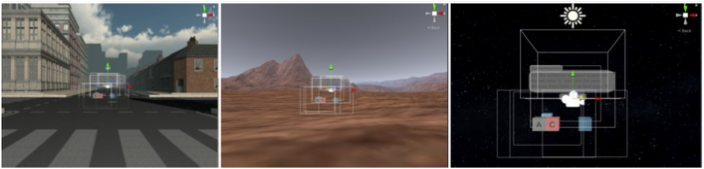
Control Group (CG): Explored a cityscape with familiar landmarks and rich visual cues.
Experimental Group 1 (EG1): Experienced a Martian-like environment with some visual cues but lacking recognizable landmarks.
Experimental Group 2 (EG2): Entered an outer space simulation devoid of any spatial frames of reference, mimicking astronaut spacewalk conditions.
Figure 1: Study environments: a) city environment, CG, b) mars environment, EG1, c) space environment, EG2 (images from Salehi et al., 2024a).
820 Salehi and Dixit
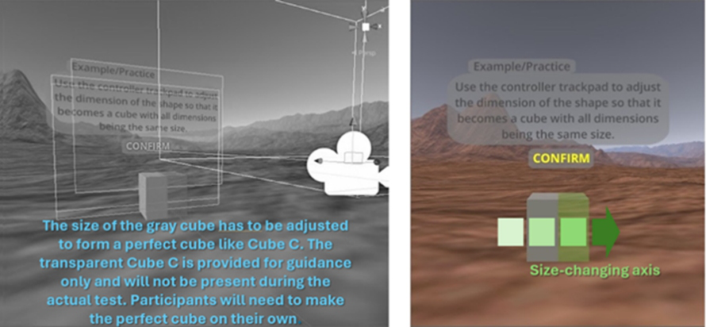
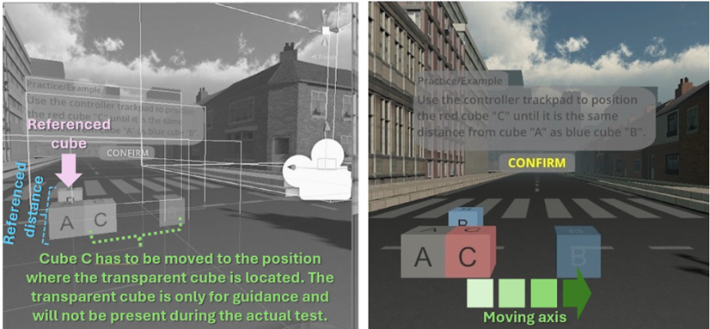
Figure 2: Size perception (SP) test procedure (images from Salehi et al., 2024a).Figure 3: Distance perception (DP) test procedure (images from Salehi et al., 2024a).
Each environment varied in the availability of spatial cues, with the cityscape providing the most, the Martian terrain offering limited cues, and the outer space setting completely lacking reference points (Figure. 1). To ensure consistent visual quality across conditions, all environments were designed with similar rendering fidelity.
Participants completed size and distance perception tests within each setting (Figures 2 and 3), allowing for an in-depth analysis of how the presence or absence of spatial landmarks influences perception. These findings will contribute to understanding how individuals adapt to unfamiliar spatial conditions, with potential applications in space exploration, virtual training, and real-world navigation strategies.
Participant Recruitment and Study Procedure With IRB approval from Texas A&M University, recruitment targeted students with normal or corrected-to-normal vision via university emails between February 11, 2019, and February 20, 2024. A total of 233 participants (ages 18–52) provided informed consent and could withdraw
Exploring the Influence of Environmental Context on Visual Attention 821
at any time. Among them, 187 were non-gamers and 46 were gamers, with 96 females and 137 males. Participants were distributed across five age groups, with the largest group aged 18–27. Conducting the study required careful workflow management, especially given logistical challenges and COVID-19-related disruptions. While the study focused on individuals adapting to extreme environments, astronauts, divers, and polar researchers were excluded to prevent bias, as their specialized training could influence spatial perception results. Before the main study, participants attended an introductory session to familiarize themselves with the procedures, equipment, and instructions. After providing informed consent, they completed: a demographic survey and a pre-test survey for assessing predicted physical responses. The study was conducted in a controlled environment using an HTC VIVE Pro Eye Head-Mounted Display (HMD). The VR controller automatically recorded accuracy and response times, while graduate students ensured smooth equipment operation. During testing, participants sat in a swivel chair, interacting with the VR environment via the controller. A post-test survey compared responses before and after the experiment. Hygiene protocols were followed with cleaning supplies provided for the equipment.
RESULTS
To analyze the data collected during the DP test, we conducted a series of statistical tests to evaluate differences in fixation counts and durations across the three experimental conditions: the Control Group (CG), Experimental Group 1 (EG1), and Experimental Group 2 (EG2). First, we assessed the normality of the data using the Shapiro-Wilk test, which indicated that the fixation counts did not follow a normal distribution across all groups (p < 0.001). Consequently, we employed the non-parametric Kruskal-Wallis test to compare fixation counts among the three conditions, followed by Dunn-Bonferroni post-hoc pairwise comparisons to identify specific group differences. These analyses allowed us to evaluate how varying levels of spatial cues influenced participants’ visual attention strategies and spatial perception in the DP test.
In the DP test, participants demonstrated the highest fixation counts in the Control Group (CG), with an average of 24.59 fixations, compared to 21.25 in EG1 and 22.19 in EG2. A Kruskal-Wallis test revealed a statistically significant difference in fixation counts across the three conditions (H(2) = 8.25, p = 0.016), indicating that environmental familiarity influenced visual attention. Post-hoc pairwise comparisons using the Dunn-Bonferroni method revealed significant differences in fixation counts between certain conditions. The comparison between the Control Group (CG) and EG1 showed a significant difference (Z = 2.52, p = 0.012), indicating that participants in the familiar urban setting (CG) exhibited higher fixation counts than those in EG1. However, the difference between CG and EG2 was not statistically significant (Z = 1.73, p = 0.083), suggesting that visual engagement in EG2 (outer space) was more comparable to CG despite the lack of familiar landmarks. Similarly, the difference
822 Salehi and Dixit
between EG1 and EG2 was also not statistically significant (Z = 1.67, p = 0.096), indicating that fixation patterns in these less familiar environments were similar. These findings emphasize the significant shift in visual attention strategies between CG and EG1 while highlighting overlapping demands in EG1 and EG2.
Fixation durations were also longest in the CG, averaging 4.80 seconds, compared to 4.17 seconds in EG1 and 4.23 seconds in EG2. These results suggest that participants exhibited sustained engagement in the familiar urban setting (CG), while fixation durations and counts in EG1 and EG2 reflected reduced focus and visual engagement in less familiar or visually sparse environments. This trend highlights the cognitive adjustments required when spatial cues are limited or absent.
For the SP test, we conducted a Shapiro-Wilk test to assess normality, which indicated that fixation counts did not follow a normal distribution across all conditions (CG: W = 0.882, p < 0.001; EG1: W = 0.841, p < 0.001; EG2: W = 0.792, p < 0.001). Given these results, we applied a non- parametric Kruskal-Wallis test to compare fixation counts among the three conditions, which revealed a statistically significant difference (H(2) = 9.14, p = 0.010), indicating that environmental familiarity influenced how participants directed their visual attention.
Post-hoc pairwise comparisons using the Dunn-Bonferroni method showed a significant difference between the Control Group (CG) and Experiment Group 1 (EG1) (Z = 2.78, p = 0.005), while the difference between CG and Experiment Group 2 (EG2) was marginally significant (Z = 2.01, p = 0.045). However, the comparison between EG1 and EG2 did not reach significance (Z = 1.21, p = 0.113), suggesting that fixation behaviors in these less familiar environments were more similar.
Participants in the Control Group exhibited the highest fixation frequencies, averaging 28.34 fixations per trial, compared to 22.67 in EG1 and 23.12 in EG2. Additionally, fixation durations were longest in CG (5.02 seconds), followed by EG2 (4.41 seconds) and EG1 (4.29 seconds). These results suggest that objects attracting more frequent fixations also held participants’ attention for longer periods, reinforcing the relationship between fixation count and sustained engagement. The most pronounced changes in fixation behaviors occurred when comparing CG to EG1, highlighting the cognitive adjustments required when transitioning from familiar urban settings to environments with reduced spatial cues.
DISCUSSION
The results of this study demonstrate that environmental familiarity significantly influences visual attention and spatial perception, as evidenced by variations in fixation counts and durations across the three experimental conditions. Consistent with previous research, our findings indicate that participants in the Control Group (CG)—where familiar landmarks were present—exhibited the highest fixation counts and longest fixation durations, suggesting enhanced cognitive engagement and spatial awareness (Chrastil & Warren, 2012; Montello & Battersby, 2022). Conversely, environments with
Exploring the Influence of Environmental Context on Visual Attention 823
limited (EG1) or no recognizable spatial cues (EG2) led to notable shifts in fixation behavior, reflecting the cognitive adjustments required to interpret space in unfamiliar settings (Chrastil & Warren, 2012).
Cognitive Load Differences Across Conditions Based on Fixation Patterns The variation in fixation counts and durations across experimental conditions provides insight into the cognitive load imposed by different spatial environments. Higher fixation counts and longer fixation durations in the Control Group (CG) suggest a more detailed and systematic visual processing strategy, likely due to the presence of familiar landmarks that facilitated spatial encoding and reference-based navigation (Montello & Battersby, 2022). The density and variety of these landmarks in the visual scene may have also caused increased visual attention. In contrast, lower fixation counts in EG1 (Mars) and EG2 (outer space) may reflect difficulty in identifying useful spatial cues due to either monotony (EG1) or complete lack (EG2) of landmarks, forcing participants to adopt alternative cognitive strategies or rely on mental representations rather than external references (Chrastil & Warren, 2012).
Reduced Fixations in EG1 and EG2: Cognitive Overload or Strategy Shift?
The decrease in fixation counts in EG1 and EG2 could indicate a shift toward a global scanning strategy rather than detailed visual analysis. In landmark-rich environments like CG, participants fixate frequently on stable reference points to maintain spatial awareness efficiently (Ekstrom & Hill, 2023). However, in featureless environments like EG2 (outer space), fewer fixations may indicate an inability to locate stable spatial references, leading to increased cognitive effort as participants struggle to construct an internal spatial model (Klatzky, 2024).
EG1 (Mars-like terrain): The partial removal of landmarks may have disrupted automatic landmark-referenced spatial encoding, requiring participants to rely more on spatial working memory and proprioceptive cues, which can increase cognitive load (Spencer et al., 2012).
EG2 (outer space): The complete absence of landmarks might have led participants to adopt shorter, less frequent fixations, either due to difficulty anchoring their gaze or the need to process spatial information through broader scanning patterns, both of which increase cognitive strain (Jürgens & Becker, 2011).
Higher Fixation Counts and Durations in CG Indicate Efficient Processing Participants in CG demonstrated significantly higher fixation counts and longer fixation durations, suggesting greater engagement with dense and diverse visual information. This aligns with studies showing that rich spatial environments allow for efficient fixation allocation, reducing the need for excessive cognitive effort (Kelly & Lea, 2023). The higher number
824 Salehi and Dixit
of fixations in CG suggests that participants actively engaged with their surroundings in a systematic manner, reinforcing research on landmark-based spatial perception (Strappini et al., 2023).
Longer fixation durations in CG further indicate that participants spent more time extracting meaningful spatial information, which suggests lower cognitive load compared to EG1 and EG2, where participants had to distribute cognitive resources differently due to missing spatial cues (Clément et al., 2022).
Implications for Cognitive Load in Spatially Degraded Environments The observed differences in fixation behaviors suggest that cognitive load is modulated by environmental familiarity:
1. In CG, participants relied on automatic visual processing, minimizing cognitive strain through efficient fixation allocation on landmarks. 2. In EG1 (Mars-like terrain), fixation reductions indicate greater reliance on internal cognitive processing, increasing working memory demands and cognitive load. 3. In EG2 (outer space), the near absence of fixations suggests extreme difficulty in spatial encoding, leading to potential cognitive overload as participants struggled to form a coherent spatial representation.
These results align with dual-processing theories of spatial cognition, where landmark-based visual strategies are disrupted in unfamiliar environments, requiring the cognitively demanding engagement of mental models (Montello & Battersby, 2022).
Training and Design Implications Understanding how cognitive load varies with spatial cue availability has important implications for training astronauts, pilots, and professionals in visually degraded environments:
Gradual exposure to environments with fewer spatial cues in VR training could help develop adaptive spatial strategies, reducing cognitive overload (Bosco et al., 2023).
Augmenting artificial landmarks or visual anchors in space exploration and planetary navigation could mitigate spatial disorientation and improve task efficiency (Ekstrom & Hill, 2023).
Integrating multisensory feedback (e.g., vestibular and haptic cues) may provide compensatory spatial information, reducing reliance on vision alone in extreme conditions (Spencer et al., 2012).
CONCLUSION
Fixation results suggest that landmark-rich environments (CG) support efficient visual attention and reduce cognitive load, whereas landmark- deficient environments (EG1 and EG2) force participants to shift to alternative strategies, increasing cognitive strain. These findings emphasize the importance of visual cues in maintaining spatial accuracy and reducing
Exploring the Influence of Environmental Context on Visual Attention 825
cognitive burden in extreme conditions. Future VR-based training programs should incorporate adaptive strategies to help individuals manage cognitive load more effectively in degraded visual environments.
FUTURE RESEARCH DIRECTIONS While this study provides valuable insights into visual attention and spatial perception across different environmental contexts, further research should explore the long-term adaptation of fixation behaviors under altered spatial conditions. Future studies could investigate how training duration, individual differences (e.g., gaming experience), or multisensory integration (e.g., haptic or vestibular cues) influence spatial perception strategies in VR-based simulations (Spencer et al., 2012). Additionally, incorporating machine learning models to analyze fixation patterns could enhance our understanding of how individuals optimize spatial strategies over time in featureless environments (Kelly & Lea, 2023).
ACKNOWLEDGMENT
This research was supported by the U.S. National Science Foundation (NSF) under grant number CNS 1928695. The opinions, findings, conclusions, and recommendations expressed in this paper are solely those of the authors and do not necessarily reflect the views of the NSF.
REFERENCES
Booher, H. R., Minninger, J. (2003) “Human systems integration in army systems acquisition”, in: Handbook of human systems integration, Booher, Harold (Ed.). pp. 663–698 Booher, Harold, ed. (2003). Handbook of human systems integration. New Jersey:
Wiley. Bosco, A., Diez, P. S., Filippini, M., De Vitis, M., & Fattori, P. (2023). A focus on the multiple interfaces between action and perception and their neural correlates. Neuropsychologia, 108722. Bruns, C. R., & Chamberlain, B. C. (2019). The influence of landmarks and urban
form on cognitive maps using virtual reality. Landscape and Urban Planning, 189, 296–306. Camp, D. S., & Harcum, E. R. (1964). Visual pattern perception with varied fixation locus and response recording. Perceptual and Motor Skills, 18(1), 283–296. Chapanis, A. (1996). Human factors in systems engineering. Wiley Series in Systems
Engineering and Management. Andrew Sage, series editor. Hoboken, NJ: Wiley. Chrastil, E. R., & Warren, W. H. (2012). Active and passive contributions to spatial learning. Psychonomic bulletin & review, 19, 1–23. Clément, G., Beaton, K. H., Reschke, M. F., & Wood, S. J. (2022). Effects of motion
paradigm on human perception of tilt and translation. Scientific Reports, 12(1), 1430. Ekstrom, A. D., & Hill, P. F. (2023). Spatial navigation and memory: A review of the similarities and differences relevant to brain models and age. Neuron, 111(7), 1037–1049.
826 Salehi and Dixit
Engle, J. R., Machado, C. J., Permenter, M. R., Vogt, J. A., Maurer, A. P., Bulleri, A. M., & Barnes, C. A. (2016). Network patterns associated with navigation behaviors are altered in aged nonhuman primates. Journal of Neuroscience, 36(48), 12217–12227. Folds, Dennis. Gardner, Douglas and Deal, Steve. (2008). Building Up to the Human
Systems Integration Demonstration, INCOSE INSIGHT Volume 11, No. 2. Friedenthal, S. Moore, A. Steiner, R. (2008) A Practical Guide to SysML: The Systems Modeling Language, Morgan Kaufmann; Elsevier Science. Honour, Eric C. (2006) “A Practical Program of Research to Measure Systems
Engineering Return on Investment (SE-ROI)”, proceedings of the Sixteenth Annual Symposium of the International Council on Systems Engineering, Orlando, FL. Jürgens, R., & Becker, W. (2011). Human spatial orientation in non-stationary environments: relation between self-turning perception and detection of surround motion. Experimental brain research, 215, 327–344. Kelly, D. M., & Lea, S. E. (2023). Animal cognition, past present and future, a 25th
anniversary special issue. Animal Cognition, 26(1), 1–11. Kim, J., & Kim, J. Y. (2020). Fixation differences in spatial visual perception during multi-sensory stimulation. Frontiers in psychology, 11, 132. Klatzky, R. L. (2024). Haptic Perception and Its Relation to Action. Annual Review
of Psychology, 76. Loomis, A. M., Evans, T. C., Grasso, D. J., & Briggs-Gowan, M. (2023). Improved reliability of dot probe measures with response-based computation: an application with young violence-exposed children. Cognitive therapy and research, 47(6), 968–979. Loomis, J. M., & Knapp, J. M. (2003). Visual perception of egocentric distance in
real and virtual environments. In Virtual and adaptive environments (pp. 21–46). CRC Press. Meilich, Abe. (2008) INCOSE MBSE Initiative Status of HSI/MBSE Activity (Presentation). Montello, D. R., & Battersby, S. E. (2022). Another look at the “Mercator Effect” on
global-scale cognitive maps: Not in areas but in directions. Annals of the American Association of Geographers, 112(2), 468–486. Muhl-Richardson, A., Cornes, K., Godwin, H. J., Garner, M., Hadwin, J. A., Liversedge, S. P., & Donnelly, N. (2018). Searching for two categories of target in dynamic visual displays impairs monitoring ability. Applied cognitive psychology, 32(4), 440–449. Munns, M. E., Tranquada-Torres, B., Chrastil, E., & Hegarty, M. (2022). Large-
scale vs small-scale spatial abilities: development of a broad spatial activities questionnaire. Proceedings of the annual meeting of the Cognitive Science Society, Munoz, D. P., Armstrong, I. T., Hampton, K. A., & Moore, K. D. (2003).
Altered control of visual fixation and saccadic eye movements in attention-deficit hyperactivity disorder. Journal of neurophysiology, 90(1), 503–514. Pagano, C. C., & Bingham, G. P. (1998). Comparing measures of monocular distance perception: Verbal and reaching errors are not correlated. Journal of Experimental Psychology: Human Perception and Performance, 24(4), 1037. Phillips, W. A., Chapman, K. L., & Berry, P. D. (2004). Size perception is less context-
sensitive in males. Perception, 33(1), 79-86. Sahm, C. S., Creem-Regehr, S. H., Thompson, W. B., & Willemsen, P. (2005).
Throwing versus walking as indicators of distance perception in similar real and virtual environments. ACM Transactions on Applied Perception (TAP), 2(1), 35–45.
Exploring the Influence of Environmental Context on Visual Attention 827
Salehi, F., Pariafsai, F., & Dixit, M. K. (2024a). The Impact of Different Levels of Spatial Cues on Size Perception: A Spatial Perception Study of Altered Conditions. International Conference on Human-Computer Interaction, Salehi, F., Pariafsai, F., & Dixit, M. K. (2024b). The impact of visuospatial cues on
human spatial perception abilities. Spencer, J. P., Austin, A., & Schutte, A. R. (2012). Contributions of dynamic systems theory to cognitive development. Cognitive development, 27(4), 401–418. Starrett, M. J., McAvan, A. S., Huffman, D. J., Stokes, J. D., Kyle, C. T., Smuda, D. N.,
Kolarik, B. S., Laczko, J., & Ekstrom, A. D. (2021). Landmarks: A solution for spatial navigation and memory experiments in virtual reality. Behavior research methods, 53, 1046–1059. Strappini, F., Ben-Nun, A., & Pecchinenda, A. (2023). A comparative study on line bisection and landmark task performance using a hybrid online setting. Symmetry, 15(3), 729. Taubman, Philip. (June 25, 2008) Top Engineers Shun Military; Concern Grow. The
New York Times Website: https://www.nytimes.com/2008/06/25/us/25engineer. html. Van Pahla, K., Uhlin, T., & Eklundh, J.-O. (1996). Dynamic fixation and active perception. International Journal of Computer Vision, 17, 113–135. Ziv, G. (2016). Gaze behavior and visual attention: A review of eye tracking studies
in aviation. The International Journal of Aviation Psychology, 26(3–4), 75–104.
LISTED IN THE AHFE DIGITAL BOOKSTORE CATALOGUE
Explore the complete digital volume
Intelligent Human Systems Integration (IHSI 2025): Integrating People and Intelligent Systems
Read this individual research paper free through the original publisher, or explore the full digital proceedings book.
ISBN 978-1-964867-36-6
Explore this ISBN in the AHFE Bookstore ↗Listed in the July 2026 bookstore catalogue; search by ISBN to confirm current availability · Digital book purchase optional