Faezeh Salehi, Manish Dixit (2025). Assessing Spatial Relations under Altered Frames of Reference: A Virtual Reality Study Using the Mental Cutting Test. In: Human Factors in Design, Engineering, and Computing. AHFE Open Access, vol. 199, pp. 849–855. https://doi.org/10.54941/ahfe1006897
Human performance in technical and operational environments depends greatly on spatial ability, the skill to imagine, interpret, and mentally manipulate relationships between objects in space. This ability supports essential tasks in design, engineering, and construction, where professionals must visualize complex forms and predict how parts fit together. In altered environments such as microgravity, the natural alignment between the body’s sense of upright (the idiotropic axis) and the visual frame of reference can be disrupted, which may weaken spatial reasoning when people must mentally cut or rotate objects without stable cues.This study tested how misalignment between visual and bodily reference frames affects spatial relations using the Mental Cutting Test (MCT) in immersive virtual reality (VR). A total of 233 participants completed the MCT under three conditions: (1) Control (CC), with aligned axes; (2) Static Misalignment (EC1), with a fixed tilt; and (3) Dynamic Misalignment (EC2), with continuously shifting orientation. These VR scenarios simulated settings with reduced gravitational cues to probe spatial reasoning in microgravity-like contexts.Results showed a clear drop in accuracy under dynamic misalignment (EC2) compared with CC and EC1, while EC1 did not differ from CC. Response times were comparable across conditions, indicating that the performance loss in EC2 reflected accuracy rather than speed. Demographic analyses showed moderation by gender and gaming experience: participants with regular gaming experience, and male participants, performed better under EC2; age showed no significant effects. From a human-factors perspective, these findings point to the need for training that prepares users to maintain spatial precision when visual and bodily frames are misaligned. VR provides a practical platform for assessing these risks and for designing targeted interventions for space, underwater, and other disorienting operational settings
Spatial ability is one of the core cognitive skills that allows people to understand, imagine, and mentally manipulate objects and spaces. It involves creating and transforming mental images, recognizing spatial relationships,
and maintaining orientation within an environment. Decades of research show that this ability is essential for success in fields that rely on visual and technical reasoning, such as design, architecture, and engineering (Kyllonen & Gluck, 2003; Lohman, 2013). In a study that was conducted by Wai et al. (2009) which is one of the most influential reviews in this area, analyzing over fifty years of data, they found that spatial ability makes a unique contribution to achievement in science, technology, engineering, and mathematics (STEM) beyond general intelligence or verbal and numerical reasoning (Wai et al., 2009). In other words, people who are strong at spatial thinking tend to perform better in complex technical and problem-solving tasks that require working with visual or three-dimensional information (Morganti et al., 2013; Uttal et al., 2013; Wai et al., 2009).
From a human-factors perspective, spatial ability becomes even more important when people operate in altered or unfamiliar environments, such as virtual reality, space, or underwater settings, where normal visual cues and gravity-based references are missing or distorted. The same review by Wai et al. (2009) also emphasized that spatial skills are trainable and can be improved with targeted exercises (Wai et al., 2009). This is particularly relevant for environments where the body’s natural sense of “up” or “down” no longer matches the visual frame of reference (Lohman, 1979; Salehi et al., 2023). In such cases, reduced or conflicting spatial cues can make it harder to maintain orientation, judge distances, or mentally rotate objects (Lohman, 2013; Vandenberg & Kuse, 1978). Understanding how spatial ability operates and can be strengthened in these conditions helps researchers design better training methods and technologies to support accurate perception and performance in demanding physical or virtual settings (Lohman, 2013; Thorp et al., 2024; Vandenberg & Kuse, 1978).
The Mental Cutting Test (MCT) is one of the most established instruments for assessing spatial relations, a key dimension of spatial ability that involves understanding how objects appear when intersected by a plane (Németh, 2007). Developed by the College Entrance Examination Board in the 1930s and later standardized by the Educational Testing Service, the MCT requires participants to visualize the cross-sectional shape that would result if a solid object were sliced along a given plane (CEEB, 1939). Unlike purely rotation- based tests, the MCT captures a more complex aspect of spatial reasoning: it demands the integration of mental rotation, spatial visualization, and perspective-taking to determine internal object geometry (Maeda & Yoon, 2011; Németh, 2007). Because of this, the MCT has been widely used in studies of engineering design, architecture, and STEM education to measure students’ capacity for three-dimensional thinking and geometric reasoning (Maeda & Yoon, 2011; Sorby, 2009).
Research has shown that MCT performance is strongly related to success in engineering graphics, design courses, and problem-solving tasks that require interpreting technical drawings or visualizing assemblies (Hsi et al., 1997; Tsutsumi, 2004). It has also proven sensitive to individual differences such as gender, training experience, and exposure to spatially demanding activities like video gaming or sketching (Sorby, 2009). More recent studies have extended the MCT into digital and virtual reality environments,
Assessing Spatial Relations Under Altered Frames of Reference 851
allowing researchers to explore how spatial reasoning operates under altered conditions, such as misaligned reference frames or reduced visual cues (Gittinger & Wiesche, 2024; Guzsvinecz et al., 2022; Salehi et al., 2023). These applications demonstrate that the MCT remains a powerful and adaptable measure for evaluating spatial ability across both educational and experimental contexts, offering insights into how humans mentally construct and manipulate spatial information in real and simulated environments (Guzsvinecz et al., 2022).
Virtual Reality (VR) offers an effective way to assess spatial ability tasks like the Mental Cutting Test (MCT) in more immersive and controlled settings (Guzsvinecz et al., 2022). Unlike traditional paper-based tests, VR allows participants to interact with three-dimensional objects in realistic spatial contexts, providing richer visual and depth cues (Guzsvinecz et al., 2019). This makes it possible to study how people process spatial information when visual or gravitational references are altered, such as in simulated microgravity (Gittinger & Wiesche, 2024; Guzsvinecz et al., 2019). By recreating these complex environments safely and precisely, VR enhances the ecological validity of spatial ability assessments and helps researchers examine how spatial reasoning adapts under different sensory and orientation conditions (Gittinger & Wiesche, 2024).
METHODS
Study Design and Objectives This study aimed to examine how misalignment between the body’s idiotropic axis and the visual frame of reference affects spatial relations, using the Mental Cutting Test (MCT) in a Virtual Reality (VR) environment. The MCT was selected because it measures the ability to visualize how an object would appear when sliced by a plane, a key component of spatial reasoning required in design, engineering, and construction. Three VR conditions were created to simulate different spatial alignments:
Control Condition (CC): visual and body axes aligned, simulating Earth- like gravity.
Static Misalignment (EC1): the visual axis was tilted and fixed throughout the test.
Dynamic Misalignment (EC2): the visual axis continuously changed orientation during the task.
These simulated environments allowed a controlled investigation of how static versus dynamic misalignment influences performance on spatial reasoning tasks like those encountered in microgravity.
Participants A total of 233 participants (ages 18–52) from Texas A&M University took part in the study after providing written informed consent approved by the Institutional Review Board (IRB2019-1707D). Participants had normal or corrected-to-normal vision and were grouped based on gender, age, and video
852 Salehi and Dixit
gaming experience to examine potential moderating effects. Individuals with professional training in extreme environments (e.g., astronauts, divers, or polar researchers) were excluded to avoid bias due to prior adaptation to altered spatial conditions (Salehi et al., 2023).
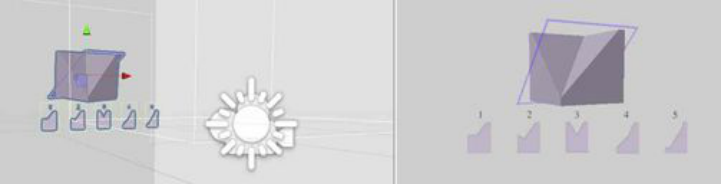
Experimental Setup The VR environments were developed in Unity 3D and experienced through an HTC VIVE Pro Eye headset. Participants were randomly assigned to one of the three conditions and completed a 25-item digital version of the MCT. Each item required participants to mentally visualize the cross-section of a 3D object sliced by a plane and select the correct answer from five options (Fig. 1). Each question had a two-minute time limit. In EC1 and EC2, objects and environments were rotated within defined angular limits to maintain visibility and prevent excessive complexity. Participants were seated on a swivel chair, allowing limited physical rotation to adjust their view as needed (Salehi et al., 2023).
Figure 1: Screenshot of digitalized test stimuli for the MCT tests.
Data Collection and Analysis Response accuracy (percentage of correct answers) and response time (seconds per item) were automatically recorded through the VR interface. Statistical analyses were conducted in R (v4.3.3). A one-way ANOVA was used to test differences among the three conditions (CC, EC1, EC2). Significant effects were followed by Tukey’s HSD post-hoc comparisons. To examine the influence of demographic factors, an ANCOVA was conducted using age, gender, and gaming status as covariates, testing interaction effects (Condition × Demographic Factor). All analyses used a significance threshold of p < 0.05.
RESULTS
The analysis focused on the effects of visual idiotropic axis misalignment on Mental Cutting Test (MCT) performance, measured through accuracy and response time. Descriptive statistics showed that participants in the dynamic misalignment condition (EC2) performed the worst overall, followed by those in static misalignment (EC1), with the control condition (CC) yielding the highest accuracy scores. Mean accuracy was 0.85 in CC, 0.85 in EC1,
Assessing Spatial Relations Under Altered Frames of Reference 853
and 0.77 in EC2, indicating a clear performance drop under dynamic misalignment.
A one-way ANOVA revealed a significant effect of condition on accuracy, F (2,195) = 7.05, p = 0.0011. Post-hoc comparisons (Tukey’s HSD) confirmed that accuracy in EC2 was significantly lower than in both CC (p = 0.0033, Cohen’s d = 0.58) and EC1 (p = 0.0068, Cohen’s d = 0.54). No significant difference was found between CC and EC1. In contrast, a Kruskal–Wallis test showed no significant differences in response time among the three conditions, χ2 (2) = 5.07, p = 0.079, suggesting that the decrease in performance accuracy under EC2 was not accompanied by slower responses.
To examine whether individual characteristics moderate these effects, an ANCOVA was conducted with age, gender, and gaming status as covariates. The Condition × Gender interaction was significant, F (2,190) = 4.67, p = 0.011, η2 = 0.04, indicating that males outperformed females in the EC2 condition, whereas no gender differences were observed in CC or EC1. Similarly, the Condition × Gaming Status interaction was significant, F (2,190) = 5.13, p = 0.007, η2 = 0.04, with gamers performing better than non-gamers in EC2, suggesting that prior exposure to visually dynamic environments may enhance adaptability to misalignment. Age did not show any significant moderating effect on either accuracy or response time (p > 0.18).
DISCUSSION
The results demonstrate that dynamic misalignment between the visual and bodily axes significantly reduces spatial reasoning accuracy, while static misalignment has a milder effect. This pattern suggests that continuously changing reference frames impose additional cognitive load, disrupting the mental processes involved in visualizing and manipulating three-dimensional structures. Similar outcomes have been observed in earlier research showing that unstable or conflicting reference cues degrade spatial performance by increasing attentional demands and impairing the ability to maintain an internal spatial map (Clément & Reschke, 2010). Studies of astronauts and participants in microgravity simulators report slower and less accurate spatial judgments when body and visual cues conflict, supporting the view that orientation consistency is a key factor for spatial accuracy (Oman, 2007; Young et al., 1984).
The significant interactions with gender and gaming experience further reinforce findings from previous spatial-ability research. Numerous studies have shown that males tend to outperform females in spatial visualization and mental rotation tasks, though these differences often diminish with training (Linn & Petersen, 1985; Maeda & Yoon, 2011). The superior performance of participants with video-gaming experience aligns with evidence that interactive, visually dynamic environments enhance spatial reasoning and mental rotation speed (Feng et al., 2007; Uttal et al., 2013). This suggests that repeated exposure to complex visual transformations in games may improve flexibility in processing changing frames of reference, making these individuals more resilient under disorienting spatial conditions.
854 Salehi and Dixit
From a human-factors perspective, these results emphasize the importance of considering axis misalignment and perceptual stability in the design of interfaces, training systems, and operational workflows for spaceflight, underwater construction, and remote robotic control. Consistent with recommendations by Clément (2016) and Oman (2007), training programs should expose users to varying spatial orientations to strengthen their internal reference stability and adaptability (Clément et al., 2016; Oman, 2007). The present study contributes to this field by showing that VR-based versions of the Mental Cutting Test can effectively simulate microgravity-like spatial challenges in a controlled, repeatable manner, offering both a research and training platform for evaluating human spatial performance under altered sensory conditions.
CONCLUSION
This study showed that dynamic misalignment between visual and bodily reference frames significantly reduced spatial accuracy in the Mental Cutting Test, while static misalignment had minimal effect. Gender and gaming experience influenced adaptability, with gamers and male participants performing better under dynamic misalignment. These findings suggest that unstable spatial frames increase cognitive demand and that VR-based testing offers a practical tool for assessing and training spatial reasoning in microgravity-like or disorienting environments.
REFERENCES
CEEB. (1939). Special aptitude test in spatial relations. In: College Entrance Examination Board New York. Clément, G., Loureiro, N., Sousa, D., & Zandvliet, A. (2016). Perception of
egocentric distance during gravitational changes in parabolic flight. Plos one, 11(7), e0159422. Clément, G., & Reschke, M. F. (2010). Neuroscience in space. Springer Science & Business Media. Feng, J., Spence, I., & Pratt, J. (2007). Playing an action video game reduces gender
differences in spatial cognition. Psychological science, 18(10), 850–855. Gittinger, M., & Wiesche, D. (2024). Systematic review of spatial abilities and virtual reality: The role of interaction. Journal of engineering education, 113(4), 919–938. Guzsvinecz, T., Orban-Mihalyko, E., Sik-Lanyi, C., & Perge, E. (2022). An Overview
of Received Results on MRT, MCT, and PSVT Spatial Ability Tests in Virtual Environments. 2022 IEEE 1st International Conference on Internet of Digital Reality (IoD). Guzsvinecz, T., Szeles, M., Perge, E., & Sik-Lanyi, C. (2019). Preparing spatial ability tests in a virtual reality application. 2019 10th IEEE International Conference on Cognitive Infocommunications (CogInfoCom). Hsi, S., Linn, M. C., & Bell, J. E. (1997). The role of spatial reasoning in engineering
and the design of spatial instruction. Journal of engineering education, 86(2), 151–158. Kyllonen, P. C., & Gluck, J. (2003). Spatial ability: Introduction to the special issue.
International Journal of Testing, 3(3), 215–217.
Assessing Spatial Relations Under Altered Frames of Reference 855
Linn, M. C., & Petersen, A. C. (1985). Emergence and characterization of sex differences in spatial ability: A meta-analysis. Child development, 1479–1498. Lohman, D. (1979). Spatial ability: A review and re-analysis of the correlational
literature (Technical Report No. 8). Arlington, VA: Office of Naval Research. Lohman, D. F. (2013). Spatial ability and g. In Human abilities (pp. 97–116).
Psychology Press. Maeda, Y., & Yoon, S. Y. (2011). Scaling the revised PSVT-R: Characteristics of the first-year engineering students’ spatial ability. 2011 ASEE annual conference & exposition. Morganti, F., Stefanini, S., & Riva, G. (2013). From allo-to egocentric spatial ability
in early Alzheimer’s disease: A study with virtual reality spatial tasks. Cognitive neuroscience, 4(3–4), 171–180. Németh, B. (2007). Measurement of the development of spatial ability by Mental Cutting Test. Annales mathematicae et informaticae. Oman, C. (2007). Spatial orientation and navigation in microgravity. Spatial
processing in navigation, imagery and perception, 209–247. Salehi, F., Pariafsai, F., & Dixit, M. K. (2023). The impact of misaligned idiotropic and visual axes on spatial ability under altered visuospatial conditions. Virtual Reality, 27(4), 3633–3647. Sorby, S. A. (2009). Educational research in developing 3-D spatial skills for
engineering students. International Journal of Science Education, 31(3), 459–480. Thorp, S. O., Rimol, L. M., Lervik, S., Evensmoen, H. R., & Grassini, S. (2024).
Comparative analysis of spatial ability in immersive and non-immersive virtual reality: The role of sense of presence, simulation sickness and cognitive load. Frontiers in Virtual Reality, 5, 1343872. Tsutsumi, E. (2004). A mental cutting test using drawings of intersections. Journal for Geometry and Graphics, 8(1), 117–126. Uttal, D. H., Meadow, N. G., Tipton, E., Hand, L. L., Alden, A. R., Warren, C.,
& Newcombe, N. S. (2013). The malleability of spatial skills: A meta-analysis of training studies. Psychological bulletin, 139(2), 352. Vandenberg, S. G., & Kuse, A. R. (1978). Mental rotations, a group test of threedimensional spatial visualization. Percept Mot Skills, 47(2), 599–604. https:// doi.org/10.2466/pms.1978.47.2.599. Wai, J., Lubinski, D., & Benbow, C. P. (2009). Spatial ability for STEM domains:
Aligning over 50 years of cumulative psychological knowledge solidifies its importance. Journal of educational psychology, 101(4), 817. Young, L. R., Oman, C. M., Watt, D. G., Money, K. E., & Lichtenberg, B. K. (1984).
Spatial orientation in weightlessness and readaptation to earth’s gravity. Science, 225(4658), 205–208.
LISTED IN THE AHFE DIGITAL BOOKSTORE CATALOGUE
Explore the complete digital volume
Human Factors in Design, Engineering, and Computing
Read this individual research paper free through the original publisher, or explore the full digital proceedings book.
ISBN 978-1-964867-75-5
Explore this ISBN in the AHFE Bookstore ↗Listed in the July 2026 bookstore catalogue; search by ISBN to confirm current availability · Digital book purchase optional