Faezeh Salehi, Manish Dixit, Vahideh Karimimansoob (2024). Studying spatial visualization ability under micro-gravity conditions simulated in Virtual Reality. In: Human Factors in Virtual Environments and Game Design. AHFE Open Access, vol. 137, pp. 60–69. https://doi.org/10.54941/ahfe1004987
Spatial cognitive processing is a fundamental aspect of human cognition, influencing our comprehension of spatial environments. Researchers have defined spatial ability in various ways, encompassing skills such as generating, visualizing, memorizing, and transforming visual information. Despite the diversity in definitions, there is a shared understanding that spatial ability is an inherent skill aiding individuals in tasks requiring visual and spatial acumen. One of the dimensions of spatial ability is spatial visualization that governs our day-to-day activities of staying and working in and navigating through space. One of the factors that could impact our spatial visualization ability is the alignment of visual and body axis that is maintained on earth due to gravitational cues. However, such cues are not available in micro-gravity environments that exist aboard the International Space Station (ISS). It is imperative to understand if human spatial visualization is impacted by such conditions to determine safety and productivity risks. In this paper, we present results of our research examining if the non-alignment of body and visual frame of reference (FOR) affects spatial visualization ability. We administered the Purdue Spatial Visualization Test: Visualization of Rotation (PSVT:R) to measure the spatial visualization ability of 230 participants. The PSVT:R assesses an individual's capacity to mentally rotate 3D objects. Participants matched the rotated view of a test object to a provided example, evaluating spatial visualization skills and cognitive abilities. The study included three test conditions, one control and two experimental conditions simulated in Virtual Reality (VR) using Unity 3D game engine. The control condition (C1) had the body axis and the visual FOR aligned just like a space on earth. The experiment conditions E1 and E2 depicted a micro-gravity environment to simulate statically and dynamically non-aligned visual and body axes, respectively. Participants sat in a swivel chair and wore HTC Vive Pro Eye headsets to experience the three conditions. Results consistently indicated a significant difference between response time (RT) and accuracy of participants’ responses under the three study conditions. Moreover, a negative correlation was found between the response time and accuracy, which implied a trade-off between response time and accuracy—a common phenomenon where individuals may prioritize speed over precision or vice versa. Our findings support the existence of a relationship between response time and accuracy, characterized by a significant difference and a weak correlation. The Bland-Altman analysis offered additional insights, emphasizing the variability in this relationship. In the C1 condition, the correlation coefficient was -0.1902, suggesting a weak tendency for accuracy to slightly decrease as reaction time increases. Similarly, the E1 condition exhibited a negative correlation of -0.2333, indicating a weak but negative trend of decreased accuracy with longer reaction times. In the E2 condition, the correlation coefficient was -0.1049, suggesting a mild decrease in accuracy as reaction time increased. Overall, the consistent negative correlations across all conditions imply a general pattern: participants with longer reaction times may exhibit slightly lower accuracy, and vice versa. Results also showed that the non-alignment of visual and body axes impact spatial visualization ability.
Studying Spatial Visualization Ability Under Micro-Gravity Conditions 61
BACKGROUND
The changing workforce landscape, driven by advancing technologies and ambitious explorations, requires a focus on unfamiliar and challenging work environments to understand risks. Such environments may make routine human cognitive processing a difficult task (Connolly and Sadowski, 2009). Human cognitive abilities, especially spatial cognitive skills, play a crucial role in adapting to these workplace environmental changes (Pellegrino et al., 1984; Tian et al., 2021). One such spatial cognitive skill is spatial ability that involves collecting and processing visual information, understanding of which is essential not only for STEM education and professional success but even for carrying out day-to-day activities safely (Pellegrino et al., 1984; Lohman, 1979). Spatial ability represents a combination of three key dimen- sions, spatial visualization, orientation, and relations, which are integral to executing routine professional as well as personal tasks (Lohman, 1979).
However, research on spatial ability often occurs in familiar environments, lacking insights into its adaptation in hard-to-access, unfamiliar, and extreme locations (He et al., 2021). These environments like space and deep oceans present unique challenges such as altered gravitational and visual conditions that may transform human spatial ability since spatial environments are piv- otal to spatial reasoning (Stapleton et al., 2016). Understanding how spatial abilities may function in these contexts is crucial for understanding work risks and preparing individuals to adapt to such challenging workplaces (Connolly and Sadowski, 2009).
One such unfamiliar environment is faced by astronauts under micro- gravity in space and while staying and working on the International Space Station (ISS) (Marin, 2018). The main goal of this study is to investigate the impact of non-alignment between the visual and body axes, as experienced in microgravity environments, on human spatial visualization ability (Linn and Petersen 1985, Lin and Suh 2021). Spatial visualization ability is an integral aspect of spatial ability that indicates our ability to mentally visualize and manipulate spatial objects (Pellegrino et al., 1984; Tian et al., 2021). One example of such ability is mentally rotating an object and visualizing its views in different rotations (Jones and Burnett, 2008; Marin and Beluffi, 2018). Spatial visualization ability can be measured using behavioural tests such as the Purdue Spatial Visualization Test: Visualization of Rotation (PSVT:R) (Connolly and Sadowski, 2009; Lohman, United States Office of Naval and Stanford University School of 1979).
The evolving landscape of technology is reshaping the way we live and work, with profound implications for the future of workplaces (Marin and Beluffi, 2018). Rapid technological advancements are opening new frontiers in exploration, enabling humans to venture into deep oceans, outer space, and polar regions previously inaccessible (Alberty, 2015; Jenkin, 2011). This transformative shift in working environments raises concerns about the potential impact on human spatial cognitive processing, particularly under altered visuospatial conditions (Kincl et al., 2003). As individuals immerse themselves in these unconventional settings, the need to understand how such conditions may affect spatial cognitive abilities becomes crucial for ensuring both safety and productivity (Jones and Burnett 2008).
The Purdue Spatial Visualization Test: Visualization of Rotation (PSVT:R) is a 30-item assessment designed to evaluate an individual’s mental rotation ability in three dimensions (Kozhevnikov and Hegarty, 2001; Contero, Naya et al., 2005; Maeda and Yoon, 2013). Developed by Guay in 1976 as part of the Purdue Spatial Visualization Test (PSVT), the PSVT:R presents partic- ipants with 13 symmetrical and 17 non-symmetrical 3D objects, requiring them to match the rotated view of a test object to provided options. Partic- ipants select the accurate rotated view from a set of five options, aiming to demonstrate their spatial visualization skills (Connolly and Sadowski, 2009; Miiro, 2017).
In the realm of spatial cognition research, Virtual Reality (VR) emerges as a powerful too, which can leverage computer graphics and real-time sensory inputs to create immersive environments, allowing users to engage with simulated physical settings intuitively and naturally (Molina-Carmona, Pertegal-Felices et al., 2018; Lowrie, Logan and Hegarty, 2019; Salehi et al., 2024). This technology becomes especially valuable for studying spa- tial cognition in conditions that are challenging to replicate firsthand. From simulating underwater environments for scuba diving studies (Coxon, Kelly and Page, 2016; Sun, Wu and Cai, 2019; Lochhead, Hedley et al., 2022; Khalil et al., 2022) to creating microgravity experiences, VR proves instru- mental in exploring extreme and unfamiliar work conditions (Kincl et al., 2003). In this study, we developed VR analogs of certain challenging spatial conditions and measured participants’ spatial visualization ability through PSVT:R test. By integrating VR into spatial cognition research, we aim to deepen our understanding of how individuals perceive and navigate spatial environments under simulated microgravity conditions, shedding light on the intricate relationship between technology, spatial cognition, and the future of work (Lochhead, Hedley et al., 2022, Salehi et al., 2024).
METHODS
The main research goal of this study is to investigate the how the absence of gravity causes the non-alignment of body and visual axes in micro-gravity conditions like those on the International Space Station (ISS), and how it may affect human spatial visualization abilities. This goal will be reached by achieving the following objectives:
Utilize the Purdue Spatial Visualization Test: Visualization of Rotation (PSVT:R) to measure the spatial visualization ability focusing on mental rotation skills in three dimensions.
Investigate the relationship between response time (RT) and response accuracy (RA) of participants’ spatial visualization responses under three distinct conditions - control (C1) with body and visual axes fully aligned, and experimental conditions (E1 and E2) simulating these axes statically and dynamically non-aligned, respectively.
Analyze the correlation between response time (RT) and accuracy (RA), to understand if participants may prioritize speed (RT) over precision (RA) or vice versa in spatial visualization tasks.
Studying Spatial Visualization Ability Under Micro-Gravity Conditions 63
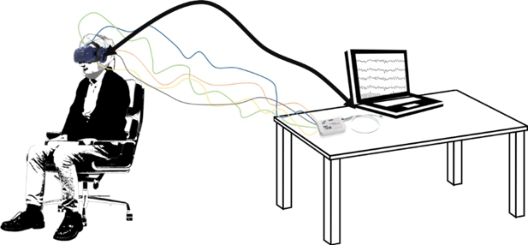
Study Environments The Unity 3D game engine was employed to construct Virtual Reality (VR) environments for this study, delineating three distinct conditions. The first condition replicated an earth-like setting, aligning participants’ body (idiotropic) axis vertically with the visual frame of reference. In the second condition, the idiotropic axis underwent static misalignment at a random angle in the X, Y, or Z axis. The third condition introduced dynamic misalign- ment, with the axis changing randomly as the spatial environment rotated around the X, Y, or Z axis. Participants in the control group (CG) encoun- tered aligned axes, while those in experiment group I (EG 1) and experiment group II (EG2) experienced static and dynamic misalignments, respectively. Seated on swivel chairs, participants interacted with stimuli and spatial envi- ronments that rotated either statically or dynamically in VR (Salehi et al., 2023). Spatial tasks constituted the core of the experiment, with participants ran- domly assigned to the control or experiment groups to mitigate repetitive tasks. The study incorporated Virtual Environments (VE) created in Unity 3D, where participants, equipped with HTC VIVE Pro Eye Head-Mounted Display (HMD), completed tests by making selections using a hand-held con- troller. Automatic recording of correct/incorrect answers, response times, and participants’ responses to pre and post-test surveys enhanced data col- lection (Figure 1). Rigorous experimental procedures were implemented to ensure participants’ familiarity with the tests, apparatus, and experiment instructions (Salehi et al., 2023).
Figure 1: Eye-tracking devices used and connectivity.
Participants A diverse cohort of 230 participants was recruited from Texas A&M Uni- versity student and staff populations for our study, which included 70% male and 30% female participants. The participants with an average age of 27.79 had normal or corrected to normal vision. These diverse demographic attributes potentially enhanced the broad applicability of our findings, offer- ing in-depth insights into the spatial visualization ability.
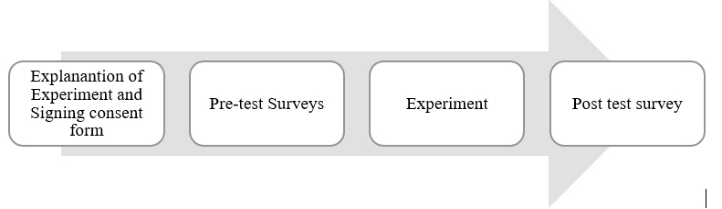
Prior to engaging in the experiment, participants completed an initial sur- vey, providing demographic information and expressing their expectations, including concerns about potential side effects such as dizziness or nausea. Upon completion of the experiments, participants filled out a second survey to share their actual experiences, detailing any instances of dizziness, nausea, or other relevant effects encountered during the tests.
Figure 2: Experiment procedures.
RESULTS
Spatial cognition is a complex process involving the integration of var- ious cognitive functions. We aimed to explore the relationship between response time (RT) and accuracy in spatial visualization tasks. The analy- sis included normality testing, matched pairs comparison, Wilcoxon Signed Rank Test, Sign Test, and Bland-Altman analysis to comprehensively examine the association between RT and accuracy.
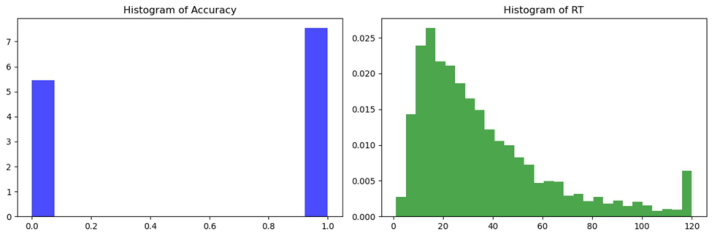
Normality Testing The Shapiro-Wilk test indicated that both accuracy and response time data did not follow a normal distribution (Shapiro-Wilk Test for Accu- racy: W-statistic = 0.627, p-value = 0.0; Shapiro-Wilk Test for RT: W- statistic = 0.861, p-value = 0.0).
Matched Pairs The matched pairs analysis revealed a significant difference between RT and accuracy. The t-Ratio was high (78.79204), with associated p-values < 0.0001, providing strong evidence against the null hypothesis of no dif- ference. The mean difference between RT and accuracy was 35.3047, and the 95% confidence interval for the mean difference (34.4262 to 36.1832) did not include zero, supporting the conclusion of a significant difference. The negative correlation (−0.2056) indicated a weak negative relationship between RT and accuracy.
Studying Spatial Visualization Ability Under Micro-Gravity Conditions 65
Figure 3: Histograms for accuracy and reaction time.Table 1. Matched pairs’ table.
Table available in the original PDF paper.
RT 35.8854 t-Ratio 78.79204 accuracy 0.58076 DF 3565 Mean Difference 35.3047 Prob > |t| <.0001 Std Error 0.44807 Prob > t <0.0001 Upper 95% 36.1832 Prob < t 1.0000 Lower 95% 34.4262 N 3566 Correlation -0.2056
Wilcoxon Signed Rank and Sign Tests Both the Wilcoxon Signed Rank Test and the Sign Test supported the find- ing of a significant difference between RT and accuracy. The test statistics were highly significant (p-values < 0.0001), reinforcing the conclusion of a significant disparity.
Table 2. Wilcoxon signed rank-results.
Table available in the original PDF paper.
RT-Accuracy Test Statistic S 3179981 Prob>|S| <0.0001 Prob>S <0.0001 Prob<S 1.0000
Table 3. Sign rank-results.
Table available in the original PDF paper.
RT-Accuracy Test Statistic M 1783.00 Prob≥|M| <0.0001 Prob≥M <0.0001 Prob≤M 1.0000
Bland-Altman Analysis The Bland-Altman analysis revealed a bias of 35.305, indicating a systematic difference between RT and accuracy. The lower and upper limits of agreement (−17.138 to 87.748) suggested substantial variability in the relationship between the two measurements.
Table 4. Bland-Altman-results.
Table available in the original PDF paper.
Parameter Value Std Dev Lower 95% Upper 95% Bias 35.305 26.757 34.4262 36.1832 Lower Limit of Agreement −17.138 0.766 −18.64 −15.637 Upper Limit of Agreement 87.748 0.766 86.2463 89.2494
The consistent significance across various statistical tests suggests a sig- nificant difference between RT and accuracy. The weak correlation, along with the Bland-Altman analysis, implies that the agreement between RT and accuracy is not strong, characterized by a noticeable bias and wide limits of agreement. This indicates substantial variability in the relationship between RT and accuracy.
Our findings provide strong support for the existence of a relationship between response time and accuracy in spatial cognition tasks. The Bland- Altman analysis offers additional context, revealing systematic differences and substantial variability in this relationship. The weak negative correlation suggests that participants may prioritize either speed or accuracy, highlighting the intricate trade-off in spatial cognitive processes.
DISCUSSION
Our study examined the evolving landscape of spatial cognition research, emphasizing the pivotal role of spatial abilities in unconventional work envi- ronments. The use of VR technology in spatial cognition research proved instrumental, enabling the simulation of microgravity conditions that are challenging to replicate firsthand. The incorporation of the Purdue Spa- tial Visualization Test: Visualization of Rotation (PSVT:R) in VR settings provided a robust platform for evaluating mental rotation abilities in three dimensions.
The observed significant difference between response time and accuracy aligns with existing literature on the trade-off phenomenon in spatial tasks (Wang et al., 2020; Bartlett et al., 2024). The negative correlation suggests that participants, when faced with spatial visualization challenges, may pri- oritize either speed or accuracy. This insight holds practical implications for designing training programs and interventions tailored to specific task requirements in dynamic and unfamiliar settings.
The Bland-Altman analysis revealed systematic differences and substantial variability in the relationship between RT and accuracy. The bias and wide limits of agreement underscore the complexity of the trade-off between speed
Studying Spatial Visualization Ability Under Micro-Gravity Conditions 67
and precision. These findings prompt further exploration into individual dif- ferences that may influence the prioritization of speed or accuracy in spatial tasks. Note that understanding if and to what extent participants answered or solved spatial tasks correctly is important. However, equally significant is to explain if they took long to answer or solve the spatial tasks correctly. Understanding this speed-precision trade-off is essential to understand under- lying cognitive processing in altered conditions and design training programs and tools that strengthen both RT and RA to improve safety and productivity outcomes.
In the broader context, our research contributes to the understanding of spatial cognitive processing in extreme environments, offering implications for fields such as space exploration, deep-sea exploration, and other uncon- ventional workplaces. As humans venture into these uncharted territories, the ability to adapt spatial skills becomes paramount for effective performance and safety. Our study provides a foundation for future research, encourag- ing a nuanced exploration of spatial abilities in diverse and challenging work conditions.
CONCLUSIONS
In the context of advancing technologies and changing work environments, our study delved into the intricate relationship between spatial visualization ability and microgravity conditions. Employing the Purdue Spatial Visualiza- tion Test: Visualization of Rotation (PSVT:R) in Virtual Reality (VR) settings, we investigated the impact of non-alignment between visual and body axes on human spatial cognition. Our study involved 230 participants across three conditions: a control group with aligned axes and two experimental groups simulating statically and dynamically non-aligned axes in microgravity.
The results consistently revealed a significant difference between response time (RT) and accuracy across all conditions. The negative correlation observed implied a trade-off between speed and precision in spatial visual- ization tasks—a common phenomenon where individuals may prioritize one aspect over the other. Bland-Altman analysis emphasized the variability in this relationship, highlighting a systematic difference and substantial vari- ability between RT and accuracy. Notably, the non-alignment of visual and body axes was identified as a factor impacting spatial visualization ability.
These findings contribute valuable insights into the adaptability of spatial cognitive processes in challenging work environments, particularly those with altered gravitational cues. The implications extend to safety and productivity considerations, emphasizing the need for understanding how spatial abili- ties function in unconventional settings. As technology enables exploration in diverse and extreme conditions, our study underscores the importance of preparing individuals to navigate spatial environments effectively, ensuring both safety and task performance.
ACKNOWLEDGMENT
This work is supported by the U.S. National Science Foundation (NSF) through grant CNS 1928695. Any opinions, findings, conclusions, and rec- ommendations expressed in this paper are those of the authors and do not necessarily represent those of the NSF.
REFERENCES
Alberty, M. (2015). How To Train Your Astronauts. https://www.nasa.gov/mission_pages/station/research/news/astronaut_training Bartlett, K. A., et al. (2024). “Design and Validation of a Virtual Reality Mental Rotation Test.” ACM Transactions on Applied Perception 21(2): 1–22. Connolly, P. and M. Sadowski (2009). Measuring and enhancing spatial visualization
in engineering technology students. 2009 Annual Conference & Exposition. Contero, M., et al. (2005). “Improving visualization skills in engineering education.”
IEEE Computer Graphics and Applications 25(5): 24–31. Coxon, M., et al. (2016). “Individual differences in virtual reality: Are spatial presence and spatial ability linked?” Virtual Reality 20: 203–212. He, X., Li, T., Turel, O., Kuang, Y., Zhao, H., & He, Q. (2021). The impact of stem
education on mathematical development in children aged 5–6 years. International Journal of Educational Research, 109, 101795. Jenkin, M., Zacher, J., Dyde, R., Harris, L., & Jenkin, H. (2011). Perceptual upright: The relative effectiveness of dynamic and static images under different gravity states. Seeing and Perceiving, 24(1), 53–64. Jones, S. and G. Burnett (2008). “Spatial ability and learning to program.” Human
Technology: An Interdisciplinary Journal on Humans in ICT Environments. Khalil, M. A., et al. (2022). “Mapping a hazardous abandoned gypsum mine using self-potential, electrical resistivity tomography, and Frequency Domain Electromagnetic methods.” Journal of Applied Geophysics 205: 104771. Kincl, L., Bhattacharya, A., Succop, P., & Bagchee, A. (2003). The effect of workload,
work experience and inclined standing surface on visual spatial perception: Fall potential/prevention implications. Occupational Ergonomics, 3(4), 251–259. Kozhevnikov, M. and M. Hegarty (2001). “A dissociation between object manipulation spatial ability and spatial orientation ability.” Memory & cognition 29: 745–756. Lin, Y. and A. Suh (2021). The role of spatial ability in learning with virtual real-
ity: a literature review. 54th Hawaii International Conference on System Sciences (HICSS 2021). Linn, M. C. and A. C. Petersen (1985). “Emergence and characterization of sex differences in spatial ability: A meta-analysis.” Child Development: 1479–1498. Lochhead, I., et al. (2022). “The immersive mental rotations test: Evaluating spatial
ability in virtual reality.” Frontiers in Virtual Reality 3: 820237. Lohman, D. F., et al. (1979). Spatial ability : a review and reanalysis of the correlational literature. Stanford, California, Stanford University School of Education Stanford, California. Lowrie, T., et al. (2019). “The influence of spatial visualization training on stu-
dents’ spatial reasoning and mathematics performance.” Journal of Cognition and Development 20(5): 729–751. Maeda, Y. and S. Y. Yoon (2013). “A meta-analysis on gender differences in mental rotation ability measured by the Purdue spatial visualization tests: Visualization of rotations (PSVT: R).” Educational Psychology Review 25: 69–94.
Studying Spatial Visualization Ability Under Micro-Gravity Conditions 69
Marin, F. and C. Beluffi (2018). “Computing the minimal crew for a multigenerational space travel towards Proxima Centauri b.” arXiv preprint arXiv:1806.03856. Miiro, S. (2017). “The Issues and Complexities Surrounding the Future of Long
Duration Spaceflight.” Molina-Carmona, R., et al. (2018). “Virtual reality learning activities for multimedia students to enhance spatial ability.” Sustainability 10(4): 1074. Pellegrino, J. W., et al. (1984). “Understanding spatial ability.” Educational psychol-
ogist 19(4): 239–253. Salehi, F., et al. (2023). “The impact of misaligned idiotropic and visual axes on spatial ability under altered visuospatial conditions.” Virtual Reality 27(4): 3633–3647. Salehi, F., et al. (2023). How Human Spatial Ability is Affected by the Misalignment
of Idiotropic and Visual Axes. International Conference on Human-Computer Interaction, Springer. Salehi, F., et al. (2024). “The impact of visuospatial cues on human spatial perception abilities.”Salehi, F., et al. (2024). “Cognitive efforts associated with spatial ability under altered spatial conditions: An eye-tracking study.” Intelli- gent Human Systems Integration (IHSI 2024): Integrating People and Intelligent Systems 119(119). Stapleton, T., Heldmann, M., Schneider, S., O’Neill, J., Samplatsky, D., White, K., &
Corallo, R. (2016). Environmental control and life support for deep space travel. Sun, R., et al. (2019). “The effect of a virtual reality learning environment on learners’ spatial ability.” Virtual Reality 23: 385–398. Tian, M., et al. (2021). “Spatial ability and theory of mind: A mediating role of visual
perspective taking.” Child Development 92(4): 1590–1604. Wang, S., et al. (2020). “The Development of a Multidimensional Diagnostic Assessment With Learning Tools to Improve 3-D Mental Rotation Skills.” Front Psychol 11: 305.
LISTED IN THE AHFE DIGITAL BOOKSTORE CATALOGUE
Explore the complete digital volume
Human Factors in Virtual Environments and Game Design
Read this individual research paper free through the original publisher, or explore the full digital proceedings book.
ISBN 978-1-964867-13-7
Explore this ISBN in the AHFE Bookstore ↗Listed in the July 2026 bookstore catalogue; search by ISBN to confirm current availability · Digital book purchase optional