Faezeh Salehi, Fatemeh Pariafsai, Manish Dixit (2024). Cognitive efforts associated with spatial ability under altered spatial conditions: An eye-tracking study. In: Intelligent Human Systems Integration (IHSI 2024): Integrating People and Intelligent Systems. AHFE Open Access, vol. 119, pp. 165–175. https://doi.org/10.54941/ahfe1004480
Spatial ability is the ability to generate, store, retrieve, and transform visual information to mentally represent a space and make sense of it. This ability is a critical facet of human cognition that affects knowledge acquisition, productivity, and workplace safety. Although having improved spatial ability is essential for safely navigating and perceiving a space on earth, it is more critical in altered environments of other planets and deep space, which may pose extreme and unfamiliar visuospatial conditions. Such conditions may range from microgravity settings with the misalignment of body and visual axes to a lack of landmark objects that offer spatial cues to perceive size, distance, and speed. These altered visuospatial conditions may pose challenges to human spatial cognitive processing, which assists humans in locating objects in space, perceiving them visually, and comprehending spatial relationships between the objects and surroundings. The main goal of this paper is to examine if eye-tracking data of gaze pattern can indicate whether such altered conditions may demand more mental efforts and attention. The key dimensions of spatial ability (i.e., spatial visualization, spatial relations, and spatial orientation) are examined under the three simulated conditions: (1) aligned body and visual axes (control group); (2) statically misaligned body and visual axes (experiment group I); and dynamically misaligned body and visual axes (experiment group II). The three conditions were simulated in Virtual Reality (VR) using Unity 3D game engine. Participants were recruited from Texas A&M University student population who wore HTC VIVE Head-Mounted Displays (HMDs) equipped with eye-tracking technology to work on three spatial tests to measure spatial visualization, orientation, and relations. The Purdue Spatial Visualization Test: Rotations (PSVT: R), the Mental Cutting Test (MCT), and the Perspective Taking Ability (PTA) test were used to evaluate the spatial visualization, spatial relations, and spatial orientation of 78 participants, respectively. For each test, gaze data was collected through Tobii eye-tracker integrated in the HTC Vive HMDs. Quick eye movements, known as saccades, were identified by analyzing raw eye-tracking data using the rate of change of gaze position over time as a measure of mental effort. The results showed that the mean number of saccades in MCT and PSVT: R tests was statistically larger in experiment group II than in the control group or experiment group I. However, PTA test data did not meet the required assumptions to compare the mean number of saccades in the three groups. The results suggest that spatial relations and visualization may require more mental effort under dynamically misaligned idiotropic and visual axes than aligned or statically misaligned idiotropic and visual axes. However, the data could not reveal whether spatial orientation requires more/less mental effort under aligned, statically misaligned, and dynamically misaligned idiotropic and visual axes. The results of this study are important to understand how altered visuospatial conditions impact spatial cognition and how simulation- or game-based training tools can be developed to train people in adapting to extreme or altered work environments and working more productively and safely.
Spatial ability is a fundamental cognitive skill that plays a crucial role in vari- ous aspects of human life. It involves the capacity to generate, store, retrieve, and manipulate visual information to mentally represent and comprehend the spatial characteristics of a given environment (Hegarty et al., 2002). This cognitive ability has far-reaching implications for knowledge acquisition, task performance, and safety in various settings, including routine workplaces (Li & Wang, 2021). Humans apply this critical cognitive ability to com- plete their day-to-day personal, vocational, and recreational tasks safely and productively (Lunneborg & Lunneborg, 1986).
The relevance of spatial ability becomes particularly crucial in scenarios where individuals are exposed to extreme or unfamiliar visuospatial condi- tions such as those encountered in environments of other planets and deep space (Lunneborg & Lunneborg, 1986; Newcombe, 2002). As human space exploration extends beyond Earth, individuals are likely to face a range of challenging visuospatial conditions (Jawin et al., 2019). These conditions can encompass factors like microgravity, which results in the misalignment of body and visual axes making spatial cognitive processing a difficult task (Kanas & Manzey, 2008). Likewise, spatial settings on other planets lack visual landmarks or reference points that are available on Earth to help humans determine size, distance, and speed (Paul et al., 2020). This lack of familiar landmarks makes it difficult to perceive the spatial environments and navigate space safely. Therefore, understanding how altered visuospatial conditions impact human spatial cognitive processing becomes a pivotal area of research (Salehi et al., 2023).
Recent studies have highlighted the importance of spatial ability in such altered settings. For instance, research by Kozhevnikov et al. (2018) inves- tigated spatial cognitive abilities in astronauts during space missions and found that spatial reasoning and mental visualization skills were essential for mission success (Kozhevnikov et al., 2005). Spatial ability encompasses key dimensions, including spatial visualization, spatial relations, and spatial orientation, which are integral to helping individuals navigate and compre- hend their spatial surroundings (Kolb & Whishaw, 2009). Standardized tests such as the Purdue Spatial Visualization Test: Rotations (PSVT: R), the Men- tal Cutting Test (MCT), and the Perspective Taking Ability (PTA) test assess these dimensions. Spatial visualization evaluates mental object manipulation, while spatial relations focus on mental 2D figure rotation, and spatial orien- tation assesses the creation of mental spatial representations from various viewpoints (Carroll, 1993; Guzsvinecz et al., 2022; Harle & Towns, 2011). These dimensions significantly influence spatial information processing, ulti- mately impacting an individual’s cognitive problem-solving skills (Clément et al., 2013; Harle & Towns, 2011; Lohman, 1979).
The use of Virtual Reality (VR) in combination with eye tracking technol- ogy in spatial ability studies presents several significant advantages. First, VR provides an unparalleled level of realism and immersion, allowing participants to engage with spatial challenges in environments that closely mimic real-world scenarios (Winter, 2014; Zhang et al., 2020). This not only
Cognitive Efforts Associated With Spatial Ability Under Altered Spatial Conditions 167
enhances the ecological validity of the study but also ensures that the data col- lected accurately reflects how individuals interact with and navigate through spatial tasks in practical settings (Salehi et al., 2023a; Slater et al., 2022). Eye tracking, on the other hand, offers precise and objective measurement of participants’ gaze patterns and fixations (Keskin et al., 2018; Kiefer et al., 2017). It allows researchers to gain insights into how individuals visually process spatial information, uncovering the subtle nuances of their eye move- ments during spatial tasks (Keskin et al., 2018). This objective data collection method eliminates potential biases associated with self-reporting or subjec- tive assessments, ensuring the accuracy and reliability of the findings (Orquin & Holmqvist, 2019). Moreover, the combination of VR and eye tracking technology sheds light on the cognitive processes at play during spatial tasks. Researchers can observe how participants mentally represent and manipulate spatial information within a dynamic and interactive environment (Soroli, 2011). This expands our understanding of the strategies individuals employ to solve spatial problems, providing valuable insights into spatial cognition (Vieira et al., 2021).
Beyond research, the combination of VR and eye tracking holds promise for spatial training and rehabilitation. It provides a safe and controlled envi- ronment for individuals to develop and enhance their spatial skills, making it especially valuable for professionals requiring spatial competence in their fields, such as pilots or medical practitioners (Salehi et al., 2023b). In eye- tracking experiments, saccades, rapid and involuntary eye movements reveal valuable insights into human spatial cognitive processing (Dong et al., 2018). They indicate attention allocation, visual scanning patterns, information processing speed, cognitive load, task strategies, learning processes, and indi- vidual differences in spatial abilities (Raptis et al., 2016). Analyzing saccades helps understand how individuals visually engage with and process spatial information, aiding the design of efficient spatial tasks and training programs (Clark, 1999; Liversedge & Findlay, 2000; Paul et al., 2020).
METHODS
Objectives The main goal of this study is to understand whether the analysis of saccades of eye-tracking data can effectively reveal the heightened mental effort and attention required in response to simulated altered visuospatial conditions. This goal is reached by pursuing the following research objectives:
Create Virtual Reality (VR) environments that simulate altered visuospa- tial conditions and incorporate digitalized behavioral tests to assess spatial ability.
Assess participants’ spatial visualization, spatial relations, and spatial orientation in response to diverse control and experiment conditions simulating gravity and microgravity conditions.
Investigate the potential impact of statically or dynamically misaligned idiotropic and visual axes in microgravity on cognitive effort during spatial ability tasks measured through saccade patterns.
Participants The study recruited 99 participants, including 27 females, all possessing nor- mal or corrected-to-normal vision. Recruitment was carried out within the Texas A&M University student community via email announcements dis- tributed through the university’s email system. The participants’ age spanned from 18 to 52 years with an average age of 24.45 years and a standard devi- ation of 6.156663. The Institutional Review Board (IRB) of the university granted approval for the study, and all participants furnished written consent before its commencement.
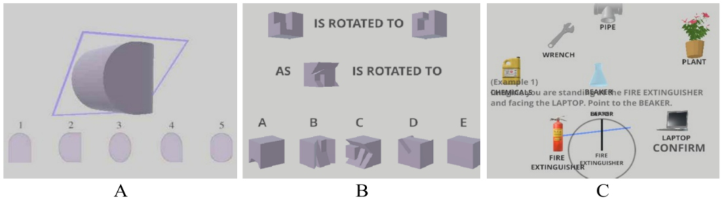
Study Environment Three spatial ability tests were digitalized, integrated into VR settings, and administered to participants in this study (See Figure 1). The Mental Cut- ting Test (MCT) was used to assess spatial relations by requiring participants to mentally cut 3D objects and select the accurate 2D cross-sectional view from the given options. The Purdue Spatial Visualization Test: Visualization of Rotation (PSVT:R) evaluated spatial visualization by testing the ability to mentally rotate 3D objects. The Perspective Taking Ability (PTA) mea- sured the capacity to imagine views from different perspectives. These tests provided a comprehensive evaluation of participants’ spatial ability, essential for understanding how they cognitively adapt to altered visuospatial condi- tions. This study used the Unity 3D game engine to create VR environments with spatial tests representing three conditions. The first condition of the control group (CG) simulated Earth-like conditions with aligned visual and idiotropic axes (participants’ body axis). The second and third conditions represented experiment group 1 and 2 (EG1 and EG2), which simulated microgravity scenarios with static and dynamic misalignment of the visual and idiotropic axes, respectively. In the case of EG1, participants’ body axis was misaligned with the visual frame of reference, and this misalignment was fixed. On the other hand, in the case of EG2, this misalignment of body (idiotropic) and visual axes was randomly changing with time. To sum up, participants were divided into one control (CG) and two experiment groups (EG1 and EG2). Participants sat in swivel chairs as the VR environment rotated. Table 1 shows the spatial tasks for each group, and random assign- ments prevented repetitive task completion by participants across conditions.
Figure 1: Experiment tests: A) mental cutting test, B) PSVT:R test, C) PTA test.
Cognitive Efforts Associated With Spatial Ability Under Altered Spatial Conditions 169
Procedures and Data Collection Participants were introduced to the test procedures and apparatus before their participation. Before their study session, they completed two surveys. All experiments were conducted in a controlled environment, with partici- pants engaging in VR tests using HTC VIVE Pro Eye head-mounted displays (HMDs) and hand-held controllers. This HMD is integrated with Tobii eye- tracker to collect gaze data. Data on choices, response times, and survey responses were recorded automatically. Trained graduate students monitored apparatus functionality and collected raw eye-tracking and spatial ability score data.
Extraction of Saccades To extract the number of saccades from raw gaze data, we developed a script that enabled the automated detection of saccades. Saccades, rapid and invol- untary eye movements, are fundamental in understanding visual attention and cognitive processes. This script is highly adaptable and serves as an essential tool for researchers seeking to explore the relationship between eye movements, mental effort, and visuospatial conditions in their studies. This script employs several criteria to identify and analyze saccades effectively:
1. Velocity Threshold: A key parameter in the script is the velocity threshold. Saccades are characterized by high-speed eye movements. Researchers can adjust this threshold as needed to determine the minimum speed required for a movement to be considered a saccade. The script identifies sac- cades based on changes in gaze point positions that exceed this threshold. By modifying this value, we can fine-tune the sensitivity of the saccade detection process. 2. Input Data: The script reads eye-tracking data from input CSV files. Each file typically represents data collected from a single participant during a specific experiment, under particular conditions. The script pro- cesses multiple input files and can handle data from various participants, experiments, and conditions. 3. Data Pre-Processing: Before identifying saccades, the script preprocesses the input data. It converts time values to seconds and calculates the velocity of gaze points, which is crucial for saccade detection. 4. Saccade Identification: Saccades are identified based on changes in gaze point velocities. The script scans through the data and marks the begin- ning and end of a saccade when the velocity exceeds the defined threshold. It records the start and end points of each saccade.
5. Data Organization: The script organizes the saccade data into a struc- tured format. It associates saccades with relevant participant information including participant IDs, experiment details, and experimental condi- tions. Each saccade event is linked to the specific trial or test question it corresponds to. 6. Output: The script generates individual CSV files for each participant, documenting their saccades during the experiment.
In summary the script’s criteria for calculating saccades revolve around adjusting the velocity threshold, processing multiple input files, identifying saccades based on velocity changes, and organizing the data. These criteria collectively enable us to extract and analyze saccade data efficiently and with flexibility, supporting the investigation of cognitive processes in response to altered visuospatial conditions.
RESULTS
The research question sought to ascertain whether a significant difference existed in the mean saccade numbers between the control group, experiment group I, and experiment group II across the MCT, PSVTR, and PTA tests. The application of a one-way analysis of variance (ANOVA) was considered to determine if there were statistically significant differences among the means of these three independent groups in each test, contingent on the required assumptions being met. The essential assumptions encompassed the absence of significant outliers in any compared group, a normal distribution of the dependent variable within each group, and homogeneity of variances across all groups. In cases where these assumptions were not met, the Kruskal-Wallis H Test was employed, contingent on the assumption that there was equivalent variability (similar distribution shape) for each independent variable group.
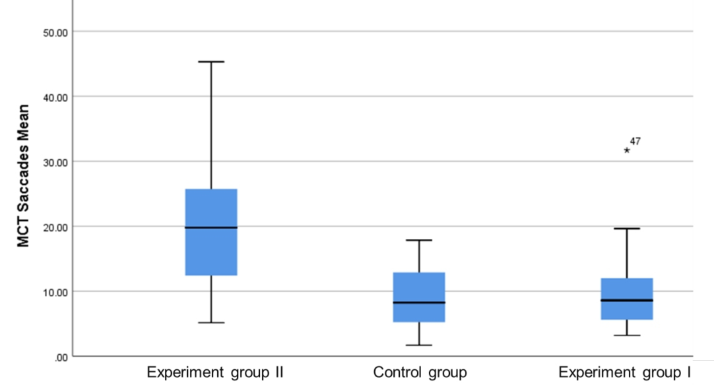
For the MCT test, Figure 2 highlighted outliers in the experiment group I, rendering the required assumptions for one-way ANOVA unmet. Subse- quently, the Kruskal-Wallis H Test was applied, and Levene’s test affirmed the equality of variances assumption. The Kruskal-Wallis H test indicated a statistically significant difference in the mean saccade numbers among the groups in the MCT test, χ2(2) = 27.568, p = .000. The saccade numbers’ mean ranks were 28.79 for control group, 31.21 for experiment group I, and 58.50 for experiment group II. Dunn’s post hoc test results confirmed sig- nificant differences between the mean ranks of saccade numbers in control group and experiment group II and in experiment group I and experiment group II, with p-values below 0.05. Pairwise comparisons demonstrated that the mean saccade numbers in the experiment group II group exceeded those in the control group and experiment group I.
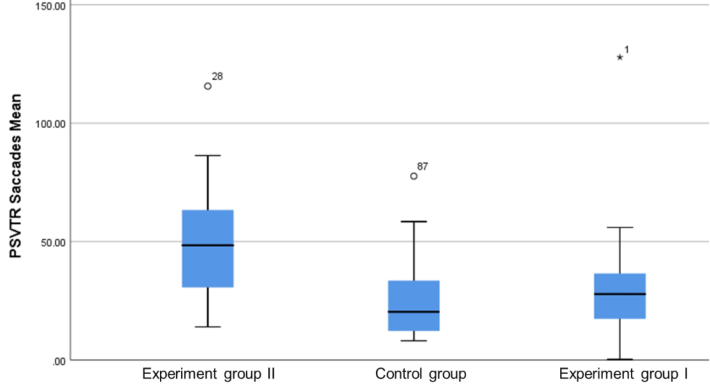
For the PSVTR test, outliers were observed in the control group and experi- ment group I, indicating unmet one-way ANOVA assumptions. Subsequently, the Kruskal-Wallis H Test was applied, and Levene’s test supported the equal- ity of variances assumption (see Figure 3). The Kruskal-Wallis H test revealed a statistically significant difference in the mean saccade numbers among the groups in the PSVTR test, χ2(2) = 18.291, p = .000. The saccade numbers’
Cognitive Efforts Associated With Spatial Ability Under Altered Spatial Conditions 171
mean ranks were 29.31 for control group, 34.46 for experiment group I, and 54.73 for experiment group II. Dunn’s post hoc test results confirmed sig- nificant differences between the mean ranks of saccade numbers in control group and experiment group II and in experiment group I and experiment group II, with p-values below 0.05. Pairwise comparisons showed that the mean saccade numbers in the experiment group II were higher than those in the control group and experiment group I.
Figure 2: Boxplots for each independent variable group in the MCT test.Figure 3: Boxplots for each independent variable group in the PSVT:R test.
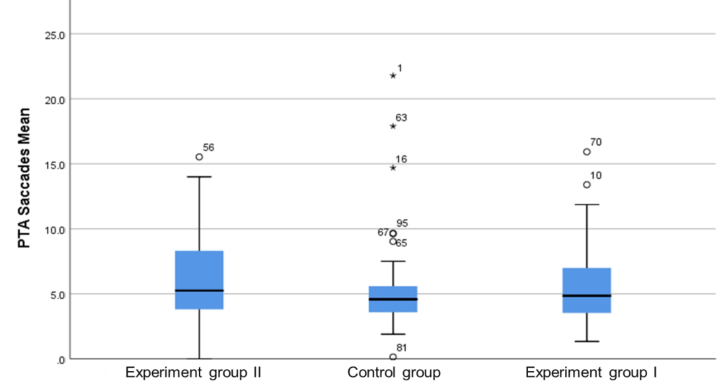
In the PTA test, outliers were observed in all three groups, which sig- nified unmet one-way ANOVA assumptions (see Figure 4). Consequently, the Kruskal-Wallis H Test could not be employed due to the inequality of variances.
Figure 4: Boxplots for each independent variable group in the PTA test.
DISCUSSION
The main objective of this study was to explore whether the analysis of saccades, as revealed in eye-tracking data, can effectively serve as an indi- cator of heightened mental effort and attention in response to altered visu- ospatial conditions. To achieve this goal, the study created virtual reality environments that replicated these conditions and integrated spatial ability behavioral tests to measure spatial visualization, spatial relations, and spa- tial orientation. These aspects were assessed within the context of simulated gravity and microgravity conditions with a focus on the potential impact of statically or dynamically misaligned idiotropic and visual axes on cognitive effort during spatial ability tasks.
The analysis of the study’s results focused on the mean saccade num- bers among the control group, experiment group I, and experiment group II across three different spatial ability tests: Mental Cutting Test (MCT), Pur- due Spatial Visualization Test: Rotations (PSVTR), and Perspective Taking Ability (PTA). The results revealed that in the MCT test, experiment group II, exposed to dynamic misalignment of axes, exhibited a significantly higher mean saccade number compared to the control group and experiment group I. This finding suggests that dynamic misalignment imposes a more complex spatial cognitive challenge, requiring an increased number of saccadic eye movements, thus indicating heightened mental effort (Kabaya et al., 2023). In other words, the misalignment of the two axes may pose visuospatial chal- lenges for the participants, demanding increased cognitive processing than the control group condition. In the case of PSVTR test, a similar pattern emerged with the experiment group II demonstrating a significantly higher mean sac- cade number compared to the control group and experiment group I. This underscores the notion that adapting to continuously shifting visuospatial conditions demands greater cognitive resources and, consequently, more sac- cadic eye movements (Imaoka et al., 2022). However, the PTA test did not
Cognitive Efforts Associated With Spatial Ability Under Altered Spatial Conditions 173
yield clear results due to the presence of outliers and a lack of homogeneity in variances. This may suggest a need for a more comprehensive study to under- stand conclusively if saccade numbers may consistently indicate cognitive effort in all spatial ability dimensions. The fact that PTA test is a large-scale spatial test that differs from the MCT and PSVTR, which are object-based small-scale tests, may offer an explanation for this lack of clear results in the case of the PTA test.
This study demonstrates that saccade numbers can effectively serve as a reliable indicator of heightened mental effort and attention when indi- viduals are exposed to dynamically misaligned idiotropic and visual axes, as experienced in microgravity simulations. These findings have significant implications for understanding how individuals adapt to extreme visuospa- tial environments, whether on Earth or in space. By leveraging saccade data, researchers and educators can develop more effective training tools and inter- ventions to enhance spatial cognition and problem-solving skills in such challenging conditions. This research aligns with existing literature high- lighting the role of saccades in measuring cognitive effort and underlines the importance of saccade analysis in understanding human adaptation to complex spatial challenges (Fukushima et al., 2013; Imaoka et al., 2022).
CONCLUSION
This study explored the research question whether saccade analysis can effec- tively reveal heightened mental effort and attention in response to altered visuospatial conditions. A custom script was developed to extract saccade patterns from raw eye-tracking data. From the study results, it is evident that saccade numbers may play a crucial role in assessing cognitive demands in such scenarios. For the MCT and PSVTR tests, results further demonstrate that the number of mean saccades in the case of dynamically misaligned visual and idiotropic axes was higher than the cases of aligned and stati- cally misaligned axes. This means that when humans are free floating under microgravity and their body axis’s alignment with the visual axis of the space station or spacecraft keep changing with time, their eyes may engage in increased saccadic movements indicating increased demand for cognitive processing. Even though the number of saccades was the highest in EG2 con- dition, the EG1 condition showed higher number of saccades than the control group condition denoting that even a static misalignment of axes may require more cognitive efforts. However, in the case of PTA test, the presence of out- liers in all groups and a lack of homogeneity in variances prevented a clear comparison of saccade numbers, which emphasizes the complexity of assess- ing spatial orientation under altered conditions and suggests that saccade numbers may not consistently indicate cognitive effort in all spatial ability dimensions.
In conclusion, this study demonstrates that saccade numbers can serve as a reliable indicator of the mental effort and attention required in response to dynamically misaligned idiotropic and visual axes, as seen in microgravity simulations. These findings have important implications for understanding how individuals adapt to extreme visuospatial environments, whether on
Earth or in space. By leveraging saccade data, researchers and educators can develop more effective training tools and interventions to enhance spatial cognition and problem-solving skills in such challenging conditions.
ACKNOWLEDGMENT
The presented work has been supported by the U.S. National Science Founda- tion (NSF) through grant CNS 1928695. The authors gratefully acknowledge the support from the NSF. Any opinions, findings, conclusions, and rec- ommendations expressed in this paper are those of the authors and do not necessarily represent those of the NSF.
REFERENCES
Carroll, J. B. (1993). Human cognitive abilities: A survey of factor-analytic studies.
Cambridge University Press. Clark, J. J. (1999). Spatial attention and latencies of saccadic eye movements. Vision Research, 39(3), 585–602. Clément, G., Skinner, A., & Lathan, C. (2013). Distance and Size Perception
in Astronauts during Long-Duration Spaceflight. Life (Basel), 3(4), 524–537. https://doi.org/10.3390/life3040524 Dong, W., Zheng, L., Liu, B., & Meng, L. (2018). Using eye tracking to explore differences in map-based spatial ability between geographers and non-geographers. ISPRS International Journal of Geo-Information, 7(9), 337. Guzsvinecz, T., Orbán-Mihálykó, É., Sik-Lányi, C., & Perge, E. (2022). Investigation
of spatial ability test completion times in virtual reality using a desktop display and the Gear VR. Virtual Reality, 1–14. Harle, M., & Towns, M. (2011). A review of spatial ability literature, its connection to chemistry, and implications for instruction. Journal of Chemical Education, 88(3), 351–360. Imaoka, Y., Flury, A., Hauri, L., & de Bruin, E. D. (2022). Effects of different vir-
tual reality technology driven dual-tasking paradigms on posture and saccadic eye movements in healthy older adults. Scientific Reports, 12(1), 18059. Jawin, E. R., Valencia, S. N., Watkins, R. N., Crowell, J. M., Neal, C. R., & Schmidt, G. (2019). Lunar science for landed missions workshop findings report. Earth and Space Science, 6(1), 2–40. Kabaya, K., Fukushima, A., Katsumi, S., Minakata, T., & Iwasaki, S. (2023). Pres-
ence of corrective saccades in patients with normal vestibulo-ocular reflex gain in video head impulse test. Frontiers in Neurology, 14, 1152052. Kanas, N., & Manzey, D. (2008). Space psychology and psychiatry (Vol. 16).
Springer. Keskin, M., Ooms, K., Dogru, A. O., & De Maeyer, P. (2018). Digital sketch maps and eye tracking statistics as instruments to obtain insights into spatial cognition. Journal of eye movement research, 11(3). Kiefer, P., Giannopoulos, I., Raubal, M., & Duchowski, A. (2017). Eye tracking
for spatial research: Cognition, computation, challenges. Spatial Cognition & Computation, 17(1-2), 1–19. Kolb, B., & Whishaw, I. Q. (2009). Fundamentals of human neuropsychology.
Macmillan. Kozhevnikov, M., Kosslyn, S., & Shephard, J. (2005). Spatial versus object visualizers: A new characterization of visual cognitive style. Memory & cognition, 33(4), 710–726.
Cognitive Efforts Associated With Spatial Ability Under Altered Spatial Conditions 175
Li, X., & Wang, W. (2021). Exploring Spatial Cognitive Process Among STEM Students and Its Role in STEM Education: A Cognitive Neuroscience Perspective. Science & Education, 30(1), 121–145. Liversedge, S. P., & Findlay, J. M. (2000). Saccadic eye movements and cognition.
Trends in cognitive sciences, 4(1), 6–14. Lohman, D. F. (1979). Spatial ability: A review and reanalysis of the correlational literature (Vol. 8). School of education, Stanford university Stanford, CA. Lunneborg, P. W., & Lunneborg, C. E. (1986). Everyday spatial activities test
for studying differential spatial experience and vocational behavior. Journal of Vocational Behavior, 28(2), 135–141. Newcombe, N. S. (2002). Spatial cognition. Orquin, J. L., & Holmqvist, K. (2019). A primer on eye-tracking methodology for behavioral science. A handbook of process tracing methods, 53–64. Paul, J. M., Reeve, R. A., & Forte, J. D. (2020). Enumeration strategy differences
revealed by saccade-terminated eye tracking. Cognition, 198, 104204. Raptis, G. E., Fidas, C. A., & Avouris, N. M. (2016). Using eye tracking to identify cognitive differences: A brief literature review. Proceedings of the 20th Pan-Hellenic Conference on Informatics. Salehi, F., Pariafsai, F., & Dixit, M. K. (2023a). How Human Spatial Ability
is Affected by the Misalignment of Idiotropic and Visual Axes. International Conference on Human-Computer Interaction. Salehi, F., Pariafsai, F., & Dixit, M. K. (2023b). The impact of misaligned idiotropic and visual axes on spatial ability under altered visuospatial conditions. Virtual Reality, 1–15. Slater, M., Banakou, D., Beacco, A., Gallego, J., Macia-Varela, F., & Oliva, R. (2022).
A separate reality: An update on place illusion and plausibility in virtual reality. Frontiers in Virtual Reality, 3, 914392. Soroli, E. (2011). Typology and spatial cognition in English, French and Greek: evidence from eye-tracking. ExLing. Vieira, J., Freitas, F., Cristino, A. S., Moda, L., Martins, J., Bitondi, M., Simões, Z., &
Barchuk, A. (2021). miRNA-34 and miRNA-210 target hexamerin genes enhanc- ing their differential expression during early brain development of honeybee (Apis mellifera) castes. Insect Molecular Biology, 30(6), 594–604. Winter, K.-F. R. S. (2014). Chapter 1 Introduction: What landmarks are, and why they are important. https://people.eng.unimelb.edu.au/winter/pubs/book- landmarks-sample-(ch-1).pdf Zhang, M., Jiao, J., Hu, X., Yang, P., Huang, Y., Situ, M., Guo, K., Cai, J., &
Huang, Y. (2020). Exploring the spatial working memory and visual percep- tion in children with autism spectrum disorder and general population with high autism-like traits. PLoS One, 15(7), e0235552. https://doi.org/10.1371/journal. pone.0235552
LISTED IN THE AHFE DIGITAL BOOKSTORE CATALOGUE
Explore the complete digital volume
Intelligent Human Systems Integration (IHSI 2024): Integrating People and Intelligent Systems
Read this individual research paper free through the original publisher, or explore the full digital proceedings book.
ISBN 978-1-958651-95-7
Explore this ISBN in the AHFE Bookstore ↗Listed in the July 2026 bookstore catalogue; search by ISBN to confirm current availability · Digital book purchase optional