Hilal Al-maqbali, Bader Alsinani, Ali Alriyami, Ruqaia Alshezawi, Hala Alfaliti (2024). Investigating Reading Behaviors of Elementary School Students in Oman Using Eye-Tracking: A Study on Familiar and Unfamiliar Arabic Content. In: Human Factors in Design, Engineering, and Computing. AHFE Open Access, vol. 159, pp. 2309–2318. https://doi.org/10.54941/ahfe1005799
This research aims to identify Oman's elementary students' reading behaviours in familiar and unfamiliar Arabic texts through an eye-tracking device. When comparing the results regarding the fixation duration and the number of fixations and saccades of second-, third-, and fourth-grade students watching the two different forms of content, fundamental differences were revealed. Specifically, students in second and third grades read unfamiliar content with longer F1, more F, and S than reading familiar content, indicating that the students invested more cognitive processing time. Therefore, the results presented herein demystify the difficulties young students experience when confronting new content and the need to employ specific intervention approaches in teaching Arabic reading.
From experience, reading can be considered a foundational area important in a child’s learning process, especially in their early childhood education. How students read familiar and unfamiliar texts can be helpful to strategies to teach. This cross-sectional research instrument uses eye-tracking technology to investigate various reading patterns of Omani elementary students’ proficiencies with varying familiarity with the texts. In particular, the authors strive to establish how the student’s familiarity with the texts determines the strategies used while reading Arabic by considering fixation durations, number of fixations, and saccades.
LITERATURE REVIEW
Background
Eye-tracking technology has revealed some exciting reading behaviors that show that a lot is happening in the reader’s mind during the reading process.
It records when and where exactly readers looked, where within a word, how long they looked, saccades, and regressions. This data is essential for accounting for the effects of text properties such as difficulty, reclaimed visuals, and readers’ skills used during reading.
Eye-Tracking and Reading Behavior According to eye-tracking research, eye-fixation behaviors are essentially associated with readers’ thought processes when reading text. Rayner’s (1998) paper offered a good account of how fixations and saccades link to different aspects of reading, word identification, meaning interpretation, and how the eye processes complex syntactic structures. Another study by Ashby et al. (2005) has shown that better-skilled readers have shorter fixation duration and fewer regressions than poor readers.
Influence of Text Complexity and Familiarity Many researchers have analyzed the impact of text’s difficulty levels and familiarity on reading patterns. Rayner et al. (2001) introduced that self- paced reading and eye-movement patterns are affected by the characteristics of the texts such that when the texts are unfamiliar or complex, readers spend more time per fixation and make more saccades because readers have to make more efforts towards processing the text. Joseph et al. (2009) pointed out that young readers regress more often and fixate more when reading challenging text, hinting at the reader’s inability to incorporate new knowledge. Such findings imply that prior acquaintance with the material is highly relevant to the texts’ ford, quantity, and understanding.
Developmental Differences in Reading Reading behaviour has also been researched concerning developmental differences. The following are some of the areas of focus. Some of these areas entail More specifically pertinent areas of study. A few years ago, Plant and Pressley researched the differences between young and older readers and concluded that younger readers, especially those in elementary school, have less efficient reading patterns than older readers or adults. Blythe et al. (2011) noted that children displayed longer fixation and more regressors as a result of children’s developing reading processes and strategies. Reading skills become more stabilized and efficient as children grow and their reading ability develops.
Arabic Reading Studies Compared to the research conducted using English and other languages, the findings of Arabic behaviours concerning reading are pretty limited. Nevertheless, it can be seen that the specific features of Arabic as the written language, including the rightward writing direction and use of diacritical marks, can be considered advantages and novelties of eye-tracking research.
In a study focused on the reading processes of native Arabic users, Abu- Rabia (2001) concluded that the Arabic readers’ eye movements are similar to the movements of the readers of other languages, with higher frequency
Investigating Reading Behaviors of Elementary School Students 2311
and shorter fixation time and fewer regressions. Another similar study by Hermena et al. (2015) focused on the influence of diacritic marks on Arabic reading and concluded that diacritic marks have an impact on fixation times and saccades, which may imply the extra processing time needed to interpret diacritic marks.
In conclusion, the literature review also demonstrates the effectiveness of eye-tracking methodology in defining patterns of reading behaviors and the effects of text difficulty, topic recognition, and reading level on eye movement patterns. In the study of reading strategies, developmental differences remind educators of the need to provide age-appropriate instructional methods. Given the lack of literature regarding Arabic reading behaviors, few current studies indicate that readers from the Arabic language solve problems similar to those of other languages but with specific references to distinctive characteristics of the Arabic alphabet. This scholarly effort is designed to advance this knowledge base by exploring the Arabic-speaking students in Oman, reading practices among the students across the grades, and familiarity with content using eye-tracking technology. In this context, this research aims to describe how these factors shape reading strategies to offer the findings that could be used to enhance the instruction practices for Arabic-speaking students.
METHODOLOGY
Experiment Setup Thus, the experiment was set up with a rigorous plan to obtain the best quality data to ascertain that the findings would be accurate. The setup involved the following steps: The setup involved the following steps:
1. Environment: All the experiments took place in a relatively soundproof room because external noise could interfere with the participants’ reading behaviors. It may be noted that during the actual experiment, the people involved directly were only the researchers and the students who agreed to participate.
2. Participants: All participants were selected from the class in the same school to ensure that all had similar levels of education. Sixty-eight participants were enrolled in the study: second-, third, and fourth-grade students, all native Arabic speakers.
3. Ethical Considerations: Among the students, consent was sought from the parents or guardians for the latter to allow their children to participate in the experiment. Furthermore, the appropriate institutional review board sought the study’s approval. This helped ensure that the survey aligned with ethical conduct when involving children.
4. Procedure: To carry out the study, each student was required to read two randomly picked topics from their respective school textbooks before the researchers and other students in the classroom. One was a topic that had been covered at least a month before and was already reviewed before the test, while the other was a fresh topic that had not been studied and was planned for the following sessions only. The researcher did not interrupt or correct the readers to obtain natural reading patterns.
5. Equipment: The Tobii Pro Glasses 3 eye-tracking collecting visual data was employed. The nature of this device captures eye movements commendably with high accuracy in fixation, saccade period, and other eye control parameters.
6. Data Collection: The data were acquired in milliseconds to obtain a high measure of temporal resolution. There was also total time concerning whole fixations, average time concerning whole fixations, fixations number, saccades number, average of saccades’ peak velocity, and average of saccades’ amplitude.
Data Processing: Subsequently, that data was, in turn, preprocessed and cleaned up to eliminate any possible exceptional values or mistakes. Subsequently, data were examined and sorted to contrast the readers’ interaction with the studied materials and the other topics in different grades.
RESULTS
Participant Overview A total of 90 students participated in this study, distributed across three grades: second, third, and fourth-grade academic outcomes data is used. The total number of students and the total recording time for each grade are as follows:
Second Grade (Class 2): 27 students, with a total recording time of 5,782,970 milliseconds. Third Grade (Class 3): 35 students, total recording time of 4,656,947 milliseconds.
Fourth Grade (Class 4): 28 students, with a total recording time of 4,829,214 milliseconds. Each grade mentioned in this study had the same Arabic teacher for all the participants. The experiment was carried out in a separate room by having every learner complete the experiment individually. The application of the experiment for every student lasted between 10 and 30 minutes due to the students’ different reading abilities.
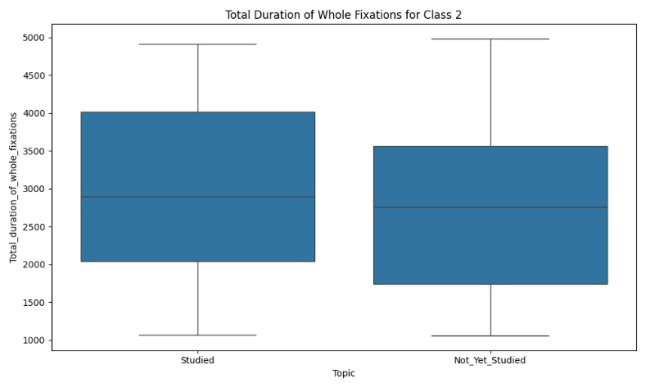
Total Duration of Whole Fixations Class 2 (Second Grade): The differences were found concerning the overall duration of whole fixations between the studied and not-yet-studied topics, with the help of two tests: t-test (t = 4. 250, p = 0. 0004) and Mann-Whitney U test (W = 958, p = 0. 0001), demonstrating longer fixation durations in not-yet-studied topics.
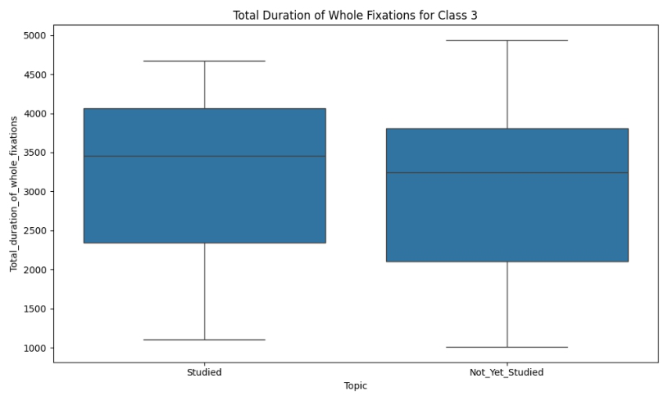
Class 3 (Third Grade): In terms of whole fixations’ total time, the alternatives hypothesized were supported by the t-test results for both the studied and not-yet-studied materials. (p = 3.07 × 10ˆ-7) and Mann-Whitney U test (p = 3.79 × 10ˆ-14). This indicates that students spent more time gazing at topics not covered in class yet.
Investigating Reading Behaviors of Elementary School Students 2313
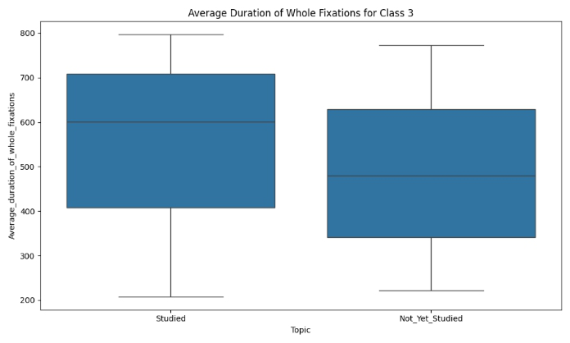
Average Duration of Whole Fixations Class 3 (Third Grade): It was also noted that there were differences in studied and not-yet-studied topics, with p values of 0.016 (t-test) and 0.0002 (Mann- Whitney U test). In this case, the not-yet-studied issues were found to attract more attention due to their having a higher average fixation duration.
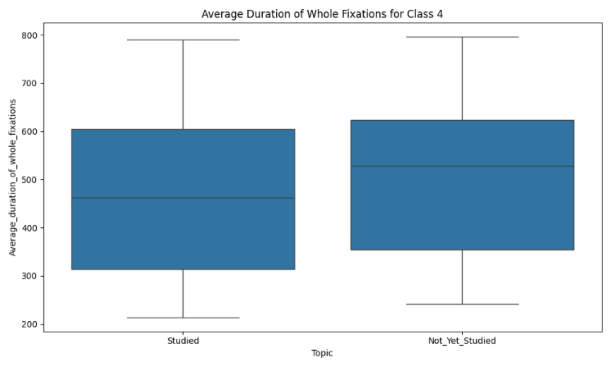
Class 4 (Fourth Grade): It is to be noted that whole fixation duration was characterized here, and a notable difference was identified in the duration of entire fixations between the two groups for all the texts; the t-test yielded a p-value of. 010.
Number of Whole Fixations Class 2 (Second Grade): Both the t-test (p = 0.0005) and Mann-Whitney U test (p = 0.0012) indicated significant differences, with more fixations on not-yet-studied topics.
Class 3 (Third Grade): Significant differences were found, with p values of 5.85 × 10ˆ-7 (t-test) and 1.16 × 10ˆ-12 (Mann-Whitney U test). The number of fixations was higher for not-yet-studied topics.
Number of Saccades Class 2 (Second Grade): Significant differences were observed, with p values of 0.00007 (t-test) and 0.0003 (Mann-Whitney U test), indicating more saccades for not-yet-studied topics.
Class 3 (Third Grade): Significant differences were found, with p values of 3.51 × 10ˆ-8 (t-test) and 1.34 × 10ˆ-15 (Mann-Whitney U test). The number of saccades was higher for not-yet-studied topics.
Average Peak Velocity of Saccades Class 3 (Third Grade): Thus, the t-test equal to 0,0027 means that saccades were indeed faster for not-yet-studied topics.
Average Amplitude of Saccades Class 3 (Third Grade): Significant differences were found with the t-test (p = 0.021), indicating larger saccades for not-yet-studied topics.
DISCUSSION
The findings of this study raise awareness about the reading behavior of Omani elementary students concerning known and unknown Arabish contexts. The significant effects relating to total fixation time, number of fixations, and number of saccades are outlined when comparing the cues to the topics studied and not yet studied by second and third-graders.
Reading Behavior in Second Grade (Class 2) Second graders’ total fixation time, the frequency of fixations, and the number of saccades to the studied and not-yet-studied topics were significantly different. This implies that the younger students take more time and perform more eye movements when reading new content. Total duration
and the number of fixations mean that the second graders may reread or attempt to comprehend the new information more carefully. Such results conform to prior studies stating that students with lower reading levels have less accurate reading strategies and perform more regressions on unfamiliar or complex text (Strandberg et al., 2023; Heikkilä et al., 2024).
Reading Behavior in Third Grade (Class 3) Third graders’ results revealed substantial changes in all the indicated categories, which points to a clear differentiation in reading-related conduct concerning the topic studied and topics that have not been studied. The raised total fixation time, the number of fixations, and the number of saccades towards not-yet-studied topics imply that these students encoded the contents more intensively, which probably means that they processed studied contents at a deeper level. More extensive and faster saccades also mean more investigation and searching for meaning in the text. This is backed by research that shows that children read more strategically as they grow older and are highly likely to reason more greatly on complex or new text.
Reading Behavior in Fourth Grade (Class 4) Finally, fourth-graders exhibited less differentiation for the measured variables between the topics that were subjects of the study performed before and the ones that were not. Hence, it can be concluded that older students may have more stable reading strategies and are less sensitive to content familiarity, and, therefore, there is a substantial difference in the average duration of whole fixations. This stability could be due to enhancement in first- and second-order reading proficiency and executive control strategies that have accrued over time; thus, they sustain small fixations to read, whichever content is known or unknown. The same tendencies are observed in older learners and adults for whom reading fluency results in more constant and less energy-consuming eye movements across different texts (Justino and Kolinsky, 2023; Shalhoub-Awwad, 2023).
Benchmarking with Other Studies Prior research texts’ difficulty and familiarity factors have been studied in detail regarding their influence on readers’ behaviors. For example, Rayner et al. (2001) showed that when text is unfamiliar or the font is small, individuals take more time, and the more they fixate on a subtext and make more saccadic movements as they try to make sense of what they are reading (Hermena et al., 2015). Furthermore, as identified by Joseph et al. (2009), the young reader makes more regression and has a longer fixation time when reading complex text, supporting the result of second-grade students (Rayner, 2001; Al Maqbali et al., 2013). Additionally, Ashby et al. (2005) also concluded that children at a higher grade level, which should imply a higher level of reading skills, have small IEPs across different types of texts, which agrees with what is seen in fourth grade (Joseph et al., 2009). This body of literature supports the proposition of
Investigating Reading Behaviors of Elementary School Students 2315
the current study that reading level and attention to text affect eye movement patterns, with specificity to text familiarity and difficulty.
Figure 1: Total duration of whole fixations for class 2.Figure 2: Total duration of whole fixations for class 3.
Recommendations for Educators From the research study presented in this paper and the research available in the literature, the following recommendations can be made for educators to improve the delivery of reading instruction and support learners’ reading acquisition efficiently. One of the viable strategies is pre-reading strategies. Among students in the second grade, most are benefitted from pre-reading activities and strategies. According to the authors, the teachers are expected
to assist in vocabulary Introductions and provide background information concerning the given text. They also enhance student performance and ease of the new content that is to be taught.
Figure 3: Average duration of whole fixations for class 3.Figure 4: Average duration of whole fixations for class 4.
Another suggestion related to reading is that instruction should be differentiated. Differentiation helps educators to teach by conforming to the manner in which students read in different classes. For instance, new texts should be given to third graders, while new and inappropriately challenging texts should be given to fourth graders so that they do not regression. This way, students are catered to depending on their abilities, and they should be able to move to the next level in reading abilities.
Investigating Reading Behaviors of Elementary School Students 2317
Another useful approach is the utilization of eye-tracking data within the process of teaching. It can also point out students who have reading difficulties, such as regressions and many more long fixations. The above information can be of useful input to educators in guiding the child with specific instructions and helping to build strong foundations by conducting such activities as summarizing and questioning. It also aids in solving student reading problems since more attention is paid to individual students’ reading levels.
The incorporation of technology into teaching reading can also be very beneficial to students. For instance, the interactive reading programs provide practice based on the client’s reading skills. By focusing on the students, the weak learners realize that they will require more practice, hence improving their reading skills. This way, lessons become more interesting and easily understandable due to the application of technology.
Finally, it is essential to make them use efficient reading skills, as you should promote active reading strategies. In another approach, the teachers can develop some sets of questions and some predictions for students to adopt as they read, which enhances the active reading disposition. While participating in read-aloud sessions, the given strategies improve the students’ readers’ involvement in the text, which is crucial for comprehension and further knowledge retention. By assuming the provided recommendations, educational practicing can enhance learning and reader support in the reasonable scale of reading instruction.
CONCLUSION
In conclusion, this study focuses on content experience influencing reading profiles within the various year levels. Consistent with expectations, fixation, and saccadic activity data revealed that students’ reading experience with the content matters; the longer and more frequently students fixated and shifted their gaze to topics in the text, the better they were at reading those topics in subsequent trials. More studies can extend to understanding the specific cognitive relations that motivate such behaviors, as well as to test ways to increase the level of literacy.
ACKNOWLEDGMENT
The research project that led to these results was funded by the Ministry of Higher Education, Scientific Research and Innovation of the Sultanate of Oman, the lead partner and other contributors (if any) under the Strategic Research Projects Program under Research Contract No. (2022\1\MoE\SRP\MoHER).
REFERENCES
Al Maqbali, H., Scholer, F., Thom, J. A., & Wu, M. (2013, December). Using eye tracking for evaluating web search interfaces. In Proceedings of the 18th Australasian document computing symposium (pp. 2–9).
Heikkilä, T. T., Soralinna, N., & Hyönä, J. (2024). Relating foveal and parafoveal processing efficiency with word-level parameters in text reading. Journal of Memory and Language, 137, 104516. Hermena, M. Drieghe, J. Hellmuth, S. Liversedge, (2015). “The influence of diacritic
marks on Arabic readers’ eye movements,” Journal of Cognitive Psychology, vol. 27, no. 6, pp. 741–774. Joseph, D. Liversedge, E. Blythe, and K. Rayner, ( 2009.). “Reading and the development of eye-movement control,” Current Directions in Psychological Science, vol. 18, no. 1, pp. 4–9. Justino, J., & Kolinsky, R. (2023). Eye movements during reading in beginning
and skilled readers: Impact of reading level or physiological maturation?. Acta psychologica, 236, 103927. Rayner, (2001). “Eye movements in reading and information processing: 20 years of research,” Psychological Bulletin, vol. 124, no. 3, pp. 372–422, Shalhoub-Awwad, Y. (2023). The role of verbal patterns in Arabic reading
acquisition: Insights from cross-modal priming. Reading and Writing, 36(3), 649–672. Strandberg, A., Nilsson, M., Östberg, P., & Seimyr, G. Ö. (2023, July). Eye movements are stable predictors of word reading ability in young readers. In Frontiers in Education (Vol. 8, p. 1077882). Frontiers Media SA. Tsang, Y. K., & Chen, H. C. (2023). Eye movements in reading Chinese. In Cognitive
and cultural influences on eye movements (pp. 235–254). Routledge. Wegener, S., Yu, L., Reichle, E., Beyersmann, E., Parrila, R., & Castles, A. (2023).
Eye movements during reading. Frontiers for young minds, 11, 1–8.
LISTED IN THE AHFE DIGITAL BOOKSTORE CATALOGUE
Explore the complete digital volume
Human Factors in Design, Engineering, and Computing
Read this individual research paper free through the original publisher, or explore the full digital proceedings book.
ISBN 978-1-964867-35-9
Explore this ISBN in the AHFE Bookstore ↗Listed in the July 2026 bookstore catalogue; search by ISBN to confirm current availability · Digital book purchase optional