Fiona Duruaku, Tulsi Patel, Nathan Sonnenfeld, Blake Nguyen, Florian Jentsch (2025). Right Hand, Left Hand, Both Hands: Exploring the Relationship Between Handedness, Interactivity, and Cognitive Load in Virtual Reality Procedural Training. In: Metaverse, Virtual Environments and Game Design. AHFE Open Access, vol. 178, pp. 49–59. https://doi.org/10.54941/ahfe1006344
Publisher statistics will load when you open Metrics.
AHFE OPEN ACCESS OPEN ACCESS CONFERENCE PROCEEDINGS PAPER
Right Hand, Left Hand, Both Hands: Exploring the Relationship Between Handedness, Interactivity, and Cognitive Load in Virtual Reality Procedural Training
Virtual reality (VR) has emerged as a viable tool for immersive learning, yet the impact of individual differences on user interaction and training outcomes in VR remains somewhat underexplored. This study aims to address this gap by examining the relationship between a number of individual difference and personality variables, interactivity (active vs. passive engagement), and cognitive load in VR. To investigate this, 79 participants were recruited from a university participant pool. One of the variables that emerged as related to performance was handedness(i.e., whether a user is left- or right-handed). Previous research has shown that handedness in VR can explain differences in movement speed, interactivity, and embodiment. Specifically, aligning controls and interactions with the user's dominant hand preferences. In our study, 72 right-handed and 7 left-handed individuals(10%, which is representative of handedness in the population)completed a series of procedural tasks in VR. These tasks were designed with varying levels of interactivity—the active instruction condition affording more user-driven engagement than the passive instruction condition. Performance metrics such as accuracy in the VR post-training test were collected, while cognitive load was measured post-training using a subjective questionnaire. Data analyses were performed using Analyses of Variance and multiple regressions. Results revealed no significant effect of handedness on cognitive load and no interaction effects between handedness and interactivity in the VR post-training scores. However, we found that handedness and cognitive load were significant predictors of procedural training outcomes. These findings suggest that handedness may influence training in VR, underscoring its potential role in shaping learning outcomes. Based on these results, we offer practical considerations for implementing VR-based training across safety critical industries like aviation, defense, and healthcare. These include recommendations for designing VR interfaces that accommodate handedness variability and guidelines for optimizing interactivity to enhance learning outcomes for both right-handed and left-handed users.
While virtual reality (VR) is not yet universally considered the “holy grail” of training in safety-critical industries including aviation, it is certainly a transformative tool that has gained substantial recognition across various industries. VR offers immersive, hands-on experiences that are particularly effective for teaching complex procedures, improving safety, and reducing costs associated with real-life training. However, the success of VR training depends on several factors, including how people interact with the technology and their individual characteristics. One important factor is handedness, which we refer to as whether someone is right-handed or left-handed. Handedness, or the preference for using one hand over the other in various tasks, is a fundamental biological trait in humans. While the majority of people are right-handed, a small percentage of the population are more inclined to using their left hand (Lou et al., 2020). This preference affects how individuals perform tasks requiring coordination and motor skills, which may influence how they learn in VR environments. Handedness has long been considered in the design of physical workspaces and tools, such as computer keyboards, vehicle controls, and airplane cockpits. However, in VR training environments, where both hands are often used simultaneously, the impact of handedness on user performance and experience has received little attention from researchers. Furthermore, studies directly examining the impact of handedness on VR procedural training outcomes are limited or even non-existent. Existing research suggests that left-handed individuals may experience challenges when interacting with interfaces predominantly designed for right-handed users, potentially affecting the efficacy of training. This highlights the importance of considering handedness in VR training design, especially when the design does not accommodate left-handed users. Despite the potential significance of handedness in shaping how users interact with virtual environments, this gap in understanding remains largely unaddressed.
Interactivity refers to the degree of control users have over their learning experience (Makransky & Petersen, 2021). Within VR training, interactivity plays a vital role in influencing learning outcomes. Active learning, in particular, often enhances procedural learning by involving learners in hands-on problem-solving and decision-making processes, fostering a deeper understanding of the tasks at hand (Conrad et al., 2024). However, the cognitive demands associated with active learning may vary depending on the individual’s handedness, potentially influencing motor performance and procedural training outcomes. This study investigates the main effects of handedness and its moderation of the impact of interactivity and cognitive load on VR procedural training outcomes. Specifically, the research hypothesizes that: a) There will be a significant difference in knowledge test scores among individuals based on their dominant handedness (right-handed vs. left- handed) and interactivity (passive vs. active).
Right Hand, Left Hand, Both Hands 51
b) Handedness will moderate the effect of interactivity on knowledge test scores. c) Handedness will moderate the effect of cognitive load on knowledge test scores.
LITERATURE REVIEW
VR training has proven to be effective for procedural training (Buttussi & Chittaro, 2021). Procedural knowledge refers to learners’ memory of the steps required to perform a sequence of tasks (Jongbloed et al., 2024). The key metrics for evaluating VR training outcomes include accuracy, task completion time, retention, and transferability to real-world settings (Strojny & Du˙zma´nska-Misiarczyk, 2023). In this study, we measure VR procedural training outcomes using the post training knowledge test scores. Higher interactivity has been shown to improve the acquisition of various types of knowledge (Patwardhan & Murthy, 2015), including procedural knowledge. However, higher interactivity often demands motor coordination, spatial cognition, and user dexterity — all of which can vary significantly between individuals. Furthermore, these increased demands may lead to higher cognitive load. This variability suggests that handedness may play an important role in influencing VR procedural training outcomes.
Handedness plays a significant role in VR tasks requiring precision, such as reach-to-grasp activities (Nataraj et al., 2022). Research has shown that controlling a virtual hand with the dominant limb enhances performance and perception (relative binding) compared to the non-dominant limb. A strong positive correlation has been found between performance and perception when using the dominant hand, indicating that users tend to feel more in control and perceive actions more accurately with their dominant limb (Nataraj et al., 2022). Additionally, a study on reaching interactions in VR highlighted how kinematic properties of virtual hand movements differ significantly based on the hand used, the direction of movement, and which side of the body is involved (Clark et al., 2024). Handedness can therefore influence the acquisition of skills using dominant and non-dominant hands (McGrath & Kantak, 2016). This, in turn, may affect interactivity and cognitive load in VR training environments. For right-handed individuals, the robust asymmetry observed in motor skill learning suggests that tasks involving their dominant hand may feel more intuitive and impose a lower cognitive load compared to tasks requiring their non-dominant hand. In contrast, left-handed individuals, who exhibit less pronounced asymmetry, may experience a more balanced cognitive load across both hands.
Handedness impacts efficiency, accuracy, and operation duration in tasks (Lou et al., 2020). The dominant hand is often faster and more agile, making it ideal for efficient tasks like moving objects or adjusting viewing angles. In contrast the non-dominant hand is more precise and better suited for tasks such as drawing or text input. These findings suggest that VR interfaces should be designed to leverage the strengths of both hands, dynamically adapting to the user’s operating hand by tracking it in real time. The results highlight how handedness impacts users’ ability to interact effectively
with VR systems, potentially due to design biases favoring right-handed individuals. This indicates that left-handed users may face limitations when using VR interfaces, which could negatively affect their learning outcomes in procedural training scenarios.
METHOD
Participants and Research Design The participants were 79 (72 right-handed and 7 left-handed) undergraduate students recruited from the University of Central Florida participant pool. They were randomly assigned to the levels of interactivity (see Table 1) and handedness information was provided through a pre-survey. The VR procedural training task was an exterior preflight inspection performed either on a desktop or using a head-mounted display and the hand input modality was a mouse or VR hand controller respectively.
Table 1: Instructional interactions in VR by condition Interactivity
Table available in the original PDF paper.
Passive Text Audio Compare States [Static Image] Active Highlight Object Point to Object View Hints/Tips View Q&A Magnify View Compare States (Dynamic Model) Animate Assembly Animate Function
Materials
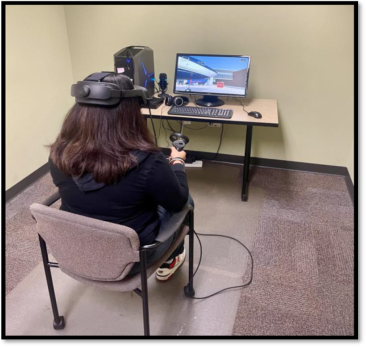
Virtual Reality Simulation The VR simulation used in this experiment was the Flightcrew Procedures Experimental Training (FlightPET) simulation (Sonnenfeld et al., 2023), designed using the Unity3D game engine. The task was an exterior preflight inspection, which involved a thorough examination by the flight crew of an aircraft’s exterior conducted, to ensure the aircraft is airworthy and safe for operation.
Participants engaged with the simulation either in passive or active conditions (see Table 1). The majority of the inputs in the VR simulation were designed to be made using the right hand.
Tests A survey was administered to participants to gather information on their handedness. Students were asked to choose from one of three options: right- handed, left-handed or ambidextrous. Cognitive load was measured using adapted items from Andersen and Makransky (2021) (see Appendix B).
Right Hand, Left Hand, Both Hands 53
Figure 1: The VR simulation.
Participants rated their mental effort in learning the exterior preflight inspection, with statements such as, “The elements in the virtual environment made the learning very unclear” and “The interaction technique used in the simulation was, in terms of learning, very ineffective”. VR procedural training outcomes were assessed based on the total score of correct answers to the multiple-choice, fill-in-the-blank, and scenario-based questions (Nguyen et al., 2023).
RESULTS
Descriptive Statistics Descriptive statistics were computed for handedness, interactivity, cognitive load, and VR procedural training scores. Among participants, right-handed individuals were more prevalent, with 37 in passive interactivity group and 35 in active interactivity group, totalling 72 individuals. In contrast, left- handed individuals included 3 in the passive interactivity group and 4 in the active interactivity group, totalling 7 individuals. Overall, the total sample included 79 participants, with 40 in the passive interactivity condition and 39 in the active interactivity condition. Cognitive load scores ranged from 7.13 to 40.75, with a mean of 26.29 (SD = 7.65). VR procedural training scores ranged from 1 to 11, with a mean of 7.51 (SD = 1.83).
Differences in Cognitive Load by Handedness We conducted a 2 × 2 between-subjects ANOVA to assess the equivalence of cognitive load between right-handed and left-handed participants. Right- handed participants (M = 26.53, SE = 0.90, 95% CI [24.74, 28.33]) showed a higher mean cognitive load compared to left-handed participants (M = 23.22, SE = 2.92, 95% CI [17.40, 29.05]). The 95% confidence intervals for the two groups overlapped, suggesting no significant difference in cognitive load based on handedness. The means and confidence intervals for the interactivity conditions showed that there was no significant difference in cognitive load between participants in the passive (M = 24.71, SE = 2.30, 95% CI [20.13, 29.29]) and active (M = 25.05, SE = 2.02, 95% CI [21.02, 29.07]) conditions.
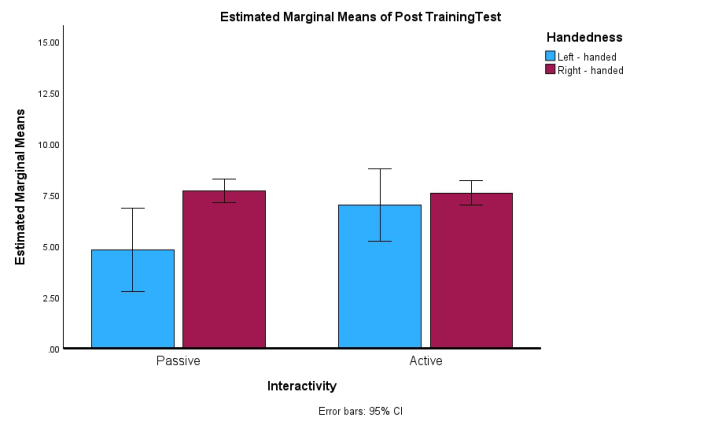
Differences in VR Procedural Training Scores by Handedness We conducted a 2 × 2 between-subjects ANOVA to examine the main effects and interaction effects of handedness (right-handed vs. left-handed) and interactivity (passive vs. active) on post-training knowledge test scores. The scale of knowledge tet scores ranged from 0 to 15. Before conducting the analysis, we verified the assumptions of normality for residuals using Shapiro-Wilk’s test. For interactivity, passive, p = .05, active, p = .65 while for handedness, left-handed, p = .96, right-handed, p = .03. Homogeneity of variances was measured using the Levene’s test, and the assumptions were met (p = .93). The main effect of interactivity was not statistically significant, F (1, 75) = 2.11, p = .15, η2 = .03, suggesting that interactivity did not meaningfully affect knowledge test scores. The main effect of handedness was statistically significant, F (1, 75) = 5.97, p = .02, η2 = .07. This shows that VR procedural training scores differ between right-handed (M = 7.65, SD = 1.78) individuals tended to have 7% better knowledge test scores than left-handed (M = 6.07, SD = 1.81) individuals. The estimated marginal means of knowledge test scores reveal that our hypothesis was supported because right-handed participants consistently outperformed left- handed participants across both passive (M = 7.49, SD = 1.99) and active (M = 7.54, SD = 1.67) interactivity conditions as shown in Figure 1. Additionally, we found no significant interaction between handedness and interactivity (see Figure 1) on knowledge test scores, F (1, 75) = 2.55, p = .11, η2 = .03, indicating that the effect of handedness on knowledge test scores was not influenced by the levels of interactivity, as the difference in performance between right-handed and left-handed participants remained consistent across both passive and active interactivity conditions.
Figure 2: VR procedural training scores by handedness and interactivity.
Right Hand, Left Hand, Both Hands 55
Moderating Effect of Handedness on Interactivity and VR Procedural Training Outcomes We employed a hierarchical multiple regression analysis (see Table 2) to investigate whether handedness (right-handed vs left-handed) moderates the relationship between interactivity (passive vs active) and VR procedural training outcomes. The scale of VR procedural training scores theoretically ranged from 0 to 15. Before data analysis, assumptions for linearity was assessed using a scatterplot, multicollinearity was measured using tolerance values (p > .1), homoscedasticity was assessed using a normal probability plot and normality of residuals were checked using a Q – Q plot. In the first block, handedness and interactivity were entered as predictors. The model explained 6% of the variance in post-training test scores (R2 = .06, p = .09). Handedness was a significant negative predictor (B = −1.59, p = .03), indicating that left-handed participants (coded as 1) scored 1.59 points lower than right-handed participants (coded as 0). Interactivity was not a significant predictor (B = .095, p = .82). In the second block, the interaction term between handedness and interactivity (HND x INT) was added to the model. This block explained an additional 3% of the variance (1R2 = .03, p = .11), but it was not a significant predictor (B = 2.27, p = .11), suggesting that the effect of interactivity on knowledge test scores did not significantly depend on levels of handedness.
Moderating Effect of Handedness on Cognitive Load and VR Procedural Training Outcomes We employed a hierarchical multiple regression analysis (see Table 3) to examine whether handedness (right-handed vs left-handed) moderates the relationship between cognitive load and post-training knowledge test core
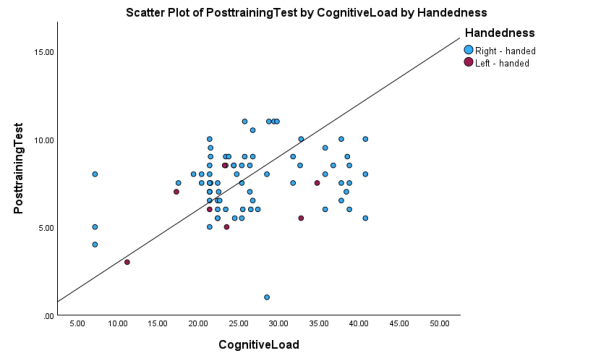
(see Appendix A). Theoretically, the procedural training scores ranged from 0 to 15, but practically, participants scored between 1 and 11. In the first block, cognitive load was entered as the sole predictor. The model explained 7% of the variance in post-training test scores (R2 = .07, p = .02). Cognitive load was a significant positive predictor (B = 0.06, p = .02), indicating that higher levels of cognitive load were associated with slightly higher test scores (see Appendix A). In the second block, Handedness was added as a predictor. (B = −1.40, p = .047), suggesting that left-handed participants (coded as 1) scored 1.40 points lower than right-handed participants (coded as 0). Cognitive load remained a significant positive predictor (B = .06, p = .03). In the third block, the interaction term between handedness and cognitive load (HND x CL) was added. Neither the interaction term (B = .05, p = .57) nor handedness (B = −2.64, p = .27) were significant predictors in this model. Cognitive load was not significant, albeit close (B = 0.05, p = .06).
The goal of this study was to examine the main effects of handedness and how handedness moderates the relationship between interactivity and cognitive load on post-training knowledge test scores. We found that handedness was a significant predictor of performance, with left-handed users generally scoring lower on the post-training knowledge test compared to right-handed users. These findings suggest that some VR interfaces may not be accessible or intuitive for users with different handedness. Left-handed users, in particular,
Right Hand, Left Hand, Both Hands 57
may face challenges using VR systems effectively due to ergonomic and design limitations. To address this, designers should include adjustable settings that let users customize controls for their dominant hand. We also found that cognitive load was a significant predictor of knowledge test scores. The positive association between cognitive load and learning outcomes suggests that a moderate level of cognitive load can enhance engagement and retention by challenging users to actively process information. Thus, it is essential to design environments that balance the mental effort required to process information and complete tasks by scaffolding learning and providing real- time feedback.
The available research on handedness in VR procedural training is limited, with most studies focusing on specific domains such as medical procedures or motor tasks. Future research should examine the interaction between handedness, interactivity, and cognitive load in VR procedural training across various fields to provide more conclusive evidence for these findings. Additionally, it is important to explore the underlying mechanisms by which handedness impacts VR procedural learning outcomes. Future studies should consider the threshold beyond which cognitive load becomes detrimental rather than beneficial, as well as the optimal strategies for balancing cognitive demands in VR environments.
APPENDIX A
Figure 3: Moderating effect of handedness on cognitive load and vR procedural training scores.
Note. The relationship between cognitive load and post training test scores does not appear to differ substantially by handedness. Both groups show a positive association between cognitive load and post training test scores, but the trend appears stronger and more consistent for right-handed participants.
APPENDIX B Cognitive Load Adopted From Andersen and Makransky (2021)
i. The interaction technique used in the simulation was very unclear. ii. The interaction technique used in the simulation was, in terms of learning, very ineffective. iii. The interaction technique used in the simulation made it harder to learn. iv. The interaction technique used in the simulation was difficult to master. v. The elements in the virtual environment made the learning very unclear. vi. The virtual environment was, in terms of learning, very ineffective. vii. The virtual environment was full of irrelevant content. viii. It was difficult to find the relevant learning information in the virtual environment.
ACKNOWLEDGMENT
The views expressed herein are those of the authors and do not reflect the views of the institutions to which they are employed, any sponsors, or the University of Central Florida.
REFERENCES
Clark, L., Iskandarani, M. E. & Riggs, S. (2024). Reaching interactions in virtual reality: The effect of movement direction, hand dominance, and hemispace on the kinematic properties of inward and outward reaches. Virtual Reality 28, 43. https://doi.org/10.1007/s10055-023-00930-9 Conrad, M., Kablitz, D., & Schumann, S. (2024). Learning effectiveness of
immersive virtual reality in education and training: A systematic review of findings. Computers & Education: X Reality, 4, 100053. https://doi.org/10.1016/ j.cexr.2024.100053 Jongbloed, J., Chaker, R., & Lavoué, E. (2024). Immersive procedural training in virtual reality: A systematic literature review. Computers & Education, 105124. https://doi.org/10.1016/j.compedu.2024.105124 Lou, X., Feng, Z., & Shi, Y. (2020). Handedness Effect and its Implication for
Designing Two-Handed Interactive Applications in Virtual Reality. In Proceedings of the AHFE 2020 Virtual Conferences on Usability and User Experience, Human Factors and Assistive Technology, Springer International Publishing. https:// doi.org/10.1007/978-3-030-51828-8_96 Makransky, G., Petersen, G. B. (2021). The Cognitive Affective Model of Immersive Learning (CAMIL): A Theoretical Research-Based Model of Learning in Immersive Virtual Reality. Educ Psychol Rev 33, 937–958. https://doi.org/ 10.1007/s10648-020-09586-2 McGrath, R. L., & Kantak, S. S. (2016). Reduced asymmetry in motor skill learning in left-handed compared to right-handed individuals. Human Movement Science, 45, 130–141. https://doi.org/10.1016/j.humov.2015.11.012 Nataraj, R., Sanford, S., Liu, M., & Harel, N. Y. (2022). Hand dominance in the
performance and perceptions of virtual reach control. Acta Psychologica, 223, 103494. https://doi.org/10.1016/j.actpsy.2022.103494 Nguyen, B., Sonnenfeld, N., Duruaku, F., & Jentsch, F. (2023). Modern training practices: Studying the use of virtual reality for training procedures in flightcrew training. https://rosap.ntl.bts.gov/view/dot/76580f
Right Hand, Left Hand, Both Hands 59
Patwardhan, M., & Murthy, S. (2015). When does higher degree of interaction lead to higher learning in visualizations? Exploring the role of ‘Interactivity Enriching Features’. Computers & Education, 82, 292–305. https://doi.org/ 10.1016/j.compedu.2014.11.018 Strojny, P., & Du˙zma´nska-Misiarczyk, N. (2023). Measuring the effectiveness of
virtual training: A systematic review. Computers & Education: X Reality, 2, 100006. https://doi.org/10.1016/j.cexr.2022.100006
LISTED IN THE AHFE DIGITAL BOOKSTORE CATALOGUE
Explore the complete digital volume
Metaverse, Virtual Environments and Game Design
Read this individual research paper free through the original publisher, or explore the full digital proceedings book.
ISBN 978-1-964867-54-0
Explore this ISBN in the AHFE Bookstore ↗Listed in the July 2026 bookstore catalogue; search by ISBN to confirm current availability · Digital book purchase optional