Francesca Massa, Sara Buonocore, Raffaele De Amicis, Andrea Tarallo, Giuseppe Di Gironimo (2025). Impact of Cognitive Load on Learning in Immersive Virtual Reality Environments. In: Metaverse, Virtual Environments and Game Design. AHFE Open Access, vol. 178, pp. 38–48. https://doi.org/10.54941/ahfe1006343
The present work focuses on the use of Immersive Virtual Reality (IVR) to train users by immersing them in safe and controlled Virtual Environment (VE) and enabling them to learn by doing. Particular attention is given to adaptive VR-training systems that are capable of dynamically adjusting the training experience based on user’s performance and cognitive state. Considering this, a new methodology for such systems is proposed, that is crafted on the Cognitive Theory of Multimedia Learning (CTML). This methodology aims to help instructors to understand how to adapt VR-training systems to users during their experience in VEs, leading to effective Learning Outcomes and avoiding a high Cognitive Load (CL). This human factor plays a critical role in mediating the relationship between Presence, Immersion, and Learning Outcomes, as the VE generates a CL to users. To have a deeper understanding, factors influencing CL in VEs are presented and relative solutions are proposed. It is our understanding that adaptive VR-training systems, their design, architecture, and attributes, can pave the way to new research directions and that the new methodology presented in this paper will be supportive.
Virtual Reality (VR) is a computer-generated simulation or recreation of an environment with scenes and objects that appear to be real (Baker, 2024). To date, when talking about VR, frequently is possible to find the expression “Immersive Virtual Reality (IVR)”, which refers to “the combination of software and hardware systems (VR technology) designed to create a complete sensory illusion of being immersed in a different environment” (Han, Zheng, e Ding, 2021). IVR is defined by two key features: “Immersion” and “Presence”. Immersion refers to the objective property (devices, graphics, sounds, etc.) of VR technology provides allowing users to establish deeper connections with the Virtual Environment (VE) (Berkman e Akan, 2024), while Presence refers to the subjective/psychological experience of the user resulting from being in the VE (Berkman e Akan, 2024). Furthermore, the expression IVR is often preceded by “low” or “high” to describe
Impact of Cognitive Load on Learning in Immersive Virtual Reality Environments 39
different levels of immersion provided by VR technology. For example, low IVR involves using a standard two-dimensional monitor and a keyboard and/or a mouse for interacting, while high IVR requires a Head-Mounted Display (HMD).
Currently, it is commonly understood that when the expression IVR is used, it refers to high immersion VR. Based on this general understanding, in our research, we use the term IVR specifically to denote high immersion VR. More precisely, our work focuses on a particular subclass of VR in which users are immersed in and able to interact with the VE, thus they are isolated from external visual cues and uncontrolled stimuli from their own physical world, allowing them to experience a highly engaging, interactive setting.
Due to the widespread availability of affordable software and hardware tools, IVR is rapidly advancing, and it is used for numerous purposes thanks to its flexibility. In the current study, we focus on the use of IVR to train users by immersing them in safe and controlled VE and enabling them to learn (i.e., the process of acquiring skills and knowledge) by doing, thus improving traditional learning methodologies because users will be an active participant (Jensen e Konradsen, 2018; Zahabi e Abdul Razak, 2020; Patle et al., 2019).
In scientific literature, it is commonly believed that high IVR enhances Learning Outcomes (Parong et al., 2020) due to increased physical and mental Immersion, interaction and imagination, fostering a strong Sense of Presence to the user. Nevertheless, conflicting results can be found. While some research suggest that high IVR improves Learning Outcomes (Markowitz, 2018; Cabrera-Duffaut, Pinto-Llorente, e Iglesias-Rodríguez, 2024), other report no significant difference (Aggarwal et al., 2019; Dhimolea, Kaplan-Rakowski, e Lin, 2022), or even worse outcomes (Makransky, Terkildsen, e Mayer, 2019; Lin, Wang, e Suh, 2020). The reasons for these discordant results are explained by the Cognitive Theory of Multimedia Learning (CTML) (Mayer, 2005); indeed, while Immersion and Sense of Presence can enhance Learning Outcomes, excessive CL may hinder them. Thus, managing CL is crucial for optimizing Learning Outcomes in the VE, as high CL negatively impacts the User Experience (Han, Zheng, e Ding, 2021).
In light of this, our research work presents a new methodology for adaptive VR-training scenarios, that is crafted on the CTML, and aims to help instructors to understand how to adapt such systems to users during their experience in the VE, leading to effective Learning Outcomes and avoiding a high CL.
Thus, the paper is structured as follows: a section is dedicated to the theoretical background of what CL is, and the theories behind it. Then, factors influencing CL in VEs are deepened and relative solutions are explained, and particular attention is given to adaptive VR-training systems. Finally, the new methodology is presented. Conclusion and Future Direction are given in the last section.
THEORETICAL BACKGROUND What is Cognitive Load? According to Sweller’s Cognitive Load Theory (CLT) (Sweller, 1988), CL is defined as the amount of mental effort required
by a user’s Working Memory (WM) to process and assimilate information during learning. This theory assumes that the capacity of WM is limited and that excessive demand for cognitive resources can compromise Learning Outcomes.
This perspective finds its theoretical basis in the model of memory proposed by Atkinson and Shiffrin (Atkinson, 1968), which divides human memory into three main components: Sensory Memory (SM), Working Memory (WM) and Long-Term Memory (LTM). SM acts as a preliminary filter for incoming sensory information (visual, auditory, tactile, etc.) briefly retaining it. Only a fraction of this information is selected and transferred to WM for further processing. WM (or Short-Term Memory) processes small amounts of information and discards or categorizes it for storage in LTM. The latter has an unlimited storage capacity and serves as the repository for information retained over extended periods, often spanning years or even decades. LTM works with WM to retrieve information and store it in structures. The more these patterns are used, the more they develop and the easier they are to remember. Sweller uses this model to explain the concept of CL, pointing out that WM is a bottleneck in information processing. When the information load exceeds the WM capacity, Learning Outcomes are ineffective.
To address this problem, in his theory, Sweller distinguishes three types of CL: Intrinsic, Germane and Extraneous Load. Intrinsic load refers to the mental effort required to understand, learn and select new information in order to organize it in WM. It depends on the complexity of the information, and the user’s prior knowledge. Germane load is the required CL to process incoming stimuli in depth in the WM and store them effectively in LTM. This requires the selection of relevant information, the organization of a coherent mental model of the information and the integration of this model with prior knowledge in LTM. Unlike Intrinsic and Germane load, which are essential for learning, Extraneous load refers to processing non-essential information, such as irrelevant information, excessive details or distractions from outside. In light of this, the goal of effective Learning Outcomes is to manage the Intrinsic load, reduce the Extraneous load, and optimize Germane load in order to improve knowledge acquisition.
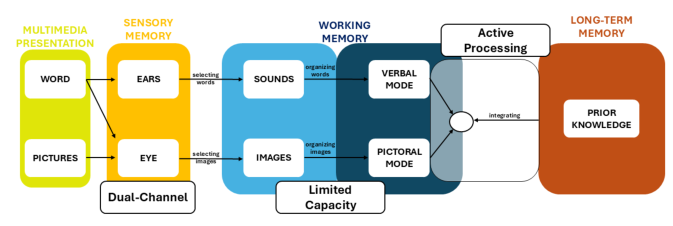
CTML: Starting from Sweller’s CLT, also Mayer’s CTML (Mayer, 2005) (Figure 1) is based on the concept of limited capacity of WM, integrating Paivio’s Dual-Channel Model (Clark e Paivio, 1991) which posits that information is processed through two distinct channels: one visual/pictorial and the other verbal.
CTML provides a useful theoretical framework for the design of immersive experiences in VR, emphasizing the need to optimize CL to facilitate Learning Outcomes. Thus, the theory allows to create experiences that optimally balance engagement and CL, maximizing long-term learning and memorization.
Therefore, it is important to deepen what are the factors that influence the user’s CL in VEs and understand how to handle them.
Impact of Cognitive Load on Learning in Immersive Virtual Reality Environments 41
Figure 1: Cognitive theory of multimedia learning (CTML).
FACTORS INFLUENCING COGNITIVE LOAD IN VIRTUAL ENVIRONMENTS
Table 1: Factors influencing cognitive load in virtual environments.
Table available in the original PDF paper.
Description Factors Influencing CL in VEs
Task Complexity Design More complex tasks requiring precise hand movements or simultaneous actions (e.g., grabbing, rotating, and placing objects) consequently increasing Intrinsic load (Han, Zheng, e Ding, 2021; Tugtekin e Odabasi, 2023). Virtual Environment’s Design
If the design presents too much complex information at once, users may feel overwhelmed. In addition, if the VE is too passive, users do not actively process the information. Finally, confusing design, excessive visual elements or unintuitive interactions increase the Extraneous load (Steinhaeusser et al., 2022). Feedback Mechanisms An insufficient feedback mechanism may lead users to uncertainty about their interactions and a constant evaluation of their actions, consequently increasing Germane and Intrinsic load (Zhao e Cen, 2024). User Prior Experiences and Familiarity
Users familiar with VR technology may experience lower CL compared to new users, because the latter can shift their attention from the learning content to the technology itself (Birbara e Pather, 2021), consequently increasing Germane and Extraneous load. User Interface Design Physical discomfort related to the use of VR technology (such as HMD, controller, biosensors, etc.) during interactions in VEs may increase Extraneous load, as users may become distracted by the difficulty of using such technologies (ergonomics and comfort). Furthermore, the choice of input devices (e.g., handheld controllers vs. gesture recognition) may affect how naturally users interact with virtual objects, impacting Extraneous load (Duan et al., 2024). Users’ Emotion Excessive performance anxiety or emotional overload can increase Extraneous load (Linares-Vargas e Cieza- Mostacero, 2024).
Discussion. Considering factors influencing CL in VEs described in the Table 1; to avoid CL from negatively impacting the User Experience, important precautions should be taken. As mentioned, the Sense of Presence and Immersion make users feel involved in the VE and this should lead to greater Learning Outcomes, only if users are not experiencing an excessive CL. The latter is the key to controlling the relationship between Sense of Presence, Immersion and Learning Outcomes, as the VE generates a CL to users. Considering this, managing CL is crucial for optimizing Learning Outcomes in the VE, as high CL negatively impacts the User Experience.
Therefore, it is recommended to make sure whether the user is familiar with VR technology (Parong e Mayer, 2021). To prevent users from experiencing difficulties in its use, they must be introduced to this technology, giving them the time to familiarize themselves with it through a pre- training phase. In principle, that should help users to better manage WM, since there are more resources to process the learning content, and greater consolidation of the information in LTM. In addition, in order for users to have a comfortable experience, it’s important to ensure that the HMD is well-balanced on the users’ head and adjusted to allow users to see clearly (Ito et al., 2021). Also, the implementation of alternative input methods (e.g., gesture recognition, voice commands) to reduce controllers’ dependency can decrease Extraneous load, as the user is not distracted in remembering how to use controllers, making interaction with the VE as natural as possible. Furthermore, in the VE, information must be organized in an intuitive and natural way, object manipulation must be simplified by allowing users to perform actions in sequence, without combining too many elements (text, sound, animation) at the same time, thus not cluttering the SM and consequently the WM. Also, it is required to provide real-time visual highlights (e.g., glowing edges, ghost previews) to indicate valid placements of objects and the use of haptic feedback to confirm successful actions and guide user movements. This should help users to better manage SM. Finally, in parallel to these “technical” aspects, it’s also recommended to understand user’s emotional state because if user lives an excessive performance anxiety or emotional overload, these can increase Extraneous load.
COGNITIVE LOAD, LEARNING OUTCOMES AND ADAPTIVE TRAINING SYSTEM To date, the precautions presented in the previous section are not sufficient to effectively control the user’s CL during its experience in the VE. Most studies rely on a generalized approach to training, applying the same VR-training system to all users without accounting for individual differences (Zahabi e Abdul Razak, 2020). Although this non-adaptive method is easier and cheaper to implement, it has several limitations. Users often experience disengagement, boredom and high CL, which can lead to ineffective Learning Outcomes. Furthermore, the lack of customization leads to excessive training time, reducing overall efficiency. In contrast, adaptive VR-training approaches, which adjust the training process according to users’ capabilities, performance, and needs, have been shown to improve
Impact of Cognitive Load on Learning in Immersive Virtual Reality Environments 43
engagement, optimize Learning Outcomes and increase user retention, as they prevent users from feeling overwhelmed by the VE (Škola, Tinková, e Liarokapis, 2019; Lucas-Pérez et al., 2024). An adaptive VR-training system is capable of dynamically adjusting the training experience based on the user’s performance and cognitive state. Unlike non-adaptive VR-training systems, which require all users to follow the same steps regardless of their progress, an adaptive VR-training system is capable to modify key elements of the training in real time. These elements may include the difficulty level of tasks, the type and frequency of stimuli presented, and the pace of instruction.
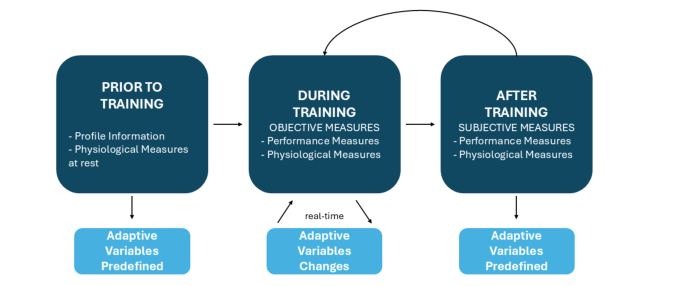
Taking into account the framework of adaptive VR-based training (Zahabi e Abdul Razak, 2020) and considering subjective and objective measurement to measure user’s CL, we propose a methodology that help instructors to understand how adapt training system to user during its experience in VEs leading to effective Learning Outcomes (Figure 2).
Figure 2: Methodology of adaptive VR-training system.
Firstly, before starting training, the instructor should collect information on the users’ profile, such as their familiarity with VR technology, previous experience with VEs, any sensitivity to VR-related effects, such as a tendency to experience headaches, dizziness, or motion sickness, and their learning style. In addition, the instructor can monitor users’ CL and their emotional state at rest by means of proper biosensors. This preliminary evaluation helps the instructor to understand how to set adaptive variables, such as content and feedback.
During training, performance measurements, such as task performance and physiological measures, can be collected through objective measures.
Objective Measurement includes task performance and physiological measurements. Task performance encompasses various quantifiable metrics such as error rate and type, completion time, task success rate, and efficiency of movements. Physiological measurement, such as users’ neural, cardiovascular, and electrodermal activity, respiration and eye movements, can be calculated in real-time using biosensors during IVR training (Guillen- Sanz et al., 2024). Users’ brainwave activity and mental workload on the scalp can be effectively measured with EEG headsets (Birbara e Pather,
2021). About cardiovascular activity, the most common parameters are Heart Rate (HR) and Blood Pressure (BP), which can be measured using ECG, and which provide indications of a user’s emotional state and physical arousal (Parong et al., 2020). EDA (Electrodermal Activity) or Galvanic Skin Response (GSR) is a measurement of electrodermal conductance and eccrine sweat gland activity. Sensors are usually placed on the body areas where most eccrine glands can be found, such as the hands, feet, and nape (Parong e Mayer, 2021). The respiratory rate is usually used as a measure of user relaxation or excitation, and it is monitored with belts placed around the abdomen or chest to measure bodily movements and their magnitude. Finally, eye trackers are used to track eyeball movement and pupil size (Shi, Du, e Worthy, 2020) indicating the levels of users’ attention.
Thus, objective measures help the instructor to understand how to set adaptive variables in real-time during users’ training.
After finishing training, instructors can collect users’ opinions about their experience in VEs through subjective measures.
Subjective Measurement includes questionnaires, self-reports, or observations to collect data after users end IVR training. The most popular questionnaire is the NASA-TLX (NASA Task Load Index). It is based on six dimensions to assess workload: mental load, physical load, time load, performance, effort, and frustration. In addition, there are other questionnaires, such as Multi-dimensional rating-scales, and subjective Workload Assessment Technique (SWAT) that were widely used for self- measurement of CL (Han et al., 2021; Zhao et al., 2020; Armougum et al., 2020; Gloy et al., 2022; Mahmoudzadeh, Afacan, e Adi, 2021). At the end of the training session, once the performance measurements and users’ opinions have been collected, the adaptation can be carried out again, if deemed necessary, in a second session of training.
This closed-loop human-in-the-loop system has the potential to keep the user in the optimal cognitive and performance state during training in VEs. By continuously monitoring user responses, the VR-training system can dynamically adjust task difficulty, pacing, and feedback mechanisms to align with the individual’s CL and skill level. This adaptive approach helps prevent both cognitive overload, which can hinder learning and cause frustration, and cognitive underload, which may lead to boredom and disengagement (Thomay et al., 2023). Real-time adjustments based on objective performance data, such as error rates, reaction times, and physiological indicators, ensure that training remains both effective and engaging. Biometric data can provide further insights into user attention and stress levels, allowing the system to adjust interactions accordingly. This adaptation enhances users’ Sense of Presence, Immersion, promotes sustained attention, and maximizes retention of learned skills. Additionally, by responding to fluctuations in cognitive demand, the system optimizes training efficiency, reducing unnecessary repetition while reinforcing challenging concepts. Such an intelligent, data-driven framework fosters deeper learning and skill acquisition while minimizing fatigue. Ultimately, an adaptive VR- training system can significantly improve User Experience, making training more efficient, personalized, and impactful. It is our understanding that such
Impact of Cognitive Load on Learning in Immersive Virtual Reality Environments 45
adaptive VR-training systems, their design, architecture, and attributes, can open up an exciting new research path for the future.
CONCLUSION AND FUTURE DIRECTION In this work, the focus was on the use of IVR to train users by immersing them in safe and controlled VEs and enabling them to learn by doing, also considering how determinant can be the CL on User Experience, and its relationship with Immersion and Sense of Presence. Particular attention is given to adaptive VR-training systems that are capable of dynamically adjusting the training experience based on the user’s performance and cognitive state. Unlike non-adaptive VR-training systems, which require all users to follow the same steps regardless of their progress, an adaptive VR- training system is capable to modify key elements of the training in real time.
In light of this, a new methodology for such systems was presented that is crafted on the CTML (Mayer, 2005). This new methodology can help instructors to understand how to adapt VR-training systems to users during their training in the VEs leading to effective Learning Outcomes and avoiding high CL. This human factor plays a critical role in mediating the relationship between Presence, Immersion, and Learning Outcomes, as the VE generates a CL to users. To have a deeper understanding, factors influencing CL in VEs were presented and relative solutions were proposed. It is evident that adaptive VR-training systems, their design, architecture, and attributes, can pave the way for new research directions and that the new methodology proposed in this paper will be supportive. Having the potential to be applied in various industrial contexts, the adoption of our methodology for real use cases is already on progress in the frame of GURU project. The latter’s goal is to revolutionize the training of workers in High-Risk Environments, such as those with confined spaces, through the development of an adaptive VR- multisensory system. Considering the methodology proposed in this work, the project aims to develop a system that personalizes dynamically training based on performance and physiological data of the user, keeping the user in an optimal cognitive state, resulting in more efficient Learning Outcomes and safer workplace behaviors.
FUNDINGS This research was funded by the National Institute for Insurance against Accidents at Work, through the “GURU” project, within the program BRIC, grant number CUP B53C22008970005.
REFERENCES
Aggarwal, Akanksha, Sapriya Kaur Birk, Katrina Hass, Jaskaran Singh Gill, Josh Mitchell, Barb Fenesi, e Bruce Wainman. 2019. ≪Is a Dissective Virtual Reality Model an Effective Learning Tool?≫The FASEB Journal 33 (S1): 17–4.
Armougum, A, A Gaston-Bellegarde, C Joie-La Marle, e P Piolino. 2020. ≪Expertise reversal effect: Cost of generating new schemas≫. Computers in Human Behavior 111:106406. Atkinson, Richard C. 1968. ≪Human memory: A proposed system and its control
processes≫. The psychology of learning and motivation 2. Baker, Bradley J. 2024. ≪Virtual reality≫. In Encyclopedia of Sport Management, a cura di Paul M. Pedersen, 1021–23. Edward Elgar Publishing. https://doi.org/ 10.4337/9781035317189.ch599 Berkman, Mehmet Ilker, e Ecehan Akan. 2024. ≪Presence and immersion in virtual
reality≫. In Encyclopedia of computer graphics and games, 1461–70. Springer. Birbara, Nicolette S, e Nalini Pather. 2021. ≪Instructional design of virtual learning resources for anatomy education≫. In Biomedical Visualisation: Volume 9, 75–110. Springer. Cabrera-Duffaut, Augusto, Ana María Pinto-Llorente, e Ana Iglesias-Rodríguez.
2024. ≪Immersive learning platforms: Analyzing virtual reality contribution to competence development in higher education—a systematic literature review≫. Frontiers in Education 9 (luglio):1391560. https://doi.org/10.3389/ feduc.2024.1391560 Clark, James M, e Allan Paivio. 1991. ≪Dual coding theory and education≫.
Educational psychology review 3:149–210. Dhimolea, Tetyana Kucher, Regina Kaplan-Rakowski, e Lin Lin. 2022. ≪A Systematic Review of Research on High-Immersion Virtual Reality for Language Learning≫. TechTrends 66 (5): 810–24. https://doi.org/10.1007/s11528-022- 00717-w Duan, Shiyu, Ziyi Wang, Shixiao Wang, Mengmeng Chen, e Runsheng Zhang. 2024.
≪Emotion-Aware Interaction Design in Intelligent User Interface Using Multi- Modal Deep Learning≫. In 2024 5th International Symposium on Computer Engineering and Intelligent Communications (ISCEIC), 110–14. Wuhan, China: IEEE. https://doi.org/10.1109/ISCEIC63613.2024.10810240 Gloy, Kilian, Paul Weyhe, Eric Nerenz, Maximilian Kaluschke, Verena Uslar, Gabriel Zachmann, e Dirk Weyhe. 2022. ≪Immersive anatomy atlas: Learning factual medical knowledge in a virtual reality environment≫. Anatomical Sciences Education 15 (2): 360–68. Guillen-Sanz, Henar, David Checa, Ines Miguel-Alonso, e Andres Bustillo. 2024.
≪A Systematic Review of Wearable Biosensor Usage in Immersive Virtual Reality Experiences≫. Virtual Reality 28 (2): 74. https://doi.org/10.1007/s10055-024- 00970-9 Han, Jining, Qiyu Zheng, e Yunan Ding. 2021. ≪Lost in virtual reality? Cognitive load in high immersive VR environments≫. Journal of Advances in Information Technology 12 (4). Han, Yu, Yongsheng Diao, Zhenzhen Yin, Ruoyu Jin, Joseph Kangwa, e Obas John
Ebohon. 2021. ≪Immersive technology-driven investigations on influence factors of cognitive load incurred in construction site hazard recognition, analysis and decision making≫. Advanced Engineering Informatics 48:101298. Ito, Kodai, Mitsunori Tada, Hiroyasu Ujike, e Keiichiro Hyodo. 2021. ≪Effects of the Weight and Balance of Head-Mounted Displays on Physical Load≫. Applied Sciences 11 (15): 6802. https://doi.org/10.3390/app11156802 Jensen, Lasse, e Flemming Konradsen. 2018. ≪A review of the use of virtual reality
head-mounted displays in education and training≫. Education and Information Technologies 23:1515–29.
Impact of Cognitive Load on Learning in Immersive Virtual Reality Environments 47
Lin, Yongqian, Guan Wang, e Ayoung Suh. 2020. ≪Exploring the Effects of Immersive Virtual Reality on Learning Outcomes: A Two-Path Model≫. In Augmented Cognition. Human Cognition and Behavior, a cura di Dylan D. Schmorrow e Cali M. Fidopiastis, 12197:86–105. Lecture Notes in Computer Science. Cham: Springer International Publishing. https://doi.org/10.1007/978-3- 030-50439-7_6 Linares-Vargas, Benjamín G. P., e Segundo E. Cieza-Mostacero. 2024. ≪Interactive
Virtual Reality Environments and Emotions: A Systematic Review≫. Virtual Reality 29 (1): 3. https://doi.org/10.1007/s10055-024-01049-1 Lucas-Pérez, Gadea, José Miguel Ramírez-Sanz, Ana Serrano-Mamolar, Álvar Arnaiz-González, e Andrés Bustillo. 2024. ≪Personalising the Training Process with Adaptive Virtual Reality: A Proposed Framework, Challenges, and Opportunities≫. In Extended Reality, a cura di Lucio Tommaso De Paolis, Pasquale Arpaia, e Marco Sacco, 15027:376–84. Lecture Notes in Computer Science. Cham: Springer Nature Switzerland. https://doi.org/10.1007/978-3-031- 71707-9_32 Mahmoudzadeh, Parisa, Yasemin Afacan, e Mohamad Nadim Adi. 2021. ≪Analyzing occupants’ control over lighting systems in office settings using immersive virtual environments≫. Building and Environment 196:107823. Makransky, Guido, Thomas S. Terkildsen, e Richard E. Mayer. 2019. ≪Adding
Immersive Virtual Reality to a Science Lab Simulation Causes More Presence but Less Learning≫. Learning and Instruction 60 (aprile):225–36. https://doi.org/ 10.1016/j.learninstruc.2017.12.007 Markowitz, Jeffrey S. 2018. ≪Introduction≫. In Mortality and Its Risk Factors Among Professional Athletes, di Jeffrey S. Markowitz, 1–6. SpringerBriefs in Public Health. Cham: Springer International Publishing. https://doi.org/10.1007/ 978-3-319-77203-5_1 Mayer, Richard E. 2005. ≪Cognitive theory of multimedia learning≫. The
Cambridge handbook of multimedia learning 41 (1): 31–48. Parong, Jocelyn, e Richard E Mayer. 2021. ≪Cognitive and affective processes for learning science in immersive virtual reality≫. Journal of Computer Assisted Learning 37 (1): 226–41. Parong, Jocelyn, Kimberly A Pollard, Benjamin T Files, Ashley H Oiknine, Anne
M Sinatra, Jason D Moss, Antony Passaro, e Peter Khooshabeh. 2020. ≪The mediating role of presence differs across types of spatial learning in immersive technologies≫. Computers in human behavior 107:106290. Patle, Dipesh S, Davide Manca, Salman Nazir, e Swapnil Sharma. 2019. ≪Operator training simulators in virtual reality environment for process operators: A review≫. Virtual Reality 23:293–311. Shi, Yangming, Jing Du, e Darrell A Worthy. 2020. ≪The impact of engineering
information formats on learning and execution of construction operations: A virtual reality pipe maintenance experiment≫. Automation in construction 119:103367. Škola, Filip, Simona Tinková, e Fotis Liarokapis. 2019. ≪Progressive training for motor imagery brain-computer interfaces using gamification and virtual reality embodiment≫. Frontiers in human neuroscience 13:329. Steinhaeusser, Sophia C., Sebastian Oberdörfer, Sebastian Von Mammen, Marc Erich
Latoschik, e Birgit Lugrin. 2022. ≪Joyful Adventures and Frightening Places– Designing Emotion-Inducing Virtual Environments≫. Frontiers in Virtual Reality 3 (luglio):919163. https://doi.org/10.3389/frvir.2022.919163
Sweller, John. 1988. ≪Cognitive load during problem solving: Effects on learning≫.
Cognitive science 12 (2): 257–85. Thomay, Christian, Andreas Fermitsch, Johannes Fessler, Patricia Garatva, Benedikt Gollan, Andrea Katharina Lietz, Michael Matscheko, e Michael Wagner. 2023. ≪Towards Cognitive Load-Based Decision Making in VR Training≫. In 2023 IEEE 2nd International Conference on Cognitive Aspects of Virtual Reality (CVR), 000023–000028. Veszprém, Hungary: IEEE. https://doi.org/10.1109/ CVR58941.2023.10395602 Tugtekin, Ufuk, e Hatice Odabasi. 2023. ≪Effect of multitasking and task
characteristics interaction on cognitive load and learning outcomes in virtual reality learning environments≫. Education and Information Technologies 28 (aprile):1–28. https://doi.org/10.1007/s10639-023-11813-6 Zahabi, Maryam, e Ashiq Mohammed Abdul Razak. 2020. ≪Adaptive virtual reality-based training: A systematic literature review and framework≫. Virtual Reality 24 (4): 725–52. Zhao, Jian, Lijia Lin, Jiangshan Sun, e Yuan Liao. 2020. ≪Using the summarizing
strategy to engage learners: Empirical evidence in an immersive virtual reality environment≫. The Asia-Pacific Education Researcher 29 (5): 473–82. Zhao, Yuxin, e Zuen Cen. 2024. ≪Exploring Multimodal Feedback Mechanisms for Improving User Interaction in Virtual Reality Environments≫. Journal of Industrial Engineering and Applied Science 2 (6): 35–41.
LISTED IN THE AHFE DIGITAL BOOKSTORE CATALOGUE
Explore the complete digital volume
Metaverse, Virtual Environments and Game Design
Read this individual research paper free through the original publisher, or explore the full digital proceedings book.
ISBN 978-1-964867-54-0
Explore this ISBN in the AHFE Bookstore ↗Listed in the July 2026 bookstore catalogue; search by ISBN to confirm current availability · Digital book purchase optional