Kurt Englmeier (2024). User-Centered Models for Adaptive Learner Journeys in Self-Paced Learning. In: Intelligent Human Systems Integration (IHSI 2024): Integrating People and Intelligent Systems. AHFE Open Access, vol. 119, pp. 676–685. https://doi.org/10.54941/ahfe1004532
Self-paced learning in digital education endows learners with the autonomy to explore educational content aligned with their interests and ambitions. However, managing the learning effort poses a challenge, as learners must continually estimate and regulate their individual learning pace throughout the course. This paper introduces a model for time and effort management to support learners' self-regulated learning (SRL) skills in self-paced digital courses. The model provides a blueprint for developing digital courses focused on self-paced learning paradigms and includes initial implementations at the Schmalkalden University of Applied Sciences. Successful self-paced learning relies on learners' metacognitive self-regulation strategies. Learners must develop effective SRL skills to monitor their progress, employ appropriate strategies for comprehension and retention, and autonomously manage their learning journey. An adaptive model is proposed to offer personalized recommendations based on individual learner characteristics. It includes a practical indicator model featuring learning complexity indices, estimated time-to-completion indicators, learning milestones, learn controls, and adaptive recommendations. Feedback mechanisms and interactive elements are highlighted for enhancing engagement and reducing cognitive effort in learning. The paper emphasizes the importance of adaptive models, user-centricity, and the need to continuously understand and enhance learner performance in self-paced learning environments to support successful course completion.
Self-paced learning is of growing importance in digital education. It offers learners the flexibility to autonomously study educational content, com- pletely on their own terms and following their individual interests and aspirations. However, autonomous learning comes with the challenge that learners have to manage the learning effort on their own. They have to find and manage their own pace that finally leads to a successful completion of the course. They have to estimate their individual learning effort at all time and at all stages along the progress through the course.
The digital learning material may motivate the engagement of the learner through its highly attractive, user-friendly, and interactive design. Of course, the designer certainly had best practices in mind when developing the learning material. Quantity and presentation of text on each course section supports
User-Centered Models for Adaptive Learner Journeys in Self-Paced Learning 677
the easy and sustainable understanding of the content to learn. Learning con- trols help the learners to check their learning progress. However, usually, learner support ends here. Course layout and navigation support the learners in developing a clear image of the structure of the learning contents, their relationships among each other and with the learn controls. They help them to develop a clear image of a learning landscape the learners want to explore successfully. This image explains much about where to go and which places to visit. The learners, however, have to manage on their own timing and effort of their individual journey stages. Learners with strong self-regulated learn- ing (SRL) skills may handle this challenge. All others risk to fail because of insufficiently managing time and effort on their autonomous learner journey.
The model for time and effort management as outlined in this paper helps to support the SRL skills of the learners. It defines a blueprint for the devel- opment of digital courses taking up the paradigm of self-paced learning. The paper also presents first implementations of such courses at the Schmalkalden University of Applied Science.
RELATED WORK: SUPPORTING SELF-REGULATED LEARNING Self-paced learning allows learners to manage their learning progress accord- ing to their ambitions, capabilities, and interests. It thus offers a flexible approach to education. However, the effectiveness of self-paced learning depends significantly on learners’ capacity to develop strategies for their indi- vidual SRL. Self-regulated learners are responsible for their learning process i.e. for developing their own metacognitive self-regulation strategies (Lajoie, S.P., 2008). Learners develop these strategies to manage their own cognitive processes, monitor their learning effort, and regulate their thinking in order to promote their learning progress. These strategies are part of metacog- nition, which involves awareness and control of one’s own thinking and learning. They include processes like setting suitable goals, monitoring their progress, and employing various strategies to comprehend and retain the learning material effectively. High SRL skills enable ambitious metacogni- tive self-regulation strategies that are thus key for the successful completion of a digital course (Kizilcec, R. et al., 2017).
The success of SRL lies in the learners’ ability to assume self-responsibility for their educational journey. SRL skills play a pivotal role for the implemen- tation of a successful learning strategy (Winne, P.H., 2015; Zimmerman, B. J., 2015; Rheinberg F. et al., 2000). The learners’ ability to take ownership of their learning process, setting their own learning goals, and actively managing their learning strategies without continuous external guidance. The level of ownership, in turn, determines the success rate of the learners (Douglas, I. & Alemanne, N., 2007). Weak SRL skills are the reason when learners cannot uptake ownership in way sufficient to successfully complete a course.
To support and enhance learners’ SRL strategies, various visions and approaches have been proposed to bolster learners’ SRL skills (Lau, K.L. & Jong, M.S.Y., 2023). They might involve methods for setting achiev- able goals, fostering effective self-monitoring habits, managing study time efficiently, and employing cognitive and metacognitive strategies for better comprehension and retention.
678 Englmeier
However, just instructing learners on ways to better engage themselves in self-regulated learning does not lead to increased learner performance in online courses. Advice must be integrated proactively in the interaction with the digital learning material to scaffold the development and application of suitable SRL strategies (Kizilcec, R. et al., 2016). Many online systems track learners by recording parameters that might reveal the learners’ SRL skills (Jansen, R.S., 2020; Du et al., 2023). These parameters are certainly helpful, when it comes to monitor learners and to develop recommendations on how they can improve their learning performance and finally achieve their learning goals. The challenge lies in the presentation of these parameters in order to raise the learners’ awareness of their performance in comparison with the performance required to successfully completing the course.
Digital courses, in general, have a positive impact on the learning per- formance of learners (Shu et al., 2022). Despite the availability of diverse digital resources, learners remain deeply rooted in their preference for text- based learning materials. Despite technological advancements, traditional texts continue to hold a prominent place in the learning preferences of many individuals (Narciss, S., 2007). An interesting question certainly is why texts remain a primary choice for learners. Does this mean the design of digital learning materials have to cater to this preference? Or does it rather mean that the good old text book lends itself better to estimate and control the learning effort? Understanding and cultivating SRL skills is pivotal for the success of self-paced learning approaches. As researchers continue to explore different support strategies and as learners persist in their reliance on text- based learning resources, the challenge lies in discovering the shortcomings of existing technological advancements and addressing the enduring preference for textual materials to foster effective and adaptive learning environments.
Let us consider a “well-thumbed text book”, that is, a printed learning material after learners have successfully completed the corresponding course. Usually, “well-thumbed”learning material is full of things like personal anno- tations, highlighted terms, markers in different colors and shapes. These traits of personal use of the learning material indicate the individual SRL strategy as implemented by the learners. The metaphor of the well-thumbed book shall also indicate that supporting SRL must be an emerging characteristic of the interaction design (Johnson, E.K., 2023).
Based on the findings as outlined here an interaction design fostering the learner performance and supporting their SRL skills must serve two basic functionalities:
guiding the learners through a scaffold supporting the development of SRL strategies and
the continuous adaptation of this guiding scaffold in accordance with the learners’ progress through the digital course.
PRACTICAL INDICATOR MODEL FOR TIME AND EFFORT MANAGEMENT Self-paced learning usually happens in asynchronous online courses. The activities are mainly self-directed navigation of the learning content, com- pletion of learn controls, and occasionally contacting instructors or other
User-Centered Models for Adaptive Learner Journeys in Self-Paced Learning 679
learners taking the same course. Most commercially available platforms focus on a handful of absolute parameters like the time spent or the points achieved and some relative ones like the elapsed time or achieved points in comparison to other learners of the same course.
Today online courses measure a few parameters, such as the time spent on a course or the points achieved in learn controls, that may help to indicate the performance of the learners. Besides being too weak or insufficient to indicate the learners’ performance, these parameters are usually not used to develop any guidance for the learner journey. The weakest point is that the learners do not get any indicators that reflect time and effort required to successfully complete a course, that is, time and effort that lies ahead on their learner journey.
Metaphor and Elements of an Indicator Model Thumbing a textbook gives an instant hint on the effort it may take to learn its content. Even the thickness of the book may serve as a rough indicator of the effort lying ahead. After passing through the first one or two chapters the learners can vaguely estimate how long it might take to get to the end of the learning material. Physical textbooks provide a tactile and visual hint concerning the depth and potentially required learning effort. From glancing at some pages the learner may get impression of the complexity of the learn- ing content. Worn out pages also retrospectively indicate more complicated subjects that required more attention.
Research in self-paced learning continually evolves, considering various factors and measures beyond the basic absolute parameters. There is still ongoing exploration and development in understanding how to comprehen- sively assess and improve learning performance in these environments (Li, S., Lajoie, S.P., 2022). Research frequently delves into learner engagement, learning styles, knowledge retention, adaptive learning strategies, cognitive load, and the like.
The metaphor of the well-thumbed textbook paraphrases the practical design paradigm for our self-paced learning courses we offer at our univer- sity. Research in self-paced learning continuously evolves. There are certainly many research aspects that should be addressed by a practical approach that is the main focus for the development of our courses. Even though this prac- tical focus seems to be somehow limited, it addresses some prominent aspects for research in self-paced learning: Learning Complexity Index (LCI): Indicating the learning complexity asso- ciated with sections (chapters or learning nuggets) of the course materials offers learners insight into the difficulty of the content. It enables learners to gauge the effort required for mastering these sections of the material. Assign- ing this index to course sections lies in the responsibility of the tutor. An index of 1.0 indicates a section of average complexity. Values above 1.0 point to more complex content. Sections with an index below 1.0 are usually easier to comprehend and retain. The complexity index includes the cognitive load which refers to the mental effort required to process the information. High cognitive load, often stemming from complex or unfamiliar content, demands
680 Englmeier
more effort to understand and retain and, therefore, must be reflected by the LCI.
Estimated Time-to-Completion: Indicators (ETCI): Estimated time-to- completion for the entire course, each learning nugget or chapter gives learners an approximation of the time required to work through the content. This could be based on an average completion time, that is time to answer quiz questions or to read a text section.
Learning Milestones and Progress Bars: Visual representations such as progress bars or milestone markers can provide learners with a clear indi- cation of their progress through the learning material. Furthermore, these visual aids also give learners a better sense of the effort and time required to reach the next milestone. Milestones can be the completion of a course chapter (including the successful pass of an exam).
Learn controls: Quizzes prompt learners to evaluate their understanding. They help to estimate knowledge retention and give the learners feedback on the accuracy of their answers. The feedback helps the learners to reflect on their knowledge acquired through the recent course sections.
Adaptive Recommendations: Personalized recommendations to learners based on their interaction patterns, understanding, and progress could offer guidance on the effort required to overcome potential difficulties or to master course contents.
Quite often the learners are overwhelmed by the challenge of autonomously managing their learner journey, in particular, managing the effort required to successfully pass the course. Without some guidance they risk not to reach their learning goals. Feedback and indicators as mentioned here help the learners to avoid failures and disappointments.
Adaptability of the Model The indicator model must be sensitive to the individual characteristics of the learners. All learner journeys differ from each other. Each learner is an individual and, thus, the indicators need to be adapted to the individual performance of the learner.
The adaptive indicator model takes into account an understanding of the learner’s journey, drawing from parameters observed during their interaction with the digital learning material. Key parameters include reading time, quiz success rate, and progress tracking, among others. The tutor’s understand- ing of successful learning strategies defines a learner independent model as a starting point. By the observation of the learner the model is gradually adjusted to the learner’s individuality. By amalgamating the two perspectives on the learner’s strategy, the system creates profiles reflecting the learner’s performance and the tutor’s recommendations.
Central to the success of these adaptive models is also the concept of user-centricity. The models support the learner’s interaction with the system, ensuring that they are actively engaged in the decision-making process regard- ing their learner journey. Learners have the agency to set their own goals and reflect their progress in the light of the tutor’s recommendation that are offered as supportive guidance to enhance the learner’s experience.
User-Centered Models for Adaptive Learner Journeys in Self-Paced Learning 681
IMPLEMENTATION OF THE PRACTICAL INDICATOR MODEL Measuring the effort required to learn a certain material can be complex, as it often involves multiple factors. Effort in learning is not solely determined by a single parameter but is influenced by various components. The most basic elements are the time spent on sections of the course and the points achieved in learn controls.
Estimating the Time Required to Study a Course Chapter For a practical indicator model the time a learner invests in studying or engag- ing with the learning material is also a fundamental parameter. It includes both the duration of studying the different sections and the overall time spent comprehending the content. We use the reading time as an indicator for the learning effort. We assume an average reading time of 160 words per minute for academic texts. This time is multiplied by the LCI resulting in individual learning time for each section. It is obvious that the complexity and difficulty level of the material significantly impact the effort required. It is the respon- sibility of the tutor to assess the material’s depth, technicality, and conceptual difficulty of the different sections of the course.
When staring with a course, it is assumed that the learners’ reading time is equivalent to the average reading time (tr,a). As soon as the learner passes the first milestone, which is usually the completion of a chapter with its cor- responding learn control, the reading time is adjusted to her or his effective reading time (tr,e). The adjustment of tr,e is repeated after each completed chapter (c). ETCI is calculated on the basis of tr,e for the texts still to be stud- ied and the time required for each quiz. The minimum reading time 20% shorter than tr,e. This value (tr,min) is used to enforce a reading time sufficient to understand and learn the content of the respective text section. It helps to avoid that the learners just glance at pages without really paying attention to them. Consequently, this minimum time limit is only enforced when the user reads the text section (s) for the first time.
Our digital courses employ three types of questions (q) in their learn con- trols. Free text questions (qnl) require the user to answer in natural language. Usually these questions require more consideration. Therefore, the maxi- mum time limit for these questions (tq,nl,max) is mostly 60 seconds, depending on the complexity of the question. Single choice (qsc) and multiple choice (qmc) questions allow for less time, 35 and 45 seconds respectively. The aver- age (effective) time to answer all these questions is usually about half the maximum time limit.
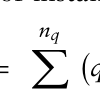
The entire time to complete a chapter for instance, can be expressed as: ns X
Equation reproduced from the original PDF.
(si)
Equation reproduced from the original PDF.
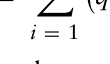
i = 1 Consequently, ETCI is the sum of all the chapters or sections to be learned and learn controls to be completed along the remaining learner journey. A very important feature of our digital learning course that uses ETCI is an early warning system that indicates learners when their success is at risk. The warning flag is raised, if the ETCI indicates a learning time longer than
682 Englmeier
the remaining timespan until the completion of the course is due. It helps the learner to take timely interventions, mostly increasing her or his learning effort.
Feedback Presence and quality of feedback mechanisms and interactive elements play a vital role in shaping the learning experience, significantly impacting learn- ers’ engagement. Well-structured feedback and interactive exercises not only foster learning but can also potentially reduce the overall cognitive effort required.
Learners receive immediate feedback after completing each quiz ques- tion, providing them with insights into their performance, displaying correct answers, and indicating errors where applicable. Typically, text sections in a chapter are complemented by quizzes featuring a series of questions. Success- ful completion of these questions earns learners a specific number of points. However, if a learner achieves less than 50% of the available points, they do not pass the quiz, indicating the necessity to revisit and reinforce the chapter’s content.
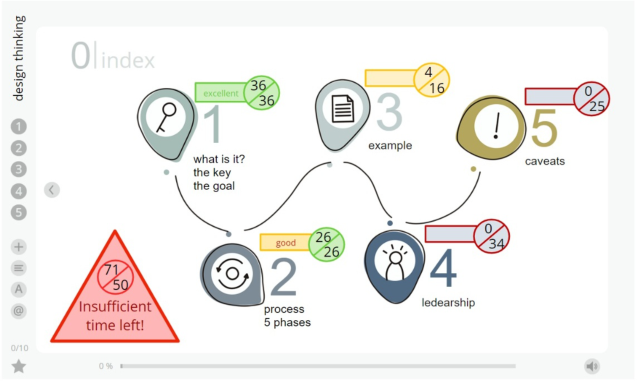
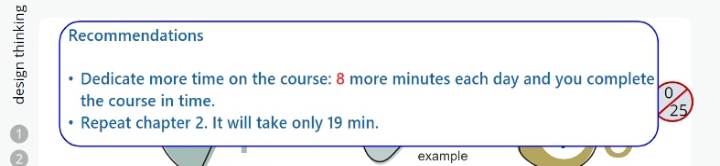
Moving forward in the course is contingent on the learner’s performance. Those who attain a grade of “good” (achieving more than 50% but less than 75% of the available points) or “excellent” (exceeding 75% of the available points) are permitted to progress to the subsequent chapters. Fig. 1 shows an example of the feedback provided to the learner in a particular situation. Specific recommendations such as shown in fig. 2 are available to support the learner.
Figure 1: The overview of the course “Design Thinking” shows the five chapters of the course and the time required for studying each chapter (lower figures in the circles). In the situation depicted the learner completed chapter 1 and 2 started with chapter 3, and has already completed a quarter of this chapter. The learn controls indicate that she has passed chapter 1 excellently and chapter 2 quite well. The system also indicates that the learner does not study enough to successfully pass the course.
User-Centered Models for Adaptive Learner Journeys in Self-Paced Learning 683
Figure 2: The learner gets recommendations considering her individual situation. They indicate measures to take in order to successfully complete the course.
A “good” grade might indicate areas where understanding or retention in a specific chapter could be improved. While deemed adequate for course continuation, it may imply potential weaknesses in the learner’s retention and recall of the acquired knowledge. Retaining and recalling information is also influenced by the passage of time after completing a chapter. As time elapses, the ability of learners to recall the knowledge acquired diminishes In essence, the feedback provided through quizzes not only regulates pro- gression in the course but also serves as a diagnostic tool, highlighting areas for potential improvement. Additionally, the grading system not only deter- mines advancement but also serves as a subtle indicator of the learner’s grasp and retention of the material, with time playing a significant role in the dura- bility of acquired knowledge. It suggests learning chapters that should be studied again or next, points to learning controls that should be taken again, and gives recommendations for the time management in order to ensure that learners stay on track and utilize their time efficiently.
CONCLUSION
The paper presents design and prototypical implementation of a digital learning course as part of the research project eduplex_api. The system is developed along the paradigm addressing a practical indicator model for learner performance. This model manifests a transformative approach to self-paced digital education. It supports user-centered adaptive models that promise to be a cornerstone in facilitating enriched and effective self-paced learning experiences.
Measuring the effort required to learn a certain material often involves a combination of a series of parameters, including reading time, points achieved in a quiz, and some more. The values recorded for these param- eters vary individually from learner to learner. Understanding these factors helps educators and learning platforms optimize content and support strate- gies to reduce unnecessary cognitive load and enhance the overall learning experience.
By providing feedback from the analysis of the behaviors of the learners, the models identify recurring patterns of effective study habits and compre- hension techniques. This information enables tailored recommendations in the first place. In the long run, the tutoring component of our adaptive models
684 Englmeier
will gradually be enriched with insights extracted from patterns of successful learning strategies.
The adaptive model excels in tailoring recommendations to suit individual learner profiles. It offers learners personalized content suggestions and guid- ance for managing their time and effort, taking into account their strengths, weaknesses, and emphasizing successful learning strategies. This adaptability ensures sustained learner engagement and motivation, as the learning journey is crafted around their distinct needs.
The forthcoming challenge in our project lies in further enhancing the adaptability and responsiveness of the course system by exploring and under- standing learner performance more comprehensively. The current system, which has been implemented, lays a robust and fertile groundwork for this future research endeavor.
ACKNOWLEDGMENT
Research as outlined here is part of the eduplex_api project under the research framework INVITE of the Federal Institute for Vocational Education and Training (BIBB) funded by the German Federal Ministry of Education and Research.
REFERENCES
Douglas, I., Alemanne, N. (2007) “Measuring student participation and effort”, proceedings of the IADIS International Conference on Cognition and Exploratory Learning in Digital Age. Du, Jiahui, Hew, Khe Foon and Liu, Lejia, (2023) What can online traces tell us
about students’ self-regulated learning? A systematic review of online trace data analysis, Computers & Education, Volume 201. Jansen, Renée S., van Leeuwen, Anouschka, Janssen, Jeroen, Conijn, Rianne and Kester, Liesbeth (2020) Supporting learners’ self-regulated learning in Massive Open Online Courses. Computers & Education Volume 146. Johnson, E. K. (2023) “Supporting Self-Regulated Learning in a User-Centered
Design Graduate Course”, proceedings of the 41st ACM International Confer- ence on Design of Communication (SIGDOC ‘23). Association for Computing Machinery, New York, NY, USA. Kaitao G. (2018) “Design and Implementation for Distant Education System Based on Whiteboard”, proceedings of the 2018 International Conference on Distance Education and Learning (ICDEL ‘18). Association for Computing Machinery, New York, NY, USA. Kizilcec, R. F., Pérez-Sanagustín, M., Maldonado, J. J. (2016) “Recommending Self-
Regulated Learning Strategies Does Not Improve Performance in a MOOC”, proceedings of the Third (2016) ACM Conference on Learning @ Scale (L@S ‘16). Association for Computing Machinery, New York, NY, USA. Kizilcec, René F., Pérez-Sanagustín, Mar., Maldonado, Jorge J. (2017) Self-regulated learning strategies predict learner behavior and goal attainment in Massive Open Online Courses, Computers & Education Volume 104. Lajoie, Susanne P. (2008) Metacognition, Self Regulation, and Self-regulated Learn-
ing: A Rose by any other Name?, Educational Psychology Review, Volume 20. Lau, Kit Ling, Jong, Morris Siu Yung. (2023) Acceptance of and self-regulatory practices in online learning and their effects on the participation of Hong
User-Centered Models for Adaptive Learner Journeys in Self-Paced Learning 685
Kong secondary school students in online learning. Education and Information Technologies, Volume 28. Li, Shan., Lajoie, Susanne P. (2022) Cognitive engagement in self-regulated learning: an integrative model. European Journal of Psychology of Education Volume 37. Narciss, Susanne, Proske, Antje, Koerndle, Hermann (2007) Promoting self-
regulated learning in web-based learning environments, Computers in Human Behavior, Volume 23, Issue 3. Rheinberg, Falko., Vollmeyer, Regina., Burns, Bruce (2000) Motivation and Self- Regulated Learning, Advances in Psychology, Volume 131. Shu, F., Zhao, C., Liu, Q., Li, H., Huang, Y. (2022) “Enhancing Adults’ Online
Course Learning Behavior Performance through Live Class in Distance and Open Education: Learning Analysis Based on a Course”, proceedings of the 6th Inter- national Conference on Education and Multimedia Technology (ICEMT ‘22). Association for Computing Machinery, New York, NY, USA. Winne, P. H., “Self-Regulated Learning”, in: International Encyclopedia of the Social & Behavioral Sciences (Second Edition), Wright, James D. (Ed.), pp. 535–540. Zimmerman, B. J. (2015) “Self-Regulated Learning: Theories, Measures, and Out-
comes”, in: International Encyclopedia of the Social & Behavioral Sciences (Second Edition), Wright, James D. (Ed.), pp. 541–546.
LISTED IN THE AHFE DIGITAL BOOKSTORE CATALOGUE
Explore the complete digital volume
Intelligent Human Systems Integration (IHSI 2024): Integrating People and Intelligent Systems
Read this individual research paper free through the original publisher, or explore the full digital proceedings book.
ISBN 978-1-958651-95-7
Explore this ISBN in the AHFE Bookstore ↗Listed in the July 2026 bookstore catalogue; search by ISBN to confirm current availability · Digital book purchase optional