Donghwan Kim (2024). Sentiment Analysis of Self-Driving Cars Using Text Mining. In: Kansei Engineering. AHFE Open Access, vol. 145, pp. 12–21. https://doi.org/10.54941/ahfe1005136
This study aims to predict future changes brought about by self-driving cars and find ways to respond to user experience (UX) through sentimental analysis of consumers' perceptions of self-driving cars. In particular, this study conducted sentiment analysis through monitoring and analysis of text information using user-generated content (UGC). Through this, the plan is to identify customer needs (Voice of Customers) and use it as a basis for future autonomous vehicle interior development.
Self-driving cars are no longer a subject of science fiction movies. Not only at motor shows but also at CES, self-driving cars are becoming the future to come. Along with these trends, research on technology and regulations related to self-driving cars is being actively conducted, but research on pub- lic awareness and response to autonomous driving technology is insufficient (Pak and Jung, 2017). In particular, self-driving cars are expected to engage in various indoor activities in self-driving situations without human interven- tion, and consumers’ sentiment analysis was needed to provide various user experiences (UX) in response.
Therefore, in this study, data from Twitter, an online SNS platform, were used to quickly analyze changes in the opinions of many people about self- driving cars. Twitter is a platform where users express their opinions and emotions within 140 characters, and it is already being used as a data source to help identify Voice of Customer in many studies (Lee and Kwon, 2019). In particular, sentiment analysis through data mining has been actively used in companies as a way to confirm consumers’ evaluation of products and services (Kim et al., 2016). When more than four of the autonomous vehicle stages 0 to 5 defined by SAE are not yet commercially available, the sen- timental structure of traditional cars was used to analyze how people feel about self-driving technology on Twitter (Brandon et al., 2014). Through this, the sentimental differences between traditional cars and self-driving cars are aimed to be verified. This entails uncovering customer expectations and con- cerns surrounding self-driving cars by examining their sentiment responses to both.
Sentiment Analysis of Self-Driving Cars Using Text Mining 13
Problem Description Companies that enter the market after companies that lead new products or technologies expand their market share through a fast-follower strategy. However, in this case, fast-follower companies may miss the opportunity to preoccupy the market, it is difficult to be competitive as a latecomer of first-mover companies, and it is difficult to develop innovative products or services. Self-driving cars that do not require human control are expected to innovate according to their interior configurations which are completely dif- ferent from traditional vehicles that only look forward. To respond to this, data collection is necessary to investigate and analyze what customers expect from self-driving cars in advance.
There are two main methods of data collection: Survey such as Observa- tion, Field Study, Questionnaire, and Interview, and experimentation such as task simulation and laboratory experiments. This traditional data col- lection method has the following limitations and disadvantages. First, it is time-consuming and expensive. In particular, large-scale data collection or complex experiments require a lot of time and cost. Second, the accuracy and reliability of the data may not be guaranteed. In the case of a survey, it may be influenced by the subjective judgment of the respondent, and in the case of an interview, the results may vary depending on the interviewer’s description. In the case of observation, it may be distorted by the subjective judgment of the observer, and in the case of an experiment, the results may vary depending on the design and execution of the experiment. Finally, the representativeness of the data may decrease. In the case of a survey, if the response rate is low, representativeness may decrease, and in the case of an experiment, it may be limited to a special situation of the subject. Therefore, to overcome these shortcomings, various ergonomic studies have recently been conducted using big data, artificial intelligence, and IoT (Internet of Things) technologies that generate a lot of information and data with the spread of digital technology. This study aims to confirm the validity of the concept of self-driving cars currently presented in CES and motor shows through a comparative analy- sis of the demands of existing cars and the demands of future customers for self-driving cars that have not yet been commercialized. It aims to analyze the perceptions of potential customers of self-driving cars on Twitter, such as requirements and expectations, using text mining, to improve the user experience.
Related Research Related studies included a study on visualization through text mining analy- sis (Don et al., 2007) and a study to extract vehicle problems and related trends using the National Highway Traffic Safety Administration’s com- plaints database (Ghazizadeh et al., 2014). In addition, text mining was used to analyze design research trends, and 2,511 studies using text mining in human engineering were found in academic DBs (IEEExplore: 2,463 cases, ScienceDirect: 3 cases, Scopus: 45 cases). Of the total 2,511 studies identi- fied in the academic DB, it is noteworthy that about 17.6% (443 studies) are studied using social network services (SNS) such as Twitter, Facebook, and Instagram and online reviews such as YouTube and Amazon. In particular, starting with research that uses Twitter’s open API environment to provide
14 Kim
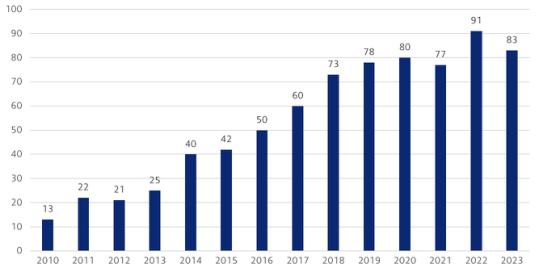
endless opportunities to study human behavior through text mining tech- niques (Kwak et al., 2010), it has been confirmed that the number of studies using online reviews in the field of human factor engineering has increased rapidly since 2010 (see Figure 1).
Figure 1: Time series trend of human factor engineering online review research using text mining.
Recently, with the development of Web 2.0, an Internet environment centered on user participation, an interactive environment is being created in which information on users’ thoughts and experiences can be directly shared, consumed, and cooperated. Therefore, user-generated content (UGC) is freely available, which complements the shortcomings of the data collec- tion methodology of traditional ergonomics, which is limited information collection due to time and space constraints along with high cost and effort. It can be seen that many studies in the field of ergonomics have been con- ducted using SNS and UGC. In particular, to be superior in the competitive environment of a company, it is necessary to monitor and analyze not only the customer’s UGC but also SNS text information (He et al., 2013). In addition, unlike the existing methodology for UX modeling, it mentions the advantages of using text mining using UGC (Yang et al., 2019).
In autonomous driving, a completely different UX is expected in SAE Reg- ulations 4 and 5 levels of advanced autonomous driving (SAE International, 2021), which eliminates the need for users to drive with their eyes on the front. There is a study that mentions the need to explore users’ future expe- riences as autonomous driving completely changes user behavior (Kim et al., 2015). In addition, in advanced autonomous driving, the UX, which changes with the metaphor of the driver as a ‘ghost in an instant shell’, is said to play an important role in the market position (Anna-Katharina et al., 2019). Therefore, this study aims to predict future changes that self-driving cars will bring by analyzing consumers’ sentiments toward self-driving cars and finding ways to improve UX.
METHODOLOGY
As in the related studies above, many previous studies say that self-driving cars are expected to have a different UX and sentiment than before, and
Sentiment Analysis of Self-Driving Cars Using Text Mining 15
when checking the concept and interior of self-driving cars that can be seen at CES or motor shows, it can be seen that there are many differences from the past. Therefore, this study aims to analyze whether the sentiments of customers who expect future self-driving cars are different from those of current vehicles. For the sentiment analysis of this study, through literature research on the sentimental structure of automobiles, the sentiment analy- sis keywords used in the evaluation of traditional vehicles in the past were set as aspects (see Table 1). Since then, to find tweets related to self-driving cars that can be missed with the aspect keyword alone, 74 sentimental adjec- tives related to self-driving cars similar to the sentimental structure aspect keyword were extracted from existing literature, research, and automobile articles. The sentimental adjectives that came out through this are as follows (see Table 2).
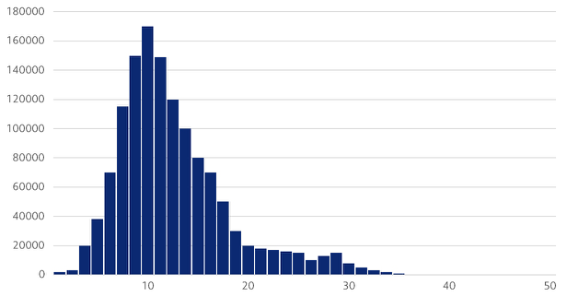
To select tweets about self-driving cars on Twitter, tweets containing the following keywords were collected from 2010 to 2023: ‘autonomous vehicle’, ‘self-driving’, ‘automated driving’, ‘driverless car’, and ‘driverless vehicle’. Overlapping data was removed from the collected data, URLs and user IDs were removed from the body using the tweet-preprocessor library, and numeric text was also removed (Özcan, 2020). After identifying the mor- pheme of words in the tweet using the Natural Language Toolkit (NLTK) library, only words whose parts of speech are nouns, adjectives, adverbs, and verbs were extracted (Steven et al., 2009). And lemmatization was applied to each word identified. In addition, words with a length of 1 were removed because it was often difficult to interpret the meaning. Furthermore, by ana- lyzing the distribution of the number of words in the tweet, tweets with 5 or fewer or 30 or more words in the sentence were defined as outliers and removed (see Figure 2).
Figure 2: Number of words in the tweet.
Based on the automobile sentimental structure aspect keyword presented in Table 2, the list of tweets mentioned for each aspect was identified. A total of 10,433 tweets were identified as referring to ‘driving’ followed by 4,098 mentions of ‘speeding’, 1,178 mentions of ‘riding’, 1,519 mentions of ‘handling”, 3,021 mentions of ‘sound’, 1,352 mentions of ‘spinning’, 520 mentions of ‘vibration’, 185 mentions of ‘unity’, and 8,234 mentions of ‘con- trol’. In this study, a keyword extraction method using chi-square statistics was applied to identify words that frequently appear in each aspect. The chi-square statistics-based keyword extraction method is a technique that effectively extracts representative keywords for each cluster, and through this study, words with high dependence between each word and aspect were identified. When an aspect is given, words that have a relatively high chi- square statistic value within the aspect compared to other aspects and are mentioned relatively more frequently are defined as representative keywords and extracted. The chi-square statistics for the word ω and the specific aspect T were obtained through the equation below.
Equation reproduced from the original PDF.
(A + C) × (B + D) × (A + B) × (C + D) (1) In the above equation, N is the total number of sentences, A is the number of tweets belonging to aspect T and including the word ω, B is the number of tweets not belonging to aspect T, C is the number of tweets belonging to aspect T and not including the word ω, and D is the number of tweets not belonging to aspect T and not including the word ω. The top 10 keywords were extracted by arranging words with large chi-square statistics for each aspect in descending order.
RESULTS
This study analyzed the sentimental values of Twitter, which mentioned self- driving cars by year. First of all, a model that can determine whether it is positive, negative, or neutral by looking at a Twitter sample is required, and Bidirectional Encoder Representations from Transformers (BERT), which has recently been widely used in the field of natural language processing, was used as the sentiment analysis model (Devlin et al., 2018). BERT is based on a transformer structure with self-attention, and the general characteristics of language are first learned through the pre-learning task of Masked Lan- guage Modelling (MLM). Fine-tuning the parameter values of the pre-trained model to the target task is actively used while showing high performance in various natural language tasks. In this study, a sentiment analysis model was constructed based on BERT. The data used for sentiment analysis learning used a Twitter dataset released as an open source (Fariza, 2017).
A total of 7,156 data sets were used, and the Twitter posts on the theme of self-driving cars and the sensitivity of the posts are graded on a 5-point scale, from positive (5 points) to negative (1 point). In this study, labels that responded positively to 4–5 points and negatively to 1–2 points were used for learning. A total of 1,903 data corresponding to positive were negative, 795 were negative, and 4,245 were neutral. The sentiment analysis model learned from the data described above showed 98% accuracy for learning data and 79% accuracy for test data. It was determined that the performance of the learned model was reasonable and applied to analyze the sentiment of Twitter data by year collected through Tables 1 and 2. In the case of the predicted data, it was predicted that about 940,000 were neutral, 180,000 were positive, and 17,000 were negative out of about 1.29 million cases.
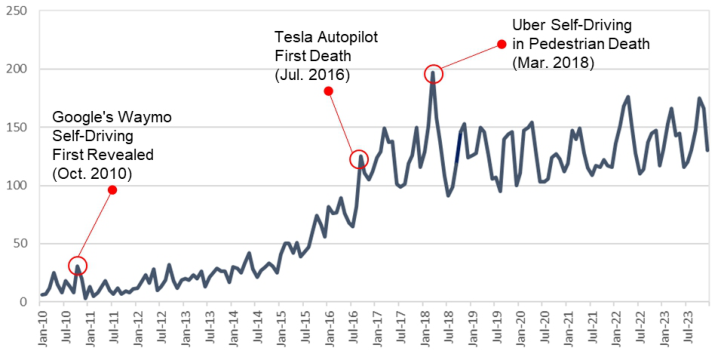
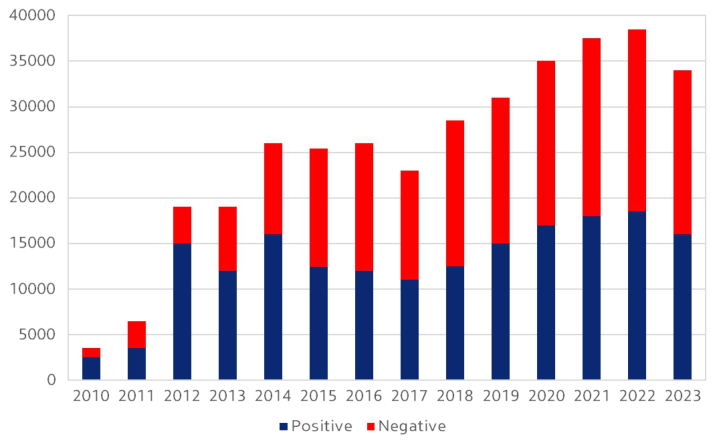
To interpret the trend of sentiment changes in tweets related to self-driving cars, Google Trends simultaneously conducted a search volume change and momentum analysis over time for ‘self-driving cars (autonomous vehicles)’ search terms. Looking at the time series trend of Google Trends, global inter- est in self-driving cars began in 2010 when Google Waymo announced the development of self-driving cars, and the number of self-driving car searches increased in 2014 when Tesla unveiled its autopilot function and self-driving car-related companies began to participate in CES in earnest (see Figure 3). In addition, it can be seen that the number of tweets by year has been showing a similar trend since 2010 over the past decade. In particular, most of the tweets related to self-driving cars showed positive sentiment until 2014, but as inter- est in self-driving cars has increased, the public has also expressed concerns
18 Kim
about the new technology of self-driving. Negative perceptions of self-driving cars have increased since 2016 when Tesla’s self-driving mode function first crashed. In the case of the aspect (sentiment word) the 1st level ‘driving’ in Table 1, the number of tweets has increased significantly since 2018, and at the same time, most of the positive reactions were positive before, but neg- ative sentiments increased rapidly. 2nd level ‘riding’ and ‘handling’ showed similar behaviors, which seems to be due to the Tesla accident that was widely reported in 2018 (see Figures 3 and 4).
Figure 3: Google trend time series trend for self-driving cars.Figure 4: The trend of sentiment changes in tweets related to self-driving cars by year.
Sentiment Analysis of Self-Driving Cars Using Text Mining 19
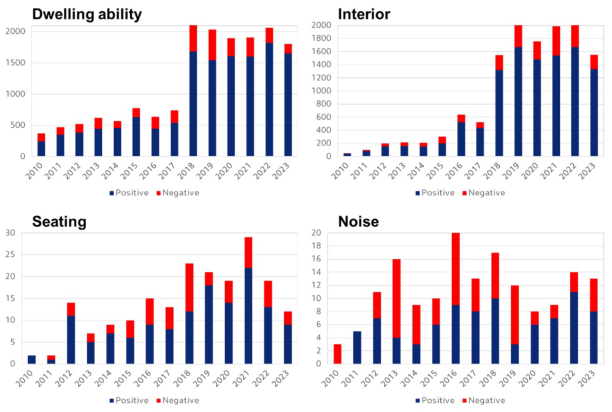
The most notable point is that there were more references to the rest of the aspect (sentiment word) than the aspect (sentiment word) of the 1st, 2nd, and 3rd levels in Table 1. Among them, there were many mentions in the order of ‘dwelling ability’, ‘interior’, ‘seating’, and ‘noise’ it was impressive that there were many positive reactions to this part. This shows that consumers’ sentiment toward self-driving cars is different from that of current cars (see Figure 5). In addition, as expected, consumers were able to confirm posi- tive expectations for this area, as they expected that various indoor activities would be expected in self-driving cars that do not require driving.
Figure 5: The trend of sentiment changes in tweets related to self-driving cars by year (‘driving’, ‘riding’, handling’, ‘dwelling ability’, ‘interior’, ‘seating’, and ‘noise’).
20 Kim
CONCLUSION
After looking at Twitter from 2010 to 2023, the public seems to be expect- ing and accepting fully self-driving cars rather than rejecting them. However, ‘driving’, ‘riding’, and ‘handling’, which are sentiment aspects that have recently increased negative reactions, should be supplemented before com- mercializing self-driving cars. To change the aspect (sentiment word) of the 1st, 2nd, and 3rd levels in Table 1 into positive responses, it was found that securing the safety of self-driving cars was the top priority. In particular, self- driving car manufacturers should try to improve public awareness through sufficient communication on risk factors related to self-driving cars if the precedents such as the failure to be accepted by the general public when the technology was released due to insufficient awareness of whether drivers hand over control of vehicles when cruise mode, which is the second stage of autonomous driving, was introduced in the past (Kohl et al., 2018). In addition, it was found that consumers’ interest and expectations are high for self-driving cars which are different from conventional cars. This study only looked at the trend of changes in public sentiments according to the keyword of sentiment aspect but did not deal with what functions customers demand and expect in self-driving cars corresponding to each sentiment aspect. In the future, it is expected that consumers’ specific needs for self-driving cars, which are directly related to the sentiment aspect that the study did not deal with, will be analyzed to become a leader through research and development of self-driving cars that customers want and expect.
REFERENCES
Anthony Don, Elena Zheleva, Machon Gregory, Sureyya Tarkan, Loretta Auvil, Tanya Clement, Ben Shneiderman, and Catherine Plaisant (2007) “Discover- ing interesting usage patterns in text collections: integrating text mining with visualization”, Proceedings of the sixteenth ACM conference on Conference on information and knowledge management, pp. 213–222. Bai Yang, Ying Liu, Yan Liang, and Min Tang (2019) “Exploiting user experi-
ence from online customer reviews for product design”, International Journal of Information and Interactive Vehicular Applications, ACM, pp. 112–117. Bird, Steven, Edward Loper, and Ewan Klein (2009) Natural Language Processing with Python. O’Reilly Media Inc. [Online] Available at: https://www.nltk.org. Fariza Z. (2017). Twitter sentiment analysis: Self-driving cars. Kaggle. [Online] Avail-
able at: https://kaggle.com/competitions/twitter-sentiment-analysis-self-driving- carsKohl, C. et al. Frison, Anna-Katharina, Philipp Wintersberger, and Andreas Riener (2019) “Resurrecting the ghost in the shell: A need-centered development approach for optimizing user experience in highly automated vehicles”, Transportation research part F: traffic psychology and behaviour 65, pp. 439–456. Haewoon Kwak, Changhyun Lee, Hosung Park, and Sue Moon (2010) “What
is Twitter, a social network or a news media?” in Proceedings of the 19th international conference on World wide web, pp. 591–600. Hyang Sook Kim, Sol Hee Yoon, Meen Jong Kim, and Yong Gu Ji (2015) “Deriving future user experiences in autonomous vehicle”, Proceedings of the 7th international conference on automotive user interfaces and interactive vehicular applications, pp. 112–117.
Sentiment Analysis of Self-Driving Cars Using Text Mining 21
Jacob Devlin, Ming-Wei Chang, Kenton Lee, and Kristina Toutanova (2018) “BERT: Pre-training of Deep Bidirectional Transformers for Language Understanding”, arXiv preprint arXiv:1810.04805. Kicheol Pak and Euichul Jung (2017) “UX Design Concept that elevates the Pleasure
of Mobility by Expanding Sense in a Complete Self-driving Environment”, KSAE Annual Autumn Conference and Exhibition. pp. 1430–1437. Mahtab Ghazizadeh, A. D. McDonald, and J. D. Lee (2014) “Text mining to decipher free-response consumer complaints: Insights from the NHTSA vehicle owner’s complaint database”, Human factors, vol. 56, no. 6, pp. 1189–1203. Mitsuo Nagamachi (2002) “Kansei engineering as a powerful consumer-oriented
technology for product development”, Applied ergonomics, vol. 33.3, pp. 289–294. SAE International (2021) Taxonomy and Definitions for Terms Related to Driving Automation Systems for On-Road Motor Vehicles J3016_202104. Said Özcan (2020) tweet-preprocessor 0.6.0. [Online] Available at: https://pypi.org/project/tweet-preprocessor. Schoettle, Brandon, and Michael Sivak (2014) “A survey of public opinion about
autonomous and self-driving vehicles in the US, the UK, and Australia”, University of Michigan, Ann Arbor, Transportation Research Institute. Seo In Kim, Dong Sung Kim, and Jong Woo Kim (2016) “Public Sentiment Analysis of Korean Top-10 Companies: Big Data Approach Using Multi-Categorical Sen- timent Lexicon”, Journal of Intelligence and Information Systems, vol. 22, no. 3, pp. 45–69. SeoYoung Lee and SangJib Kwon (2019) “A Study on Predicting Presidential Election
Results by Analyzing Twitter Message Contents: A Focus on the 18th Presidential Election in Korea”, Journal of the Korea Contents Association, vol. 19, no. 4, pp. 174–186. Wu He, Shenghua Zha, and Ling Li (2013) “Social media competitive analysis and text mining: A case study in the pizza industry”, International Journal of Information Management, vol. 33, pp. 464–472.
LISTED IN THE AHFE DIGITAL BOOKSTORE CATALOGUE
Explore the complete digital volume
Kansei Engineering
Read this individual research paper free through the original publisher, or explore the full digital proceedings book.
ISBN 978-1-964867-21-2
Explore this ISBN in the AHFE Bookstore ↗Listed in the July 2026 bookstore catalogue; search by ISBN to confirm current availability · Digital book purchase optional