Recent advances in Large Language Models and Generative AI continue to have a positive impact on the design process and Kansei engineering.At AHFE 2023, we presented the trials of product design using Generative AI based on Kansei engineering (Ishihara, Kuo & Ishihara, AI image generation boosts Kansei engineering design process, 2023).In this study, we explored the possibilities of multi-agent discussion in the design process and Kansei engineering. GPT-4 (OpenAI) was asked to create experts and discuss the given topic from each expert's point of view. In the example below, the topic was given as "We would like to discuss the design of an innovative chair made with a 3D printer. We would like to hear opinions from as many different perspectives as possible.GPT-4 automatically creates 3 virtual experts as: a designer, an engineer, and an environmental specialist. These different experts were created without any specific direction.The following lines are the roles of the experts set up in GPT-4: Designer - Focuses the discussion from an aesthetic point of view. Emphasizes innovation and aesthetics in design. Passionate in tone and fond of creative ideas.Engineer - Focuses on practicality and technical feasibility. Discusses cost and material efficiency in detail. Analytical in tone and logical in approach.Environmentalist - Focuses on sustainability and environmental impact. Discusses the use of recyclable materials and reducing environmental impact. They are soft-spoken and have deep insight into environmental issues.Intermediate discussions are in the following lines;---Persona 1: DesignerInspired by the engineer's opinion, I'd like to think a little more about the balance between durability and design. Durability is very important because chairs are used on a daily basis, and the key to manufacturing with a 3D printer is ensuring structural strength while still maintaining an aesthetically pleasing design. This can be seen as a design challenge.Persona 3: Environmental SpecialistI agree with the designer's suggestion, but materials should be carefully chosen to minimize environmental impact. Environmentally friendly materials, such as bioplastics, can provide greater design freedom while ensuring sustainability. The energy efficiency of the 3D printer is also important.Persona 2: EngineerI agree with the points made by the environmental experts. However, when using environmentally friendly materials, one must also pay attention to the physical properties of these materials. It is important to choose materials that are sustainable while still meeting the basic performance requirements of the chair, such as strength and heat resistance.Persona 1: DesignerThe engineer's technical perspective is very important. As a designer, the challenge is how to turn these technical limitations into art. For example, if there is a limit to the strength of a material, we can incorporate that as part of the design. I think balancing the flexibility of the design with the technical requirements will be key to the success of this project.The final agenda is as follows;---Designer's PerspectiveDesign Innovation: 3D printing allows for unique shapes and patterns that were previously impossible.Aesthetics and Individuality: Aesthetically pleasing designs that match consumer tastes and contemporary interior trends are important.Appealing to consumer sensibilities: Unique and beautiful designs can serve as status symbols, making them feel worth the high price tag.Engineer's PerspectivePracticality and technical feasibility: Consider the balance between manufacturing efficiency and cost while maintaining durability and safety.Customization and Quality: Ensure long-term cost-effectiveness and satisfaction by allowing adjustments to accommodate each individual's body shape and preferences.Overcoming technical limitations: Consider the physical limitations of 3D printing technology as part of the design.Environmental ExpertiseSustainability: Consider the use of recyclable materials and the recyclability of the product.Environmental impact: Energy consumption and material choices during the manufacturing process are important.Appealing to eco-conscious consumers: Green products add value and justify a price premium.---This is a summary of the discussion on the design of 3D-printed chairs from each expert's perspective. A balance between design innovation, technical feasibility, and sustainability is important, and a product based on these factors will influence consumer purchase incentives and can be successful in the marketplace, even at a high price point.We are now trying to combine this with Generative Graphics AI to visualize ideas based on this discussion among virtual experts.
Kansei Engineering Design Process Kansei engineering is a collection of techniques for measuring and analyzing human sensibilities and translating them into product design. It was proposed by Professor Mitsuo Nagamachi of the Faculty of Engineering at Hiroshima University in the early 1970s and is now used by companies worldwide.
This year, 2024 marks 50 years anniversary from the first paper on Kansei Engineering (Nagamachi et al., 1974). In 1977, a joint research on interior lighting with Matsushita Electric Works, Ltd. In the field of home appli- ances, Kansei Engineering was later applied to the development of Sharp Corporation’s refrigerator with a freezer in the lower section and the “LCD Viewcam” video camera. In the 1980s and early 1990s, Mazda, Nissan, and Izuzu actively applied Kansei engineering to passenger cars. After the 1990s, many attempts were made to apply Kansei engineering to civil engineering and residential environments. After 2000, both physiological and physical
measurements of ergonomics and Kansei engineering were used in many cases (Nagamachi & Lokman, 2011, 2017).
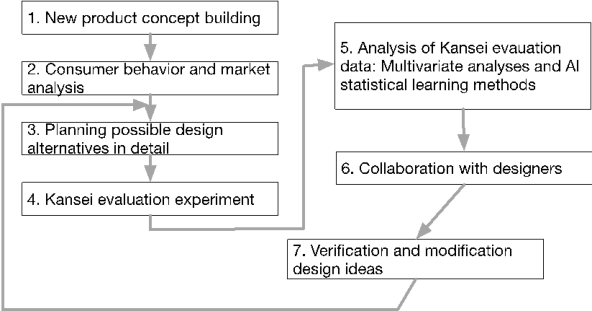
Prof. Nagamachi showed the product design process scheme applied with Kansei Engineering (Nagamachi, 2017, 2018). The below lines include sev- eral expansions from his scheme. First, the new product’s style, mode, and design would be the focus. The domain of the product and the potential target consumer must also be decided. The second step would be the measurement and analysis of the Kansei of the target consumers and the market. Behaviors related to Kansei, such as usage, are also analyzed. The third step is plan- ning possible design alternatives. In this step, the design elements that could be varied are considered. Often, this is bound by the manufacturing pro- cess and cost. This consideration also has to be repeated at the verification phase. The fourth step is to carry out a Kansei engineering evaluation exper- iment. The fifth step is Multivariate and AI (Statistical Learning methods) analyses. The sixth step in the Kansei design process is to collaborate with designers to create a new design using the results of the Kansei evaluation. This new design will encompass all aspects of the product, including external design, functional design, circuit design, mechanical design, user interface, and user experience. The seventh step involves verifying new product candi- dates and modifying design ideas to fit the manufacturing process. modified for the manufacturing process. Intensive designer involvement is intensively required in the third and sixth steps.
When working with Product Designers, at least two aspects must be considered. One is promoting the efficiency of the design works of reifica- tion, such as 2D drawing and 3D CG modeling. Another is the process of generating and refining ideas.
Figure 1: Product design process with Kansei engineering (adapted from Nagamachi, 2017, 2018).
Generative AI for Product Drawing Through Fine-Tuning For the first aspect, efficient design works, we have applied generative image AI, which was presented in AHFE 2023 (Ishihara et al., 2023).
Facilitation of Kansei Engineering Design Process With LLM Multi-Agent Discussion 3
Performing Kansei evaluation only on products available on the market is often insufficient for creating innovative products due to the lack of varia- tion in appearance and functionality. 3D CG is often used, but modeling is not easy. To alleviate this problem, the generative AI image generator Sta- bleDiffusion (Rombach et al., 2021) was applied to the Kansei engineering design process. An analysis of a Kansei engineering study (Ishihara et al., 1996) of 71 milk cartons is referenced. First, StableDiffusion 1.4 and 2.0 are tested using “milk carton” or “milk- carton” prompts. Both versions of SD fail to generate the correct milk carton shape and are considered not to capture the milk carton’s shape accurately. Since SD 2.0 is confused with other packages, we decided to let SD 1.4 learn the correct milk carton shape. Small-amount additive learning is called “fine-tuning.”
To generate additional learning data, a 3D CG model of a white milk car- ton was rotated 8 times at 15-degree intervals to create a series of 2D images. The pre-built model and its rendering were created in Adobe Dimension ver 3.4.6. The images were examined from different angles, so the relationship between the configurations of the surfaces was learned.
Figure 2: Images of white milk cartons rendered from 8 directions (4 of them shown), used for additional training (fine-tuning) of StableDiffusion 1.4.
Figure available in the original PDF paper.
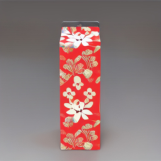
Left two images of figure 3 are generated from the “red flower milkcarton” prompt. Floral patterns are rare on milk cartons but are often seen on sweets packages. The result is an elegant, traditional design.
Ishihara et al. (1996) found that the color of milk cartons is often blue. Blue abstract designs are standard, and they are related to the Kansei of “simple” and “monotonous. Here, blue and abstract designs were generated in search of a “modern” and “sophisticated” touch. Figure 3, on the right, shows the results.
Figure 3: Left two images: generated from the prompt “red flower milkcarton”, right two images: from prompt “blue abstract painting modern milkcarton”.
Process of Generating and Refining Ideas Through Discussions In Ishihara et al. (2007), we have examined the process of generating and refining product design ideas with Kansei engineering analysis data.
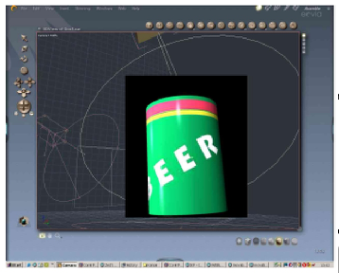
Two students from Linköping University and two from Hiroshima Inter- national University, who had never met each other before, were tasked with designing a beer can in three days by communicating over the Internet. The database of previous Kansei engineering research results, such as beer cans and hair treatments, was prepared as a system so the students could refer to the database as they wished. On the first day, they began to generate ideas while confirming that this color is sporty and chic, and this illustration has this effect. Soon, based on the analysis results, they began to discuss differ- ences in cultural backgrounds and activities. In Scandinavia, beer companies often sponsor winter sports events, and this became the focus of mutual discussion as a difference in consumer culture. On the third day, four final designs were created by modeling each other’s ideas with computer graphics. On the third day, they modeled each other’s ideas with computer graphics and produced four final proposals. The results of the Kansei engineering analysis made it possible to use them as a common ground. They allowed us to rapidly deepen the substantive discussions and document the successful development of creative ideas that went more profound than the original analysis.
Figure 4: Remotely collaborative beer can be designed between Sweden and Japan.
In the above lines, we mention the significance of generating and refining design ideas through discussions with Kansei engineering research results.
This paper presents our attempt to utilize a large language model (LLM) to generate and refine product development ideas through discussions with different aspects from virtual multiple agents. The LLM is fine-tuned with the results of the Kansei engineering analysis.
METHODS
RAG and Prompt Engineering for Multiple Expert Agents As our attempt at “Generative AI for Product Drawing”, we add knowl- edge of Kansei engineering research results to LLM. The method is called
Facilitation of Kansei Engineering Design Process With LLM Multi-Agent Discussion 5
Retrieval-augmented Generation (RAG). Discussion between virtual multiple experts on the product idea was realized through Prompt engineering.
RAG (Lewis et al., 2021) is a technique that enhances the capabilities of large language models (LLMs) by integrating them with external knowledge sources. This method allows LLMs to access and incorporate up-to-date, relevant information from databases or the internet, thereby improving their responses’ accuracy, relevance, and context-awareness. RAG is handy for tasks that require factual consistency, domain-specific knowledge, or information that evolves.
When an LLM receives a query, the RAG system first searches an external database or knowledge base to find relevant information related to the query. This information is then fed back to the LLM, along with the original query, enabling the model to generate a response informed by the most current and relevant data available.
Prompt engineering for multi-agent, multi-expert discussion refers to the process of designing and refining prompts that facilitate effective communica- tion and decision-making among multiple artificial intelligence (AI) agents, each of which may possess expertise in different domains or aspects of a problem. This process is crucial in scenarios where complex tasks require the collaboration of various specialized AI systems, often referred to as agents or experts, to achieve a common goal or to produce a comprehensive solu- tion. In multi-agent systems, each agent may have a unique role, perspective, or knowledge base, making it essential to communicate and negotiate with one another to resolve conflicts, combine insights, and reach a consensus. Prompt engineering in this context involves creating structured inputs that guide the agents’ interactions, ensuring the dialogue between them is coher- ent, relevant, and aligned with the task. In 2023, this approach was rapidly developed by researchers and practitioners. One of the papers on multi-expert discussion at LLM is Liang et al. (2023).
We have used our modified prompts, which are based on Shin Matsuzaki’s Discussion prompt for ChatGPT 4 (Matsuzaki, 2023).
Devices and Computing Environment The LLM used for this research was Llama2 70B (Touvron et al., 2023) by Meta AI research. We used a 5-bit quantized version in GGUF format (llama2-70b.Q5_K_M.gguf, https://huggingface.co/TheBloke/Llama-2-70B- GGUF). Llama2 70B was run on Ollama LLM engine (https://ollama.com). Open WebUI (https://github.com/open-webui/open-webui) was used for chat and the RAG user interface to Ollama.
The computing hardware was the Apple MacStudio 2022 M1 Ultra processor with 128GB memory.
MILK CARTON DESIGN DISCUSSIONS OF MULTI-EXPERT We show an example of a multi-expert discussion on milk carton design, referring to Kansei engineering research results.
Upload a PDF file containing the analysis results of the milk carton Kansei. These rules are used for RAG. They are the result of Ishihara et al.[28].
PDF: Milk carton design and Kansei relations. Simple, proper, and monotonous, they relate to abstract shapes and sans- self fonts.
Flesh, lively, natural, and healthy relate to photo or realistic illustrations. Juvenile, tender, young, and bright relate to cartoon-like illustrations and large white areas.
Prompt>> Give me ideas to make modern and attractive milk cartons based on this document.
Response>> Sure, here are some ideas for modern and attractive milk cartons based on the provided context:
1. Minimalist Design: Create a simple and clean design that incorporates abstract shapes and sans-serif fonts. This will give the milk carton a modern and sophisticated look. 2. Nature-Inspired Illustrations: Use realistic illustrations of flowers, leaves, or trees to create a natural and healthy look. This will also help to convey the idea of freshness and purity. 3. Bright Colors: Incorporate bright and cheerful colors into the design to give it a youthful and playful feel. This can be done by using bold background colors, contrasting with white or light-colored fonts and illustrations. 4. Cartoon-Like Illustrations: Use cute and playful cartoon-like illustra- tions of animals, like cows, goats, or sheep, to create a fun and friendly look. This will also help to appeal to younger consumers. 5. Large White Areas: Incorporate large white areas into the design to give it a clean and modern look. This can be done by using white backgrounds with contrasting colors for the text and illustrations. 6. Unique Shapes: Create unique shapes for the milk carton, such as a square or hexagonal shape, to give it a distinctive look that stands out from traditional rectangular cartons. 7. Interactive Design: Incorporate interactive elements into the design, such as a pull-out tab or a flap that reveals additional information or a surprise message. This will create a fun and engaging experience for consumers. 8. Eco-Friendly Materials: Use eco-friendly materials for the milk car- ton, such as recycled paper or biodegradable plastic, to appeal to environmentally conscious consumers. 9. Customizable Design: Create a design that allows consumers to cus- tomize their milk carton, such as by adding their name or a personal message. This will create a sense of ownership and make the product more appealing.
Facilitation of Kansei Engineering Design Process With LLM Multi-Agent Discussion 7
10. Limited Edition Designs: Create limited edition designs for special occa- sions or holidays, such as Christmas or Halloween. This will create a sense of exclusivity and make the product more desirable.
Prompt>> based on above ideas, ## Process 1 Please consider the best personas for three people so that we can have a balanced discussion without bias in any particular direction, and let us know the results.
To maintain diversity, please give each persona a different setting for tone and personality.
## Process 2 As each persona, the three of you discuss each other’s solutions. When you speak, please express your arguments based on the history of the discussion up to that point.
### Restrictions for Execution of Process 2 Please do not summarize the discussion. The volume of each statement should be between 500 and 1,000 words. Please stop after 10 conversations. Each speaker will randomly take one of the following actions in response to the opinions of others.
Agreeing Rebuttal Praise an excellent question or opinion and explain why it is crucial. Expressing a question that comes to mind Ask others about the question. ### Process 3 Summarize and output bullet points of suggestions from the discussion. ### Process 4 Based on the suggestions from the discussion, propose four bulleted questions that update the consultant’s questions for further elaboration.
Response>> Persona 1: Design Enthusiast Hi there! I’m a design enthusiast, and I’m excited to share my thoughts on modern and attractive milk carton designs. I believe that a well-designed product can make a big difference in the market.
Based on the provided context, I think that simple, proper, and monotonous designs with abstract shapes and sans-serif fonts can effectively convey a sense of modernity and sophistication. However, we should also consider flesh, lively, natural, and healthy designs that incorporate realis- tic illustrations or photos. These designs can help consumers associate the product with freshness and purity.
Another approach could be to use juvenile, tender, young, and bright designs that feature cartoon-like illustrations and large white areas. This will give the milk carton a playful and friendly look that appeals to younger consumers.
I’m interested in hearing your thoughts on these ideas! Do you think we should focus more on minimalism or playfulness in our designs?
Persona 2: Marketing Specialist Hello, I’m a marketing specialist, and I’m here to provide insights on how to make our milk cartons stand out in the market. From my perspective, the design should communicate the brand’s personality and values effectively.
I agree with the design enthusiast that simple and clean designs can give the product a modern and sophisticated look. However, we should also consider unique shapes or interactive elements that create a memorable user experi- ence. This will help our product differentiate from traditional rectangular cartons and attract consumers’ attention.
Moreover, incorporating eco-friendly materials into the design can be a great marketing strategy, as it appeals to environmentally conscious con- sumers. We could also consider limited edition designs for special occasions or holidays to create a sense of exclusivity and drive sales.
I’d like to hear your thoughts on how we can balance modernity and playfulness in our designs while still conveying the brand’s values and personality.
Persona 3: Environmental Activist Hi, I’m an environmental activist, and my primary concern is the envi- ronmental impact of our milk cartons. While it’s essential to create visually appealing designs, we must also consider sustainability in our decision- making process.
I think that using eco-friendly materials for the milk carton is a great idea, as it reduces waste and minimizes harm to the environment. Addi- tionally, incorporating interactive elements or unique shapes can encourage consumers to engage with the product and appreciate its environmental benefits.
However, we should also consider the production process and ensure that it’s environmentally friendly. We could explore using renewable energy sources or reducing waste in our manufacturing processes.
I’d like to hear your thoughts on how we can create visually appealing designs while maintaining a strong commitment to sustainability.
CONVERSATION Design Enthusiast: Hi, marketing specialist! I’m glad you agree that simple and clean designs can give our milk cartons a modern and sophisticated look. Have you considered incorporating unique shapes or interactive elements to create a memorable user experience?
Marketing Specialist: Absolutely! Unique shapes or interactive elements can help differentiate our product from traditional rectangular cartons and attract consumers’ attention. We could also consider limited edition designs for special occasions or holidays to create a sense of exclusivity and drive sales. What are your thoughts on balancing modernity and playfulness in our designs while still conveying the brand’s values and personality?
Design Enthusiast: That’s a great point! I think we should focus on creating designs that communicate the brand’s personality and values effectively while
Facilitation of Kansei Engineering Design Process With LLM Multi-Agent Discussion 9
still incorporating playful elements. We could use bright colors or cartoon- like illustrations to give the milk carton a friendly and approachable look. What do you think, environmental activist?
Environmental Activist: Hi, design enthusiast! While visually appealing designs are essential, we must also consider sustainability in our decision- making process. Using eco-friendly materials for the milk carton is a great idea, as it reduces waste and minimizes harm to the environment. We should also explore using renewable energy sources or reducing waste in our manufacturing processes.
Marketing Specialist: Absolutely! Sustainability is a critical factor in our design process. We could consider using recycled paper or biodegradable materials for the milk carton. Additionally, we could incorporate interac- tive elements that encourage consumers to engage with the product and appreciate its environmental benefits.
Design Enthusiast: That’s a great idea! I think we should focus on creating designs that communicate the brand’s values and personality while incorpo- rating sustainable materials and production processes. We could also consider limited edition designs for special occasions or holidays to create a sense of exclusivity and drive sales. What do you think, environmental activist?
Environmental Activist: I agree! Limited edition designs can be a great way to create buzz around our product while promoting sustainability. We could also consider incorporating educational elements that teach consumers about the importance of sustainability and the benefits of eco-friendly materials.
Marketing Specialist: That’s a fantastic idea! By incorporating educational elements into our designs, we can engage consumers and promote sustainabil- ity while still conveying the brand’s personality and values. I think we have a great starting point for creating modern and attractive milk cartons that stand out in the market.
Conclusion
The consultation between the design enthusiast, marketing specialist, and environmental activist resulted in several key points to consider when design- ing modern and attractive milk cartons. Firstly, the design should communi- cate the brand’s personality and values effectively while incorporating playful elements that appeal to younger consumers. Secondly, sustainability should be a critical factor in the design process, with eco-friendly materials and production processes considered. Finally, unique shapes or interactive ele- ments can create a memorable user experience and differentiate the product from traditional rectangular cartons. By balancing modernity, playfulness, and sustainability, we can create milk cartons that stand out in the market and communicate the brand’s values effectively.
Revised Consultant Questions:
1. How can we incorporate educational elements into our designs to pro- mote sustainability and engage consumers? 2. What specific eco-friendly materials could we use for the milk carton to minimize waste and reduce environmental impact?
3. What unique shapes or interactive elements could we incorporate into the design to create a memorable user experience and differentiate our product from traditional rectangular cartons? 4. How can we ensure that our production process is environmentally friendly, and what steps can we take to minimize waste and reduce energy consumption? 5. What are some creative ways we could incorporate limited edition designs for special occasions or holidays to create a sense of exclusivity and drive sales while still promoting sustainability?
CONCLUSION
The study presented in this paper attempts to accelerate product design pro- cesses by integrating Kansei Engineering with advanced AI technologies. The multi-expert discussion simulation using an LLM fine-tuned with Kansei engineering results has proven to be a promising tool for generating and refining design ideas. The milk carton design case study illustrates the prac- tical application of this approach, where diverse expert personas engage in a balanced and unbiased discussion, leading to a set of actionable design suggestions. Using RAG and Prompt engineering enables the LLM to draw upon a wealth of Kansei engineering knowledge, ensuring that the resulting product designs are innovative and emotionally resonant with the target audi- ence. This integration of AI with Kansei Engineering opens up new avenues for product designers to create aesthetically pleasing offerings that are deeply connected to consumer sensibilities, ultimately leading to products that are successful in the market and cherished by customers.
ACKNOWLEDGMENT
This work was supported by JSPS KAKENHI Grant Number JP 20K20500.
REFERENCES
Ishihara, S., Ishihara, K. & Nagamachi, M. (1996) Neural networks approach for Kansei analysis on milk carton design, Human Factors in Organizational Design and Management-V, 7–12, North-Holland. Ishihara, S., Kuo, R., Ishihara, K. (2023) AI image generation boosts Kansei engineer-
ing design process, 14th AHFE International Proc., Vol. 101. Kansei Engineering, SF, USA. Ishihara, S., Tsuchiya, T., Nagamachi, M., Ishihara, S., and Nishino, T. (2007) Kansei engineering system as a catalyst - An international empirical study, Proc. of The First European Conf. on Affective Design and Kansei Engineering. Lewis, P. et al. (2021) Retrieval-Augmented Generation for Knowledge-Intensive
NLP Tasks, arXiv:2005.11401. Liang, T. et al. (2023) Encouraging Divergent Thinking in Large Language Models through Multi-Agent Debate, arXiv:2305.19118. Matsuzaki, S. (2023) Method for build agents have different characters and make dis-
cussions, https://techblog.ap-com.co.jp/entry/2023/10/20/174917 (in Japanese).
Facilitation of Kansei Engineering Design Process With LLM Multi-Agent Discussion 11
Nagamachi, M. (2018) Successful points of Kansei product development, Proc.
of KEER 2018: 7th Int. Conf. on Kansei Engineering and Emotion Research, Kuching, Malaysia. Nagamachi, M., Mohd Lokman, A. (2011) Innovations of Kansei Engineering, Boca Raton, FL: CRC Press. Nagamachi, M., Mohd Lokman, A. (2017) Kansei Innovation: Practical Design
Applications for Product and Service Development, Boca Raton, FL: CRC Press. Nagamachi, M., Senuma, I., Iwashige, R. (1974) A Study on Emotion Engineering, Ningen-Kougaku (J. of Japanese Ergonomics Society), 10(2), 121–130 (in Japanese). Rombach, R. et al. (2021) High-Resolution Image Synthesis with Latent Diffusion
Models, CVPR 2022, https://doi.org/10.48550/arXiv.2112.10752. Touvron et al. (2023) Llama2: Open Foundation and Fine-Tuned Chat Models, arXiv:2307.09288.
LISTED IN THE AHFE DIGITAL BOOKSTORE CATALOGUE
Explore the complete digital volume
Kansei Engineering
Read this individual research paper free through the original publisher, or explore the full digital proceedings book.
ISBN 978-1-964867-21-2
Explore this ISBN in the AHFE Bookstore ↗Listed in the July 2026 bookstore catalogue; search by ISBN to confirm current availability · Digital book purchase optional